
Published: March 2020 | Last Updated:January 2026
© Copyright 2026, Reddog Consulting Group.

Boosting your Amazon sales isn't about finding a single magic trick. It's about building a scalable, data-driven system that delivers results month after month. The most effective path to sustainable growth is a disciplined, three-stage approach: building a solid Foundation, continuously Optimizing your presence, and strategically Amplifying your reach.
Thriving on Amazon requires more than just launching a product and hoping for the best. It's a dynamic ecosystem where long-term success is built on a structured, repeatable framework.
Without this structure, brands often get stuck in a reactive cycle—dealing with suppressed listings, wasted ad spend, or negative reviews—instead of proactively driving growth. This playbook is designed to give you that structure.
We're going to walk through the exact three-stage process we use at RedDog to transform a brand’s Amazon presence into a predictable, high-performance revenue channel. This isn't theory; it’s a practical guide based on our experience managing thousands of SKUs across countless categories. The goal is to shift you from guesswork to a data-driven system that integrates with your broader brand strategy and delivers measurable results.
The visual below outlines our core methodology and how each stage builds on the last.
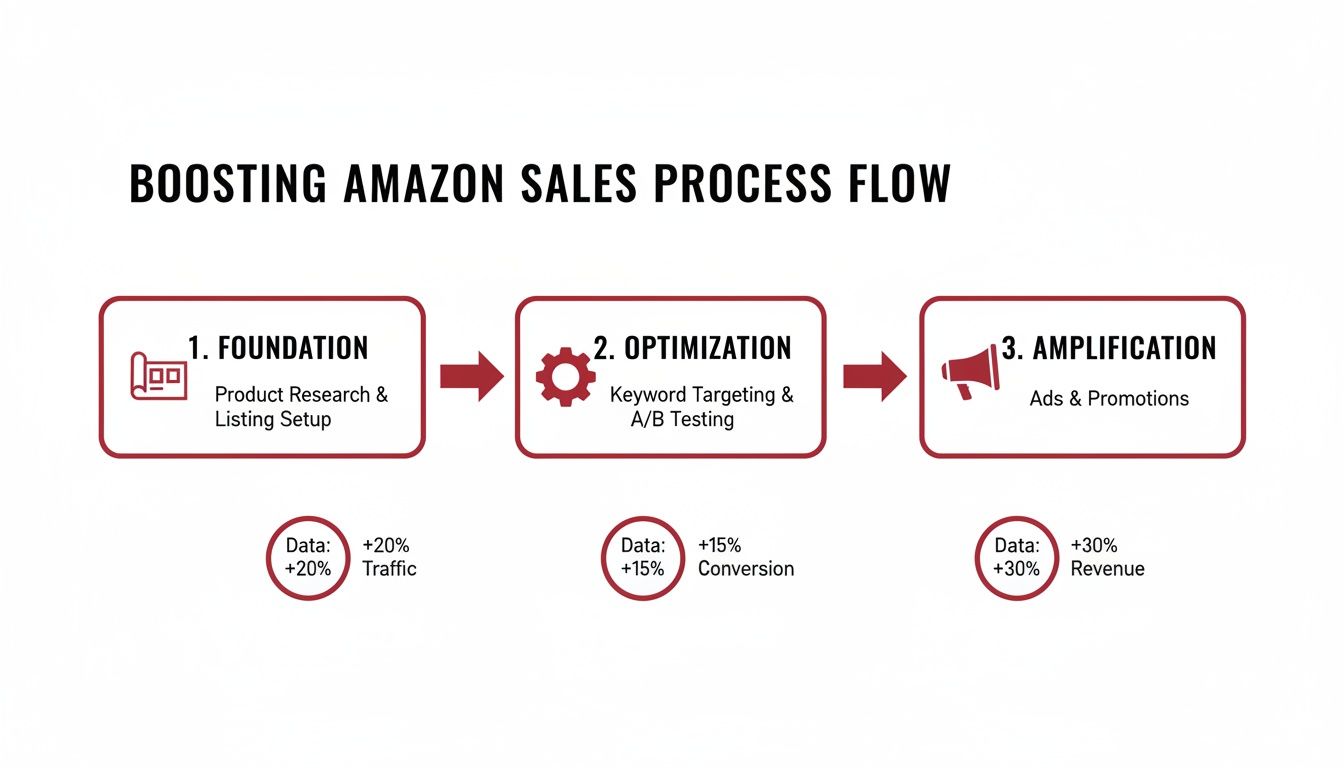
As the flowchart illustrates, sustainable growth starts with a solid foundation. Attempting to skip to optimization and amplification without it is like pouring marketing dollars into a leaky bucket—inefficient and costly.
The opportunity on Amazon is massive. Projections show US ecommerce sales will hit $540.29 billion by 2025, and Amazon is capturing over 40 cents of every dollar spent online. During the 2020 lockdowns alone, 200,000 new sellers joined the platform, contributing to a record sales surge. To capture a piece of this market, you need a deliberate plan, not just a handful of random tactics.
A disciplined framework is what separates the brands that struggle from those that scale. It connects your operations, merchandising, and marketing into a single, cohesive engine, ensuring every dollar you invest contributes directly to measurable brand growth and your bottom line.
For brands with both online and offline channels, understanding core retail principles is just as crucial. For a deeper dive into effective strategies for sourcing, merchandising, and market approaches that drive omnichannel growth, check out this guide on how to increase retail sales.
This playbook will give you the practical steps to build your own growth engine, starting with the absolute essentials.
Before you invest a single dollar in advertising, your Amazon presence must be built on solid ground. Many brands, eager for quick sales, rush through the setup phase. This is a critical mistake that creates expensive, long-term operational headaches. A strong foundation isn't just about avoiding problems; it’s about creating a stable platform for aggressive, measurable growth.
Boosting Amazon sales starts right here, with the operational bedrock that supports every other strategy. Getting this part right prevents suppressed listings, account health warnings, and frustrating roadblocks later. It ensures that when you're ready to amplify, your business is built to handle the scale.
Think of Seller Central as the command center for your entire Amazon operation, not just a dashboard. Nailing the configuration from day one is non-negotiable for both compliance and performance. This means being meticulous with your business information, payment details, and shipping settings.
Even a minor discrepancy, like a slight mismatch between your registered business name and your bank account details, can trigger verification delays that halt momentum before it even starts.
Your Seller Central setup is the blueprint for your business on Amazon. Any cracks in the foundation will only get bigger and more expensive to fix as you scale. Getting it perfect from the start saves an incredible amount of time and money down the road.
We’ve seen brands have their entire launch plan derailed by something as simple as incorrect tax information. These aren't the glamorous parts of selling on Amazon, but they are absolutely critical for maintaining a healthy account and ensuring you get paid on time.
Once your account is stable, your next move—without question—should be enrolling in Amazon Brand Registry. This is arguably the most powerful tool available to brand owners on the platform. It's the key that unlocks a suite of features designed to protect your brand and significantly upgrade your marketing capabilities.
Enrolling in Brand Registry gives you several immediate advantages:
Without Brand Registry, you're competing with one hand tied behind your back. You have far less control over your product listings and miss out on the very tools that build customer trust and drive higher conversion.
The final piece of your foundation is a clean, accurate product catalog. This is where many sellers unintentionally create future nightmares. Every product you list needs a valid Global Trade Item Number (GTIN), which for most categories means a UPC barcode sourced directly from GS1.
Using cheap, resold barcodes is a common but dangerous shortcut. Amazon regularly validates UPCs against the GS1 database, and a mismatch can get your listings suppressed or even removed. We worked with a brand whose top-selling product was delisted for weeks because of a non-GS1 UPC they bought years ago—erasing thousands in daily sales overnight.
Beyond UPCs, catalog integrity means focusing on the details:
Building this foundation isn't glamorous, but it is the most important work you'll do. It's the essential first step in creating a system designed for sustainable, long-term success on the world's largest marketplace.
With your operational foundation secure, it's time to focus on turning your product pages into high-performance conversion machines. This stage moves beyond basic setup and into actively optimizing for both Amazon’s A9 search algorithm and, more importantly, the customers looking for your products.
Think of this as a blend of art and science. It’s about weaving the right keywords into compelling, benefit-driven copy that not only helps you rank higher but also convinces shoppers to click "Add to Cart." This is the difference between a listing that just exists and one that actively drives sales 24/7.
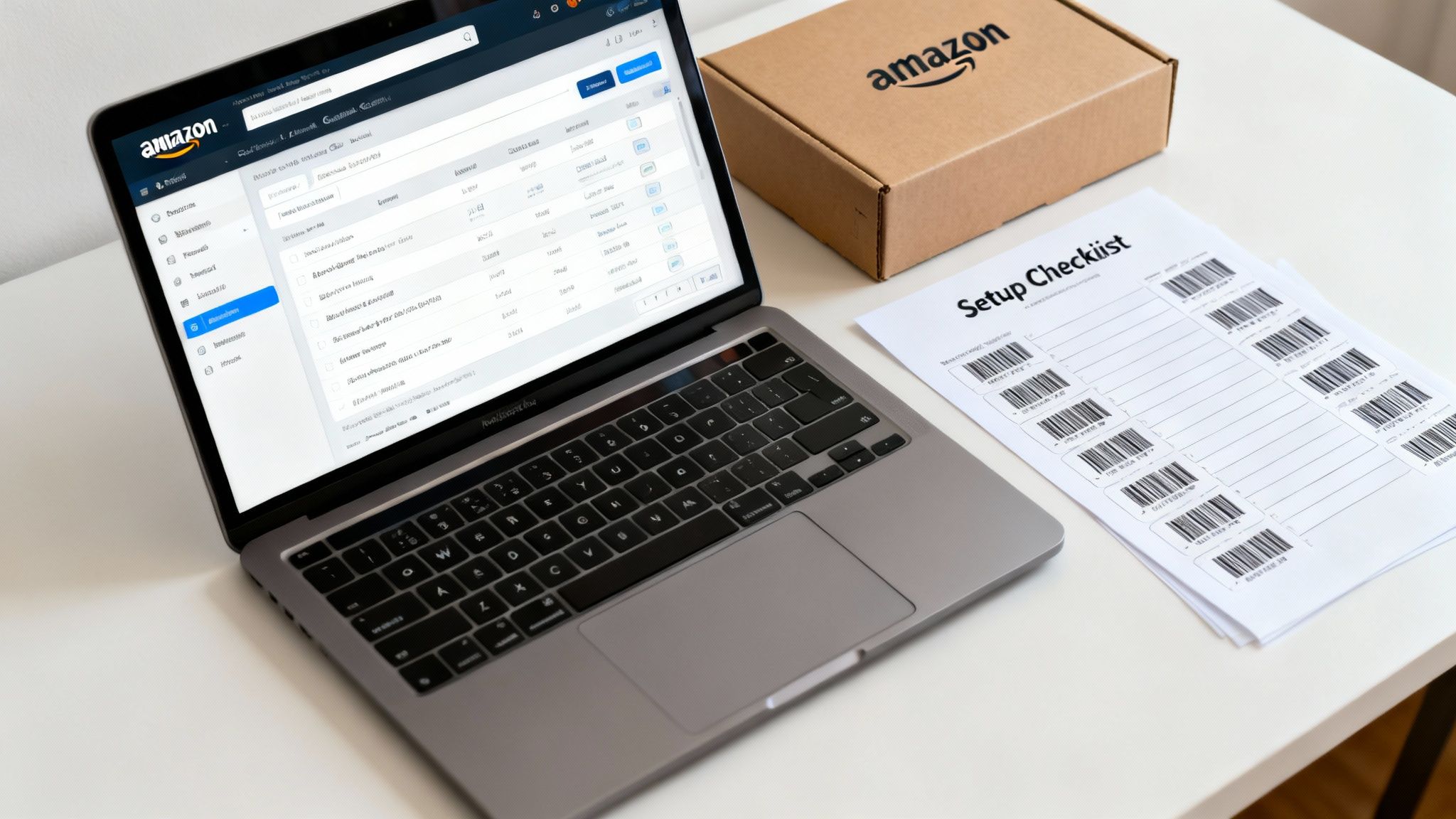
Your product title is the single most important piece of SEO real estate on your listing. It's your first and often only chance to capture a shopper’s attention in a crowded search result page. A great title strategically balances your most critical keywords with clear, readable benefits.
A common mistake is "keyword stuffing"—jamming every possible term into the title until it becomes an unreadable mess. Instead, build a title that flows naturally while including your top 2-3 search terms.
A solid structure to follow is: [Brand Name] [Main Keyword/Product Name] - [Key Feature 1], [Key Feature 2], [Benefit/Use Case].
Your bullet points are where you translate features into tangible benefits. Don't just say "100% Cotton"; say "Breathable 100% Cotton for All-Day Comfort." Each bullet point should address a potential customer question or highlight a key advantage over your competitors, helping them make an informed buying decision.
While your title and bullet points are written for human shoppers, your backend search terms are purely for Amazon's A9 algorithm. This is your opportunity to target relevant keywords that don’t fit naturally into your front-end copy.
Here are a few best practices to maximize their impact:
Think of your backend keywords as a direct conversation with the A9 algorithm. You're providing a clear roadmap to what your product is and who it's for, using language you might not put on the front-end. This is crucial for capturing valuable long-tail search traffic.
Getting this right ensures your product appears for a wider range of relevant searches, directly boosting visibility and session traffic. It’s a simple but incredibly powerful step that requires no changes to what your customers see.
To help you stay on track, we've created a quick checklist of the core elements every well-optimized Amazon listing needs.
| Element | Objective | Key Best Practice |
|---|---|---|
| Product Title | Capture attention and rank for top keywords. | [Brand] + [Main Keyword] + [Key Features/Benefits]. Keep it readable and under 200 characters. |
| Bullet Points | Convert shoppers by highlighting benefits. | Translate features into tangible benefits. Use all 5 bullets and start each with an emoji or capital letters. |
| Product Description | Provide detailed information and overcome objections. | Use short paragraphs, bold text, and tell a story. If Brand Registered, use A+ Content instead. |
| Backend Keywords | Index for additional, long-tail search terms. | Fill all available space, use no commas, and include synonyms and common misspellings. Avoid repeating front-end keywords. |
| Main Image | Grab clicks from the search results page. | High-resolution, on a pure white background, and fill at least 85% of the frame. |
| Secondary Images | Showcase the product from all angles and explain its value. | Mix lifestyle photos, infographics, and feature callouts. Show the product in use. |
| Product Video | Demonstrate the product in action and build trust. | Keep it short (under 60 seconds) and focus on demonstrating the top 1-2 benefits. |
Ticking every box on this checklist is a surefire way to build a listing that not only ranks well but also converts browsers into buyers, improving the ROI of your entire Amazon channel.
Once you’re enrolled in Brand Registry, A+ Content becomes your primary tool for visual storytelling. This is where you move beyond plain text to use rich images, comparison charts, and detailed graphics that demonstrate your product's value. In fact, Amazon's data shows that A+ Content can boost conversion rates by an average of 3-10%.
Use this premium real estate to:
An Amazon Storefront takes this a step further, allowing you to build a multi-page, branded microsite on Amazon. It's the perfect platform to display your entire product catalog, tell a richer brand story, and drive cross-sells, creating a cohesive brand experience. For a deeper dive, learn more about how to optimize Amazon product listings with these advanced strategies.
In ecommerce, your product imagery does the heavy lifting. Shoppers can't touch or feel your product, so your photos and videos must fill that sensory gap. Your main image must be on a pure white background, but your secondary images are where you can be creative.
A strong visual strategy includes a mix of high-quality lifestyle photos showing the product in use, infographics calling out key features, and a short video demonstrating its benefits. Video is especially potent; a well-produced clip can significantly lift conversion rates by showing the product in action and building shopper confidence.
Finally, nothing drives conversions like social proof. Customer reviews are the ultimate trust signal. Be proactive about generating them by using Amazon’s "Request a Review" button and, most importantly, providing an exceptional customer experience. A steady stream of positive reviews tells both shoppers and the A9 algorithm that your product is a winner.
You've built a solid foundation and optimized your listings for conversion. Now it's time to amplify your reach.
This is where you strategically invest capital to acquire new customers, increase sales velocity, and kickstart a powerful feedback loop that lifts your organic rankings. This is the role of Amazon Pay-Per-Click (PPC).
PPC isn't just "buying" sales; it's a calculated investment in customer acquisition and market visibility. When executed correctly, it generates a positive Return on Ad Spend (ROAS) while feeding Amazon's A9 algorithm the sales data it needs to see. This creates a virtuous cycle where paid traffic provides a significant boost to your organic performance.
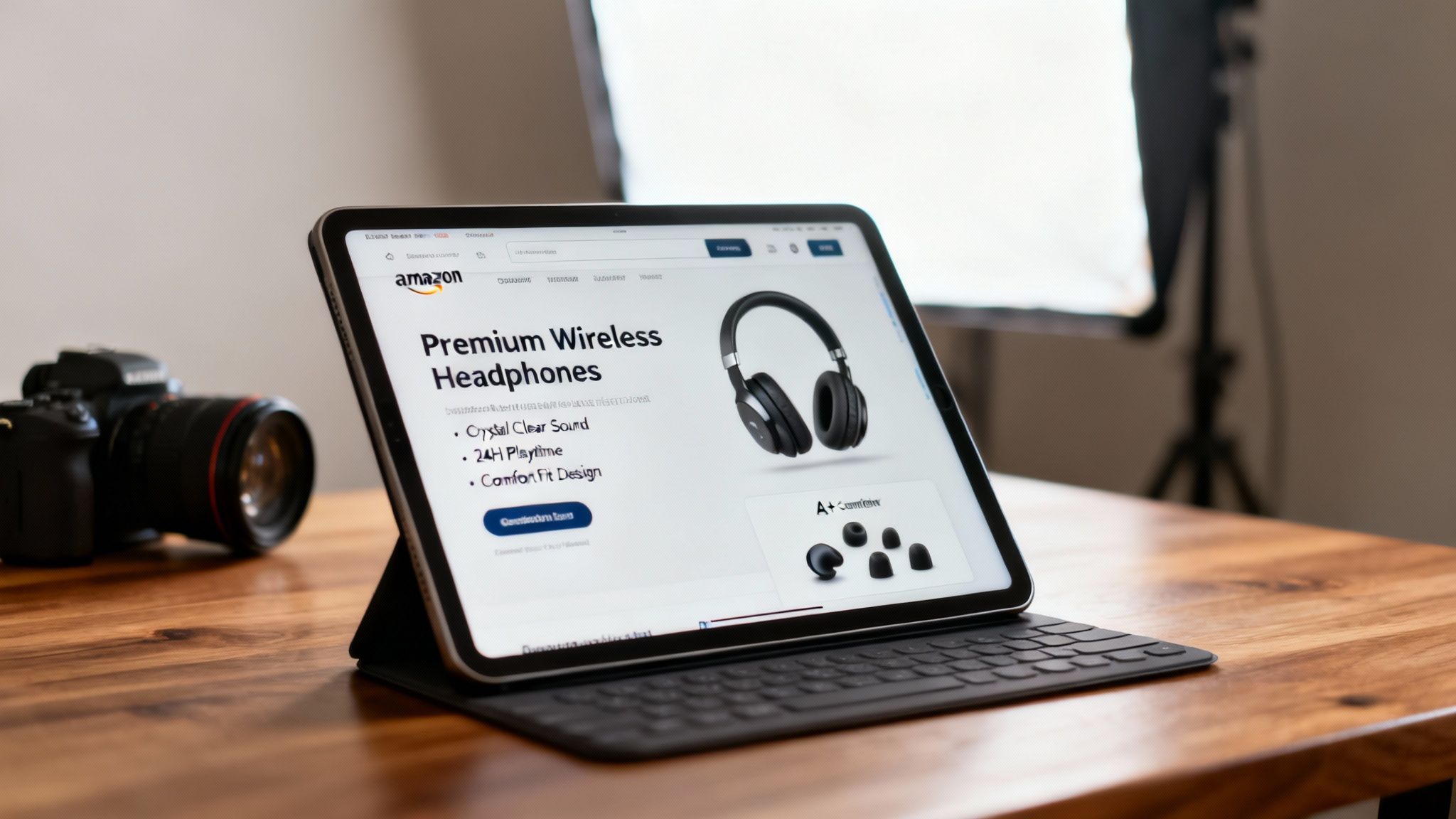
Amazon offers a suite of ad products, each designed for a different objective. Knowing which tool to use is key to spending your ad budget efficiently.
Sponsored Products: These are the ads you see in search results and on product detail pages. They are targeted by keywords or specific products, making them your primary tool for capturing high-intent shoppers ready to buy.
Sponsored Brands: These headline banners appear at the top of search results, showcasing your logo, a custom headline, and a selection of products. They are perfect for building brand awareness and driving traffic to your Amazon Storefront, allowing you to tell a broader brand story.
Sponsored Display: This ad type enables you to retarget shoppers who have viewed your product pages (or similar ones) both on and off Amazon. It's an excellent tool for staying top-of-mind and bringing interested browsers back to complete their purchase.
A common mistake is lumping all keywords into one large, disorganized campaign. This approach makes it impossible to manage bids effectively or understand what’s actually driving sales.
A structured campaign setup is non-negotiable for measurable results.
For a single product, we recommend creating separate campaigns based on your targeting strategy:
This segmentation provides precise control over your budget. You can allocate more spend to keywords delivering the best ROAS and reduce spend on underperformers. For a deeper dive, check out our detailed guide on structuring effective Amazon ad campaigns.
A well-structured PPC account is like a well-organized toolkit. You know exactly which tool to grab for a specific job, whether it's discovering new keywords or doubling down on top performers. This control is what separates profitable ad spend from wasted budget.
The strategy involves continuously identifying winning search terms in your discovery campaigns (Auto and Broad) and "graduating" them to your performance campaigns (Phrase and Exact) for more aggressive bidding.
Your bidding strategy determines how aggressively you compete for ad placements. Amazon offers several options, but "Dynamic bids - down only" is almost always the safest starting point, as it prevents overpaying for clicks unlikely to convert. Once you have sufficient performance data, you can experiment with "up and down" bidding for top-of-search placements on your best-performing keywords.
Budget management is equally critical. Set a daily budget for each campaign based on your overall advertising goals. Keep a close eye on your Advertising Cost of Sale (ACoS)—your ad spend divided by ad revenue—to ensure profitability. A "good" ACoS is relative and depends entirely on your product's profit margin.
It's also crucial to align your strategy with major platform trends. Events like Prime Day and new technology rollouts can be game-changers. For instance, Amazon's 2025 summer Prime Day was extended to four days and set new sales records, while its AI shopping assistant, Rufus, reportedly made users 60% more likely to purchase. These trends highlight the importance of adapting your strategy to capitalize on moments of high traffic and new user behaviors, especially considering Amazon's average revenue growth of 18.3% between 2020 and 2024.
One of the most powerful—and most overlooked—tools in your PPC arsenal is the negative keyword. These are terms you instruct Amazon not to show your ads for, saving you from wasting money on irrelevant clicks that will never convert.
For example, if you sell premium leather phone cases, you would add words like "silicone," "plastic," and "cheap" as negative keywords. Regularly review your search term reports to identify and block these budget-draining terms. This simple act of refining your targeting is one of the fastest ways to improve your ROAS.
Strategic PPC is the final piece of the growth puzzle. It takes your foundational work and optimized listings and broadcasts them to a much wider audience. It's a continuous, data-driven process of testing, learning, and refining to ensure every dollar you invest drives measurable brand growth.
Exceptional listings and finely tuned ad campaigns are only half the equation. If your backend operations can't keep up with the demand you generate, all that hard work will be for nothing. Mastering fulfillment and inventory management is a core component of boosting Amazon sales—it’s what sustains momentum and protects your account health.
This is where your marketing promises meet operational reality. Running out of stock, shipping late, or failing at customer service can kill your sales velocity and damage your search rankings faster than any competitor. A smooth, scalable operational engine isn't just nice to have; it's non-negotiable for long-term growth.
One of the most significant strategic decisions you'll make is how to get products to your customers. Amazon offers several models, each with distinct advantages and disadvantages. The right choice depends on your product type, profit margins, and logistical capabilities.
Here’s a breakdown of the main options:
For a deeper dive, check out our guide on what is FBA and how it fits into a broader omnichannel strategy.
Your Inventory Performance Index (IPI) is a critical metric Amazon uses to score how effectively you manage your FBA inventory. If your score drops below 400, you can face storage limits, severely restricting your ability to grow.
Think of your IPI score as your operational report card from Amazon. Keeping it healthy ensures you have the storage space you need during peak seasons and helps you avoid costly overage fees. It’s a direct reflection of your supply chain efficiency.
Maintaining a strong IPI score boils down to four key actions:
These factors are interconnected. Accurate inventory forecasting prevents overstocking, which improves your sell-through rate and keeps your IPI score high.
As you scale, managing logistics in-house can become a major bottleneck. This is where specialized partners become invaluable. To truly master your operations, consider using specialized logistics providers like Unidad Logistics to optimize your supply chain and delivery. A 3PL can handle your FBM or omnichannel fulfillment, freeing you to focus on marketing, brand growth, and product development.
This operational backbone enables many independent sellers to thrive. Third-party sellers are the engine of Amazon's growth, with independent US sellers averaging over $290,000 in annual sales in 2024. Globally, more than 55,000 sellers surpassed $1 million each that year, contributing to the $47.7 billion in revenue from third-party seller services in Q4 2024 alone.
Ultimately, your fulfillment strategy must be robust enough to deliver on your brand's promises. A seamless customer experience—from click to delivery—is the final, crucial step in securing not just a sale, but a positive review and a loyal customer.
Navigating the Amazon marketplace can feel complex. As brands grow, certain questions and challenges appear consistently. Here are practical answers to some of the most common questions we hear from sellers focused on driving measurable growth.
This depends on the strategy, as each operates on a different timeline.
For Amazon SEO—optimizing titles, bullets, and backend keywords—you can see initial movement in search rankings within a few weeks as Amazon's A9 algorithm re-indexes your listing. However, achieving a stable, high organic rank typically takes 2-3 months as you build the necessary sales history and conversion data.
Amazon PPC delivers more immediate impact. You can launch a campaign and start generating clicks and sales within hours, making it the fastest way to get your product in front of shoppers.
The real power lies in understanding how these two strategies work together. PPC drives immediate traffic and sales, which provides the A9 algorithm with positive data signals that your product is relevant for specific keywords. This, in turn, accelerates your long-term organic ranking. An effective strategy always balances short-term paid acquisition with sustained organic growth.
An account suspension is a serious threat, but it's almost always preventable. Proactively monitoring these common triggers is your best defense:
The FBA vs. FBM decision is a strategic one without a single correct answer. It depends on your products, profit margins, and operational capabilities. Many successful brands use a hybrid approach.
Fulfillment by Amazon (FBA) is typically the best choice for fast-moving, standard-sized products. The Prime badge is a powerful conversion driver, and Amazon handles all logistics. The downside is that storage fees can become costly for slow-moving or oversized items.
Fulfillment by Merchant (FBM) gives you full control. It can be more profitable if you have efficient in-house logistics, especially for large, heavy, or specialized items. You avoid FBA fees but are responsible for meeting Amazon's strict shipping performance metrics.
Many sellers find a sweet spot by using FBA for their bestsellers to maximize Prime eligibility and FBM for the rest of their catalog to manage costs effectively.
A+ Content is incredibly important for one primary reason: it boosts your conversion rate. Amazon’s own data shows that it can increase conversions by an average of 3-10%.
Think of A+ Content as your opportunity to build a dedicated sales page within your product listing. You can use high-quality images, comparison charts, and brand storytelling to answer customer questions, overcome objections, and clearly demonstrate why your product is the superior choice.
While A+ Content itself isn't directly indexed for search ranking, its impact on conversion rate is a powerful signal to the A9 algorithm. A higher conversion rate tells Amazon that your product satisfies customers for relevant search terms. Over time, this improved performance leads to better organic placement, making A+ Content a critical component of any Amazon growth strategy.
Ready to move from guesswork to a clear growth strategy? The RedDog Group team has spent two decades building scalable systems that turn marketplace presence into measurable profit. We manage the entire process—from foundational setup and listing optimization to strategic PPC and operational excellence—helping brands like yours achieve their omnichannel growth potential.
Let’s Talk Growth. Visit us at https://www.reddog.group.
Leave a comment: