
Published: March 2020 | Last Updated:January 2026
© Copyright 2026, Reddog Consulting Group.

Every eCommerce manager has faced the challenge of wrangling product data that just will not fit neatly into one system. Juggling item updates, managing attributes, and presenting products clearly are daily frustrations that directly affect how customers shop and buy. With so many platforms and sales channels in play, understanding the core concepts of online catalog management helps retailers maintain accurate listings, support sales strategies, and keep digital shelves customer-ready.
| Point | Details |
|---|---|
| Effective Catalog Management | Integrate advanced technological capabilities with strategic workflows to enhance product information management. |
| Real-Time Updates | Maintain accurate pricing and inventory information across all sales channels for optimal customer experience. |
| Avoid Common Pitfalls | Implement standardized processes and data validation to prevent inconsistencies and enhance data quality. |
| Leverage Advanced Analytics | Utilize data-driven insights for informed decision-making and improved customer engagement strategies. |
Online catalog management represents a strategic approach to organizing, presenting, and optimizing product information across digital platforms. At its core, these systems function as critical intermediaries between retailers and customers, enabling comprehensive product representation and seamless information retrieval.
Electronic catalog management systems (ECMSs) serve multiple essential functions in modern retail environments, focusing on creating dynamic, interactive product experiences. These systems allow businesses to develop comprehensive product presentation models that accommodate complex product classifications and attributes.
Key components of effective online catalog management include:
Modern catalog management goes beyond simple listing, transforming into a sophisticated user experience design. Retailers must address challenges like missing product attributes, limited classification views, and inconsistent information presentation. Successful systems create intuitive navigation paths that guide customers through complex product ecosystems.
Information Architecture plays a crucial role in catalog management, determining how products are structured, tagged, and made discoverable. This involves creating metadata frameworks that support intelligent search and recommendation algorithms.
Pro tip: Invest in detailed, consistent product descriptions and high-quality visual assets to dramatically improve customer engagement and conversion rates.
Retail catalog systems have evolved dramatically, offering businesses sophisticated tools for managing product information across diverse digital platforms. These systems range from basic product listing platforms to advanced, integrated solutions that provide comprehensive inventory and sales management capabilities.

Several distinct catalog management approaches exist, each designed to meet specific business needs. Some organizations utilize web-based catalog platforms that automate product publishing and support complex procurement processes. These systems enable retailers to streamline product information management, ensuring accurate and up-to-date representations across multiple sales channels.
Key types of catalog systems include:
Multichannel Catalog Systems represent the most advanced approach, allowing businesses to synchronize product information across websites, mobile apps, physical stores, and external marketplaces. These sophisticated platforms enable real-time updates and consistent product representation.
Here’s a side-by-side look at catalog system types and their business advantages:
| Catalog System Type | Best For | Main Advantage |
|---|---|---|
| Basic Listing System | Small online shops | Quick setup, low cost |
| Enterprise Management Solution | Large-scale retailers | Full integration, scalability |
| Marketplace-Specific Catalog | Multichannel sellers | Native platform optimization |
| Custom-Built Proprietary | Unique business needs | Tailored functionality |
| Multichannel System | Diversified sales channels | Real-time data consistency |
Advanced catalog systems now incorporate intelligent features like automated attribute tagging, dynamic pricing algorithms, and predictive analytics. Retailers can leverage these technologies to optimize product visibility, improve search rankings, and enhance overall customer experience.
Pro tip: Select a catalog management system that offers robust integration capabilities and scalability to support your business’s future growth and evolving digital sales strategies.
Effective online catalog management requires a comprehensive approach that integrates advanced technological capabilities with strategic workflow design. Modern retailers must implement systems that not only store product information but also enable dynamic, intelligent product management across multiple sales channels.
The most sophisticated catalog systems incorporate cloud-based catalog management features that provide seamless, real-time updates and centralized control over product information. These platforms support complex business requirements by enabling automated publishing, detailed data capture, and comprehensive vendor onboarding processes.
Key features of advanced catalog management systems include:
Workflow Essentials represent the critical operational processes that support effective catalog management. These typically involve structured procedures for:
Successful catalog management requires a holistic approach that combines technological sophistication with strategic organizational processes. Retailers must develop robust workflows that enable quick, accurate, and consistent product information management while maintaining flexibility to adapt to changing market conditions.
Use this reference table to understand impact areas of catalog management features:
| Feature | Business Impact | User Experience Benefit |
|---|---|---|
| Automated Data Sync | Reduces manual errors | Always current product details |
| Real-Time Inventory Tracking | Prevents stock-outs | Accurate availability for shoppers |
| Dynamic Pricing | Enables fast market responses | Competitive pricing, timely deals |
| Multichannel Publishing | Expands reach, improves consistency | Uniform product info everywhere |
| Advanced Analytics | Informs strategic decisions | Personalized recommendations |
Pro tip: Implement a centralized catalog management system with clear approval workflows and automated validation checks to minimize errors and streamline product information updates.
Omnichannel retail strategies have revolutionized how businesses approach product distribution and customer engagement across multiple sales platforms. Modern retailers must develop sophisticated approaches that seamlessly connect online and offline channels, creating a unified and consistent shopping experience for customers.
Research from leading institutions highlights the critical importance of strategic omnichannel supply chain coordination. These advanced approaches require intricate management of distribution networks, leveraging mobile technology and e-commerce capabilities to meet increasingly complex consumer expectations.
Key components of effective omnichannel integration include:
Marketplace Management demands a strategic approach to navigating multiple online selling platforms. Successful retailers must develop:
The most advanced omnichannel strategies go beyond simple multichannel selling, creating a truly integrated ecosystem where online and offline channels complement and enhance each other. This approach requires sophisticated technology, flexible operational processes, and a deep understanding of customer behavior.
Pro tip: Develop a centralized product information management system that enables real-time updates and consistent representation across all sales channels and marketplaces.
Online catalog management presents numerous challenges that can significantly impact retail performance and customer experience. Retailers must proactively identify and address potential issues to maintain a robust and effective digital product representation strategy.
One of the most critical challenges involves avoiding catalog management mistakes, which can lead to substantial operational inefficiencies and customer frustration. These pitfalls often emerge from inadequate planning, insufficient data management, and lack of standardized processes.
Common catalog management mistakes include:
Data Quality Challenges represent a significant risk for online retailers. Key problem areas involve:
Successful catalog management requires a comprehensive approach that addresses these potential pitfalls through systematic processes, advanced technological tools, and continuous quality monitoring. Retailers must develop robust strategies that anticipate and mitigate these common challenges.
Pro tip: Implement a rigorous data validation process with automated checks and regular manual reviews to maintain high-quality, accurate product information across all sales channels.
Efficient catalog management transforms digital retail operations, providing businesses with a powerful competitive advantage in increasingly complex online marketplaces. By implementing sophisticated catalog management strategies, retailers can dramatically improve their operational effectiveness and customer engagement.
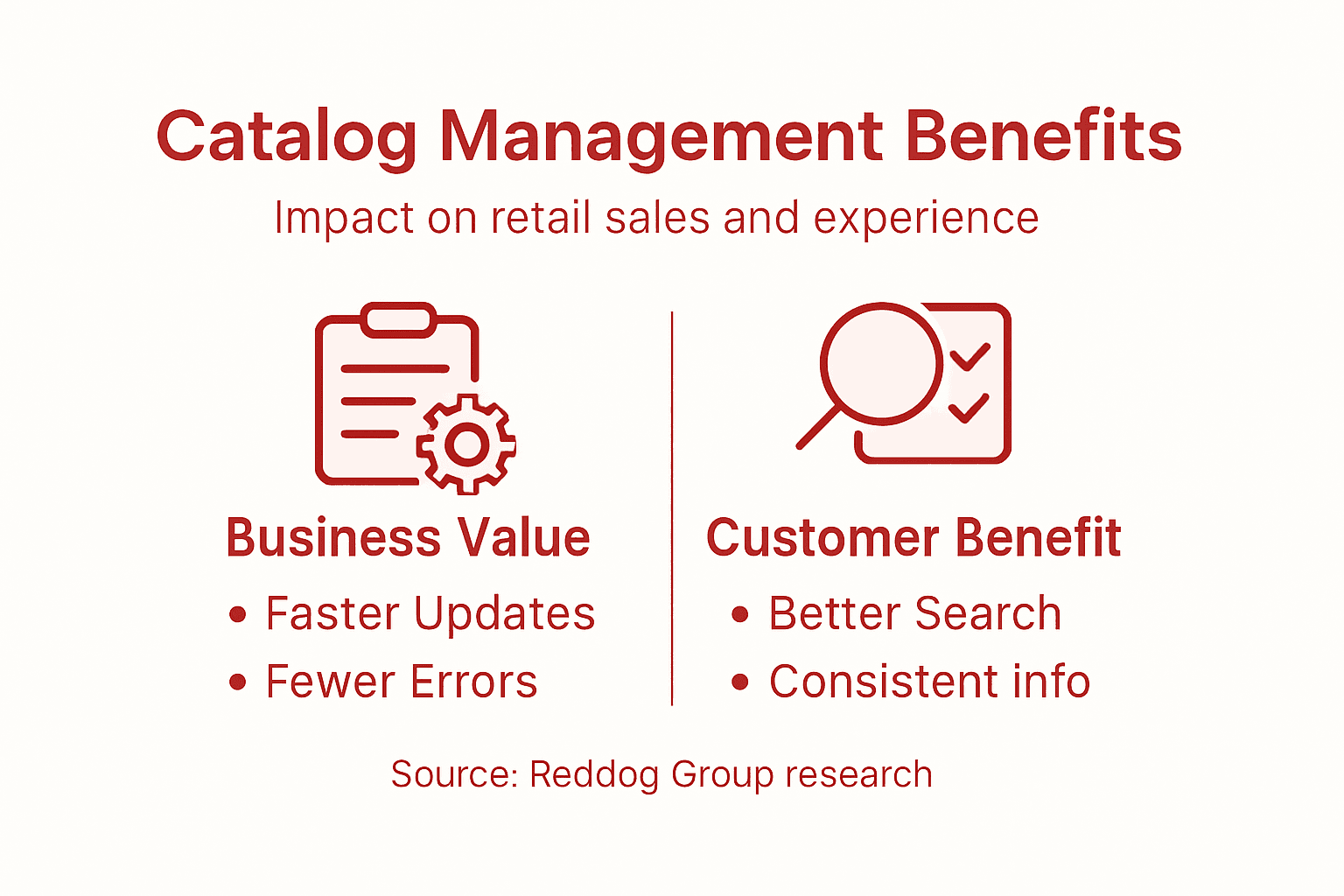
Modern businesses can enhance catalog performance through automated platforms that streamline product information management, reduce data inconsistencies, and support real-time updates across multiple sales channels. These advanced systems enable retailers to maintain accuracy, improve procurement processes, and create more dynamic customer experiences.
Key benefits of efficient catalog management include:
Strategic Advantages of robust catalog management extend beyond basic information management:
Successful catalog management requires a holistic approach that integrates technological capabilities with strategic business processes. By leveraging advanced digital tools and maintaining rigorous data standards, retailers can create more engaging, responsive, and profitable online shopping environments.
Pro tip: Invest in a flexible catalog management system that offers real-time synchronization and comprehensive reporting capabilities to maximize your digital retail performance.
Online catalog management is crucial for retailers looking to resolve challenges like inconsistent product information, real-time inventory tracking, and seamless multichannel publishing. If you are striving to boost retail sales while avoiding common pitfalls such as poor image quality or incomplete descriptions, strategic omnichannel integration and smart catalog workflows are key. Mastering these complex tasks demands a specialized approach that combines technology with proven processes.
Unlock growth potential by partnering with experts who understand these specific hurdles. Reddog Group offers tailored Digital & Business Consulting Services designed to optimize your product listings, streamline inventory management, and enhance marketplace performance. Our experience managing thousands of SKUs across multiple brands ensures you gain a competitive edge through effective catalog solutions.
Explore how our results-driven strategies can transform your product catalog and accelerate sales growth. Visit our Home page to learn more and get started today at reddog.group. Take action now to create consistent, scalable, and profitable retail experiences across every channel.
Key components include product classification, multimedia integration, search optimization, and real-time updates to maintain accurate pricing and inventory.
ECMSs create dynamic product experiences, streamline information retrieval, and support complex product classifications, improving overall customer engagement and operational efficiency.
Look for features such as automated product data synchronization, real-time inventory tracking, dynamic pricing capabilities, and advanced analytics for informed decision-making.
Common mistakes to avoid include inconsistent product information, outdated inventory tracking, poor image quality, incomplete product descriptions, and lack of standardization in data formatting.
Leave a comment: