
Published: March 2020 | Last Updated:January 2026
© Copyright 2026, Reddog Consulting Group.

An account suspension on Amazon brings your business to a screeching halt. One minute you're managing sales, the next you're staring at the dreaded “selling privileges removed” email. It’s a jarring experience, but a suspension doesn’t have to be a death sentence for your brand. With the right strategy, it can become a catalyst for growth.
Let’s be direct: getting that notification from Amazon is a gut punch. Your revenue stops cold, inventory is stranded, and the future of your business feels uncertain.
Your first and most critical move is to pause. Take a breath. Resist the powerful urge to fire off a frantic, emotional email. This is the single biggest mistake sellers make, and it almost guarantees your first appeal will be rejected, making every subsequent attempt more difficult.
Amazon's enforcement system is largely automated, flagging accounts for anything that signals risk to the customer experience. This could be a clear drop in performance metrics or a subtle policy violation you didn't even notice. The system is designed to protect the buyer, and sellers often get caught in the crossfire.
This is the moment to shift from panic to a structured plan. A rushed, emotional response will fail. A calm, data-driven, and professional approach is the only path to reinstatement. We’ll walk you through a clear process based on our core framework for turning this crisis into a comeback.
Your goal isn't just to get back online. It's to emerge from this crisis as a stronger, more compliant, and ultimately more profitable seller. This process forces you to optimize your operations in a way you might not have otherwise.
Think of this as an unscheduled, high-stakes audit of your entire business. By following a structured plan, you can turn a nightmare scenario into a measurable improvement. Let's start by digging into the data to understand why this happened.
The suspension notice is just the starting point. To craft an appeal that actually works, you need to dig deeper and find the real root cause of the problem.
A vague or incorrect diagnosis is the leading reason initial appeals are rejected, trapping sellers in a frustrating cycle of denials. This foundational step is everything.
Move past the initial shock and dive straight into your Seller Central dashboard. Your two primary sources of truth are the Account Health Dashboard and your Performance Notifications. This is where you'll find the raw data that triggered Amazon's algorithms.
Amazon's suspension notices are notoriously generic. They cite a policy but rarely point to the specific ASIN or customer complaint that triggered the action. Your job is to connect the dots using your account data.
For example, a notice about "inauthentic" items doesn't automatically mean you're selling counterfeits. It could be triggered by a customer noting different packaging or by supplier invoices that don’t meet Amazon's strict standards. Imagine building a seven-figure brand, only to have it halted because an invoice wasn't formatted correctly. This is a reality that could impact a projected 40% of seven-figure sellers by 2026, based on escalating enforcement trends.
Amazon's AI is becoming more proactive, flagging accounts for risks like an Order Defect Rate (ODR) creeping toward 1% or as few as two intellectual property (IP) complaints in 90 days.
This flowchart breaks down the crucial first decision you need to make—choosing a calm, methodical approach over a panicked reaction.
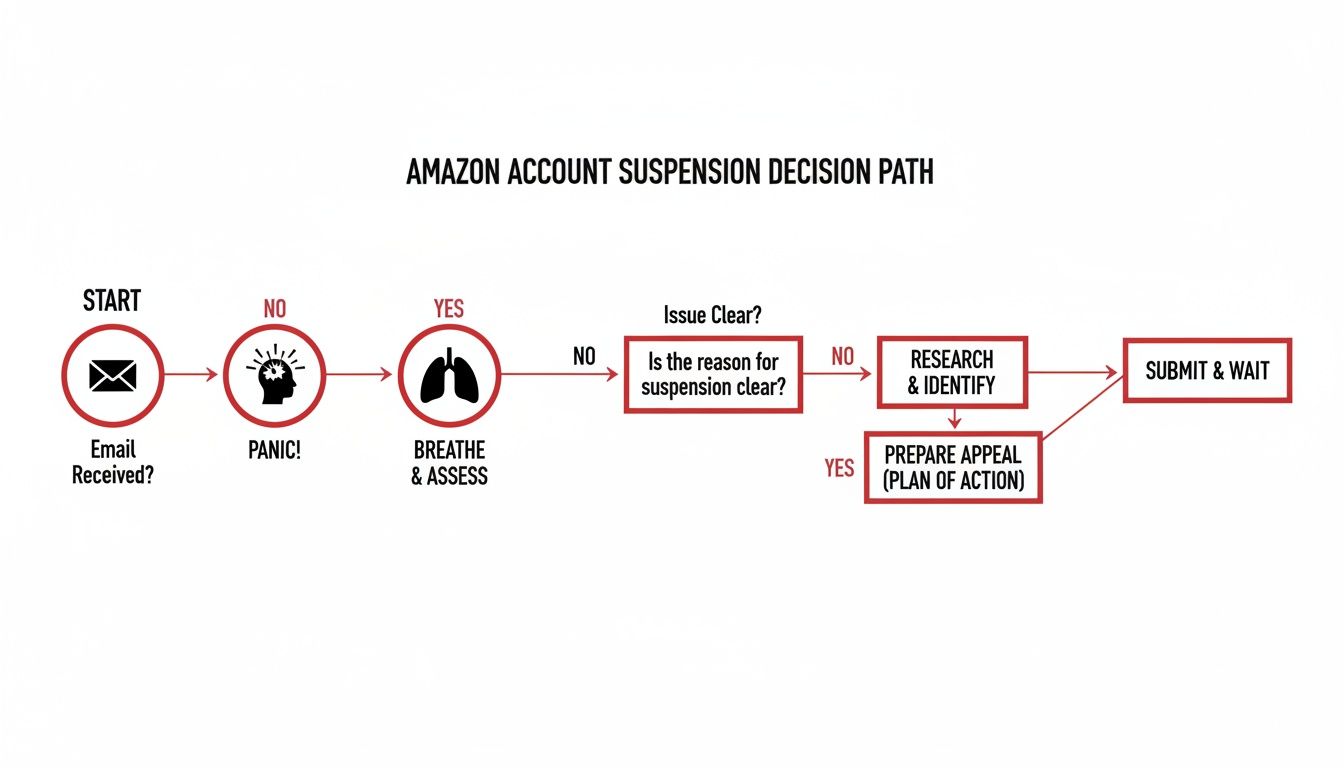
The key takeaway is that your immediate emotional response is the first obstacle to overcome. A clear-headed diagnosis is impossible until you move past that initial shock.
Your investigation must be systematic. Look for patterns across different data points to build a clear picture of what went wrong. Understanding these underlying issues is critical; exploring common Amazon account issues can provide valuable context for your diagnosis.
To help you get started, use this table to decode the language in your suspension notice and understand what Amazon is really telling you.
| Suspension Type | Key Phrases in Notification | What It Really Means |
|---|---|---|
| Performance Related | "Order Defect Rate," "Late Shipment Rate," "Valid Tracking Rate," "Pre-fulfillment Cancel Rate" | Your core seller metrics fell below Amazon's required thresholds. There is a breakdown in your fulfillment or customer service operations. |
| Inauthentic Items | "Inauthentic," "Counterfeit," "Not as described" | A customer questioned your product's authenticity. This could be a sourcing issue, a packaging change, or a problem with your supplier's invoices. |
| IP Complaints | "Intellectual Property," "Copyright," "Trademark," "Patent Infringement" | A rights holder filed a complaint against you for using their IP without permission on your listing. |
| Related Accounts | "Operating multiple accounts," "Related to an account that may not be used" | Amazon's system linked your account to another suspended seller account, possibly via shared Wi-Fi, addresses, bank info, or employees. |
| Review Manipulation | "Manipulating customer reviews," "Unfair rating, feedback, or review practices" | You were caught trying to artificially inflate your product reviews through incentivized reviews or other prohibited tactics. |
This table provides a solid starting point for your investigation. Here are the most frequent culprits and where to find the evidence in your account:
The suspension notice tells you what policy you violated. Your account data and internal processes tell you why it happened. You cannot write a successful appeal without answering the 'why.'
By dedicating real time to this diagnostic phase, you build the solid foundation your entire appeal rests on. You shift from reacting to Amazon's claims to proactively presenting a solution to a business problem you've thoroughly investigated and understood.

You’ve diagnosed the problem. Now comes the most critical part: writing your Plan of Action (POA). This isn't a plea for forgiveness; it’s a clear, professional business document. Your sole objective is to convince Amazon’s investigators that you’ve identified a systemic failure in your business and have implemented a permanent fix.
The goal here is to project ownership, control, and competence. A powerful POA not only gets your account reinstated but also serves as a blueprint demonstrating you’ve transformed a failure into a stronger, more compliant operation. Every word counts.
Amazon's Seller Performance team reviews countless POAs daily. They don’t have time for emotional appeals or excuses. They are trained to scan for a specific three-part structure. If your POA deviates from this format, it will likely be rejected.
This structure isn't a suggestion—it's a requirement. It is the most effective way to communicate with Seller Performance.
This is where most sellers falter. They either blame customers, make excuses, or simply repeat the reason Amazon gave them. To uncover the real root cause of an account suspension on Amazon, you have to demonstrate that you understand the platform’s rigid policies, like Amazon's enforcement of identification rules. You have to prove you’ve done your homework.
Approach this as an objective audit of your own business.
The second example takes full ownership. It pinpoints the exact internal failure (a weak verification process) and uses precise language that shows you understand Amazon’s operational standards.
You must connect the policy violation directly to a specific failure within your business operations. Vague admissions signal that you haven't truly understood the problem and are therefore likely to repeat it.
The next two sections must be concrete, actionable, and written in the correct tense. Immediate actions are past tense; preventative actions are future tense. You are demonstrating tangible change.
The abruptness of enforcement is a major challenge for sellers. In 2020, 23% of German Amazon third-party sellers had their accounts suspended, with a staggering 66% receiving no prior warning. This data underscores a global issue where inauthenticity claims—often due to invalid documentation like retail receipts instead of proper invoices—are a primary reason for deactivation.
For corrective actions, list what you've already done. Be specific.
For preventative actions, detail the new systems you've built. This is where you prove the problem is solved permanently.
These examples are specific and measurable. They demonstrate a real operational upgrade and show you've invested in becoming a more reliable seller—which is exactly what Amazon needs to see to reinstate your account.
If you’re struggling to formulate a compelling POA, consider seeking professional Amazon reinstatement services from experts who navigate these challenges daily.
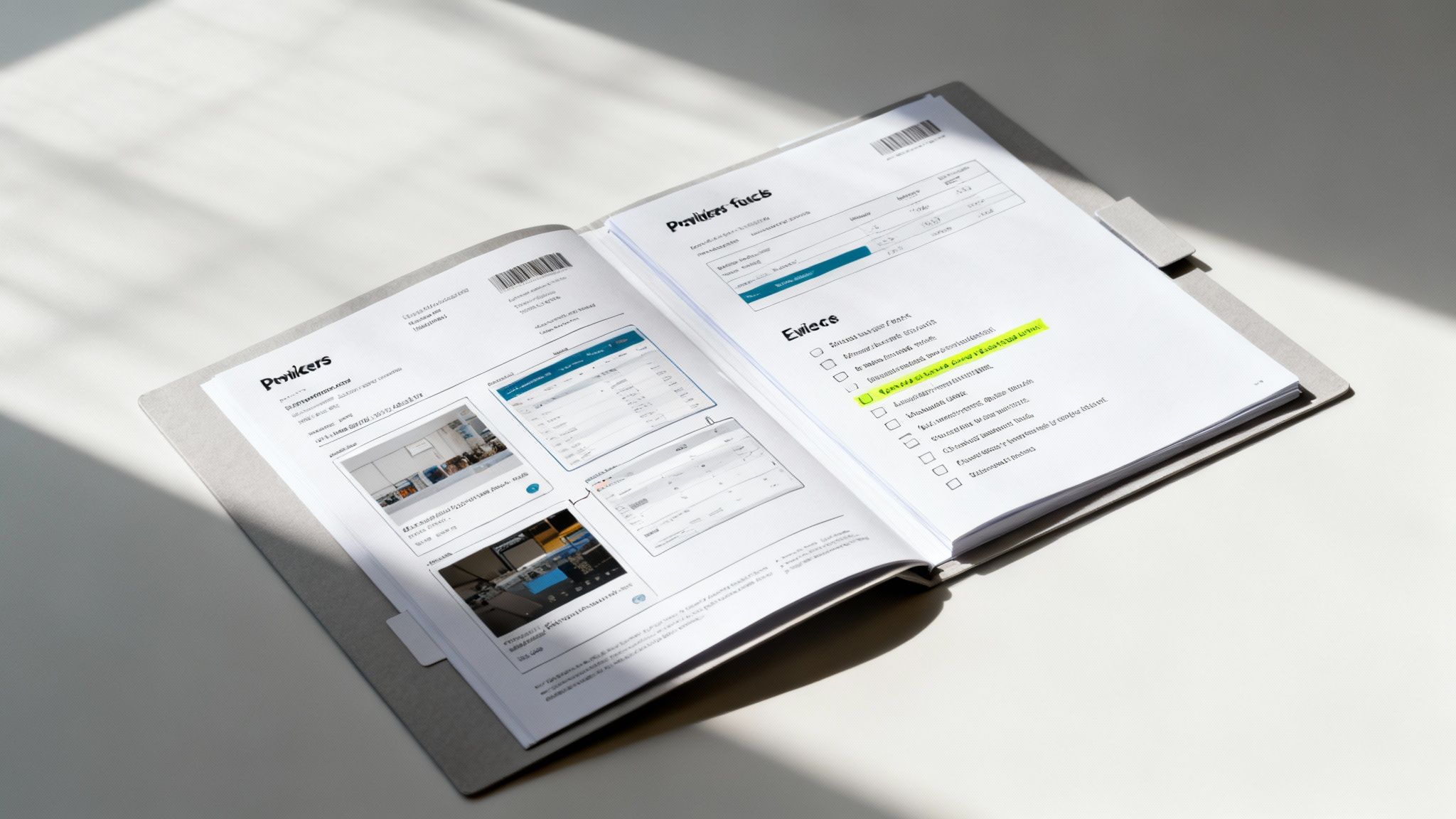
Your Plan of Action makes the argument; your evidence proves it. Submitting an appeal without solid documentation is like presenting a case in court without witnesses. It’s your word against theirs, and Amazon won’t take that risk.
The evidence you provide is the foundational proof that every claim in your POA is true. A rushed or disorganized submission makes it easy for an investigator to deny your appeal and move on. Your goal is to present a polished, undeniable case that gets you back in business fast.
This is a major hurdle for sellers facing an inauthenticity-related account suspension on Amazon. Let's be clear: a retail receipt or an online order confirmation is not a valid invoice. Submitting them is a fast track to rejection.
Amazon requires commercial invoices that prove a legitimate business-to-business transaction and an unbroken supply chain. A valid invoice must meet these criteria:
If you redact supplier information or submit documents that are hard to read, Amazon will assume you are hiding something. Transparency is non-negotiable.
Don't make the investigator hunt for information. Guide their eyes directly to what matters. Before submitting your documents, use a simple image editor to highlight or circle the key details.
For each flagged ASIN, you should clearly mark:
This simple step makes the reviewer's job easier, which increases the likelihood of a favorable outcome. It signals professionalism and an understanding of their workflow.
What if your suspension was due to performance issues, like late shipments? You can't submit an invoice to prove you’ve improved your packing process. In these cases, you create your own evidence.
If your POA claims you've implemented new internal procedures, you must prove it. This is your chance to demonstrate tangible operational improvements.
Consider creating and submitting documents like these:
This proactive documentation proves you’ve moved beyond simply saying you'll do better. It shows you've made real, structural changes to your business, reinforcing your commitment to long-term compliance. Don't just tell them you've fixed it—show them.
Getting reinstated is a huge relief, but the work isn’t over. That was the immediate battle; long-term success on Amazon is about building a business that’s too strong to fail.
This is the Amplification stage of your recovery—turning a crisis into a catalyst for fortifying your entire omnichannel operation.
An account suspension on Amazon is a costly lesson in the importance of proactive compliance. Now is the time to implement systems that prevent you from ever writing another Plan of Action. This means shifting your mindset from reactive problem-solving to proactive risk management.
The first step is making your Account Health Dashboard a daily checkpoint, not an afterthought. Treat it like your business's vital signs monitor.
Waiting for a warning notification from Amazon means you're already behind. True operational resilience comes from identifying and fixing potential issues before they trigger an algorithm.
Your team needs a documented, daily routine to check these key performance indicators:
A suspension is often the result of several small, unaddressed issues piling up over time. A daily five-minute check-in is the most effective insurance you can have against another shutdown.
Constant monitoring provides the data to act before Amazon does.
Your operations are only as strong as their weakest link. For many sellers, this is the supply chain or product catalog. A single unreliable supplier or a problematic ASIN can jeopardize your entire business.
It’s time for a top-to-bottom audit. Vet every supplier by requiring commercial invoices, business licenses, and brand authorizations. If a supplier cannot provide this documentation, they are a liability and must be removed from your supply chain.
Simultaneously, conduct a full catalog audit. Review every ASIN for compliance risks, from inaccurate descriptions to unvetted product claims. A well-managed catalog is just as critical as inventory mastery. For a deeper dive, our guide to Amazon FBA inventory management can help you avoid costly out-of-stock scenarios that hurt your metrics.
The landscape for Amazon sellers is only getting more competitive. By 2026, Amazon's holistic evaluation of performance will be faster and less forgiving. A borderline ODR above 1% combined with a minor policy violation will be enough to trigger a suspension. To stay compliant, you must keep your Late Shipment Rate under 4% and maintain a 95% Valid Tracking Rate. As thousands of accounts are deactivated yearly, building a resilient business is not optional. You can explore more insights on how to prevent Amazon account suspensions.
Finally, use the tools Amazon provides. Enroll in Brand Registry to gain powerful protections against hijackers and counterfeiters. It gives you more control over your listings and access to tools that can stop IP infringement before it escalates.
By combining vigilant monitoring, a fortified supply chain, and proactive use of Amazon's tools, you transform your business from a reactive entity into a resilient, growth-oriented operation.
If you’re facing an Amazon suspension, it's easy to feel isolated. But you’re not the first seller to go through this, and you won’t be the last. Having guided countless brands through this exact process, we’ve seen the same urgent questions come up every time.
Here are clear, practical answers to the most common concerns we hear from sellers in your position.
This is always the first question, and the honest answer is: it depends entirely on your case and the quality of your appeal.
Timelines can vary significantly. For a straightforward performance issue with a well-crafted Plan of Action (POA) on the first try, reinstatement can happen in as little as 24 to 48 hours. For more complex cases, be prepared for a longer process.
The single biggest factor influencing the timeline is the quality of your first appeal. A rushed or poorly written POA guarantees rejection, adding significant delays and making every follow-up attempt harder. Your fastest path to reinstatement is investing the time to get it right the first time.
Let me be direct: absolutely not. Attempting to open a new seller account after a suspension is a critical policy violation and the fastest way to get a permanent, lifetime ban from selling on Amazon.
Amazon's systems for linking accounts are incredibly sophisticated, using a wide range of data points:
Even the slightest overlap can trigger the "related account" flag, instantly connecting your new account to the suspended one. Your only viable path forward is to resolve the original problem by successfully appealing the suspension on your existing account.
The only way out is through. You have to fix the foundational problem that got you suspended. Starting over isn't an option and will only make things worse.
These terms are often used interchangeably, but the distinction is critical. A suspension (which Amazon now calls a "deactivation") means your selling privileges have been paused. It’s serious, but it's temporary. It includes the opportunity to appeal the decision by submitting a Plan of Action. Think of it as a solvable problem.
A ban, on the other hand, is the end of the road. It's a final, irreversible decision. This typically happens after Amazon has definitively denied your appeal. You will receive an email stating, "we may not respond to further emails about this issue." That phrase signals the conversation is over for that account.
This is precisely why your first appeal must be your best effort. Every rejection pushes you one step closer to a permanent ban.
While some sellers can manage straightforward suspensions independently, there are clear indicators that it’s time to bring in an expert.
You should seriously consider hiring a consultant or agency if:
Professionals who handle Amazon suspensions daily know exactly what investigators need to see. They know how to frame your POA in the precise language and format that gets results, saving you time, money, and stress.
An account suspension is a serious business threat, but it doesn't have to be the end. With the right strategy, you can get back to selling and build a stronger, more resilient brand. If you're facing a suspension and need an expert partner to guide you through the process, RedDog Group is here to help. Our team has the deep experience needed to handle complex reinstatements and fortify your omnichannel operations for sustainable growth.
Leave a comment: