
Published: March 2020 | Last Updated:January 2026
© Copyright 2026, Reddog Consulting Group.

Managing multiple sales channels can leave even the most organized American eCommerce owner buried in spreadsheets and guesswork. When every transaction and customer touchpoint generates data, business intelligence offers a way out by revealing patterns that drive real growth. By exploring how business intelligence transforms scattered information into clear, actionable insights, this guide shows how small brands can compete smarter and make better decisions with every click and sale.
| Point | Details |
|---|---|
| Business Intelligence Enhances Decision-Making | BI transforms raw data into actionable insights, helping retail brands make informed decisions across various operations. |
| Comprehensive Data Analysis is Key | Leveraging advanced analytics can uncover deep insights into customer behavior, inventory management, and market trends. |
| Risks of BI Implementation | Retail brands must address data quality, user adoption, and integration challenges to fully benefit from BI tools. |
| Choose BI Solutions Wisely | Selecting scalable BI solutions that integrate easily with existing systems is crucial for supporting business growth. |
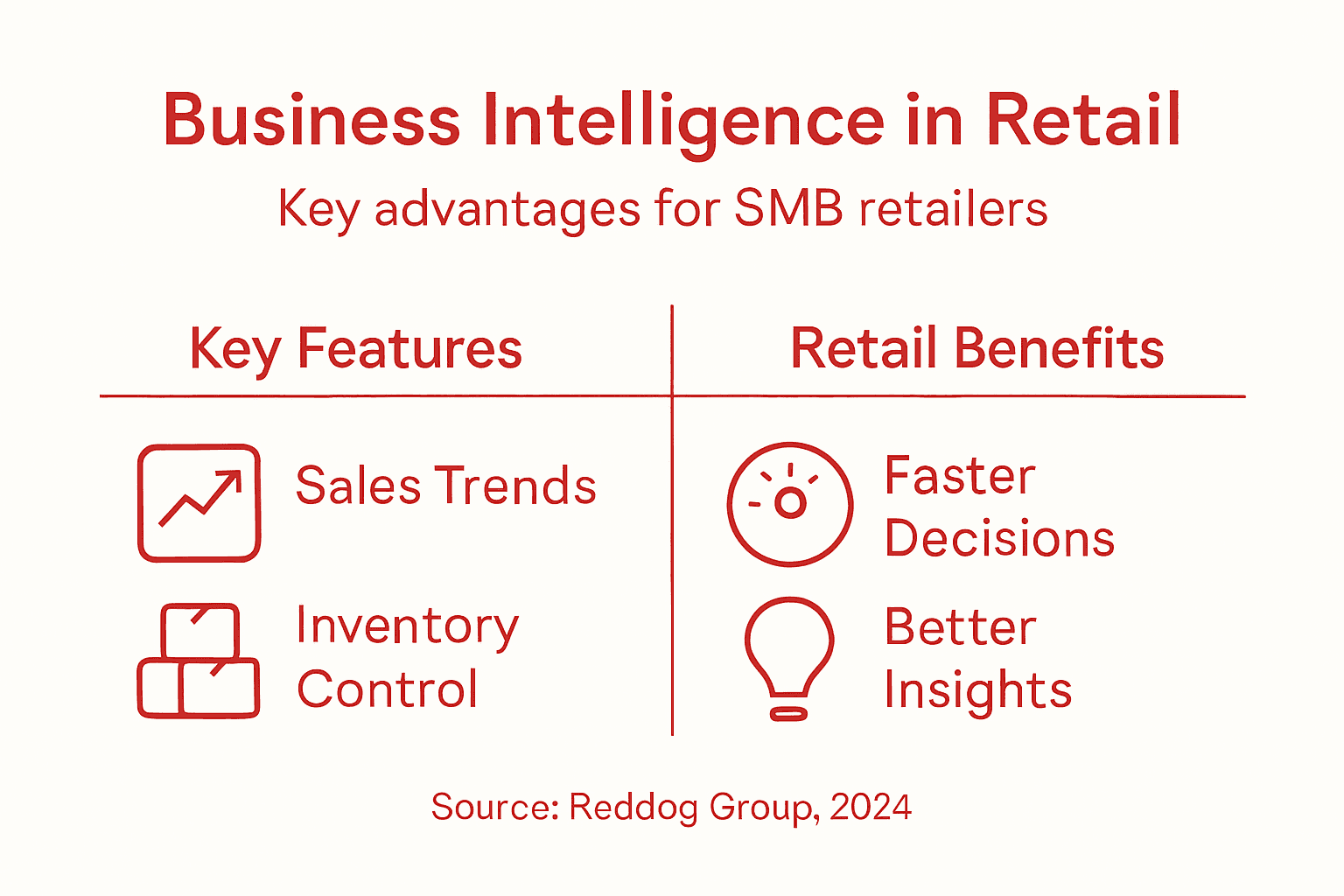
Business intelligence (BI) is a strategic framework that transforms raw data into actionable insights for small to medium-sized retail brands. At its core, business intelligence helps retailers make informed decisions by collecting, analyzing, and interpreting complex data from multiple sales channels and business operations.
Retail business intelligence goes beyond simple number-crunching. Comprehensive data analysis strategies enable brands to uncover deep patterns in customer behavior, inventory management, and market trends. The primary goal is to convert massive datasets into clear, meaningful information that drives strategic planning and competitive advantage.
Key components of business intelligence for retail brands include:
By leveraging advanced BI tools, retailers can transform complex data into strategic roadmaps. Retail analytics software integrates information from diverse sources like point-of-sale systems, e-commerce platforms, inventory management, and customer relationship management (CRM) databases, providing a holistic view of business performance.
Pro tip: Start small by identifying 2-3 key metrics critical to your business growth, and gradually expand your business intelligence capabilities as you become more comfortable with data-driven decision-making.
Business intelligence (BI) solutions for multichannel sales have evolved to provide small and medium-sized retail brands with sophisticated tools for comprehensive data analysis and strategic decision-making. These solutions help retailers integrate and interpret data from multiple sales channels, transforming raw information into actionable insights.
Digital transformation strategies enable retailers to leverage advanced BI tools that connect physical stores, online marketplaces, and emerging sales platforms. The most effective multichannel BI solutions typically include several key technologies and approaches:
Retail brands can choose from various BI solution types depending on their specific needs and complexity. Multichannel retail technologies range from simple reporting tools to sophisticated enterprise-level systems that provide deep insights into business performance.
These solutions typically offer modular approaches, allowing businesses to start with basic analytics and gradually expand their capabilities. Advanced BI tools can help retailers understand customer purchasing patterns, optimize pricing strategies, and identify potential growth opportunities across different sales channels.
Pro tip: Begin by selecting a BI solution with scalable features that can grow with your business, focusing on tools that offer seamless integration across your existing sales platforms.
Here’s how BI features contribute to retail growth:
| BI Feature | Retail Benefit | Example Impact |
|---|---|---|
| Data Integration | Unified performance view | Tracks online and offline sales |
| Real-Time Dashboards | Quick trend identification | Adjusts marketing in real time |
| Predictive Analytics | Anticipates future demand | Reduces inventory shortages |
| Customer Data Unification | Personalized marketing programs | Increases return customer rate |
Business intelligence (BI) transforms raw data into strategic insights, serving as a critical tool for small and medium-sized retail brands seeking to optimize their decision-making processes. Business intelligence systems collect, analyze, and synthesize information from multiple sources, creating a comprehensive view of business performance that goes far beyond traditional reporting methods.
The core functionality of BI relies on several essential features that enable sophisticated data analysis:
BI works through a systematic process of data extraction, transformation, and analysis. Strategic decision support systems enable retailers to monitor performance metrics, identify emerging trends, and make data-driven decisions across different business functions.
The most powerful BI solutions offer modular approaches that allow businesses to start with basic analytics and gradually expand their capabilities. By providing actionable insights, these tools help retailers understand complex patterns in customer behavior, optimize pricing strategies, and identify new growth opportunities.
Pro tip: Select a BI solution with flexible integration capabilities that can connect seamlessly with your existing technology infrastructure and scale as your business evolves.
Business intelligence transforms small and medium-sized eCommerce brands from guesswork-driven operations into data-powered growth engines. Operational efficiency strategies enable retailers to uncover hidden opportunities, optimize resource allocation, and make precise, informed decisions that directly impact bottom-line performance.
The major benefits of business intelligence for SMB eCommerce growth include:
Business intelligence advantages extend beyond simple data collection, providing small retailers with sophisticated tools to compete against larger, more established brands. These insights help businesses understand complex customer journeys, predict emerging market trends, and develop agile, responsive strategies that drive sustainable growth.
By leveraging comprehensive data analysis, SMB eCommerce brands can transform raw information into actionable strategies. This approach allows smaller retailers to make strategic decisions with the same level of precision as much larger organizations, effectively leveling the competitive playing field and creating opportunities for rapid expansion.
Pro tip: Start by focusing on 2-3 key performance metrics most critical to your business, and gradually expand your business intelligence capabilities as you become more comfortable with data-driven decision-making.
Business intelligence implementation comes with potential challenges that small and medium-sized retail brands must carefully navigate. Business intelligence risks can undermine the effectiveness of data-driven strategies if not proactively addressed.
Key risks and potential pitfalls for SMB retailers include:
Implementation challenges often stem from underestimating the complexity of data management and organizational change. Small businesses must develop comprehensive strategies that address technical, operational, and human factors to successfully leverage business intelligence.

Mitigating these risks requires a holistic approach that combines robust technology selection, ongoing employee education, and a commitment to continuous improvement. Successful BI implementation demands more than just purchasing software – it requires creating a data-driven culture that embraces analytical insights and adapts to changing business needs.
Pro tip: Conduct a thorough organizational assessment before implementing BI tools, identifying potential resistance points and developing a strategic change management plan to ensure smooth adoption.
Business intelligence (BI) and business analytics represent complementary yet distinct approaches to data-driven decision-making for small and medium-sized retail brands. Business intelligence techniques differ fundamentally in their approach to understanding and utilizing organizational data.
Key differences between BI and analytics include:
Business Intelligence (BI):
Business Analytics:
Advanced data science alternatives have emerged that go beyond traditional BI and analytics approaches. These include artificial intelligence-driven solutions and machine learning technologies that can provide even more sophisticated insights, though they typically require higher levels of technical expertise and investment.
For small and medium-sized retail brands, the choice between BI, analytics, and alternative solutions depends on specific business needs, available resources, and strategic objectives. While traditional BI offers foundational insights, more advanced analytics can provide deeper, more predictive understanding of business performance and potential opportunities.
See how BI, analytics, and advanced alternatives compare for SMB retailers:
| Approach | Main Focus | Tech Skill Required | Best For |
|---|---|---|---|
| Business Intelligence | Operational improvements | Basic to intermediate | Small teams, daily decisions |
| Business Analytics | Predictive strategies | Intermediate to high | Growth planning, forecasting |
| Advanced Data Science | Automated deep insights | Advanced | AI, machine learning adoption |
Pro tip: Start with a basic BI solution and gradually upgrade to more advanced analytics as your organization develops data literacy and technical capabilities.
Small and medium-sized retail brands often face the challenge of managing complex sales data across multiple channels while striving to deliver personalized customer experiences and optimize inventory. This article highlights how business intelligence transforms raw data into actionable insights through predictive analytics, real-time dashboards, and customer data unification. If you want to move beyond guesswork and confidently drive omnichannel growth, mastering these BI concepts is critical.
At Reddog Group, we specialize in helping SMB retailers overcome these exact pain points by providing tailored solutions in omnichannel retailing, digital marketing, and strategic brand growth. With expertise managing over 30,000 SKUs and 50 brands, our team integrates advanced business intelligence strategies into marketplace management, Amazon FBA, and DTC channels to deliver measurable revenue increases year after year.
Gain competitive advantage by leveraging state-of-the-art data integration and inventory optimization combined with marketing campaigns designed to boost customer lifetime value. Explore how our growth strategies can align your data insights with real-world retail success. If you are ready to transform your business intelligence challenges into powerful opportunities, visit Reddog Group to start your data-driven retail expansion today.
Take control of your retail future now with expert guidance in omnichannel BI solutions. Discover the difference at Reddog Group and unlock your full potential.
Business intelligence (BI) for retail brands is a strategic framework that transforms raw data into actionable insights, helping retailers make informed decisions based on comprehensive analysis of sales, customer behavior, inventory, and market trends.
Business intelligence can enhance decision-making by providing deeper insights into customer behavior, improving inventory management, enabling targeted marketing strategies, and identifying competitive market trends, ultimately leading to greater operational efficiency and growth potential.
Popular types of BI solutions for multichannel retail include cloud-based analytics platforms, real-time dashboards, predictive analytics software, customer data integration systems, and inventory management intelligence, which help retailers synthesize data from various sales channels.
Common pitfalls in BI implementation include poor data quality, limited user adoption due to resistance to new tools, integration challenges with disparate systems, insufficient training, and siloed data sources, which can hinder effective data analysis and insight generation.
Leave a comment: