
Published: March 2020 | Last Updated:February 2026
© Copyright 2026, Reddog Consulting Group.

The email notification—"Your Amazon seller account has been closed"—is an operational gut punch. It freezes revenue, strands inventory, and forces an immediate business crisis. Before reacting, take a breath. The first 48 hours are for calm, calculated diagnosis, not panicked, emotional appeals.
This is a business problem that demands a methodical response. How you manage these initial moments dictates the speed and success of your recovery.
When your account is closed, the immediate aftermath is chaos. Revenue stops, FBA inventory is locked, and panic sets in. The temptation to fire off a quick appeal is strong, but it's the biggest mistake you can make. Amazon’s automated systems are designed to reject poorly written, frantic Plans of Action (POAs) on sight.
Instead, treat this like the critical business event it is. Your objective is to build a structured, evidence-based case for reinstatement. It's time to shift from panic to a deliberate, three-step triage process. This approach ensures you have all the facts before writing your appeal, avoiding common errors that can prolong a suspension for weeks or months.
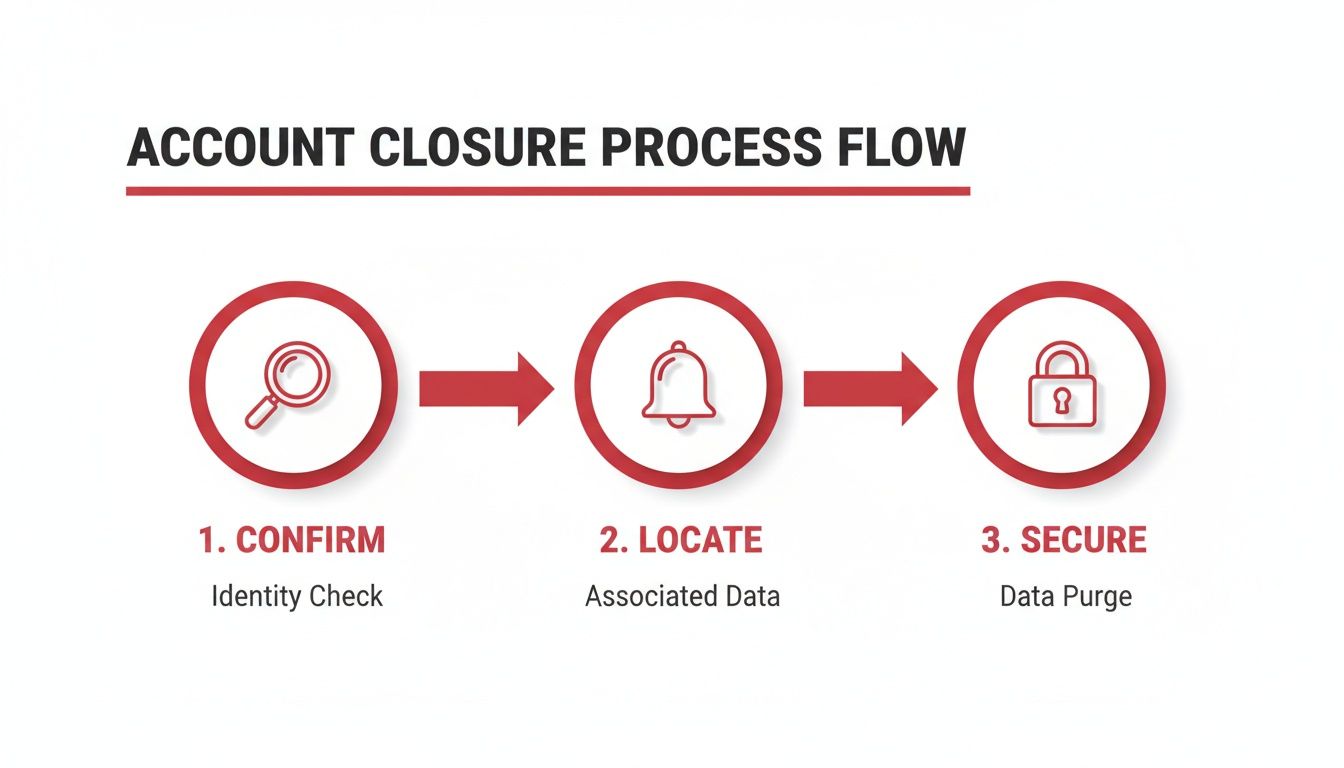
This structured method is your roadmap back to selling. Let's break down where to start.
First, understand the severity of the situation. Is your account suspended or deactivated? They sound similar, but the operational and financial implications are vastly different.
A suspension is typically a temporary roadblock, often reversible with a solid Plan of Action. Think of it as a serious warning. A deactivation, however, is far more critical—it signals a near-permanent closure and requires a much more robust, evidence-heavy appeal.
To quickly assess the situation, here’s a breakdown of what each term implies and the correct operational response.
| Attribute | Suspension | Deactivation |
|---|---|---|
| Common Causes | Performance issues (ODR, LSR), policy warnings, isolated IP complaints, inauthenticity claims. | Repeated violations, linking to a banned account, illegal activity, severe code of conduct breaches. |
| Severity | High, but often reversible with a clear, corrective POA. | Critical. A final-notice-style closure demanding an exhaustive appeal. |
| Amazon's Language | "Your selling privileges have been suspended." "You may not sell on Amazon." | "Your Amazon.com seller account has been deactivated." "You may no longer sell." |
| Your Next Step | Draft a detailed POA addressing the specific operational root cause. | Prepare for an intensive appeal, potentially requiring professional or legal intervention. |
Understanding this distinction is crucial. Amazon has ramped up enforcement, hitting the 12-13% of sellers operating on thin contribution margins the hardest. Suspensions are typically tied to fixable operational breakdowns, while deactivations are reserved for major or repeated offenses. A comprehensive Amazon Seller Account Reinstatement Guide can help frame your initial approach based on this severity.
Knowing whether you’re dealing with a suspension or deactivation sets the entire strategic tone for your appeal.
Do not guess why you were shut down. Amazon operates on specific data triggers, and you must know exactly which one they flagged.
Log into Seller Central and navigate to Performance > Performance Notifications. Find the exact message announcing the closure. This is your primary piece of evidence.
This notification contains the "root cause" as Amazon sees it. It will almost always cite a specific policy violation, such as:
Every action you take from this moment must directly address the violation stated in that notification. If you write an appeal about inauthenticity when the notice cited review manipulation, it’s an automatic rejection. No exceptions.
Before writing a single word of your POA, compile every piece of operational data related to the violation. This is about building an airtight operational timeline, not just finding a single invoice.
Start by downloading reports from your Account Health Dashboard, Voice of the Customer (VOC), and all customer feedback related to the ASINs in question.
Next, gather all supply chain documentation: purchase orders, invoices, and any communication with your suppliers or distributors. If it’s an IP complaint, find your Letters of Authorization. This methodical data collection is the foundation of a winning appeal—it forces you to shift from emotion to objective, operational facts.
The performance notification from Amazon is often frustratingly vague. It will tell you what policy you violated but rarely explains the specific operational breakdown that triggered their system. When your Amazon seller account is closed, your first move shouldn’t be a rushed reply—it must be a deep-dive diagnosis. You have to dissect your account data and find the true failure point before writing an appeal.
This isn’t about telling Amazon what you think they want to hear. It's about building a case based on operational facts and proving you understand the exact system that failed. Your Plan of Action (POA) must be an autopsy of your own processes, showing you’ve not only identified the weakness but have engineered a permanent fix. To get to the bottom of why your Amazon seller account was closed, a specialized account audit can be critical.

That email from Amazon is just your starting point. For established CPG brands, an "inauthenticity" claim is rarely about selling counterfeit goods. More often, it's a documentation issue flagged by Amazon's bots. They didn't like your invoice, your supplier wasn't on their pre-vetted list, or your paperwork trail had a gap.
Your job is to trace the entire supply chain for every flagged ASIN. This means going beyond simple retail receipts, which are an automatic red flag for Amazon's investigators and a fast track to rejection.
Operator Insight: Amazon's system is built to trust verifiable B2B documentation. A clean invoice from a reputable distributor holds infinitely more weight than a dozen receipts from a big-box retailer, even if the product is legitimate. Your sourcing must be as defensible as your product quality.
As of 2025, inauthenticity complaints have become a leading reason for account closures. Experts have seen a huge spike in cases where sellers submitted receipts from stores like Walmart or Target instead of proper invoices, which Amazon considers insufficient proof.
To uncover the real root cause, you need to pull data from several different places inside Seller Central and connect them to the violation notice. It's about building a complete picture of what went wrong.
Imagine a CPG brand selling a popular snack food gets suspended for an "inauthentic" claim. The brand knows their product is genuine—they manufacture it. A panicked appeal stating "our product is authentic!" would be rejected instantly.
The real diagnosis requires tracing the lot numbers tied to the complaint. In this scenario, the operator discovered the flagged units came from a batch fulfilled through a new, smaller regional distributor. While the distributor was legitimate, their invoices weren't detailed enough for Amazon’s standards—they were missing key information like the distributor’s website, phone number, and a clear product description.
The root cause wasn't counterfeiting. The root cause was a failure in their distributor vetting process. They onboarded a partner whose documentation couldn't stand up to Amazon's automated scrutiny. Their POA needed to focus on fixing that systemic weakness in their supply chain—not just defending the product's authenticity. This is the level of operational detail required for reinstatement.
Let's be clear: your Plan of Action (POA) is not an apology letter. It’s a critical business document—a formal report proving to Amazon that you’ve identified and completely re-engineered a broken operational process.
Amazon’s review systems are designed to instantly flag and reject generic, templated responses. Vague promises don't address the specific failure point their system has pinpointed. To get reinstated, you must prove you’ve implemented systemic, lasting fixes. Anything less prolongs the freeze on your revenue.
A solid POA is built on three core pillars. Each section must be distinct, data-packed, and grounded in operational reality. You’re telling Amazon: here’s exactly what broke, here’s how we cleaned up the immediate mess, and here are the new Standard Operating Procedures (SOPs) that make a repeat failure impossible.
Your entire submission must be structured logically, making it simple for an Amazon investigator to see the problem and your solution. Vague statements like "we will monitor our account more closely" are useless. You need to detail the how—the new software installed, the revised checklist your team now uses, the extra QA personnel hired.
The tone should be factual, concise, and professional. Leave emotion out of it. Your goal is to project operational competence and control.
Let's break down what separates a POA that gets approved from one that is rejected. The difference is always in the details and the focus on process, not apologies.
| POA Section | Weak Statement (Gets Rejected) | Strong Statement (Operator-Focused) |
|---|---|---|
| Root Cause | "We are very sorry a customer received a used item. This was a mistake." | "The root cause was a failure in our FBA inbound receiving process. On [Date], a customer return (Order ID: XXX-XXXXXXX-XXXXXXX) was mistakenly re-staged with new inventory instead of being routed to our inspection queue, bypassing our QA check." |
| Immediate Actions | "We have contacted the customer and issued a full refund." | "We immediately issued a full refund to the affected customer (Order ID: XXX-XXXXXXX-XXXXXXX) on [Date]. We have also recalled FBA batch [Batch ID] to our warehouse for a full unit-by-unit inspection, removing 32 units from sellable inventory." |
| Systemic Prevention | "We will implement better quality control to prevent this from happening again." | "We have implemented a two-step verification process for all inbound FBA shipments. A new SOP now requires a supervisor sign-off on the 'Returns vs. New Inventory' reconciliation sheet before any units are prepped for shipment. Additionally, we have integrated a barcode scanner that flags returned units if they are accidentally scanned into an outbound FBA workflow." |
The strong statements are specific, measurable, and demonstrate a deep understanding of process engineering. That’s exactly what Amazon’s team is trained to look for.
If you're wondering what kinds of issues trigger these suspensions, our guide on why an Amazon account gets suspended provides a deeper look into common operational pitfalls.
Let's walk through a real-world example for a "Used Sold as New" complaint, one of the most common suspensions CPG sellers face. This violation almost always comes down to a breakdown in handling customer returns, especially for sellers using FBA.
A. The Root Cause of the Failure
B. Immediate Corrective Actions Taken
C. Systemic Preventive Measures
This level of detail proves you’ve moved beyond a superficial fix. You've diagnosed a specific operational vulnerability and re-engineered the process to eliminate it. This is the foundation of a successful appeal and a more resilient business.
Crafting the perfect Plan of Action is a major step, but it's only half the battle. The moment you hit "submit," you enter an opaque, often frustrating review process. Your tactics from here matter just as much as your POA.
Knowing the right channels, having realistic expectations, and understanding the escalation path are critical to getting your account back online.
The first rule: Do not panic and spam every contact channel. This is a fatal error. Every time you submit a new appeal or open a new case for the same issue, you risk resetting your spot in the queue. Amazon's system sees it as a new event, pushing you to the back of the line. A methodical, patient approach is the only way to succeed.

Always use the official channel first. Go to your Account Health page in Seller Central and find the "Appeal" button next to the policy violation that triggered the suspension. Using this button ensures your POA gets attached to the correct internal case file from the start.
Once sent, the waiting game begins. Response times vary significantly:
While you're waiting, your cash flow is frozen and your inventory is accumulating storage fees. The operational cost of this delay is immense, which is why getting the POA right on the first attempt is vital. Every day your Amazon seller account is closed is a day of lost revenue and mounting FBA fees.
If your appeal is rejected or you receive a generic, copy-paste response, it’s time to escalate intelligently. Sending the same POA again will yield the same rejection.
Here’s a typical escalation path that works:
Knowing when to escalate is a judgment call—a fine line between patience and recognizing when your case is truly stuck.
Getting that reinstatement notification feels like a major victory. Your revenue is flowing again, inventory isn't stranded, and the crisis seems over.
But this is where many brands make a fatal mistake: they relax. The truth is, your account is now on probation. You’re under a microscope.
The period immediately following reinstatement is arguably more dangerous than the suspension itself. Amazon's algorithms are watching your every move with extreme prejudice. A minor slip-up that might have earned a warning before can now trigger an instant re-suspension. Coming back from a second one is a nightmare.
This isn’t a return to business as usual. It’s the start of a new, stricter reality.
Think of your reinstated account as having a very short leash. The grace period for small operational mistakes is gone. We’ve seen accounts shut down again within weeks for something as simple as a slightly elevated Late Shipment Rate or a single customer complaint on a new ASIN.
This intense scrutiny covers every corner of your operation:
Operator Insight: The single biggest risk after reinstatement is complacency. Brands are so relieved to be back that they fall right into the old habits that got them suspended. You have to treat this as a permanent shift in how you operate, not the end of a temporary problem.
This unforgiving environment is part of a bigger trend. By early 2026, the number of active sellers on Amazon had dropped by 25% over four years, falling from 2.4 million to 1.8 million, even as the platform grew.
This shrinkage is mostly due to aggressive enforcement weeding out non-compliant sellers. A recent report calls this the 'Competition Paradox'—fewer sellers, but fiercer competition among those who can follow the rules. You can find more on this Amazon trend on myamazonguy.com.
Even with your account back online, the financial and operational damage from a suspension lingers. First, there's the cash flow crunch. Amazon typically holds your funds for at least 90 days during a deactivation, and getting that money released isn't always immediate. This hits you right when you need cash to restock and ramp up ads.
Then there's the challenge of rebuilding sales velocity. It’s a multi-front battle:
Getting reinstated isn't the finish line. It’s the moment you take every hard-learned lesson and bake it into the foundation of your business. Rigorous quality control, compliant sourcing, and proactive account health monitoring are no longer "best practices"—they are the price of admission.
A suspension isn't just a temporary loss of revenue. It's a cascade of hidden costs and difficult trade-offs that most brands fail to calculate. Understanding these pressures is critical for making sound decisions during and after the crisis.
The most underestimated factor is the opportunity cost. While you're fighting to get reinstated, your competitors are capturing your market share, winning over your loyal customers, and cementing their rank on keywords you used to own. Every day you're offline, the cost to regain that ground increases exponentially. A two-week suspension can easily require two months of aggressive, margin-crushing ad spend to claw back your position.
Then there's the inventory risk. Your FBA inventory isn't just sitting—it's aging. For CPG brands with expiration-dated products, a 30-day suspension can turn perfectly good inventory into unsellable, destroyed assets, wiping out the entire COGS for that stock. Even for non-perishable goods, you're bleeding cash on FBA storage fees for products that generate zero revenue.
Finally, consider the team morale and focus drain. Your entire team, from operations to marketing, gets pulled into the crisis. Strategic projects are shelved. New product launches are delayed. The entire organization shifts from growth-oriented activities (Amplification) to damage control, stalling your momentum and creating a long-term drag on performance. The real cost of an "amazon seller account closed" event is measured in months of lost progress, not just days of lost sales.
An account suspension is a costly, gut-wrenching event. But it's also an involuntary, high-stakes operational audit that shines a spotlight on every weak link in your business.
Lasting success on Amazon isn’t about chasing top-line revenue. It's about building a profitable, compliant, and resilient operation. This event forces a shift from just making sales to ensuring your operational foundation is bulletproof—the only way to build a sustainable marketplace business.
The brands that thrive after an "amazon seller account closed" notice are the ones who learn the lesson. They don't just patch the immediate problem; they re-engineer their workflows.
This is where you stop just doing things and start building a real system. A suspension means your foundation was cracked. The recovery process is your chance to pour reinforced concrete.
Operator Insight: Look at this as a forced investment in your operational maturity. The SOPs you’re creating for your Plan of Action—like a new three-step supplier vetting process or mandatory QA checks on all returned inventory—aren't just to appease Amazon. They directly reduce long-term costs from returns, bad reviews, and lost inventory, which boosts your contribution margin.
Use this painful experience to build a competitive advantage. While competitors cut corners on compliance, you’ll have a battle-tested system. Your deep understanding of your channel economics, inventory health, and operational controls becomes your moat.
Brands that make these deep, systemic changes turn a massive liability into a core strength. They can scale their FBA inventory with confidence, knowing their backend processes can handle the intense scrutiny of Amazon's ecosystem and prevent future shutdowns.
An account suspension is a complex operational problem. If you're a CPG operator fighting to get reinstated or want to build a more resilient Amazon channel, we should talk.
Book a free 30-minute strategy call. We'll dig into your specific situation—from inventory velocity to channel economics—and outline actionable steps to fortify your operational foundation. This is a working session, not a sales pitch. Schedule your call at RedDog Growth Strategy Session.
Leave a comment: