
Published: March 2020 | Last Updated:December 2025
© Copyright 2026, Reddog Consulting Group.

When your Amazon account gets suspended, your selling privileges are frozen, and your entire operation—sales, logistics, and cash flow—grinds to a halt. This typically happens due to a policy violation or a dip in your performance metrics. The first step toward recovery is a crucial one: you must analyze the suspension notice to understand exactly what went wrong. Your ability to get reinstated hinges on this initial diagnosis.
Receiving the "your Amazon selling account has been suspended" email is a gut-punch that can stop your business cold. But before panic sets in, it's time to get strategic. This is the Foundation phase of your recovery—building a solid case for your appeal, and it all starts with a calm, methodical breakdown of the notification from Amazon.
Your first move isn't to start typing a frantic reply. It's to stop, breathe, and dissect every word of that email. Amazon’s messages can seem vague, but they always contain clues—keywords and policy references that point directly to the root of the problem. Rushing this step is the single biggest mistake sellers make, leading to generic appeals that Amazon will reject without a second thought.
Most Amazon suspensions fall into one of three categories. Identifying which bucket you're in is the first step toward building a Plan of Action (POA) that delivers measurable results.
This decision path shows you exactly how to categorize the notice and determine your next steps.
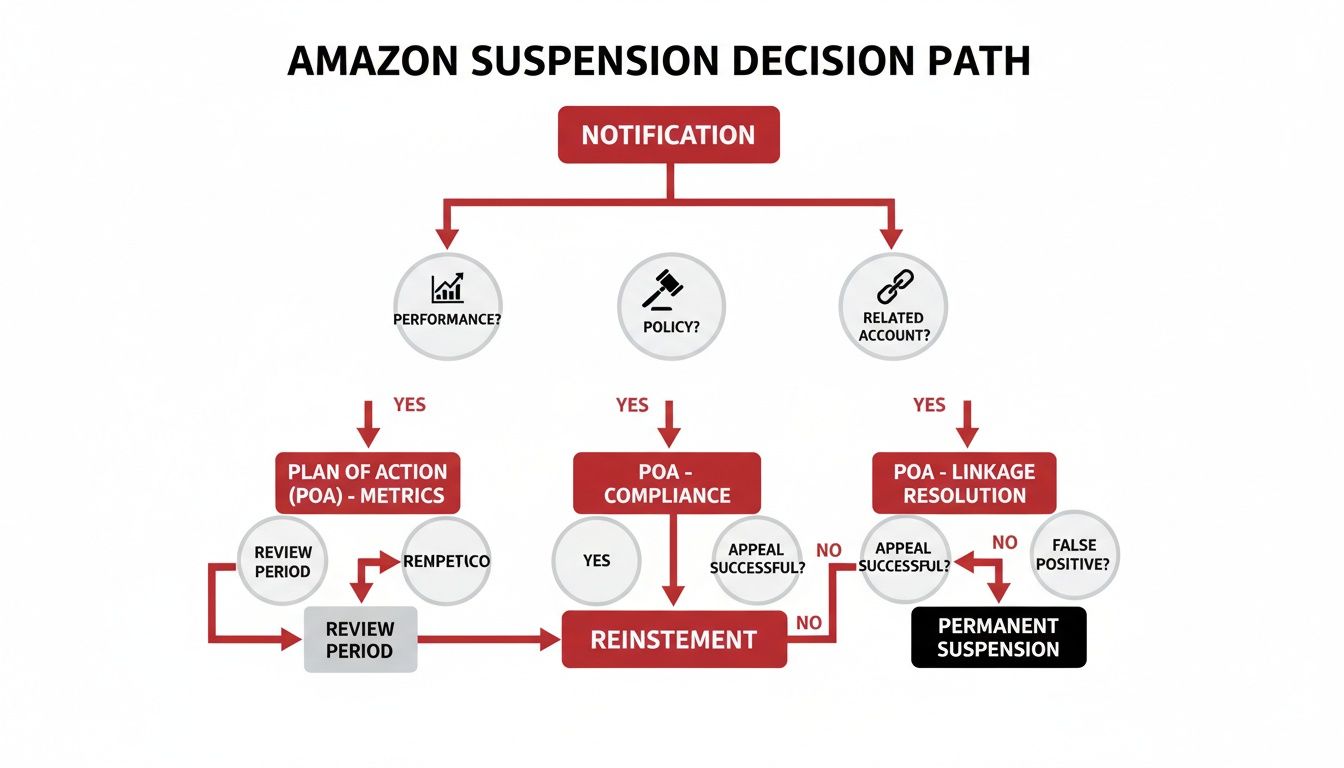
As the flowchart illustrates, your entire appeal strategy depends on correctly identifying the initial problem. A performance issue requires a completely different approach and set of evidence than a policy or related account issue.
With roughly 1.9 million active sellers competing on its marketplace, Amazon leans heavily on automated systems to enforce its rules. For many sellers, performance metrics are the tripwire.
Amazon demands that you keep your Order Defect Rate (ODR) below 1%, your Late Shipment Rate (LSR) under 4%, and your Pre-fulfillment Cancel Rate below 2.5%. Let any of these slip, and you're heading straight for a suspension. This makes daily monitoring inside Seller Central absolutely non-negotiable. You can learn more about navigating the Amazon ecosystem by understanding what Seller Central is and its importance to your business.
To help you get started, here's a quick reference table to translate the language in Amazon's suspension notices.
| Keyword in Notification | Likely Suspension Reason | Initial Action Required |
|---|---|---|
| "Order Defect Rate," "A-to-z," "Negative Feedback" | Poor Performance: Your customer service metrics have exceeded the allowed threshold. | Review all recent A-to-z claims and negative feedback to find common themes. |
| "Inauthentic," "Counterfeit" | Product Authenticity: A customer complained your product isn't genuine. | Gather all invoices, supplier information, and letters of authorization. |
| "Intellectual Property," "Infringement," "Copyright" | IP Violation: You've used a brand's trademark, patent, or copyrighted material without permission. | Identify the specific ASINs and complainant. Prepare retraction request or proof of rights. |
| "Used Sold as New" | Product Condition: A buyer received an item that appeared used, damaged, or had broken seals. | Check your returns, feedback, and packaging process for the cited ASINs. |
| "Review Manipulation," "Code of Conduct" | Policy Violation: You've tried to manipulate reviews or violated other selling policies. | Audit your review generation process and all buyer-seller messaging. |
| "Related Account," "Linked Account" | Multiple Accounts: Amazon's system has linked you to another suspended account. | Investigate any potential links: old accounts, shared addresses, WiFi, or third-party services. |
This table should give you a head start in pinpointing the exact cause, which is the essential first step before you even think about writing your appeal.
A successful reinstatement isn't about proving Amazon wrong. It’s about showing you understand their rules, have fixed the core problem, and have built systems to guarantee it never happens again.
Take full ownership. When you read that notification, fight the urge to get defensive. Treat it like a diagnostic report. Everything you need to get reinstated is in there—you just have to learn how to read between the lines. Pinpoint the exact ASINs, the specific policies they quoted, and the dates of any infractions. This data will become the bedrock of your evidence.

Before writing your appeal, you need to arm yourself with evidence. This is the Optimization phase, where you shift from panic to precision, building a logical case that leaves Amazon no room for doubt. Submitting a Plan of Action without the right documents is like showing up to court without proof—a waste of your time and one of your limited appeal opportunities.
The specific documents you’ll need depend entirely on why you were suspended. Every suspension type has its own evidence checklist. Your job is to meticulously gather every piece of data that proves you’ve identified the problem and are a trustworthy seller ready for growth.
Generic documents won't cut it. Amazon's investigators are trained to look for specific paperwork that directly addresses the violation. Let's break down what you’ll need for the most common suspension types.
For performance issues like a high Order Defect Rate (ODR) or Late Shipment Rate (LSR), all the proof you need is inside your own account. You’ll have to:
This isn’t about blaming buyers. It’s about proving you’ve done a thorough internal audit and found the exact point where your operations failed.
Policy violations, on the other hand, require external documentation. If you were hit with an "inauthentic" or "counterfeit" claim, your focus must be on your supply chain. This is where many sellers stumble, sending documents that Amazon’s team rejects on sight.
Your evidence must be a direct, professional response to the root cause. If you were suspended for inauthentic claims, Amazon wants to see your supply chain, not hear your apologies.
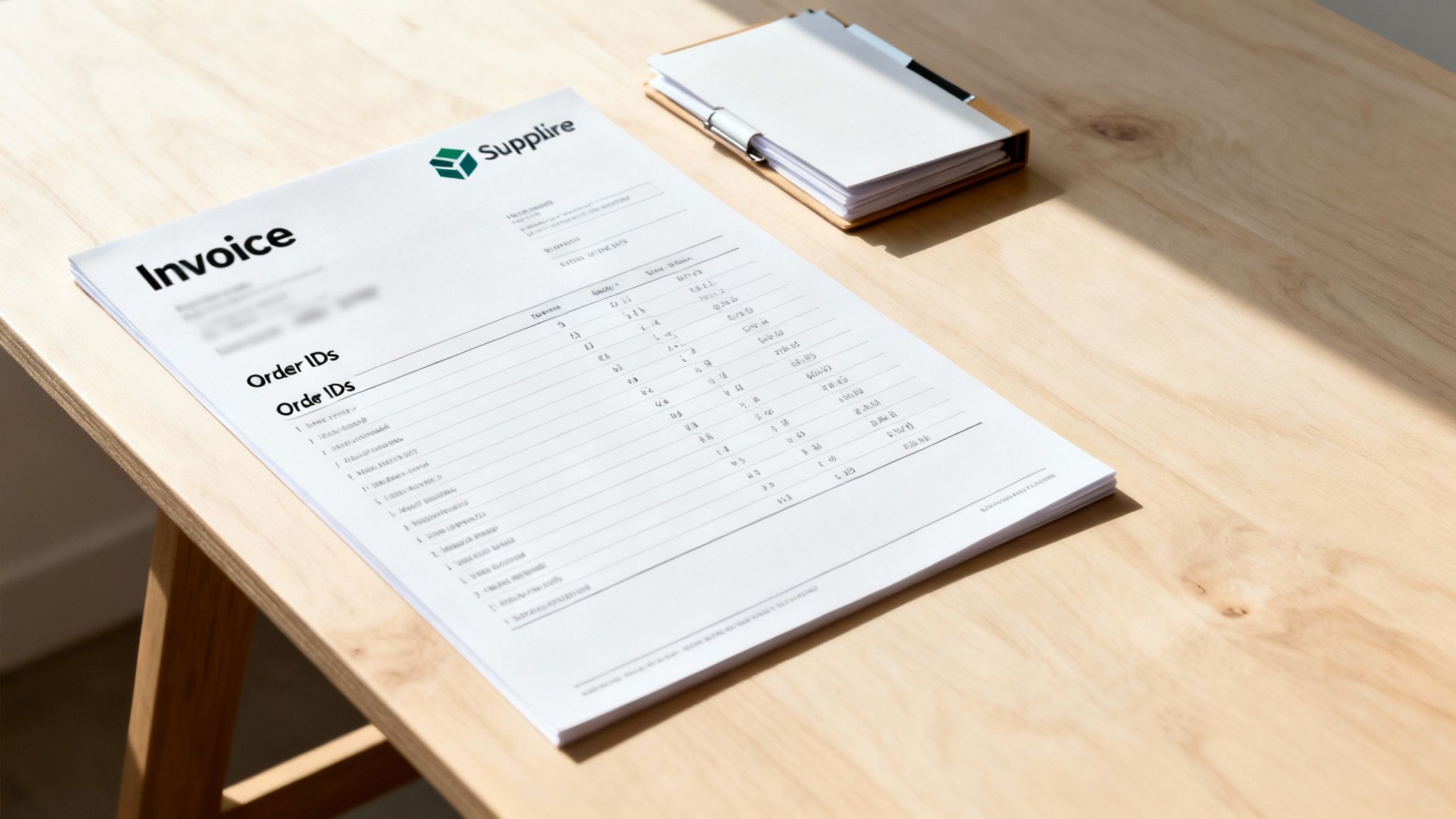
A rock-solid evidence file for authenticity issues is built on valid, unaltered supplier invoices. This is non-negotiable.
Amazon has incredibly strict standards for sourcing documents. Submitting the wrong kind of proof is one of the fastest ways to get your appeal denied. In fact, sourcing documentation issues are now a top reason for suspensions, especially for resellers who don't have proper invoices from authorized distributors. You can get more insights on Amazon's compliance enforcement by exploring this guide on navigating seller suspensions.
For an invoice to be considered valid, it absolutely must meet these criteria:
And let's be crystal clear: retail receipts, packing slips, or screenshots of online orders are not valid invoices. These documents don't prove you have a legitimate B2B relationship with a manufacturer or authorized distributor.
Before you submit anything, go through this checklist with a fine-toothed comb. A strong evidence file is the backbone of a successful appeal, making this preparation a critical step in your reinstatement process.
Your Plan of Action (POA) is the single most important document you’ll write to get your account back. This isn't the time for a lengthy apology. Think of it as a clear, professional business proposal proving to Amazon that you’re a reliable partner who understands their rules.
A vague, defensive, or incomplete POA is the fastest way to get your appeal rejected. We're going to break down how to build a POA that gets the Seller Performance team's attention and shows you’re serious about compliance. This is about taking complete ownership and presenting a logical case for your reinstatement.
Amazon’s team expects a very specific three-part structure. Straying from this format makes their job harder and increases the chance of rejection. Each section must be concise, factual, and directly tied to the issues identified during your investigation.
This framework is non-negotiable. It proves to Amazon that you’ve not only figured out what went wrong but, more importantly, why it happened and how you’ve built a system to stop it from happening again.
This is where most sellers go wrong. They describe a symptom, not the underlying problem. For instance, stating "a customer complained our product was inauthentic" isn't a root cause—it's the outcome.
The real root cause is the failure in your business process that allowed an inauthentic product to reach a customer. Was your supplier vetting process weak? Did you buy from an unverified wholesaler instead of a brand-authorized distributor? You have to dig deep and be brutally honest.
A strong root cause analysis doesn't make excuses. It pinpoints the exact operational, procedural, or knowledge-based failure within your business that led to the policy violation.
For an inauthenticity claim, a powerful root cause statement looks like this:
Root Cause Example: Inauthentic Claim "The root cause of the inauthenticity complaint for ASIN B00XXXXXX was a failure in our supplier verification protocol. We sourced this product from a general wholesaler who was not an authorized distributor for the brand. Our previous process did not include cross-referencing suppliers with the brand's official distributor list, creating a critical gap in our supply chain integrity."
See the difference? It takes full ownership, names the specific ASIN, and identifies the precise internal process that failed. No excuses, just facts.
Now that you've identified the core problem, you need to show Amazon what you’ve already done to fix it. This section must be written in the past tense. It’s a list of completed actions, not future promises.
Here’s where you tie your actions back to the evidence you’ve gathered, demonstrating that you’ve been proactive.
Effective corrective actions are specific and measurable:
Vague statements like "we handled customer complaints" are useless. Be specific.
This is the most critical part of your POA. It's your opportunity to convince Amazon that you are a safe bet for the future. You must outline the new systems, processes, and checks you’ve implemented to ensure the root cause cannot happen again.
These aren't one-time fixes; they are permanent, systemic changes to how you run your business.
Following our inauthenticity example, your preventive measures might include:
These steps are specific, proactive, and show a long-term commitment to playing by the rules. You’re not just fixing a mistake; you’re building a stronger, more compliant business.
Finally, keep the entire POA professional and to the point. Use bullet points and short paragraphs to make it scannable.
When drafting your POA, it's easy to let emotion or frustration creep in. Stick to the facts and follow a professional structure. This table breaks down what Amazon's reviewers want to see versus what will get your appeal instantly denied.
| Do | Don't |
|---|---|
| Take 100% responsibility for the issue. | Blame customers, competitors, or Amazon. |
| Be specific, using ASINs and Order IDs. | Use vague language like "some items" or "a few customers." |
| Keep the POA concise and focused on the facts. | Write a long, emotional letter or tell your life story. |
| Use the three-part structure: Root Cause, Corrective Actions, Preventive Measures. | Mix everything together in one long paragraph. |
| Write in the past tense for actions already taken. | Say you "will" do things you haven't done yet in the corrective section. |
By sticking to this framework, you present a compelling business case that proves you’re ready to be a responsible seller on their platform.
You’ve crafted the perfect Plan of Action and gathered your evidence. Now it’s time to formally submit your appeal. This is about presenting your case to Amazon clearly and professionally to get your account reinstated.
The submission itself is done right inside Seller Central. Navigate to your Performance Notifications, find the original suspension notice, and click the “Appeal” button. This opens a form where you can paste your POA and attach your files.
A pro tip: paste your POA as plain text to avoid formatting issues. Also, name your files logically—something like "Supplier_Invoice_ASIN_B00XXXXXX.pdf" works great.
Once you hit "Submit," the waiting game begins. This is often the most stressful part of the entire process.
After you’ve submitted your appeal, the urge to check in constantly is real. But patience is your best ally right now. The Seller Performance team is dealing with thousands of cases, and response times vary widely—it could be a few hours or several weeks.
Sending multiple messages won’t speed things up. In fact, it can hurt your case by creating duplicate tickets and making you look frantic and unprofessional.
As a general rule, give it at least 7-10 days before considering a follow-up. If you haven't heard back after that time, a single, polite message through the same case log is appropriate. Just ask for an update on the status of your review.
While you're waiting, start putting the preventive measures from your POA into action. It shows you’re serious and gets your business ready for a stronger, more compliant future once you’re reinstated.
Getting a rejection after all that work is discouraging, but it’s not the end of the line. Amazon’s denial emails are notoriously brief and rarely specify what was wrong with your appeal. Your job now is to go back to the drawing board and figure out what was missing.
A denied appeal usually means one of two things: you misidentified the true root cause, or your preventive measures weren't strong enough. Amazon needs to see that you've fundamentally changed your business processes for the long term.
Carefully re-read the original suspension notice and the POA you sent. Did you misdiagnose the problem? Was your evidence incomplete? Often, a second look reveals gaps you missed the first time.

For your next attempt, you need to refine your POA based on this new analysis. Make it even more specific and demonstrate a much deeper understanding of the policies you violated.
Navigating this, especially after a denial, is tough. If you feel like you're hitting a wall, it might be time to bring in an expert. Exploring professional Amazon reinstatement services can provide expert guidance to get your business back on track.
Getting your account reinstated is the immediate goal, but long-term success on Amazon means ensuring you never end up here again. This is the Amplification phase—locking in your processes to build a business that’s resilient, scalable, and more profitable.
Think of proactive compliance as building a rock-solid operational foundation. When you treat Amazon’s policies as a blueprint for an excellent customer experience, your business transforms. You shift from putting out fires to running a predictable, profitable operation that can grow across all channels.
To stay out of trouble, you need a system—a simple routine that catches problems before Amazon does. Think of it as preventative maintenance for your seller account. A consistent weekly audit can make all the difference.
Here’s what your weekly checklist should cover:
Amazon’s rules are constantly evolving. What was acceptable last year might be a policy violation today. Staying informed is a core business function.
Make it a weekly habit to review the Seller Central news dashboard and your Performance Notifications. This is how Amazon announces policy updates. Subscribing to trusted industry blogs can also provide context on what these changes mean for sellers like you.
The reality is that Amazon account suspensions are getting more severe. For serious issues like selling counterfeit goods or repeated violations, reinstatement is becoming nearly impossible as the platform cracks down.
Proactive compliance is the ultimate growth amplifier. It frees up the time and resources you'd otherwise spend fighting fires, allowing you to focus on scaling your brand, expanding your catalog, and reaching new customers across all channels.
Protecting your account health also means protecting your brand's reputation. To avoid issues with pricing policies, which can lead to suspensions, many brands use tools like MAP Policy Monitoring Software to stay compliant.
Ultimately, this proactive mindset builds more than just a safe Amazon account. It builds a disciplined, data-driven operation ready for omnichannel success. By mastering the details of compliance and branding, like those outlined in the Amazon brand guidelines, you create a business that customers trust and platforms want to feature.
When your Amazon account is suspended, the questions come fast. The uncertainty is the worst part—how long will this take? Who can I talk to? What does this mean for my business? It's a stressful situation.
Let's cut through the noise and tackle the most common questions sellers have with direct, practical answers.
One of the first questions is, "How long will it take to get my account back?" The honest answer: it depends. A simple suspension with a clear root cause and a strong Plan of Action (POA) might be resolved in a few days.
However, more complex issues, like a related accounts case or an intellectual property dispute, could take several weeks or even months. The single biggest factor impacting this timeline is the quality of your first appeal. A well-researched, clearly written submission can significantly reduce your downtime.
Let me be crystal clear: no. Do not attempt this.
Trying to open a new seller account after a suspension is one of the fastest ways to get permanently banned. Amazon’s systems for detecting linked accounts are incredibly sophisticated. They track everything—bank information, addresses, IP addresses, and even the digital fingerprint of your computer.
They will find the new account, shut it down, and make reinstating your original account nearly impossible. Why? Because you've just shown them you'd rather sidestep their rules than address the problem. The only way forward is through the official appeals process for your original account.
A common mistake sellers make after a suspension is letting panic take over. They either fire off a sloppy, emotional appeal or try to game the system. Both actions just dig the hole deeper. A successful reinstatement requires a calm, methodical, business-like approach.
This is where things get really frustrating. You’ve sent your appeal, and all you get back is silence. Or worse, the same canned, automated response over and over.
If it's been a few weeks with no meaningful update, you have a couple of options. You can try resubmitting your appeal through the same case log, but only if you’ve significantly reworked your POA with new information or a stronger root cause analysis. Don't just send the same document again.
Another option is to try and escalate the case, though this isn't always successful. Your core strategy must remain the same: refine your appeal, bring stronger evidence to the table, and show Amazon you have a deep understanding of the policy you violated. Every communication needs to add value and demonstrate progress. Prove to them you're a partner who is serious about running a compliant business on their platform.
Navigating an Amazon suspension is a complex challenge, but you don't have to face it alone. At RedDog Group, we specialize in tackling the tough stuff, from account reinstatements to brand protection, helping you get back to what matters most—growth. Our team combines deep marketplace expertise with a proven framework to build stronger, more profitable brands. Let’s Talk Growth.
Leave a comment: