
Published: March 2020 | Last Updated:January 2026
© Copyright 2026, Reddog Consulting Group.

Nothing sends a chill down a seller’s spine like that dreaded deactivation notice. It’s a gut-punch moment that freezes your revenue and throws your entire omnichannel operation into chaos. Your first instinct might be to panic and fire off a quick, desperate reply. Don’t.
The best move you can make right now is to take a breath and approach this like a detective. Before you do anything else, you need to methodically diagnose exactly why Amazon shut you down. A precise diagnosis is the foundation for a successful recovery.
That deactivation email feels personal, but your response in the first 24 hours is purely business. It sets the stage for your entire reinstatement effort. Before you even think about writing an appeal, your only job is to become an expert on your own suspension. This goes beyond just reading the notice—it's about conducting a deep, brutally honest audit of your account from Amazon's point of view.
Start with the performance notification itself. Is Amazon flagging a specific policy violation? A performance metric like a high Order Defect Rate (ODR)? Or is it something more severe, like a Section 3 violation for suspected inauthentic inventory? Each one of these requires a completely different playbook.
Next, dive into your Account Health dashboard in Seller Central. This is ground zero. Scrutinize every metric, customer complaint, and policy warning. A seemingly small issue from a few weeks back could be the root cause of today's deactivation. This first phase is all about building a solid Foundation for your appeal by gathering hard facts, not jumping to conclusions.
This flowchart maps out how we tackle an account diagnosis—it's a proven process for measurable results.
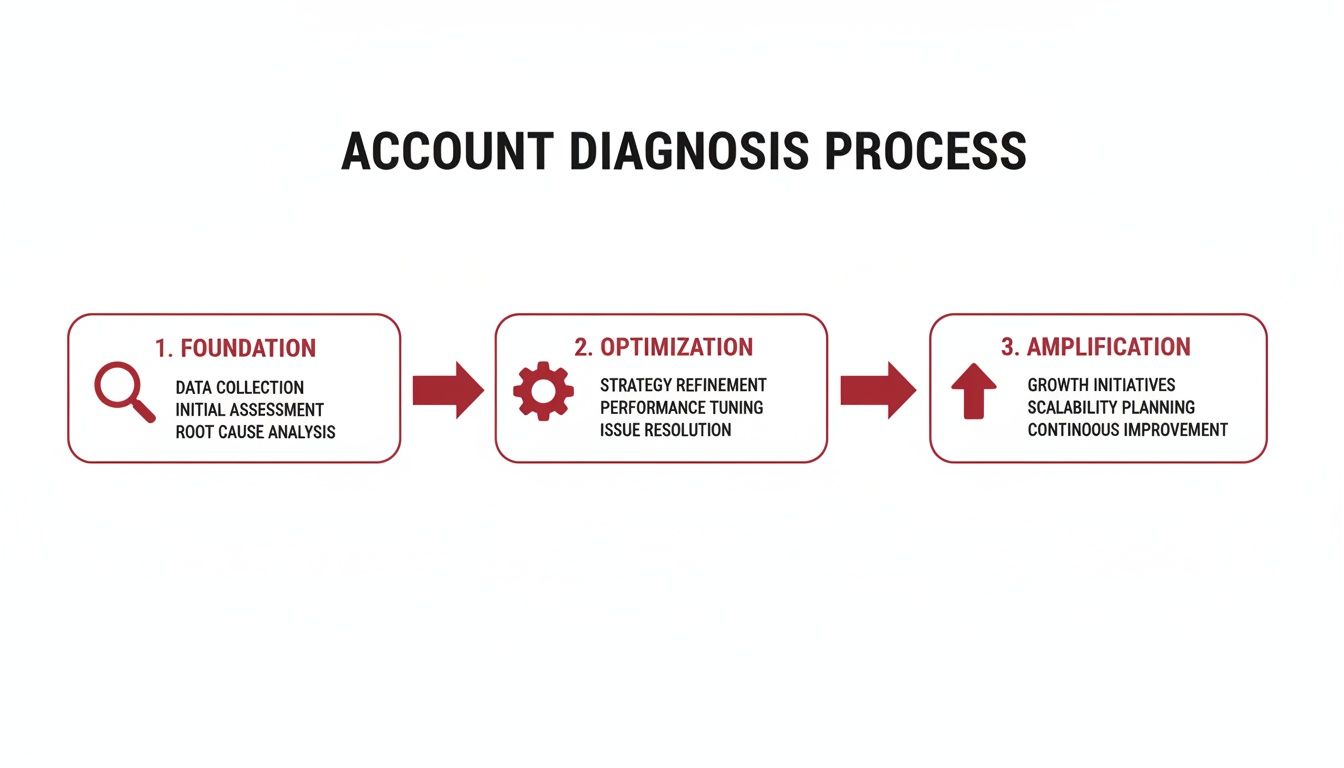
This Foundation → Optimization → Amplification flow ensures every action you take is strategic and data-driven. You're not just treating symptoms; you're fixing the core problem to support long-term brand growth.
With the data in front of you, it's time to connect the dots. Did you receive an intellectual property complaint? Match it to the specific ASINs Amazon mentioned. Did your Late Shipment Rate suddenly spike? Pull your fulfillment reports for that exact time frame. Your goal is to pinpoint the precise operational breakdown that triggered the violation. This analytical work is exactly what Amazon's investigators expect to see.
Sometimes, the cause isn't obvious. Regulatory changes can trigger mass deactivations that catch even savvy sellers off guard. For instance, in 2023, thousands of US sellers were suspended due to the INFORM Consumers Act. They had a tight 60-day window for identity re-verification, and many who missed the deadline received vague notices citing "deceptive, fraudulent or illegal activity," causing massive confusion.
Practical Takeaway: Never assume you know why you were suspended. A wrong diagnosis leads to a rejected Plan of Action, digging you into a deeper hole. Your appeal's success depends entirely on correctly identifying the true root cause.
To give you a head start, here’s a breakdown of the common triggers we see causing account deactivations.
| Violation Category | Common Triggers | First Step to Take |
|---|---|---|
| Performance Issues | High Order Defect Rate (ODR), Late Shipment Rate (LSR), or Pre-fulfillment Cancel Rate. | Review your Account Health dashboard and customer feedback for the last 90 days to identify trends. |
| Policy Violations | Inauthentic items, IP complaints (copyright, trademark), listing restricted products. | Check Performance Notifications for specific ASINs and complaint details to isolate the problem. |
| Related Accounts | Linking your account to another suspended account (shared info, IP address, banking details). | Identify any potential links—past or present—to other seller accounts across all your channels. |
| Code of Conduct | Review manipulation, dropshipping violations, attempting to divert sales off-Amazon. | Audit your marketing practices, communication with buyers, and fulfillment methods for compliance. |
| Verification Issues | Failure to complete identity verification (e.g., INFORM Act), outdated documents. | Check your Account Info page for any pending verification requests or alerts that need attention. |
This table isn't exhaustive, but it covers the majority of cases and should help you start narrowing down the possibilities.
Once you've nailed the diagnosis, you can switch from analysis to action. This is where you outline the immediate fixes you'll make and—more importantly—the long-term, systemic changes you'll implement to ensure this never happens again.
A winning appeal demonstrates ownership and a forward-thinking plan to be a better partner on the platform. For a deeper dive into crafting your response, our guide on navigating an Amazon account suspension is a great next step. This crisis is your chance to come back with stronger, more resilient business operations.

Submitting a generic Plan of Action (POA) is the fastest way to get your appeal ignored. Amazon’s performance teams see thousands of these every day and can spot a downloaded template from a mile away. To get your amazon deactivated seller account back online, your POA can't just be an apology—it must be a custom, data-backed business document that demonstrates complete ownership.
Think of it less like a plea for forgiveness and more like a C-suite report on operational improvements. It needs to be precise, factual, and focused on solving the problem for Amazon and its customers. Every sentence must prove you’ve done the hard work to build a more resilient, compliant business.
A successful POA is built on a specific three-part structure. Amazon's investigators are trained to look for this exact format because it logically breaks down the problem, the immediate fix, and the long-term solution. Straying from this framework is one of the most common mistakes sellers make, and it almost always leads to a swift rejection.
Your entire appeal must be organized around these three pillars:
This structure forces you to stop making excuses and start presenting concrete solutions—which is the only thing the review team cares about.
This is where most sellers get it wrong. They identify a symptom, not the underlying issue. A vague admission like, "We accidentally listed an inauthentic product," is useless.
Amazon needs to know why it happened. Was your supplier vetting process inadequate? Did a team member lack the proper training to match ASINs correctly? You have to dig deeper.
For instance, instead of saying, "We had a high Late Shipment Rate," a powerful root cause statement sounds like this: "The root cause of our Late Shipment Rate exceeding the 4% threshold between October 15 and October 30 was a failure in our inventory management software to sync accurately with our 3PL partner's WMS. This data lag resulted in 17 orders being processed 48 hours behind schedule."
Expert Insight: Get surgically specific and use data. Mentioning exact dates, order IDs, and performance metrics shows you’ve conducted a thorough internal audit. You aren’t guessing; you’re presenting cold, hard facts from your own business records.
This section is about the "now." It’s your opportunity to prove to the investigator that you’ve already contained the damage. These are actions you have completed, not things you're planning to do.
Your list of actions should be clear and verifiable. For example:
Each bullet point should be a concrete, finished task that directly addresses the problem laid out in your root cause analysis.
This is, without a doubt, the most important part of your POA. It shows Amazon you’re not just putting out a fire but fireproofing your entire operation for the future. A weak prevention plan signals that you’re a high-risk seller who will likely end up back in the queue.
Your goal here is to showcase systemic, permanent changes that support scalable growth.
Here’s how you can frame these measures to be truly effective:
These solutions prove you’re building a stronger, more compliant business. For a deeper dive, learn more about handling a suspended Amazon account in our guide. Your long-term plan is your promise to be a better seller, and Amazon needs to believe it.
Your Plan of Action tells Amazon what went wrong, but your documents are what prove you’re telling the truth. When your Amazon deactivated seller account is on the line, submitting the right evidence in the right format is non-negotiable. Amazon’s performance teams don’t operate on trust—they need hard, verifiable proof, and one small mistake can send your appeal back to square one.
Submitting the wrong paperwork, or even formatting it incorrectly, is one of the fastest ways to get a rejection. This isn't just about having the documents; it's about presenting them so clearly that an investigator’s job becomes effortless. They're looking for an unbroken chain of custody that proves your products are authentic and your business is legitimate.
The proof you need is dictated entirely by the suspension notice. Your response to a high Order Defect Rate requires completely different documents than an appeal for an intellectual property (IP) complaint. Don't just dump a folder of random files on them—be surgical.
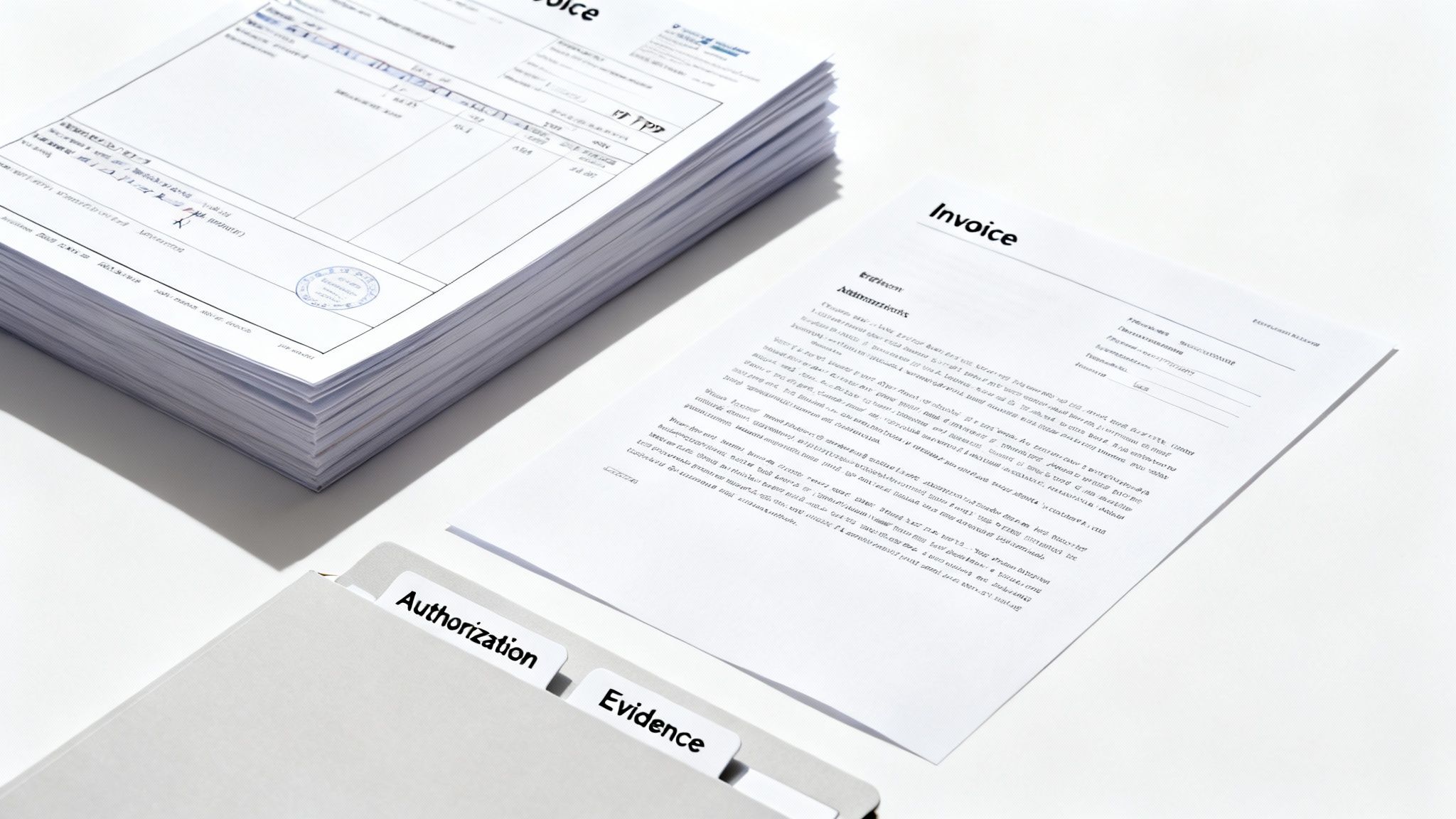
For common supply chain issues like inauthenticity or IP claims, your evidence has to be perfect. This is your core documentation:
A pro tip: always annotate these documents. Use a simple editor to circle or highlight the most important details—the supplier’s contact info, your business name, purchase dates, and the specific ASINs in question. This small step saves the reviewer precious time and makes your case stronger.
Amazon has become incredibly strict about supply chain integrity. A "forged or manipulated" rejection often leads to permanent account closure, and it usually happens because a supplier's information couldn't be verified. This is where you graduate from simply providing documents to building a transparent operational backbone.
We saw this play out during a wave of deactivations in January 2024 tied to Amazon’s Unsuitable Inventory Investigations Policy. Sellers with spotless records were suddenly flagged because Amazon couldn't independently verify their suppliers. As one seller shared, even after passing initial checks, their account was shut down, proving just how critical robust records are. You can read more about what these sellers went through in these Amazon seller forum discussions.
Practical Takeaway: Make your supply chain an open book. If an Amazon investigator can’t pick up the phone, find a website, and confirm your supplier is a legitimate business in a few minutes, you’re in the danger zone. Vet every partner to ensure they are a registered, verifiable entity.
Submitting flawed evidence is often worse than providing none at all. It signals to Amazon that you either don’t understand the rules or, worse, you’re trying to deceive them.
Steer clear of these common pitfalls:
Your documentation is the final piece of the puzzle. It backs up every promise you make in your POA and proves you’ve built a compliant, trustworthy business. By assembling clear, verifiable, and correctly formatted evidence, you give Amazon the confidence it needs to hit that "reinstate" button.
Hitting "Submit" on your Plan of Action isn't the finish line—it's the start of the next phase. The silence that follows can be one of the most stressful experiences for any seller, but how you handle this waiting period is as critical as the appeal itself. You need a persistent, professional strategy to keep your case from getting lost in the shuffle.
First, understand that Amazon's internal review teams are handling a massive volume of cases. Response times for an Amazon deactivated seller account can range from a few hours for simple verification issues to several weeks for complex policy violations. Patience is a strategic asset.
When you finally get an email, it will almost always fall into one of three categories. Understanding which one you’ve received is crucial for your next move.
Expert Insight: Whatever you do, never spam the "Appeal" button. Firing off multiple messages or opening new cases for the same issue won't get you a faster response. In fact, it usually kicks your case to the back of the line, resetting your wait time.
If weeks turn into a month with no response, or you're stuck in a loop of generic rejections despite a solid POA, it might be time to escalate. Escalation isn't about yelling louder; it's about getting a fresh pair of eyes on your case file.
Your best first stop is the Account Health Support team. You can request a call directly from your Account Health dashboard. Be prepared: have your case ID handy and be ready to summarize your issue and the steps you've taken in 60 seconds or less. These specialists can't reinstate you on the spot, but they can review your POA, offer feedback, and add internal notes to your case that can help the performance team see the full picture.
If that doesn't move the needle, the next level is contacting Amazon’s executive teams. This is a last-ditch effort and should only be considered after you've exhausted all standard options. Your email needs to be flawless—professional, concise, and focused strictly on the facts.
There's a point where the revenue you're losing in sales starts to dwarf the cost of bringing in a professional. If you're trapped in a cycle of rejections, dealing with a complex Section 3 deactivation, or simply don't have the time to manage a drawn-out appeal, it’s time to call an expert.
Hiring a consultant isn't giving up; it's a strategic business decision. An experienced firm can cut through the noise, pinpoint the real root cause, draft a POA in the language Amazon understands, and handle the entire escalation for you. That frees you up to focus on what matters most: getting your operations ready to ramp back up for renewed growth.
Getting your Amazon seller account back is a huge relief, but the real victory is building a business so solid you never go through that again. This is where you pivot from reactive fixes to a proactive, long-term strategy. Think of the deactivation not as a failure, but as the catalyst for building a stronger, more sustainable omnichannel operation.
The promises you made in your Plan of Action aren't just for Amazon—they are the new foundation of your business. This shift is about embedding compliance and best practices so deeply into your daily workflow that they become second nature. It’s not just about avoiding another suspension; it's about building a more profitable and scalable brand.
Those preventive measures you detailed in your appeal? They now need to become your standard operating procedures (SOPs). If you promised a new two-step quality control check or a more rigorous supplier vetting process, it’s time to implement it religiously.
True resilience is built on consistency. These aren’t temporary patches; they are permanent upgrades to your operational DNA.
Your Account Health dashboard is your business’s real-time report card. Ignoring it is like driving with your eyes closed. Make checking it a non-negotiable part of your daily routine. The goal is to keep your Account Health Rating (AHR) solidly in the green, well above the 200-point threshold for "Healthy" status.
But a perfect score isn't a suit of armor. In one shocking case, a seller with a flawless AHR of 200 and zero violations had their account permanently deactivated. Despite more than a dozen appeals, Amazon’s opaque Section 3 enforcement held firm, demanding IP compliance evidence for an issue that didn't exist. This case is a stark reminder that proactive documentation is absolutely critical, because even top performers are vulnerable.
Practical Takeaway: Treat every metric on your Account Health page as a leading indicator. A tiny dip in your On-Time Delivery Rate or a single negative feedback can be the first tremor before an earthquake. Address these small issues immediately before they become a crisis.
Amazon’s rulebook is constantly evolving. What’s compliant today might get you suspended tomorrow. Staying informed isn’t an afterthought; it’s a core business function.
Assign someone on your team to be the designated policy expert. Their job is to monitor the Seller Central news feed, subscribe to eCommerce publications, and understand how upcoming changes—like new verification requirements or category restrictions—will impact your business. For instance, you can proactively secure your account by exploring advanced methods like biometric identity verification for fraud prevention. This forward-looking stance gives you time to adapt your processes instead of scrambling to react.
If you own your brand, enrolling in Amazon Brand Registry is one of the most powerful shields you can have. It’s far more than a tool for creating A+ Content; it’s a fortress against intellectual property threats.
Brand Registry gives you control over your product detail pages, stopping unauthorized sellers from making damaging changes. It also equips you with powerful tools to report and remove counterfeit listings or IP infringements, letting you neutralize threats before they can harm your account health. For a comprehensive look at leveraging these tools, check out our deep dive into the essentials of Amazon Brand Guidelines.
By transforming your operations and adopting this proactive mindset, you’re doing more than just preventing another deactivation. You’re building a brand that’s engineered for long-term, profitable growth—turning a crisis into a true competitive advantage.

When your account gets shut down, a flood of questions hits you all at once. Getting straight answers is the only way to clear your head and build a plan to get reinstated.
This section cuts through the noise and tackles the most common—and most urgent—concerns we hear from sellers whose amazon deactivated seller account is on the line. Think of it as your first-response guide to the most critical issues you’re facing right now.
Honestly, reinstatement timelines are all over the map. A straightforward case, like a simple document re-verification, can sometimes be resolved in 24-72 hours. But that's the best-case scenario.
More complex issues are a different beast. If you're dealing with violations for intellectual property, linked accounts, or the dreaded Section 3 deactivation, you could be looking at weeks or even months of back-and-forth with Amazon.
The single biggest factor is the quality of your first Plan of Action (POA). A sharp, well-documented POA can cut the timeline down significantly. A vague or incomplete one just starts a frustrating cycle of denials.
Practical Takeaway: Patience is your best friend here. Don't give in to the urge to spam Seller Performance with follow-ups or open new cases. All that does is knock you to the back of the line and drag out the process even longer.
Let me be crystal clear: absolutely not. Trying to open a new seller account after a deactivation is one of the worst mistakes you can make. It's a major policy violation, and Amazon will catch you.
They use sophisticated systems to connect accounts using a host of data points:
When they link your new account to the old one, it will be shut down immediately. Even worse, it will torpedo any chance you had of ever getting your original account back. Your only viable path forward is to put 100% of your energy into appealing the deactivation on your primary account.
A Section 3 deactivation is about as serious as it gets. This isn't a slap on the wrist for a minor policy slip-up. It refers to Section 3 of Amazon's Business Solutions Agreement, a catch-all clause that lets them terminate an account for almost any reason.
It's usually reserved for what Amazon considers the most severe offenses:
The deactivation notice for a Section 3 is often deliberately vague, making it notoriously difficult to appeal. You must write an incredibly thorough and brutally honest POA that correctly pinpoints what Amazon sees as a fundamental breach of trust. This is one of those situations where getting professional help isn't just a good idea—it's often necessary.
That really depends on what you're up against. For something straightforward and metric-based, like a high Late Shipment Rate, you can probably handle the appeal yourself by following a good guide and providing clear data.
However, for anything more complex, hiring an experienced consultant is a smart business decision. You should seriously consider bringing in an expert if you're dealing with:
A seasoned consultant knows the specific language and evidence Amazon's internal teams are looking for. They can put together an appeal that drastically improves your odds of getting reinstated, saving you a massive amount of time and lost sales. Their expertise can often turn a situation that feels hopeless into a successful recovery.
When your revenue is on the line, you need a partner with a proven track record. RedDog Group has navigated countless deactivations, from simple metric issues to the most complex Section 3 cases. We build data-driven appeals that get results. Let's get your business back online.
Leave a comment: