
Published: March 2020 | Last Updated:January 2026
© Copyright 2026, Reddog Consulting Group.

An Amazon account suspension means your selling privileges are revoked, your funds are frozen, and your inventory is stranded. This isn't just a temporary pause; it's a full stop that can erase years of brand growth and sales momentum in an instant. Getting back online requires a specific, evidence-backed appeal, and there's no time to waste.

Waking up to that dreaded performance notification is every Amazon seller's nightmare. An account suspension brings your business to a screeching halt on the world's largest marketplace. Your listings disappear, your access to funds is cut off, and your sales velocity plummets to zero overnight.
This isn’t a minor setback; it's a full-blown business emergency. The financial and operational damage is immediate and severe. Without a clear plan to get reinstated, a suspension can threaten the very existence of your brand on the platform. Understanding why this happens is the first step toward recovery and building a more resilient omnichannel strategy.
Amazon is obsessed with customer experience. Any action that threatens that trust—from shipping delays to questions about product authenticity—can trigger a suspension. The platform uses a mix of complex algorithms and human review teams to monitor every seller against a long list of strict policies.
Amazon is quick to act when it sees a problem. Here’s a rundown of the most frequent reasons sellers find themselves shut down and the measurable impact on their business.
| Suspension Trigger | What It Means | Immediate Business Impact |
|---|---|---|
| Poor Performance Metrics | Your Order Defect Rate (ODR) is over 1%, or your Late Shipment/Cancellation Rates are too high. | Listings become inactive, Buy Box eligibility is lost, and funds are immediately frozen, disrupting cash flow. |
| Policy Violations | You've listed a restricted product, manipulated reviews, or received intellectual property (IP) complaints. | Account is shut down, inventory may be stranded, and you risk permanent deactivation, damaging brand reputation. |
| Related Accounts | Amazon has linked your store to another suspended account, or you tried opening a second one without permission. | Both accounts are suspended, and appealing becomes incredibly difficult as you must resolve the original suspension first. |
As you can see, these aren't just administrative issues. Amazon views them as fundamental breaches of the seller agreement, and the consequences are designed to be a powerful deterrent.
The moment an account gets suspended, a chain reaction of negative consequences kicks off. This isn't just about losing sales for a few days; it's a multi-faceted crisis. Frozen funds can cripple your cash flow, making it impossible to pay suppliers or invest in other marketing channels.
A strong operational Foundation is your best defense against Amazon account suspensions. Proactive account health management isn't just a best practice; it's a core pillar of sustainable growth that prevents these emergencies before they happen.
This problem is more widespread than many sellers realize. Recently, Amazon account suspensions impacted a staggering 35% of all sellers, a sharp surge that highlights just how high the stakes are. Data shows that mid-sized businesses—especially those with revenues between $100K and $1M—were hit the hardest as Amazon ramped up its scrutiny.
While mastering these rules can feel complex, understanding if selling on Amazon is still worth it involves getting these operational basics right from day one. This reality check underscores just how critical it is to have a robust strategy to protect your business.

Receiving that suspension email feels like a punch to the gut. It's easy to panic, but firing off a rushed, emotional appeal is the worst thing you can do. The first 24 hours are critical, and they should be spent conducting a clear-headed internal audit—not pleading your case.
This is your diagnostic phase. It’s all about digging into the data to find the exact reason Amazon took action. Submitting an appeal without knowing the true root cause is like guessing a password; you’ll waste valuable time and reduce your chances of success with every failed attempt. Your only goal right now is to gather evidence.
First things first, head straight to Seller Central. Go to your Performance Notifications and find the official suspension email from Amazon. This message is your starting point, even if the language seems frustratingly vague.
Read it. Then read it again. Amazon won’t spell out every single order that caused the issue, but they will point you in the right direction. They'll typically mention a specific policy violation or performance metric that you failed to meet.
For example, the notice might cite "inauthentic complaints" or a "high Order Defect Rate." Your job is to take that clue and follow the breadcrumbs back to the source within your account's data.
With the notice as your guide, it’s time to conduct a thorough internal audit. This means getting your hands dirty and digging deep into your performance metrics, customer messages, and operational records. Don't just skim the surface; you're looking for patterns that align with Amazon’s complaint.
Performance-related issues are often the biggest culprits. The big three—Order Defect Rate (ODR), Late Shipment Rate, and Pre-Fulfillment Cancel Rate—can sink even a successful account. Amazon is ruthless with its metrics; your ODR, which includes negative feedback, A-to-Z claims, and chargebacks, must stay below 1%. Anything higher is a massive red flag.
A Plan of Action that just says, "we will improve our metrics," will get rejected instantly. You have to prove you know why they slipped in the first place. Was it a bad batch of inventory? Did your new shipping carrier drop the ball? Were you short-staffed in the warehouse?
To get those answers, you need to systematically review several key areas of your business. The evidence you gather will become the backbone of your appeal. For more on this, the guide on fixing your suspended Amazon account offers some solid, actionable advice for diagnosing the core issues.
A comprehensive audit leaves no stone unturned. Use this checklist to gather all the evidence you need before you even think about writing a single word of your Plan of Action (POA).
By following this process, you shift from panicking to problem-solving. Every piece of data you collect is another building block for a powerful appeal that shows Amazon you take ownership and have a real plan. This methodical approach is what separates a quick reinstatement from a business-killing delay.
You've dug through the data and gathered your evidence. Now it's time to build your case. A generic, half-hearted Plan of Action (POA) is a one-way ticket to a quick rejection from Amazon. This document is your single best chance to prove you understand what went wrong, you’ve already fixed it, and you have a system to prevent it from ever happening again.
Forget apologies. Think of your POA as a serious business document. It needs to be clear, factual, and packed with concrete details that scream competence. The investigators at Amazon review hundreds of these daily; yours has to be logical, easy to scan, and completely persuasive.
Every successful POA is built on the same three-part structure. Don't get creative here. Straying from this format just confuses investigators and signals that you don’t understand their process. Your appeal must clearly and separately address each of these points.
The Root Cause of the Issue: What really happened? Be brutally specific. Vague statements like "we had shipping problems" are useless. A strong root cause is precise: "Our third-party logistics provider failed to meet their promised 24-hour processing time for 17 orders between May 10th and May 15th, causing our Late Shipment Rate to exceed the 4% threshold."
Immediate Corrective Actions: What have you already done to make things right for the customers who were affected? This is all about taking accountability. For example: "We have fully refunded all 17 customers impacted by the shipping delay," or "We have recalled and disposed of the entire batch (Lot #48B) of the product that received inauthentic complaints."
Long-Term Preventative Measures: How will you guarantee this exact problem never happens again? This is the most critical section. It's where you prove you’ve actually improved your business operations. This part has to be filled with tangible, verifiable changes.
This structured approach shows Amazon you're not just scrambling to get your account back—you're committed to being a better, more reliable seller on their platform.
The difference between a rejected POA and a successful one usually boils down to the level of detail. Amazon's team is trained to spot generic, copy-paste answers from a mile away. You need to provide specifics that are unique to your business and this exact situation.
Here’s a quick guide on what to aim for in your POA. Think specifics, not generalizations.
| Do | Don't |
|---|---|
| Be specific. Name software, people, and processes. | Use vague phrases like "we will improve" or "we will monitor." |
| Take full ownership. Accept responsibility for the issue. | Blame Amazon, customers, or your competitors. |
| Provide measurable commitments. "Within 6 hours," "every Friday." | Make empty promises with no clear way to verify them. |
| Keep it factual and concise. Get straight to the point. | Write an emotional, novel-length apology. |
| Attach supporting evidence. Invoices, screenshots, etc. | Submit the POA with no documentation to back up your claims. |
The strong statements name specific tools, assign responsibility to a team member, and lay out measurable commitments. These are promises backed by process, not just words.
Navigating this can be a nightmare, especially for complex cases. If you're stuck, exploring professional Amazon reinstatement services can bring in the expert guidance needed to craft an appeal that actually meets Amazon's sky-high standards.
Once your POA is drafted, proofread it like your business depends on it—because it does. Typos and grammatical errors make you look careless and unprofessional. Keep the language direct and unemotional. Stick to the facts.
Key Takeaway: Take full ownership of the problem, even if you feel it wasn't entirely your fault. Amazon's world runs on accountability. Showing you accept responsibility isn't optional; it's the price of admission for getting reinstated.
When you're ready, submit the POA using the "Appeal" button in your Seller Central performance notification. Attach all the supporting evidence you gathered—supplier invoices, shipping manifests, screenshots of new software, whatever you have.
After you hit submit, the hardest part begins: waiting. Resist the urge to send follow-up emails. A well-crafted POA gives you the best possible shot at getting your business back online quickly.
Getting a rejection notice on your first Plan of Action (POA) is a gut punch, but it’s definitely not the end of the road. Many sellers have their initial appeals denied, usually because the POA was too vague or didn't dig deep enough to find the real root cause. Giving up isn’t an option. This is the moment to get smarter, not discouraged.
Instead of panicking, see the rejection as feedback. Sure, Amazon’s responses can be maddeningly generic, but they force you to go back and double-check your work. A failed POA almost always means you haven't convinced them you've built a permanent, foolproof solution.
If Amazon actually gives you specific feedback, consider it a gift. Sometimes they’ll say your POA "does not sufficiently address" a certain policy or that your preventative measures are "not robust enough." That’s your roadmap. Go right back to that section and load it up with more detail, more data, and more proof.
More often than not, though, you’ll just get a canned template response with zero new information. When that happens, the burden is on you to figure out where you went wrong. Was your root cause analysis too shallow? Did your preventative actions sound like empty promises? You have to go deeper.
This flowchart breaks down the three core pillars your revised POA needs to nail to get you reinstated.
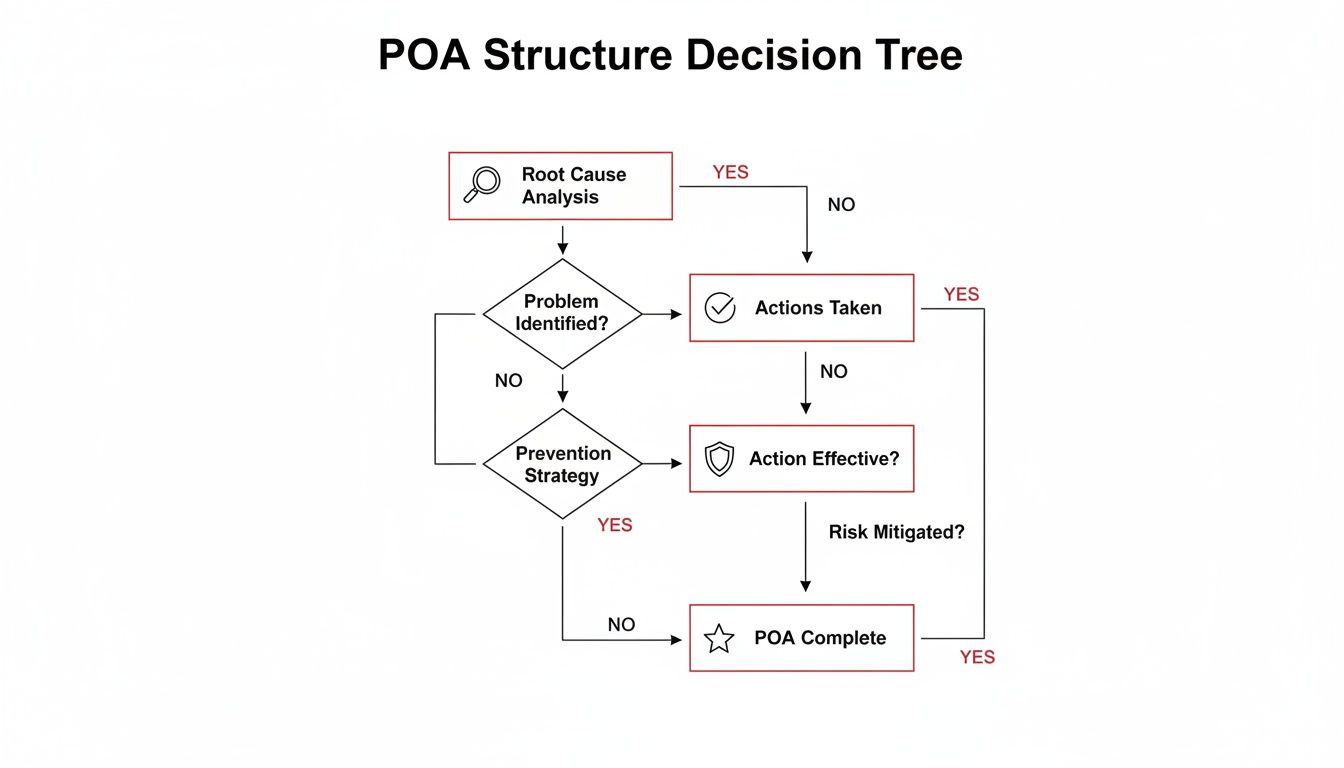
As the visual shows, a weak link in any of the three stages—Root Cause, Actions, or Prevention—can make the whole appeal collapse. Your next POA has to be rock-solid in all three areas.
If you’ve sent in a revised POA and it’s still getting rejected, it’s time to escalate. You have a few options beyond just hitting the "Appeal" button again and hoping for the best. These channels can get more human eyes on your case, but you should only use them after you've given the main appeal process a fair shot.
Knowing when to call for backup is a critical business skill. For minor issues with performance metrics, a seller can often handle the appeal themselves. But for certain high-stakes suspensions, trying to go it alone is a massive risk.
The best time to hire an expert is when the suspension’s complexity is beyond your team's direct experience. This is especially true for legal-adjacent problems like counterfeit claims or Section 3 violations, where the rules of the game are entirely different.
Section 3 suspensions—Amazon's nuclear option for deceptive or illegal conduct—have been on the rise. Reinstatement timelines for these cases can drag on for weeks or even months, particularly when there are multiple complainants or related accounts tangled up in the mess. As countless case files show, these situations often require escalating to specialized internal teams and even submitting formal legal arguments to get resolved. You can review detailed plans of action for suspended sellers to see just how intricate these appeals can get.
Ultimately, navigating escalations comes down to persistence and precision. Treat every rejection as a chance to sharpen your argument, gather more evidence, and prove to Amazon that your business deserves to be on their platform. Don't let a failed first attempt stop you from fighting for your brand’s future.

Getting your account reinstated is a massive relief, but the real win is building an operation so solid that it deflects problems before they become suspension-worthy threats. This is where we move from reactive damage control to proactive growth, a key part of our Optimization and Amplification pillars. By building systems that protect your business, you free up the time and energy to focus on scaling your brand.
Waiting for a performance notification from Amazon is like waiting for the smoke alarm to go off. By the time you hear it, the fire has already started. The only way to stay safe long-term is to make proactive monitoring a non-negotiable routine.
A disciplined approach turns account health management from a stressful, reactive fire drill into a predictable part of your weekly workflow. A simple checklist is often all it takes to ensure nothing important slips through the cracks.
Here’s a practical schedule we use with clients to stay ahead of trouble:
This structured routine transforms account monitoring from a reaction into a strategy, stopping small issues from snowballing into account-threatening disasters.
Beyond just watching your metrics, building true resilience means hardening the core of your operation—from your supplier agreements to your brand protection strategy. An account suspension rarely comes out of nowhere; it almost always exposes a deeper weakness in the operational chain.
First, robust quality control is non-negotiable. If you're sourcing products, you need a documented inspection process. For example, a practical step is to implement a system where a random 5% of every incoming shipment is physically inspected for defects. This catches problems before a single unit ever reaches an FBA warehouse.
Your supplier agreements should spell out quality standards and give you recourse if a batch doesn't meet them. This paperwork is gold if you ever need to prove to Amazon that you have a rigorous QC system.
Brand protection is another powerful defensive shield. Enrolling in Amazon's Brand Registry gives you access to tools that let you control your own listings and shut down counterfeiters. It also provides a direct line to Amazon's internal teams for reporting infringement, which is far more effective than trying to fight off false claims as an unregistered seller.
For a deeper dive, check out our guide on the latest Amazon brand guidelines to see how you can use these tools to your advantage.
Finally, never underestimate the power of great customer service. A huge number of suspensions are triggered by a handful of negative reviews or A-to-Z claims. A responsive customer service team can de-escalate these issues long before they ever damage your metrics.
For sellers who are scaling fast, using a specialized third-party customer service outsourcing partner can be a game-changer. They can ensure 24/7 support and professional handling of buyer issues, keeping customers happy and your account safe.
Staying on top of policy changes is just as critical. Amazon’s rulebook is constantly evolving, and "I didn't know" is an excuse that will get you nowhere. Set aside time each month to actually read the Seller Central news and policy update sections. What was perfectly fine yesterday might be a violation tomorrow.
By integrating these practices—consistent monitoring, strong operational controls, and proactive customer engagement—you stop playing defense. You're not just avoiding a suspension; you're building a smarter, stronger, and more scalable business that's ready for long-term growth.
When your Amazon account gets suspended, the stress hits you instantly, and a million questions pop into your head. To cut through the noise, here are straight-talk answers to the questions we hear most often.
There’s no magic number here—response times are all over the map. For a straightforward performance issue with a well-documented Plan of Action (POA), you might hear back in as little as 24-48 hours.
But for tougher cases, like intellectual property (IP) complaints or the dreaded Section 3 violations, you need to be patient. These appeals often get passed between multiple internal teams for review. It’s not unusual for sellers to wait several weeks for a final verdict. And if Amazon asks for more info? The clock resets every time you reply.
Don't even think about it. This is the cardinal sin of Amazon suspensions and the fastest way to get a lifetime ban. Seriously, do not do this.
Amazon’s systems are incredibly sophisticated at sniffing out linked accounts. They connect the dots using dozens of data points, including:
If Amazon links a new account to a suspended one, they’ll almost always shut down both under their "related accounts" policy. That makes getting reinstated a hundred times harder. Your only option is to fix the original suspension first.
The cautionary tale of author Nicolas Cole is a perfect real-world example. He had his decade-old publishing account with thousands of reviews banned simply because he created a separate account for a pen name, not realizing it violated the related accounts policy.
While people throw these terms around interchangeably, they mean very different things in Amazon’s world. Getting them straight is key.
A suspension can quickly snowball into a permanent ban, especially if the original violation was serious or you keep sending weak, poorly written appeals.
The moment your account is suspended, Amazon hits the pause button on your funds. This is standard procedure to cover any potential customer refunds, A-to-Z claims, or chargebacks.
Typically, your money is held for 90 days from the suspension date. After that period, you can usually request a disbursement. But let's be clear: the fastest and most reliable way to get your capital unfrozen is to get your account reinstated.
Be warned, though. For severe violations like selling confirmed counterfeit products, Amazon reserves the right to withhold your funds permanently to compensate rights holders and customers.
Navigating an Amazon suspension takes a sharp strategy, firsthand experience, and a real understanding of how Amazon thinks. If you’re staring down a suspension and need an expert in your corner, RedDog Group knows how to build a case that gets results and fight for your reinstatement.
Leave a comment: