
Published: March 2020 | Last Updated:September 2026
© Copyright 2026, Reddog Consulting Group.

The suspension email usually arrives at the worst possible moment. A replenishment is already moving, advertising is still running, and the Amazon dashboard suddenly shows that the account can't sell. The immediate question is, “Why is my Amazon account suspended?” The useful answer rarely comes from the notice alone. It comes from connecting the cited violation to fulfillment, catalog controls, supplier records, and the margin decisions that created the exposure.
Amazon generally suspends sellers for measurable performance failures, trust concerns, policy violations, or account-health problems. Reinstatement is therefore more than a paperwork exercise. You need to identify what failed, fix the immediate customer or catalog impact, and show Amazon that the operating system behind the account has changed.
A mid-seven-figure CPG brand with more than 40 ASINs discovers the suspension after a late FBA cycle. The team has already shipped peak-quarter inventory, demand forecasts are locked, and roughly $180,000 in inventory is stranded. The suspension notice is short. Seller Central is partially locked. Customer service wants an answer, finance wants a cash forecast, and the founder wants the account restored before the next sales pulse disappears.
The first reactions often waste the most valuable time. Someone calls support without gathering the account data. Someone else sends a long apology. A third person blames a carrier, a review, or one warehouse transfer. None of those actions answers Amazon's actual question: what happened, which policy or metric was affected, and what control prevents recurrence?
Treat the notice as an operational interruption first. It may have legal and commercial consequences, but the diagnosis starts with the mechanics of the business:
Practical rule: A suspension is usually a margin and fulfillment signal first, and a paperwork problem second.
That framing changes the response. Instead of writing an appeal before understanding the failure, the operator traces the path from inventory decision to customer experience to account-health alert. A fast appeal still matters, but speed without evidence produces a generic submission and often extends the disruption.
Amazon's own seller guidance identifies three core performance thresholds. Sellers should keep Order Defect Rate below 1%, Late Shipment Rate below 4%, and Cancellation Rate below 2.5%. Amazon also expects Valid Tracking Rate above 95%, and exceeding the relevant levels can lead to suspension or deactivation, as described in Amazon's account health guidance.
The main categories overlap in practice. A CPG brand can launch too aggressively, run out of available stock, cancel orders, ship late, and then receive customer complaints that create a broader trust review.
| Trigger Category | Metric or Signal | Threshold | Common CPG Driver |
|---|---|---|---|
| Order performance | Order Defect Rate | Below 1% | A-to-z claims, negative customer experience, chargebacks |
| Fulfillment | Late Shipment Rate | Below 4% | FBM capacity gaps, carrier handoff failures, inventory shortages |
| Order handling | Cancellation Rate | Below 2.5% | Overselling, inaccurate stock, delayed replenishment |
| Tracking compliance | Valid Tracking Rate | Above 95% | Weak carrier scans, manual shipping workflows, incomplete tracking |
| Trust and catalog | Inauthenticity, IP, review abuse, related-account signals | Policy-specific | Supplier documentation gaps, listing claims, review activity |
Performance thresholds are especially dangerous during SKU launches and promotions. A demand plan may look attractive at the revenue level while the warehouse lacks the labor, packaging, or carrier capacity to process the resulting orders. If the brand uses FBM, the operational constraint appears directly in late shipments and cancellations. If it uses FBA, inbound delays, stranded inventory, or suppressed offers can still create customer-service and availability problems.
A 2025 industry analysis reported that inauthentic product complaints represented 28% of cases, policy violations at scale 22%, review manipulation detection 18%, intellectual property infringement 15%, persistent performance failures 12%, and identity or verification failures about 5%. Those figures are reported in Ceta International's suspension-prevention analysis, and they point to a practical conclusion: Amazon evaluates trust signals across the catalog, not only the most recent order.
CPG brands face particular exposure with supplements, beauty products, ingestibles, and products carrying safety or efficacy claims. A complaint tied to one ASIN can prompt a sourcing review, request for invoices, or examination of related listings. Review manipulation and intellectual property complaints create a different problem. Better advertising or more aggressive launch tactics won't repair a catalog that lacks defensible sourcing and compliant claims.
Multiple warehouses, shared staff, common payment details, or overlapping business information can create related-account concerns. A transfer pattern that resembles drop shipping, especially when tracking and sourcing records don't line up, can make an otherwise legitimate operation difficult to verify.
For a practical companion to the diagnostic and appeal process, Next Point Digital's guide to how to get back on Amazon is useful. The important point is that one bad review rarely explains the whole event. Amazon usually sees a combination of operational data and trust signals.
Don't draft the appeal during the first hour. Build the evidence file first. Amazon's own help flow directs sellers to the Account Health page and the Reactivate your account process after deactivation or listing removal, but the submission will be stronger when the underlying records are already reconciled. See the Amazon reactivation and appeal flow for the platform's official path.
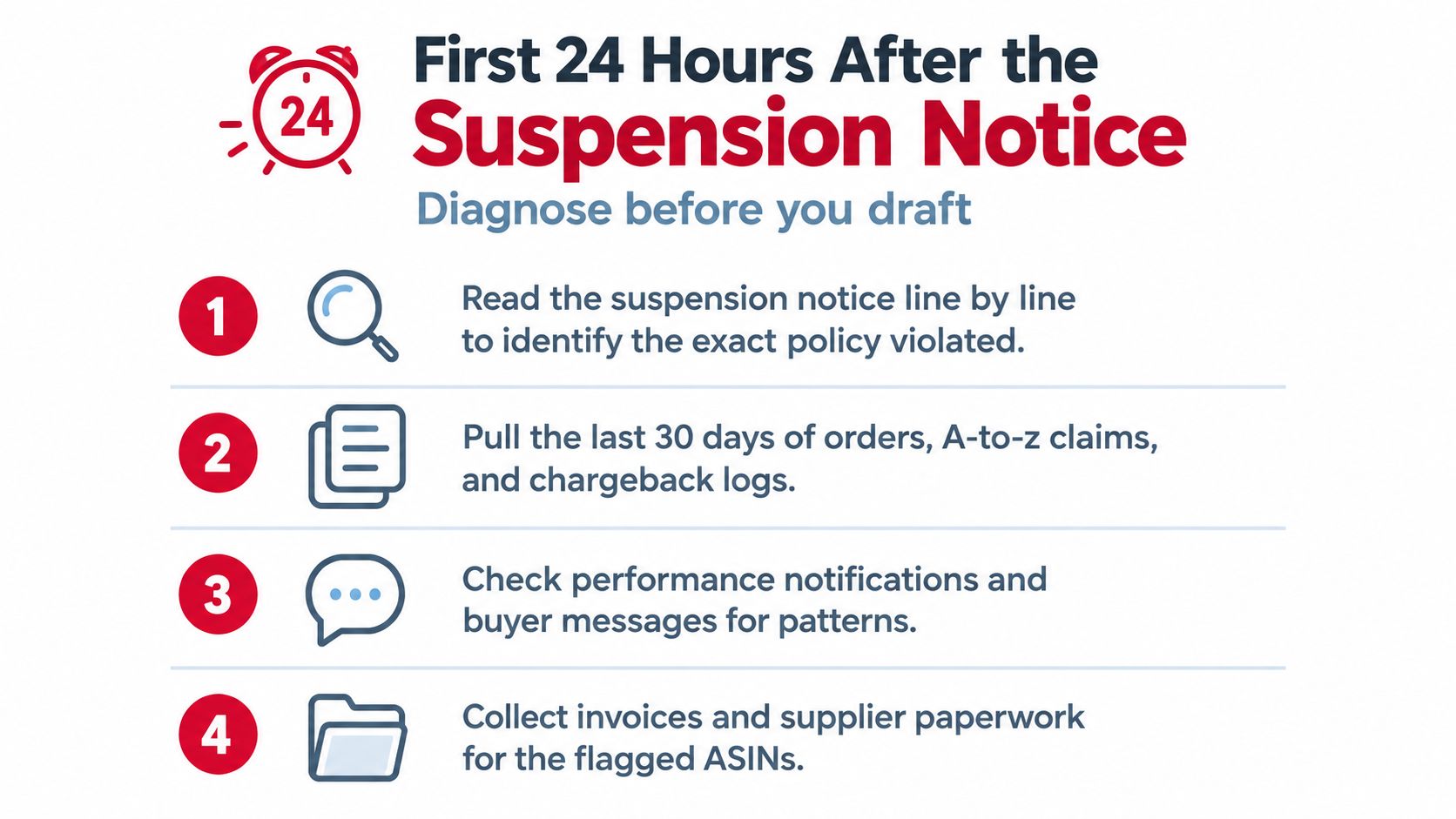
Copy the notice into a working file. Highlight every policy code, ASIN, date range, complaint type, and requested document. Don't paraphrase the violation from memory. The exact wording determines whether your response needs invoices, product-quality evidence, listing changes, customer-resolution records, or performance data.
Inside Seller Central, review Performance Notifications, Account Health, and Voice of the Customer. Export the visible order history, A-to-z claims, chargebacks, buyer messages, and complaint details. Then pull the relevant FBA shipment records, removal orders, inventory adjustments, and Manage Inventory history.
Look for patterns rather than a convenient single cause. A late shipment cluster may follow a stockout. A complaint cluster may map to one supplier lot. An authenticity complaint may involve one ASIN whose invoices don't clearly connect the brand, distributor, and purchase dates.
Before the second day, organize the file by ASIN and issue:
Calling an Account Health Associate or hiring a reinstatement service before this file exists often produces vague language. The RedDog account recovery resource can help frame the work, but no outside party can replace the ASIN-level records Amazon will evaluate.
Amazon's Plan of Action structure is straightforward, but the standard is demanding. The document needs root cause, corrective actions, and preventive actions, supported by evidence that makes the fix easy to audit. Amazon's account-health materials also state that a violation can be forgiven when the seller successfully appeals and Amazon determines the breach wasn't intentional, which makes intent, transparency, and documentation important in the submission (Amazon's appeal guidance).
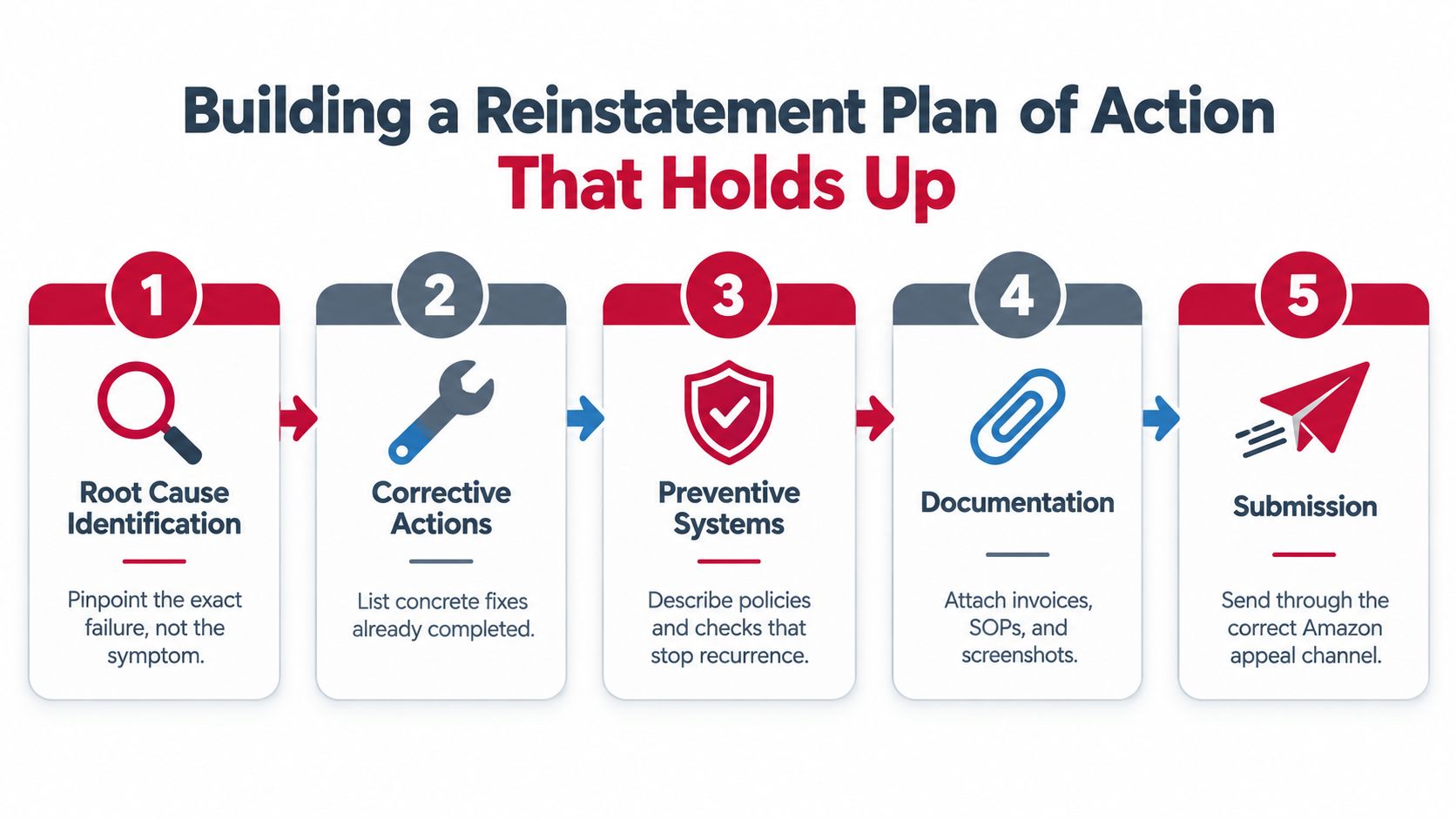
Name the failure precisely. “Our team made an error” isn't a root cause. A useful statement identifies the ASIN or performance area, the date range, the breached threshold, and the process that allowed the failure.
For example, an order-performance root cause might state that the brand's FBM workflow accepted orders after available stock had been exhausted, which led to cancellations and late shipments. An authenticity root cause might identify a distributor invoice that didn't establish a traceable chain of supply for the flagged ASIN. Attach the account-health snapshot, order records, and supplier documents that support the statement.
One plan shouldn't combine unrelated explanations. If Amazon cited a product complaint and a performance issue, address each issue separately while showing how the controls connect.
Corrective actions are completed actions, not future promises. Depending on the issue, they may include:
Preventive actions show durable control. Add a documented supplier-qualification process, pre-shipment inspection, listing approval checklist, reorder trigger, and weekly Account Health review with a named owner. If the brand changed its workflow, show the actual SOP, training record, or system screenshot.
A reviewer should be able to answer three questions quickly: what failed, what did you fix, and how will you detect recurrence before customers do?
The Amazon reinstatement services overview from Reddog reflects this evidence-first approach. Use outside help to improve diagnosis and structure, not to substitute polished language for missing proof.
The video below offers another visual explanation of the reinstatement workflow.
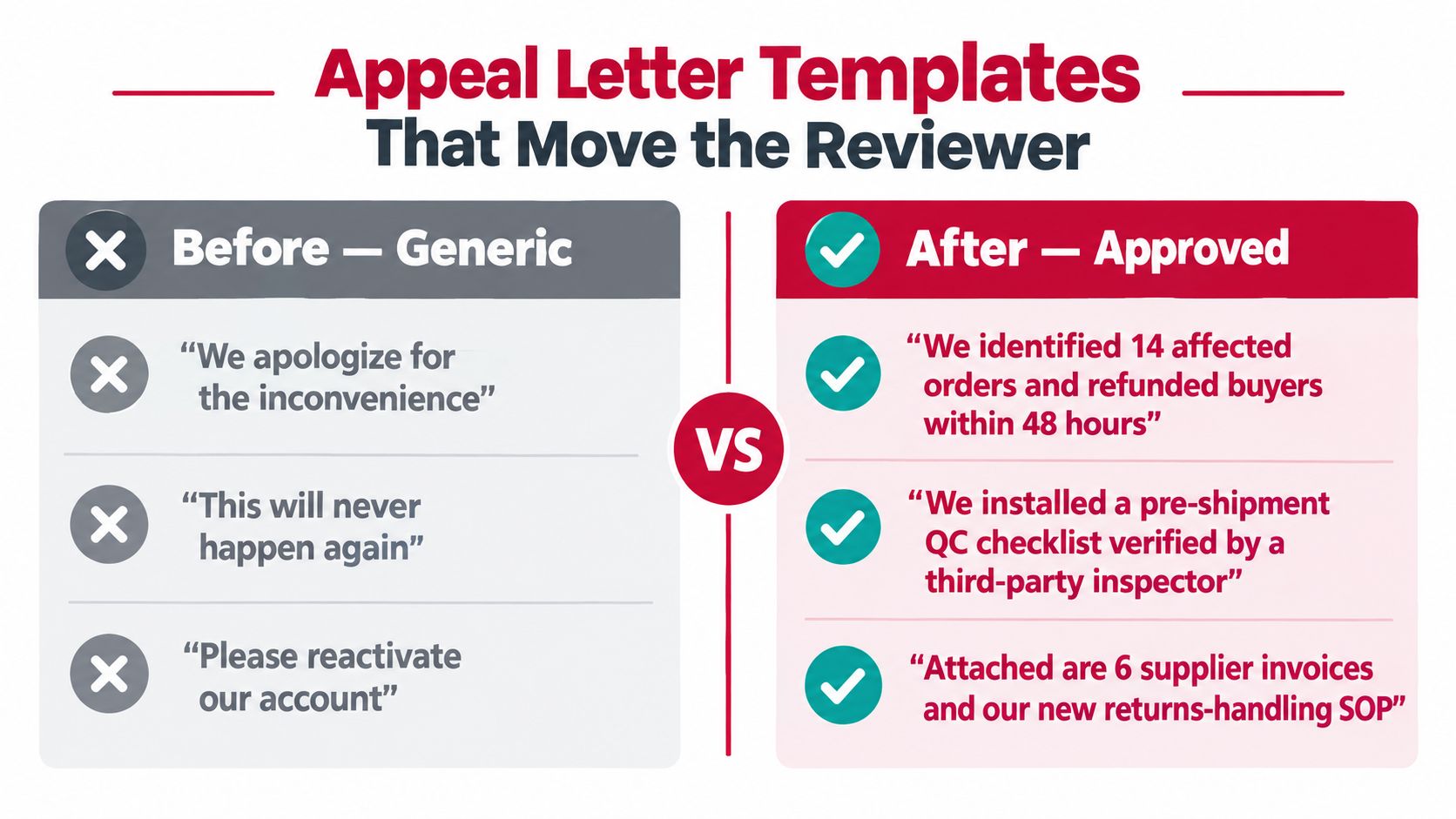
Weak appeals sound sincere but remain impossible to audit. “We take compliance very seriously” doesn't identify the failure. “This will not occur again” doesn't explain which process changed. “Please reactivate our account” asks for an outcome without supplying a reason to approve it.
The strongest submissions replace broad assurances with dates, ASINs, order references, completed actions, and attachment names. Use a direct subject line, a short timeline, and numbered evidence. Keep the tone accountable without admitting facts you can't support.
Root cause
“We identified that the documentation submitted for ASIN [ASIN] didn't establish a complete, traceable supply chain for the units connected to the complaint. The affected inventory came from [supplier], purchased under [invoice references], and our review found that the file lacked [specific missing element]. We've attached the relevant invoices and supplier verification records.”
Corrective actions
“We removed the affected offer, placed the associated inventory on hold, and reviewed the remaining units against our product and packaging specifications. We contacted the supplier, obtained replacement documentation, and completed a sourcing review. The attached file includes the invoice set, inspection record, inventory action, and updated listing screenshots.”
Preventive actions
“We added a supplier-approval checklist requiring traceable invoices, product identity verification, and documentation review before inventory is ordered. The operations owner now reviews each new supplier and ASIN before launch, while the catalog manager checks claims and packaging against the approved product file.”
Root cause
“Our review found that the order defect issue originated in a fulfillment workflow that allowed orders to remain available after the warehouse had exhausted sellable stock. The team also lacked an escalation rule for orders approaching the promised ship date. We've attached order, inventory, and shipping records showing the affected period.”
Corrective actions
“We corrected the inventory quantity, cancelled or refunded affected orders where required, contacted impacted buyers, and reviewed the shipment records. We moved the affected fulfillment workflow to a controlled inventory process and documented the completed changes.”
Preventive actions
“We added daily inventory reconciliation, a pre-ship exception queue, and an escalation owner for orders approaching the ship-by date. The account manager reviews Account Health and fulfillment exceptions each week, and the warehouse manager signs the updated SOP after training.”
Avoid denied testimonials, hedging such as “we believe” or “to our knowledge,” passive voice, and unsupported claims. A reviewer needs to see accountability rather than “the issue was caused by a third party.” Name the supplier, workflow, listing, ASIN, or owner when the evidence supports it.
Use a compact attachment index:
Don't copy the sample language mechanically. Replace every bracket with a verified fact. A fabricated date or unsupported number can do more damage than a concise qualitative explanation.
Suspension prevention belongs in the operating plan because Amazon performance metrics affect contribution profit. A product that earns attractive gross revenue but creates repeated tickets, returns, cancellations, or inspection work may be a poor channel item even when its advertising looks efficient.
Start with the fulfillment decision. FBM can preserve control and work well for predictable, operationally disciplined products, but it exposes the seller directly to late-shipment and cancellation risk. FBA can reduce some fulfillment friction, but it introduces inbound planning, preparation, stranded-inventory, and fee exposure. The correct choice depends on contribution margin, inventory velocity, service requirements, and the team's ability to control exceptions.
Brands often underestimate the trade-off between availability and margin. Holding more safety stock can protect service levels but tie up cash. Retiring a low-margin variant can reduce revenue while removing disproportionate customer-service cost. Tightening supplier preparation can add labor or inspection expense, but it may cost less than repeated defects, removals, and lost selling time.
| Metric | Amazon Threshold | Operating Lever | Cadence to Monitor |
|---|---|---|---|
| Order Defect Rate | Below 1% | Review complaints, claims, refunds, and product quality by ASIN | Weekly |
| Late Shipment Rate | Below 4% | Reconcile inventory, warehouse capacity, promised dates, and carrier handoffs | Daily exceptions, weekly review |
| Cancellation Rate | Below 2.5% | Control available stock and prevent overselling | Daily |
| Valid Tracking Rate | Above 95% | Standardize carrier selection and tracking capture | Each shipping cycle |
Amazon's seller guidance identifies these thresholds as suspension risks, so the dashboard should connect them to commercial decisions rather than sit in a compliance folder. If a SKU repeatedly drives complaints, calculate its contribution after customer service, returns, inventory handling, and advertising. A catalog reduction can improve account resilience even when it lowers top-line sales.
A deactivation also has an opportunity cost. The precise financial impact depends on contribution margin, inventory exposure, channel substitution, and the duration of the interruption. Model the downside before a crisis by ASIN and by week, then use that model to decide which controls deserve investment.
Margin test: If a product cannot support the operational controls required to sell it safely and reliably, its Amazon revenue may be masking a channel-level loss.
A practical rhythm includes a Monday Account Health review, a ticket-aging report, a listing audit, and a supplier-performance scorecard. The cadence can fit the brand's operating calendar, but ownership must be explicit. Foundation work establishes compliant sourcing, accurate listings, and dependable fulfillment. Optimization improves the economics of the existing catalog. Amplification comes only after the account can absorb more velocity without pushing defects or service failures beyond control.
Reinstatement should change the management system, not just restore the selling privileges. After recovery, Account Health belongs in the same operating conversation as inventory velocity, contribution margin, pricing, and advertising. A dashboard that nobody reviews until Amazon sends a warning isn't a control.
The weekly review should cover Order Defect Rate, Late Shipment Rate, policy notifications, buyer complaints, and the ASINs creating the most operational friction. The monthly catalog sweep should look for suppressed listings, outdated claims, mismatched packaging, missing documentation, and variants that no longer justify their handling cost.
First 30 days: Reconcile inventory, verify every corrective action, review open complaints, and confirm that the account owner can retrieve the supporting evidence without relying on one operator's inbox.
Days 31 to 60: Audit catalog changes, supplier documents, listing claims, fulfillment exceptions, and the relationship between order velocity and defect signals. Turn recurring exceptions into written procedures.
Days 61 to 90: Review the root causes behind every alert, score suppliers, assess SKU contribution after service costs, and decide whether each fulfillment method still fits the product's economics.
The system should also log every corrective action with an owner and date. For teams with multiple marketplaces, an approach to automate account health monitoring can reduce manual checking, provided someone still reviews the alerts and makes the operating decision. Automation can surface a risk. It can't decide whether to pause a promotion, move an ASIN to FBA, change a supplier, or retire a variant.
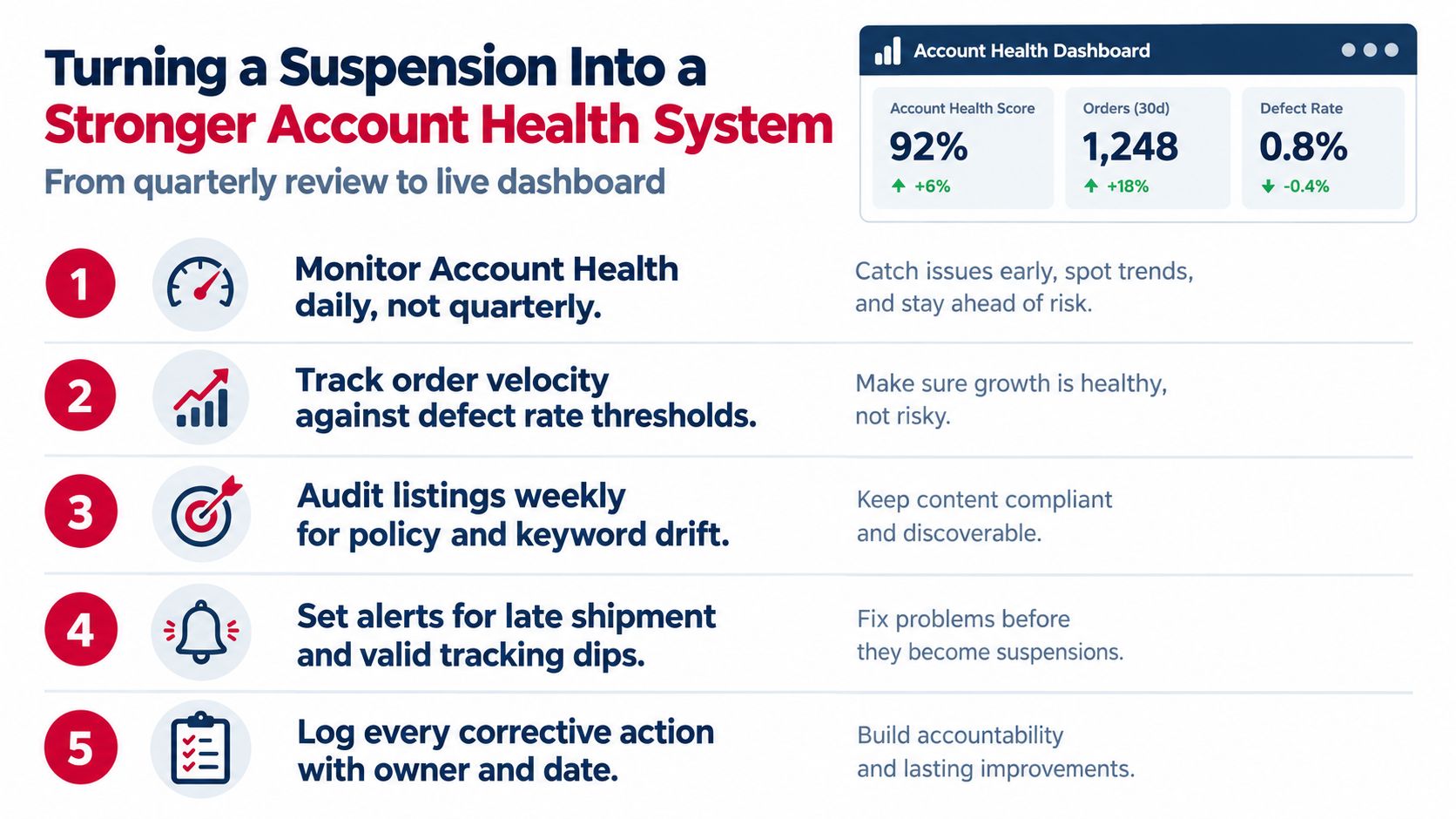
The durable fix is visible in the workflow: a named owner, a documented check, a recorded exception, and a decision tied to the account's economics.
For a broader operating model, the Amazon seller account health guide from Reddog connects monitoring with listing, inventory, and channel decisions. The practical answer to “why is my Amazon account suspended” is rarely one isolated event. It's usually a system that allowed a measurable risk to remain invisible until Amazon acted.
Reddog Consulting Group works with CPG founders and operators on account recovery, listing controls, fulfillment decisions, and contribution-margin planning across Amazon and other retail channels. Visit Reddog Consulting Group to book a free 30-minute working session focused on your account-health thresholds, inventory exposure, and the controls needed for a stronger reinstatement and growth plan.
Leave a comment: