
Published: March 2020 | Last Updated:September 2026
© Copyright 2026, Reddog Consulting Group.

Your listing disappears, your seller account shows a warning, and the team starts searching old emails for clues. Meanwhile, inventory is still sitting in fulfillment, advertising decisions are becoming harder to interpret, and every hour without a clear diagnosis creates more operational pressure. Amazon account recovery isn't a pleading exercise. It's an incident-response process tied directly to revenue continuity, inventory velocity, and contribution margin.
The sellers who recover efficiently don't write the most emotional appeals. They identify the exact policy issue, assemble evidence that answers Amazon's questions, correct the underlying process, and show how the same failure won't recur. That approach also protects the business after reinstatement, because an account that returns without better controls remains exposed.
A suspension should trigger triage before anyone writes a Plan of Action. A listing deactivation can remove a meaningful share of channel revenue almost immediately, freeze cash movement, disrupt replenishment decisions, and create pressure across the Account Health dashboard. The exact commercial impact depends on the catalog, but the operating problem is consistent: Amazon has interrupted the mechanism that converts inventory into cash.
Amazon's review team isn't evaluating sincerity. It's looking for three things:
An apology letter usually fails because it answers none of those questions. “We take this seriously” and “we'll do better” don't give a reviewer enough evidence to approve access. An operator builds an evidence ledger instead, with the notice date, affected ASINs, order or complaint references, inventory actions, supplier records, listing changes, and ownership for each remediation step.
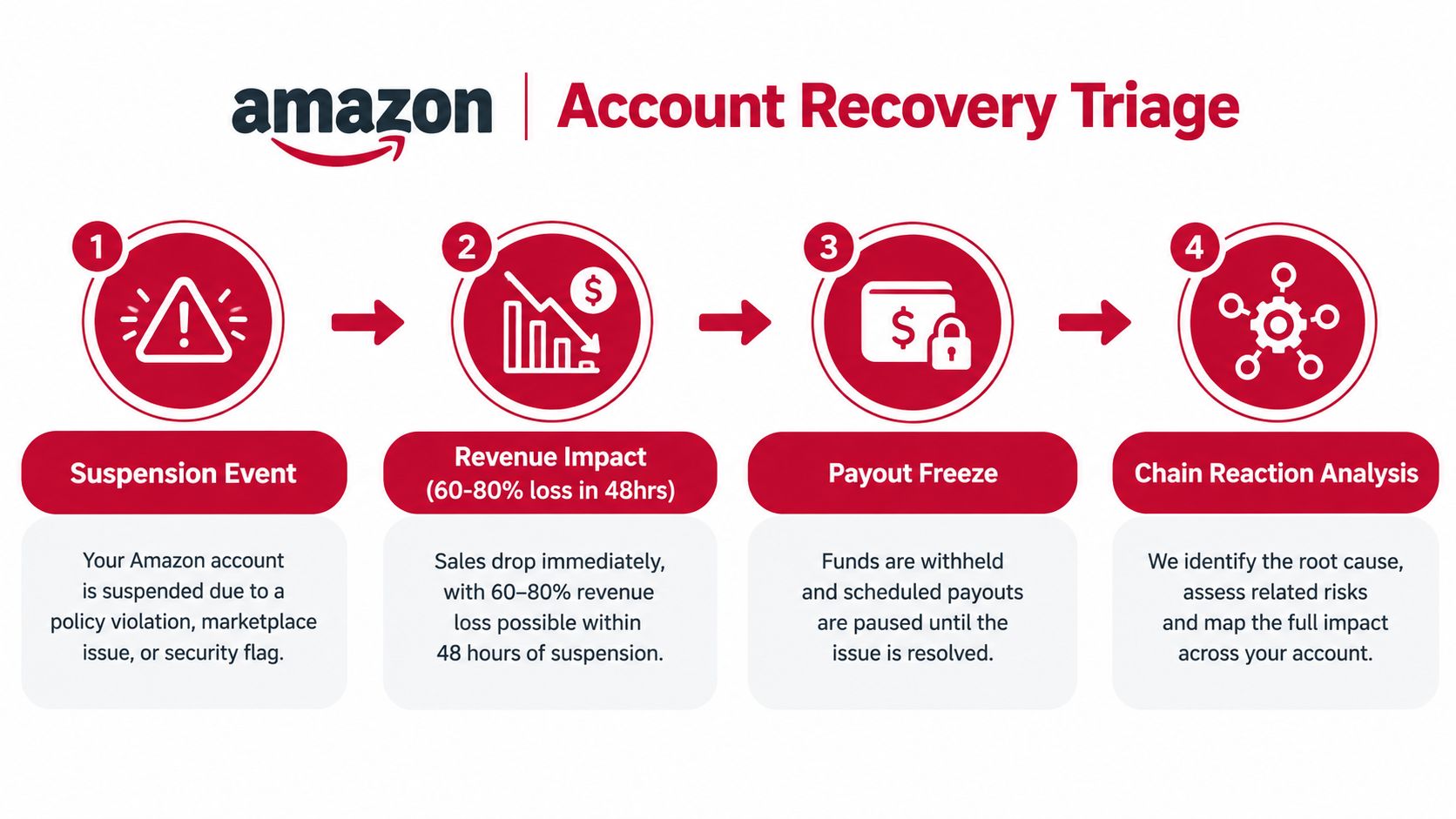
Before appealing, quantify what stopped moving and what remains exposed. Separate a single-ASIN problem from an account-level interruption. Check whether FBA inventory is stranded, whether ads are still spending against unavailable offers, whether open purchase orders need to be slowed, and whether another marketplace can absorb demand without creating a pricing or inventory conflict.
A useful operational excellence framework for retail success treats the incident as a system failure, not an isolated customer-service event. That distinction matters because Amazon's checklist-driven review process rewards verifiable controls, while emotional submissions often receive templated rejections.
Practical rule: Don't submit the first draft because the account is urgent. Submit it when every sentence can be tied to a document, action, or control.
Amazon usually leaves the clues in three places: the suspension email, Account Health in Seller Central, and Performance Notifications. Read all three before choosing a remedy. The email may use broad language, while the dashboard identifies the affected ASIN, policy category, performance metric, or buyer complaint that narrows the investigation.
Start by copying the exact wording into an internal case file. Then record the ASIN or product family, suppression reason, date of the triggering metric, order ID if Amazon cites a specific transaction, and whether the action affects one offer, several listings, or the entire account.

Don't treat every suspension as an authenticity issue. The policy code determines the evidence and the corrective action. Common categories include:
The critical distinction is single-ASIN deactivation versus account suspension. A single-ASIN action may require product-level remediation, while an account-level action requires a broader control review. Repeat violations increase the need to address the process that allowed the problem to happen again.
The Amazon Seller Central suspension guide is useful background, but your own notice remains the controlling document. Guessing the reason is expensive. If the appeal responds to a general fear instead of the exact code, Amazon has little basis to approve it.
Evidence should answer the policy question without forcing a reviewer to reconstruct your business. Organize the package around the violation, not around whatever files happen to be available in your shared drive.
For authenticity complaints, gather supplier invoices or receipts covering the relevant purchasing history, with supplier name, contact information, quantities, and product identifiers visible. For an intellectual property complaint, use licensing agreements, authorization letters, or correspondence showing a retraction from the rights owner where applicable. For condition complaints, combine product photographs with supplier condition descriptions and FBA inbound shipment records.
| Suspension Reason | Primary Documents | Supporting Evidence |
|---|---|---|
| Authenticity | Supplier invoices or receipts, supplier contact details, product identifiers | Supplier verification, purchasing records, affected inventory review |
| Intellectual property | License, authorization letter, rights-owner correspondence | Listing ownership records, brand documentation, removal or correction log |
| Condition complaint | Product and packaging photographs, condition standards, inbound records | Return inspection notes, prep records, fulfillment review |
| Account or process failure | Account records, policy-specific documentation, corrective-action file | Training record, approval workflow, recurring audit schedule |
Formatting can decide whether good evidence gets reviewed. Prepare legible PDF files, keep each file under Amazon's stated size limit, and use English-language documents or certified translations when needed. Don't obscure the supplier identity, dates, quantities, or product identifiers that establish a traceable chain.
Create a dated remediation log beginning with the suspension notice. Record the person responsible, action taken, timestamp, affected ASIN or inventory, and proof of completion. Inventory pulls, supplier audits, listing edits, customer refunds, and access changes should each have a corresponding record.
Upload every document into the category Amazon requests in the appeal form. Misplaced attachments can slow review because the reviewer may not connect a file to the issue it was meant to resolve. A clean file name such as ASIN_supplier_invoice_date.pdf is more useful than final_new_3.pdf.
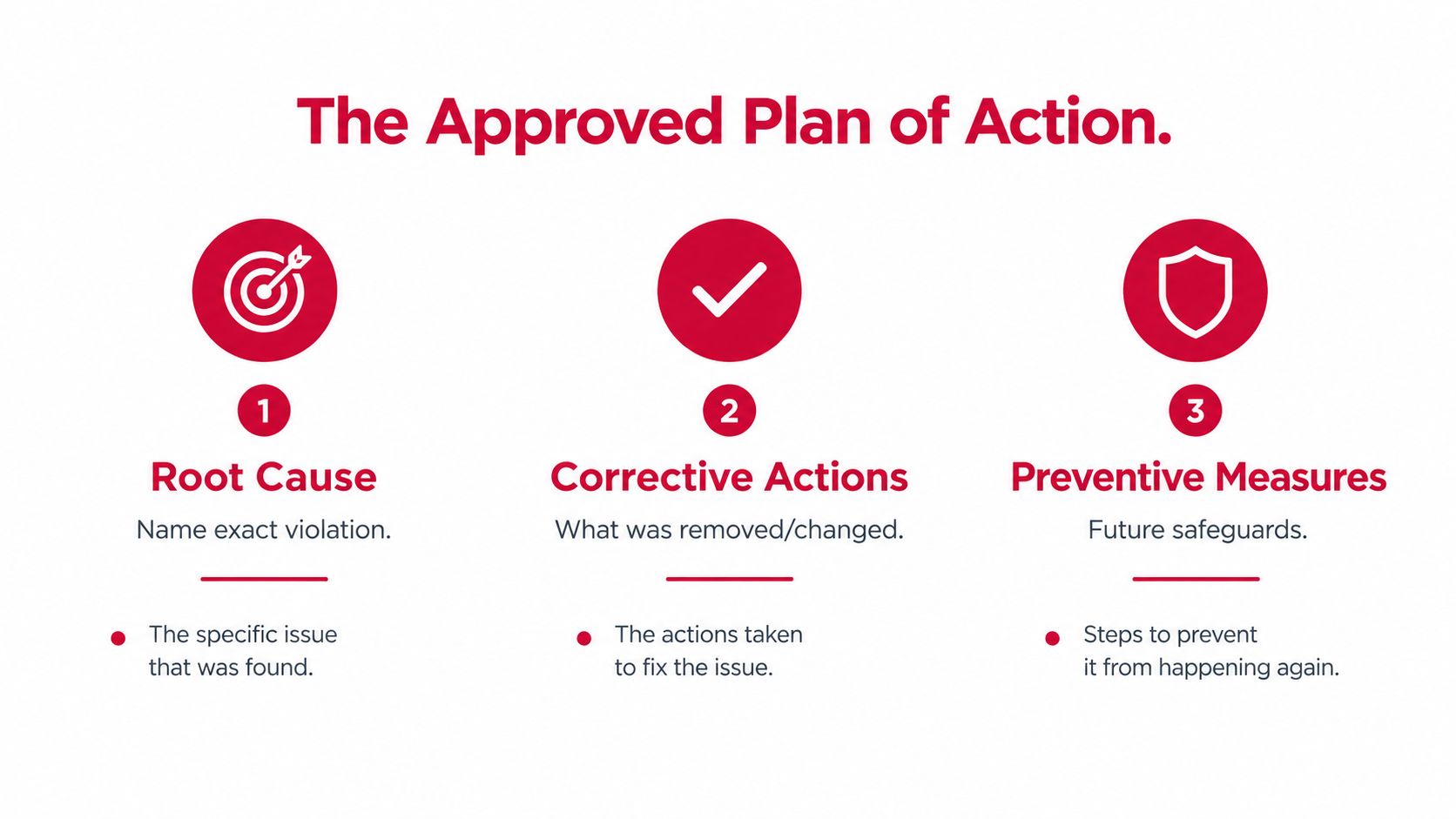
A strong Plan of Action is short enough to scan and specific enough to verify. Amazon reviewers need to find three blocks quickly: root cause, corrective actions, and preventive measures. Put those labels in the document and keep each block tied to the exact policy notice.
Write one sentence that names the violation and the process failure. Don't hedge with “possibly,” blame the customer, or repeat the notice without explaining what your operation did wrong.
List what you removed, corrected, refunded, audited, or changed. Include dates and quantities when they exist in your records. If the action affected one ASIN, name it. If it affected inventory, identify the disposition.
Show the new control. A promise to pay more attention isn't a control. A supplier approval checklist, listing-change review, return inspection workflow, or documented employee access process is.
Example for a Section 3 authenticity complaint
Example for a used sold as new violation
Avoid apologies, generic promises, and defensive explanations. Save the final POA in a shared document before pasting it into Seller Central, because a browser session or form error shouldn't erase the only copy. Respect the form's character limits, and don't attach an appeal inside an unrelated case. Use the appeal path Amazon identifies for the violation.
A lost phone creates a different recovery problem from a suspended listing. The user may know the password, but the registered device is gone, the number was swapped, an employee left with the phone, or an attacker changed the account's access factors. In that situation, repeated login attempts won't fix the missing verification path.

Begin from the sign-in or two-step verification screen. Select “Didn't receive the OTP?”, “Need help signing in,” or “Two-Step Verification Account Recovery,” depending on the screen presented. Amazon's guidance says that users without a backup device must use the formal recovery process, which includes identity verification and can disable 2SV after approval so the user can sign in and configure accessible devices again. The relevant Amazon recovery guidance for sellers should be treated as the source of truth for the account type and marketplace involved.
Amazon's account-recovery process requires a government-issued photo ID with the name, address, and issuing authority clearly visible. A passport, driver's license, or national identity document may fit that requirement, but don't upload an expired document or a cropped image that removes identifying fields. Hide sensitive fields such as account or identification numbers when Amazon's instructions permit or request it.
For sellers, the route can involve password assistance, a one-time code sent to the registered email, identity documentation, or a broader support case if the normal sign-in route fails. Consumer and seller accounts shouldn't be treated as interchangeable. A seller also needs to consider staff access, business ownership, and whether the registered contact details still match the operating entity.
The video below provides a visual orientation for the account-support path. It shouldn't replace the account-specific instructions shown in Seller Central.
Once access returns, replace the lost factor, review trusted devices, remove former employees, and confirm backup methods. If the first submission fails, follow the instructions in Amazon's verification response rather than opening unrelated cases. Amazon Seller Support guidance can help organize the operational response, but Amazon still makes the identity decision.
Most rejected appeals aren't rejected because the seller lacks a legitimate business. They fail because the submission doesn't give Amazon a clean decision path.
The first failure is a vague POA that names the policy but not the ASIN, SKU, transaction, or process failure. The second is documentary mismatch. An invoice may show the right product but the wrong quantity, an unclear supplier identity, or a seller name that doesn't match the account. A third submission that merely rewrites the first appeal adds length without adding proof.
Read the rejection message as a request for missing evidence. Then compare it with the original file:
Open the next appeal through the correct route, reference the prior case ID, and add the evidence Amazon flagged. Shift the tone from defensive to diagnostic. Don't argue that the account is too important to suspend. Show why the stated issue is resolved and why the reviewer can trust the new process.
Amazon's official seller workflow says sellers should review Account Health, submit requested questionnaires or supporting documents, monitor email and the appeal view, and check the relevant compliance and notification areas before appealing. That procedural discipline matters more than volume. If Amazon asks for a particular document, provide that document rather than burying the request under unrelated attachments.
A second failure should trigger a change in process, not another near-identical submission. Review the case history, correct the evidence package, and use the available Account Health appeal path, Seller Support case, or Performance Team escalation where appropriate.
Outside help earns its keep when the account carries serious financial exposure, the violation spans multiple ASINs or marketplaces, ownership records are complicated, or the team can't independently validate the root cause. A reinstatement consultant may help with policy interpretation, legal counsel may be necessary for rights or entity disputes, and a marketplace operations partner such as Reddog Consulting Group may be appropriate when the recovery issue reflects broader catalog, inventory, access, or compliance controls.
Recovery belongs inside the operating system because a suspension affects more than the offer itself. It can interrupt ranking history, degrade advertising signals, strand inventory, distort replenishment decisions, and force the brand into costly channel workarounds. The immediate problem is access, but the commercial problem is contribution margin under disruption.
A listing that stops converting can leave paid media with weaker data and make inventory velocity harder to forecast. A seller may respond by discounting elsewhere, accelerating wholesale transfers, or over-ordering for a recovery that hasn't been approved. Those choices carry trade-offs. Protecting top-line availability at any cost can worsen margin, while cutting inventory too aggressively can create a second problem when the account returns.
RedDog's structured growth framework starts with Foundation, then moves into Optimization and Amplification. Account integrity belongs in Foundation because advertising and expansion can't compensate for weak access controls, unreliable documentation, or unowned compliance workflows.
A practical foundation review includes:
Map every incident to a recurring operating ritual. Compliance issues belong in listing and documentation audits. Intellectual property concerns require authorization tracking. Account Health problems need a recurring performance review. Authentication failures require access ownership and recovery checks. The point isn't to create bureaucracy. It's to make the next response faster, more complete, and less dependent on one person remembering what happened last time.
If your Amazon account is already restricted, start with the notice and evidence ledger. If access has been restored, use the incident to repair the surrounding system while the details are still fresh. That turns amazon account recovery from a one-off appeal into continuity planning that protects margin across Amazon, Walmart, DTC, wholesale, and distribution.
Reddog Consulting Group helps qualified CPG founders and operators turn account recovery into a working operating plan, including margin impact, marketplace performance, documentation, and growth priorities. Visit Reddog Consulting Group to book a free 30-minute strategy call focused on your recovery and marketplace economics, not a sales pitch.
Leave a comment: