
Published: March 2020 | Last Updated:September 2026
© Copyright 2026, Reddog Consulting Group.

Most marketplace advice says to eliminate negative product reviews as quickly as possible. That's incomplete advice. A bad review can reduce conversion, increase comparison shopping, and slow inventory, but suppressing every criticism can also make a product page look artificial. The operator's job isn't to chase a perfect star rating. It's to determine whether the review signals a product problem, a fulfillment failure, an expectation gap, or an authenticity problem, then fix the issue at the lowest total cost.
That distinction matters across Amazon, Walmart, and DTC. Reviews influence demand, price tolerance, advertising efficiency, returns, and eventually contribution profit. A product can maintain acceptable gross sales while review-driven conversion loss leaves inventory aging in fulfillment centers and forces the brand to spend more to produce the same order volume.
A perfect rating looks attractive in a dashboard, but it isn't automatically a commercial advantage. Shoppers understand that real products create occasional complaints. A page with only glowing, generic praise can raise questions about review quality, especially when consumers use AI tools and comparison engines that evaluate the consistency of product claims, customer feedback, and product content together.
The better target is credible confidence, not cosmetic perfection. In Pew Research's survey of Americans who read online reviews, 54% paid more attention to extremely negative reviews, compared with 43% who paid more attention to extremely positive reviews. The same research found that 51% believed reviews generally gave an accurate picture of product quality, while 48% found it difficult to tell whether reviews were truthful and unbiased. Those figures explain why a small number of specific complaints can carry more weight than a larger set of vague compliments. Pew's review findings show that shoppers use negative feedback to assess risk, not to calculate an average rating.
INSEAD research reported that adding one negative review to an otherwise clean product page reduced purchase probability by 50% among consumers who read reviews. Moving that review to a second page, where shoppers had to click again to see it, increased purchase likelihood by about 40%. The research also reported an average sales elasticity of -18% and search elasticity of 4%, indicating that criticism can reduce demand while pushing shoppers into more comparison shopping. The review elasticity research puts a financial frame around what operators often describe as “weak conversion.”
A separate INSEAD analysis found that a single negative review on the first page reduced purchase likelihood by 42% and increased the likelihood of exploring alternative products by 10%. The effect was strongest among shoppers already examining reviews, which makes review placement and review mix operational variables, not just reputation metrics. INSEAD's analysis of negative reviews is particularly relevant when a core SKU is losing rank and the team responds by increasing ad spend without addressing the trust problem.
Operator rule: Treat review sentiment as a demand input. If conversion falls, investigate the review experience before assuming the answer is more traffic or a lower price.
A few negative reviews may help a page look balanced when the complaints are specific, varied, and outweighed by useful positive feedback. A shopper may accept “the pouch arrived dented” as a manageable logistics issue while rejecting a page filled with repetitive praise that says nothing about taste, texture, size, use, or performance.
That doesn't make negative reviews harmless. It means the commercial response depends on the surrounding trust signals, review quantity, product content, imagery, price position, and fulfillment reliability. Brands should monitor whether criticism is isolated or repeated, whether it describes the product accurately, and whether the listing resolves the expectation gap. The practical principles behind how customer reviews drive CPG sales growth are simple: credible feedback supports evaluation, while unresolved patterns increase perceived risk and price sensitivity.
A one-star review is not a diagnosis. It's an alert that requires classification. The fastest way to waste marketplace resources is to treat every complaint as a product defect or every low rating as a removal request.
Start with the review's root cause, then assign an owner and a financial priority. A useful triage system separates four questions:
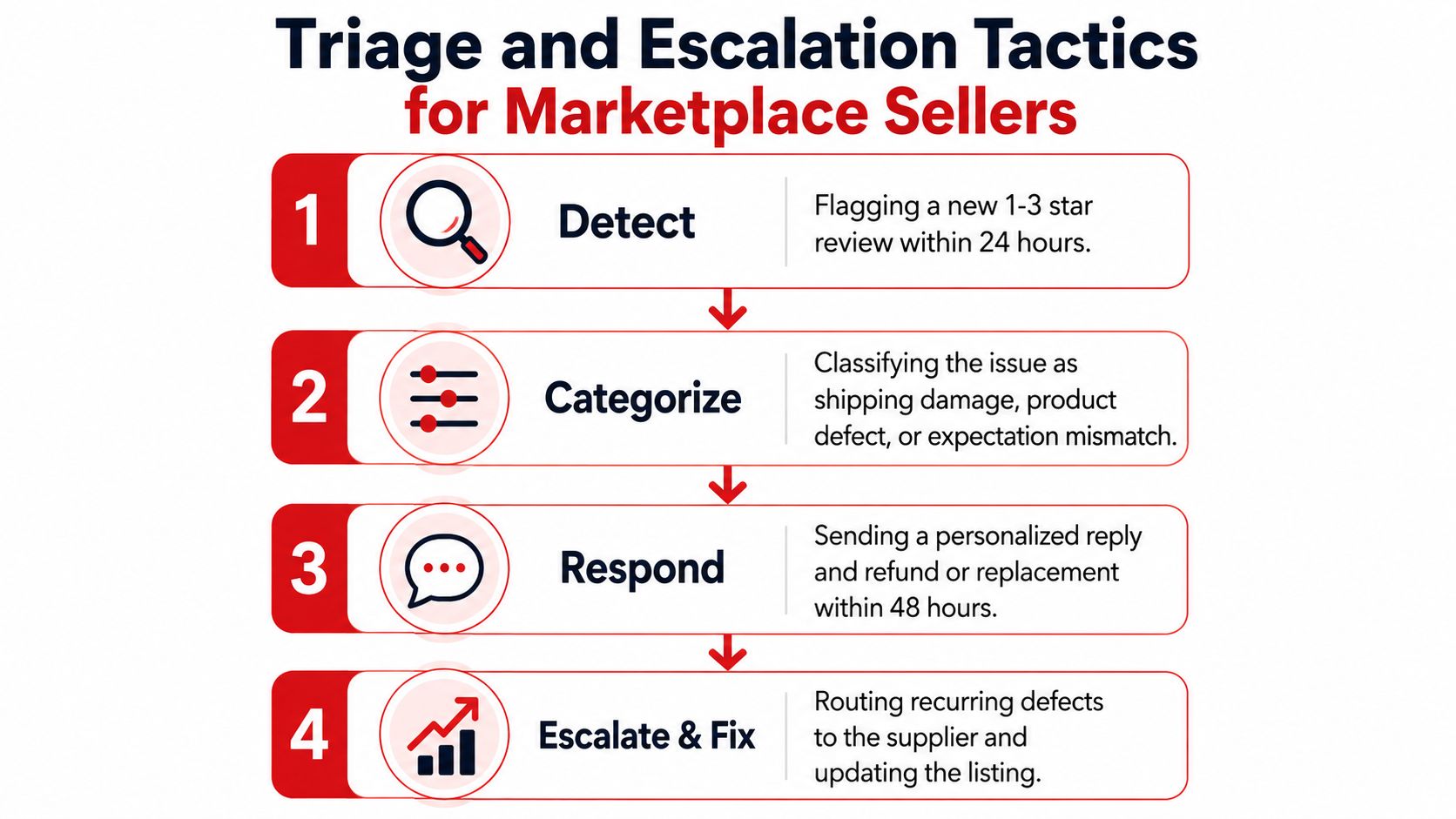
Subjective preference includes flavor, scent, texture, color, or performance expectations that the product never promised. The response should acknowledge the experience without implying a manufacturing defect. The listing may still need clearer language if many shoppers expect something different.
Product defects include broken components, leaking containers, contamination concerns, missing contents, or performance failures that contradict the product specification. These require evidence collection, supplier review, batch or lot investigation, and a decision about inventory quarantine. A public apology without a corrective action plan protects neither the customer nor the P&L.
Fulfillment failures include crushed cartons, missing units, late delivery, or temperature exposure caused after the product leaves the brand's controlled process. The seller should document whether the issue is isolated to a warehouse, carrier lane, packaging configuration, or fulfillment program. Otherwise, the team may redesign a sound product to compensate for a handling failure.
Authenticity concerns require a separate path. Review ecosystems contain fake, incentivized, coordinated, and AI-generated content. Tripadvisor reported that about 8% of its 31.1 million 2024 reviews were fake, Trustpilot reported that 7.4% of submitted reviews were detected as fake in 2024, and Yelp said it filtered nearly half a million suspected AI-generated reviews in 2025. CNBC's review authenticity reporting illustrates why brands should preserve screenshots, order details, reviewer patterns, and unusual language before filing a platform report.
Request removal only when the review violates the marketplace's rules, such as irrelevant content, abusive language, personal information, manipulation, or a complaint that clearly concerns a different product or transaction. Don't file removal requests because the review is damaging. Unsupported appeals consume time and can distract from a genuine product issue.
For difficult cases, use platform support with a concise evidence packet. Resources covering tools for removing negative reviews can help organize the process, but no tool substitutes for marketplace policy compliance. Maintain a case log with the review URL, SKU, order reference where available, category, evidence, action taken, and final disposition. When the issue involves account access or a listing-level problem, route it through Amazon seller support rather than allowing individual operators to improvise escalation.
A public response has two audiences. The reviewer wants recognition and resolution. Future shoppers want evidence that the brand notices problems, communicates clearly, and follows through.
Baymard Institute found that 37% of users positively factor brand responses to negative reviews into their evaluation of the review, product, and site overall. Baymard's review response research makes the commercial implication clear: the reply can influence the buyer who never contacts support.
A weak response says, “We're sorry you had this experience. Please contact us.” It sounds automated, reveals no understanding of the complaint, and gives a future shopper no reason to believe the issue will be resolved. A stronger response uses a compact structure:
For a packaging complaint, the response might acknowledge that the product arrived damaged, offer a replacement through the approved channel, and state that the team is reviewing transit protection. The listing and packaging team should then examine carton strength, void fill, sealing, and carrier handling.
For unclear instructions, the response should explain the correct use briefly and direct the customer to the full guidance. The content team can then revise the first image, A+ content, title support copy, or insert. If shoppers repeatedly report that the flavor differs from expectation, the brand may need more precise sensory language rather than a defensive statement that the product tastes exactly as described.
Structured responses can also improve later feedback. A field study of Yelp and TripAdvisor data examined 43,747 reviews from 56 restaurants that enabled owner responses and 27,952 reviews from 37 control restaurants. It found that higher response intensity and greater response diversity were associated with longer subsequent review text and more cognitive-language content. The field study on owner responses suggests that thoughtful replies can influence the quality of future feedback, not just the immediate rating.
A public promise becomes a margin liability if the operations team never executes it.
Research on French Michelin-listed restaurants reached the same operational warning through a mixed-methods approach that combined experiments, response coding, machine-learning classification, and interviews. Public reply quality is only one layer. The visible message must align with the private corrective action, or future shoppers will eventually see the gap. The research on offline corrective action after online criticism supports a simple rule: don't publish a fix until someone owns it internally.
The most useful negative product reviews rarely arrive as clean engineering tickets. They say the lid popped open, the powder clumped, the bottle leaked, the label was confusing, or the item looked smaller than expected. The operator's job is to convert that language into a testable failure mode.
Aggregate reviews by component, symptom, use case, fulfillment condition, and batch or lot. Then compare those groups with return reasons, support contacts, inspection reports, and warehouse damage data. A complaint that appears subjective may become objective when it repeats across a particular package format or shipping method.
A practical review meeting should produce decisions, not a sentiment presentation. For each recurring complaint, record:
The distinction between a product fix and a content fix protects cash. If the product performs correctly but shoppers misunderstand preparation, changing the listing may be cheaper and faster than reformulating. If customers understand the promise and the product fails in use, better copy only increases the number of disappointed buyers.
Amazon reviews may reveal a packaging problem that also appears in DTC support tickets. Walmart returns may expose damage that doesn't show up in marketplace text because shoppers use different language. Wholesale partners may report the same issue through account managers rather than public reviews.
That's why review analysis belongs in the same operating cadence as inventory planning and contribution-margin review. A recurring defect can create replacement costs, return processing fees, write-offs, negative ad efficiency, and slower stock turns. A fulfillment problem may require a carton redesign, a different prep configuration, a warehouse escalation, or a channel-specific packout.

The most profitable fix is often unglamorous. It may be a stronger seal, a clearer dosage panel, a better inner bag, a revised case pack, or a more honest size comparison. Those changes don't create a compelling executive slide, but they can protect the contribution left after product cost, marketplace fees, fulfillment, returns, and advertising.
Average rating is too blunt for P&L management. A useful review dashboard connects customer feedback to conversion, return behavior, advertising efficiency, inventory age, and contribution profit.
Track the core SKU before and after meaningful review events. Look for changes in detail-page conversion, paid and organic order mix, branded and non-branded traffic, return reasons, customer contacts, and the amount of advertising required to maintain sales. Don't assume causation from a single daily movement. Look for a sustained pattern and compare the affected SKU with a similar product that didn't experience the same review change.
The contribution-margin calculation should include the costs that review problems expose. A practical framework is available in this guide to calculating contribution margin. For review management, the relevant question is not “Did the rating improve?” It's “Did the SKU produce more profit after all variable costs and working-capital pressure?”
| Margin Leak Point | Direct Impact | Secondary Operational Cost |
|---|---|---|
| Lower conversion | Fewer orders from existing traffic | More paid traffic or discounting may be required to preserve volume |
| Higher returns | Refunds, replacements, and processing costs | Sellable inventory can become damaged, opened, or harder to redeploy |
| Weaker organic demand | Lower sales velocity and rank pressure | The team may increase bids before fixing the customer objection |
| Unresolved product defect | Ongoing complaints and repeat failures | Supplier claims, inspections, write-offs, and customer-support workload |
| Aging marketplace inventory | Capital remains tied up in slow stock | Storage charges and eventual liquidation or removal can erode contribution |
A review problem can look small when measured per order. The economics change when it slows a large inventory position. Walmart Fulfillment Services announced new U.S. storage fee tiers effective June 30, 2026, including $2.25 per cubic foot per month for inventory stored 366 to 450 days and $7.50 per cubic foot per month for inventory stored more than 450 days. Walmart's WFS fee information shows why a conversion problem can become an inventory-cost problem if the team leaves the SKU untouched.
Fulfillment economics also vary by product shape and weight. Walmart lists a WFS fee of $3.45 for items at or below 1 lb. and $155 plus $0.80 per lb. over 90 lb. for items up to 500 lb. Walmart states that WFS rates average 15% less than the competition and that the service has no signup or monthly subscription fees. The WFS pricing page makes the operator's trade-off visible: a review-driven slowdown can be especially painful for bulky or heavy CPG items, where storage and fulfillment costs consume contribution before advertising is considered.
The right intervention may be a response, a listing change, a supplier correction, a packaging test, a promotion, or a controlled inventory reduction. Measure the cost of each option against the cost of letting the review problem age with the stock.
Review management should sit inside the operating system, not in a customer-service inbox. The durable approach follows a progression from Foundation to Optimization to Amplification, with each stage tied to a different commercial responsibility.
Set a review-monitoring process for Amazon, Walmart, DTC, retailer portals, and support channels. Assign ownership by issue type, define escalation rules, and maintain one source of truth for review classification. The basic record should connect the review to the SKU, channel, product version, fulfillment path, likely root cause, response status, and corrective action.
Foundation also requires honest product content. Dimensions, ingredients, usage instructions, pack count, flavor profile, compatibility, and delivery expectations should match what the buyer receives. Clear content won't eliminate preference complaints, but it reduces avoidable expectation gaps.
Once the data is organized, rank issues by contribution impact rather than star rating. A one-star complaint about an isolated preference may require a thoughtful reply. A cluster of three-star complaints about leaking packaging may justify a supplier investigation, a packaging test, and a temporary inventory decision.
Marketing, operations, merchandising, and finance should review the same evidence. Marketing can update claims and imagery. Operations can inspect production and fulfillment. Finance can model returns, replacements, storage, and advertising consequences. No team should optimize its own metric while the SKU loses money overall.
Generate authentic positive feedback by delivering a product that matches its promise and making the post-purchase experience easy to use. Don't manipulate ratings, incentivize reviews improperly, or flood a listing with generic language. Shoppers are evaluating whether the review set feels credible, and platforms are investing heavily in detecting artificial activity.
A healthy strategy also treats criticism as product intelligence. Use strong reviews to identify the benefits customers naturally describe, then use those words to sharpen merchandising. Use negative reviews to locate friction, then decide whether the fix belongs in formulation, packaging, instructions, fulfillment, or positioning.
The brands that scale profitably don't hide every complaint. They reduce preventable failures, respond with evidence, and use the remaining criticism to improve the product and the economics around it. That is how review management supports inventory velocity and contribution margin instead of becoming another vanity reporting exercise.
Reddog Consulting Group helps CPG founders and operators connect negative product reviews to marketplace performance, contribution margin, and inventory decisions across Amazon, Walmart, and DTC. Book a free 30-minute working session with Reddog Consulting Group to review your review-related margin leaks and build a practical growth plan, with no sales pitch.
Leave a comment: