
Published: March 2020 | Last Updated:September 2026
© Copyright 2026, Reddog Consulting Group.

Most advice about Amazon PPC campaign structure starts in the wrong place. It tells sellers to add more keywords, split match types, or bid more aggressively. Those tactics matter, but they won't rescue an account where launch traffic, branded demand, competitor targeting, and mature profit campaigns all draw from the same budget.
For a CPG operator, campaign structure is a margin-management system. It determines which products receive spend, which search terms get tested, how quickly inventory moves, and whether advertising supports contribution margin or erodes it. Amazon describes Sponsored Products as cost-per-click ads organized through campaigns, budgets, ad groups, and targeting, which makes the structure an operating framework rather than a filing system (Amazon Sponsored Products guide).
More traffic does not automatically create growth. It helps only when the product converts at a price and margin that can absorb advertising cost. Otherwise, a campaign can generate orders while reducing profit per order, pulling inventory forward, and pressuring the brand to rely on promotions to maintain sales velocity.
A single campaign can conceal that trade-off. Branded searches may convert efficiently, while non-branded discovery terms need testing. A launch ASIN may warrant controlled investment to gather demand signals, whereas a mature ASIN should protect contribution margin. Putting all of those jobs under one budget and KPI allows efficient traffic to hide expensive traffic.

Amazon recommends starting campaign planning with a goal, budget, and KPI, and warns that changing the KPI after launch can reset performance learnings and affect optimization (Amazon campaign KPI guidance). Set the economic job before assigning spend. A campaign built for awareness should not be judged by the same efficiency standard as one built to protect margin.
Campaign names should make that job visible to the operator. “Auto | Protein Bar Variety Pack | Discovery” communicates that the campaign is buying information. “Campaign 14” does not show whether the spend is intended to generate profitable sales, test demand, or support a launch.
Practical rule: If you cannot explain what a campaign may sacrifice and what it must protect, it is not ready for a meaningful budget.
Poor structure creates operational risk as well as inefficient ad spend. A campaign that spends heavily on a fast-moving ASIN can accelerate depletion before the supply team has time to replenish. A high-margin item can face the opposite problem when a lower-margin product consumes the shared budget.
Fee compression increases the pressure. Fulfillment, referral, promotional, and storage costs reduce contribution margin before advertising is counted. Manage PPC against what remains after product and channel costs, not revenue alone.
Amazon reporting includes impressions, clicks, sales, CTR, CVR, ROAS, and placement data. History is available for up to 15 months at daily or weekly granularity and up to 6 years at monthly or yearly granularity (Amazon Sponsored Products history and reporting background). Separate campaigns make those reports useful for decisions about margin, inventory, and testing instead of producing one blended account average.
A profitable Amazon PPC structure starts with contribution margin, not a keyword taxonomy. For each ASIN, record selling price, landed cost, marketplace fees, fulfillment cost, promotional allowance, and the contribution dollars left before advertising. That figure sets the amount available for testing and determines which campaigns can absorb inefficient spend.
Campaign names should make the commercial job visible. “Auto | Protein Bar Variety Pack | Discovery” shows that the campaign is buying information. “Campaign 14” gives the operator no clue whether the spend is intended to generate profitable sales, test demand, or support a launch.
Amazon recommends separating targeting strategies and creating enough campaigns for clear monitoring. It also advises keeping campaigns or ad groups distinct when one product is optimized for ROAS and another is managed for awareness or impression growth (Amazon targeting guidance).
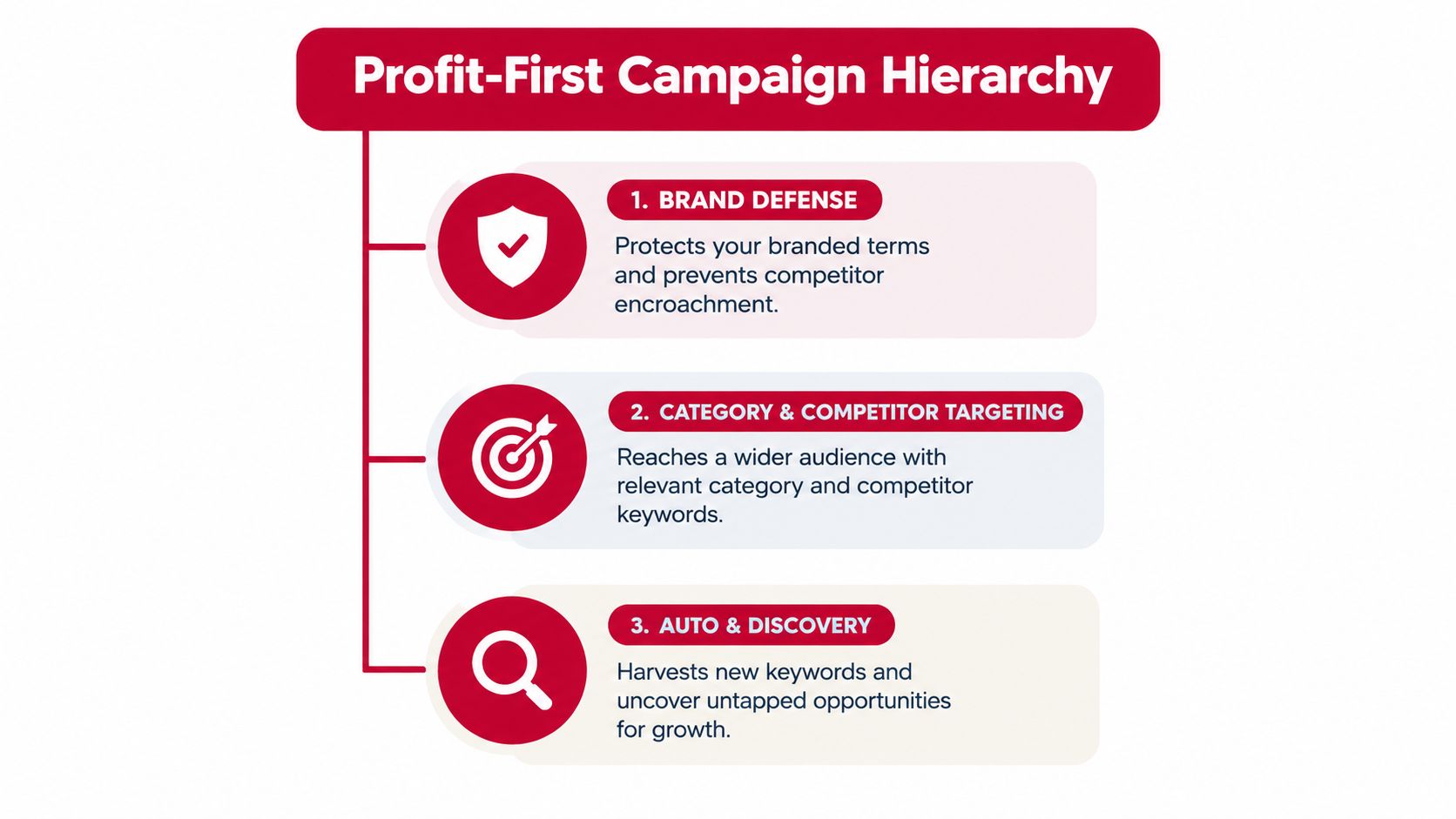
A workable hierarchy separates these roles:
This structure aligns with RedDog's Foundation → Optimization → Amplification framework. Foundation covers clean catalog data, accurate economics, and consistent naming. Optimization separates discovery from proven demand and applies negatives. Amplification increases investment only when inventory, margin, and conversion can support it.
Use a naming convention that exposes the variables needed during a budget review:
[Targeting] | [ASIN or product group] | [Role] | [Brand status]
“Exact | Hydration Mix | Scale | Non-Brand” gives the team more operating information than a generic label. Portfolios can group campaigns by product line, marketplace objective, or lifecycle stage without hiding individual KPIs.
Keep the architecture as small as control allows. Amazon's campaign framework includes campaign name, channel, dates, daily budget, and ad groups, while its guidance recommends automatic targeting when the immediate goal is to generate traffic and sales quickly (Amazon Sponsored Products campaign framework). For broader operating guidance, review Amazon ads management practices.
Daily budgets are cash-flow decisions disguised as campaign settings. Amazon defines a campaign budget as the amount available per day across a calendar month. A $100 daily budget can produce up to $3,100 in clicks during a 31-day month, so review the console setting against the full month, not only today's spend (Amazon Sponsored Products budget mechanics).
Amazon's new-advertiser guidance says a $10-per-day budget can be enough to begin generating clicks and sales, with no end date recommended for year-round momentum. For a CPG brand, that does not mean every campaign should run indefinitely. Set the budget and end date around the product's replenishment cycle, cash position, inventory coverage, and demand plan. A campaign that spends efficiently can still create an operational problem if it accelerates sales ahead of the next inbound shipment.
Break-even ACoS is the advertising cost divided by sales at which an order produces no contribution after the other variable costs you include. If a product sells for $30 and leaves $6 before advertising, its break-even ACoS is 20%. That example is a planning calculation, not a platform benchmark. Price, coupons, fulfillment, returns, and product cost can change the result.
Assign a different efficiency tolerance to each campaign job:
Bid strategy should follow the same economic logic. Higher bids can improve access to valuable placements, but they increase click costs before conversion improves. Lower bids protect margin while potentially limiting data collection and inventory velocity. Choose the trade-off based on whether the campaign is in Foundation, Optimization, or Amplification, and whether stock can support the resulting demand.
Amazon advertising guidance reports average Amazon conversion rates around 9.9% to 10.3% and average CPC near $0.99 to $1.10 in 2026, implying roughly $10 to $11 in ad spend per sale at that conversion level. Those figures offer context, but your break-even calculation should set the operating limit.
Wait at least seven days before making major judgments, remove the most recent 48 hours because attribution may be incomplete, and gather enough clicks for a meaningful decision. Frequent bid changes after short-term fluctuations destabilize delivery and make it harder to identify whether campaign structure or bid level caused the result. Review spend, sales, margin, inventory, and search-term quality together before changing the setting.
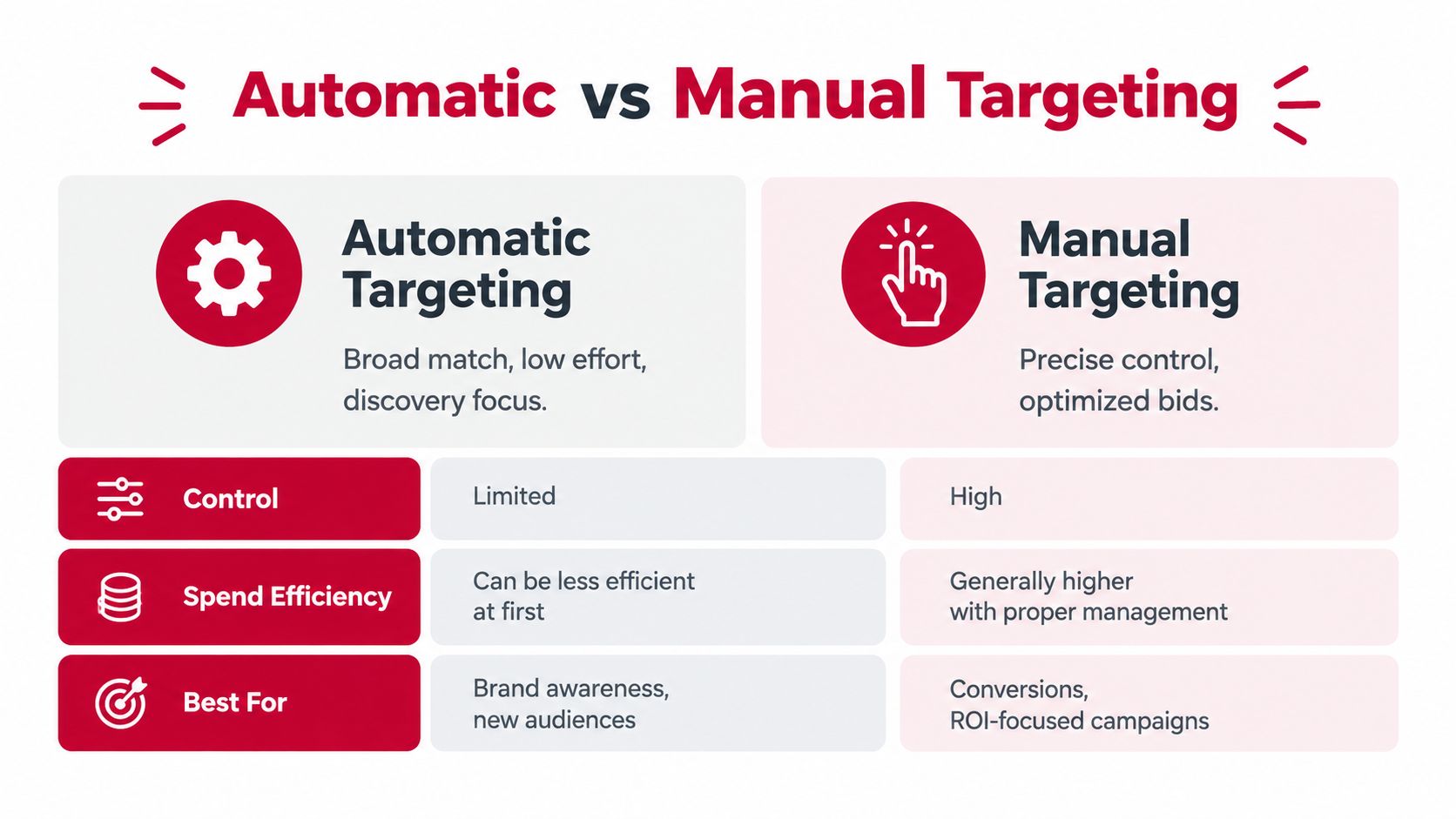
Automatic and manual targeting should serve different margin decisions. Automatic campaigns give Amazon room to match a product with shopper queries and placements. Manual campaigns give the operator control over terms, match types, bids, and budgets that merit deliberate investment. The choice is less about visibility than about how much control the account needs before it spends another dollar.
Automatic targeting fits the discovery layer. It can reveal customer language that is missing from the detail page or initial keyword research. The cost is limited control: Amazon selects the matching opportunities, so search-term review must separate useful demand from spend that cannot support the contribution target.
Manual targeting fits the testing and scaling layers. Broad and phrase campaigns test variations, while exact-match campaigns concentrate budget on terms with evidence of commercial value. That control requires more operating work. Keyword selection, bid logic, listing relevance, and negative-keyword discipline all affect whether manual spend improves profit.
| Product situation | Primary role | Operating choice |
|---|---|---|
| New ASIN or uncertain demand | Discovery | Use automatic targeting to collect relevant query and placement signals |
| Product with emerging demand | Testing | Use separate broad and phrase campaigns to evaluate variations |
| Proven commercial terms | Scaling | Move validated terms into exact-match campaigns with dedicated budgets |
| Mature, margin-sensitive ASIN | Efficiency | Restrict spend to terms and placements that support the contribution target |
A click alone does not justify moving a term from automatic to manual targeting. Promote it when relevance, conversion behavior, selling price, and margin support a more deliberate bid. After moving a term into an exact campaign, add a negative exact match to the discovery campaign when appropriate. This reduces overlap and keeps performance easier to interpret.
Keep branded, non-branded, and competitor targeting separate. Each audience has a different level of intent and can require a different budget decision. Separating targeting strategies also makes bid changes and negative management easier to control. Use the Amazon Sponsored Products targeting best practices guidance as a practical reference when setting up that separation.
A concise video walkthrough can help teams visualize the operating distinctions:
For implementation detail, review Amazon Sponsored Products best practices, then apply the recommendations against your contribution margin and inventory position.
Negative keywords control where spend goes. They prevent discovery campaigns from buying queries that belong in a more controlled exact-match campaign, while excluding searches that do not fit the product, margin, or inventory plan.
Use the search-term report as the starting point. Check for irrelevant intent, weak product fit, low-margin variants, and queries that spend without creating commercially useful results. Apply the narrowest negative that fixes the problem. A negative exact match blocks one query while preserving related variations. A broader negative is appropriate only when the entire concept is unsuitable for the ASIN.
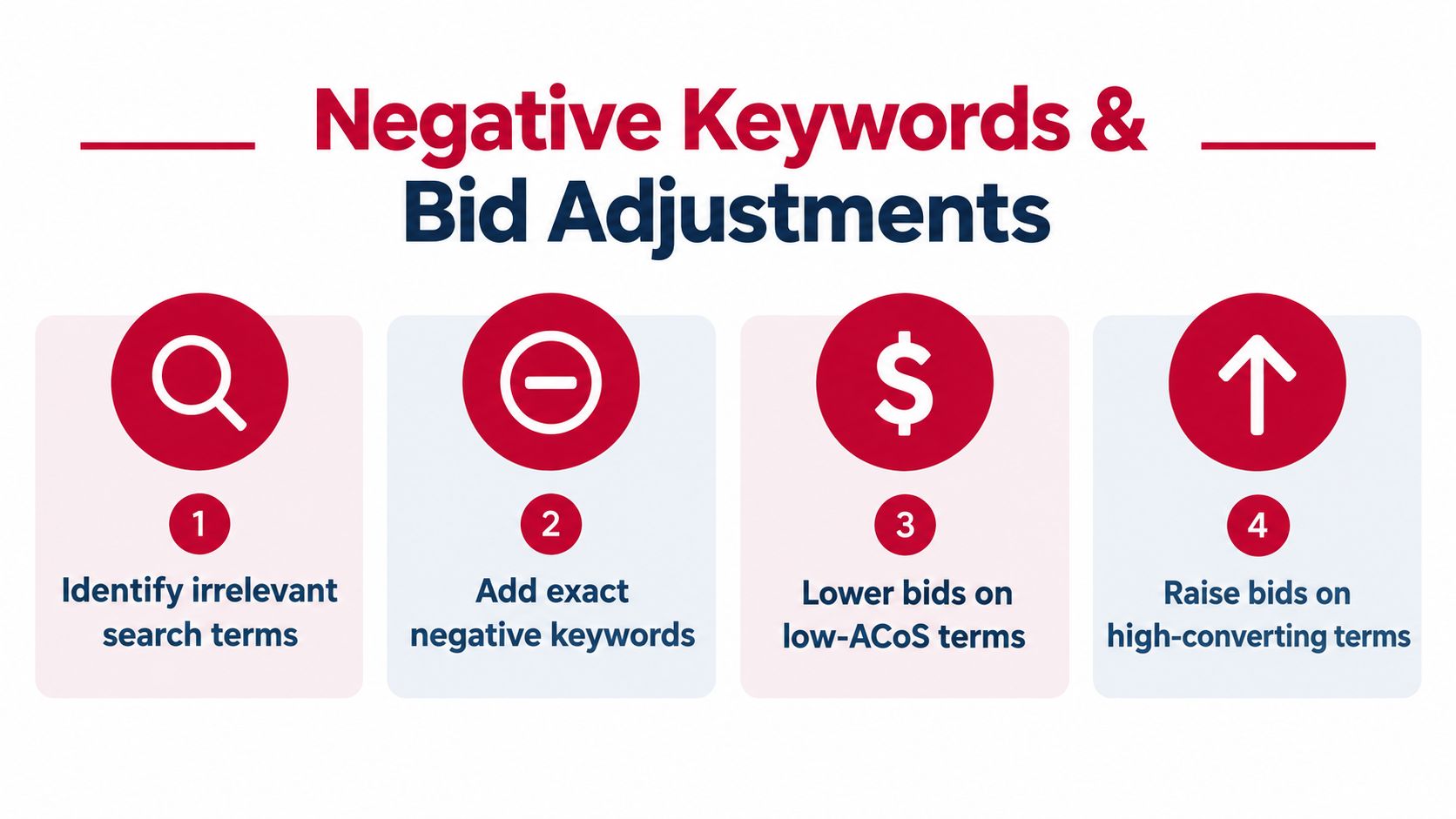
A low ACoS does not automatically justify a higher bid. Check whether the keyword can generate additional volume, whether inventory can support faster sales, and whether the sales would be incremental. A branded term may already capture most available demand. A category term may have more room, but require a higher cost tolerance.
Reduce bids when clicks consume contribution without a credible path to conversion. Raise them when the term is relevant, the detail page supports the promise, inventory can handle added velocity, and the resulting ACoS fits the campaign's role.
Margin check: Every bid change should answer three questions. What incremental demand could this create, what contribution remains after click cost, and can the supply plan support the resulting sales?
Scaling profitable Amazon PPC campaigns requires more than raising budgets on campaigns with sales. The decision is whether additional spend can produce incremental demand without weakening product-line economics or disrupting the inventory plan.
Amazon reporting provides impressions, clicks, sales, CTR, CVR, ROAS, and placement data. Read those signals together. Impressions without clicks may point to weak relevance or an uncompetitive offer. Clicks without sales may reflect mismatched traffic, detail-page problems, pricing friction, or insufficient listing evidence. Sales with falling contribution can show that growth is coming from the wrong price or placement.
Start with contribution margin. Then review ACoS and TACoS, followed by campaign-level drivers. Revenue is an output, not the first rule for increasing spend.
A profit-focused program may target roughly 15% to 25% ACoS, while a launch campaign may tolerate roughly 30% to 50% when the goal is faster ranking and data collection, based on Amazon Sponsored Products campaign planning guidance. These ranges are not universal targets. They only work when break-even ACoS, inventory position, pricing strategy, and product lifecycle support them.
| Signal | Likely operator question | Possible action |
|---|---|---|
| Strong conversion and available inventory | Can this campaign absorb more qualified demand? | Increase budget cautiously and monitor placement economics |
| High clicks with weak conversion | Is the traffic wrong, or is the listing failing? | Review query relevance, offer, detail page, and price before raising bids |
| Efficient branded sales, weak category reach | Is brand defense consuming expansion capacity? | Keep budgets separate and fund non-branded testing deliberately |
| Rising spend with falling contribution | Is growth coming from lower-quality traffic or a lower selling price? | Recheck bids, placements, promotions, and campaign role |
Amazon has also moved toward broader full-funnel planning and AI-assisted optimization. Amazon says its Ads Agent expanded to 11 countries in the current year. That makes campaign architecture and objectives more consequential, because automated tools act within the structure operators provide (Amazon Ads marketing trends).
Use Foundation to establish clean reporting and reliable economics. In Optimization, harvest search terms, apply negatives, and refine bids. In Amplification, increase investment only when inventory velocity and contribution margin support it. For practical operating detail, review this guide on how to optimize Amazon PPC campaigns.
A profitable Amazon PPC campaign structure separates business objectives before it separates keywords. Foundation gives the account clean economics, product data, naming, and budgets. Optimization assigns each search term and placement to the right campaign role. Amplification increases investment where contribution margin, inventory, and conversion support additional demand.
The brands that manage this well don't treat PPC as an isolated advertising task. They connect bids to pricing, promotions, replenishment, assortment, and channel economics. When fees rise or inventory tightens, that connection helps the operator reduce the right spend instead of cutting blindly.
If you're a CPG founder or marketplace operator dealing with margin pressure, inconsistent campaign reporting, or an ASIN that needs a more disciplined growth plan, a working review can clarify the next move. Book a free 30-minute strategy call to examine campaign structure, contribution margin, and marketplace performance.
Reddog Consulting Group helps CPG brands connect Amazon advertising structure with pricing, inventory velocity, marketplace performance, and contribution margin. Visit Reddog Consulting Group to book a free 30-minute strategy call focused on your current PPC economics and growth plan.
Leave a comment: