
Published: March 2020 | Last Updated:January 2026
© Copyright 2026, Reddog Consulting Group.

Every american eCommerce business owner feels the pressure to stand out in a crowded online marketplace. With over 80 percent of successful sellers now relying on data insights for growth, those without a clear data strategy risk falling behind. Understanding how data fuels smarter decisions and faster growth is no longer optional. This guide reveals exactly how strategic data use can sharpen your marketplace edge, drive targeted sales, and transform unpredictable challenges into new opportunities.
| Point | Details |
|---|---|
| Data as a Strategic Asset | Data has evolved into a vital resource that drives marketplace growth and strategic decision-making. Organizations must leverage data analytics for insights into consumer behavior and market trends. |
| Integration of Data Types | Businesses can benefit from a sophisticated integration of various data types, which enhances predictive capabilities and optimizes user experiences. This interconnectedness is essential for marketplace success. |
| Legal Compliance Importance | Adhering to data privacy regulations is crucial for protecting consumer rights and maintaining trust. Companies need to embed compliance into their core operations proactively. |
| Investment in Technology and Governance | Successful marketplace growth requires investments in automation and data governance strategies to mitigate risks and enhance operational efficiency. Continuous monitoring and adaptation to market changes are essential for sustainability. |
Data has transformed from a simple information asset to the core strategic driver of modern marketplace growth. In today’s hyper-competitive digital environment, data analytics provide businesses unprecedented insights into consumer behavior, market trends, and operational efficiencies. The economics of data have fundamentally shifted, creating new opportunities for strategic decision-making and value creation.
Understanding data’s role requires recognizing its unique characteristics. Digital information now functions as a dynamic economic resource that can be replicated, combined, and leveraged across multiple business contexts. Unlike traditional assets, data offers exponential potential - one dataset can generate insights across numerous strategic initiatives, from product development to marketing personalization.
Marketplace growth through data manifests in several critical dimensions. Businesses can now:
The transformative power of data extends beyond simple information gathering. Advanced technologies like artificial intelligence and machine learning1/FINAL/en/pdf) enable businesses to extract profound insights, turning raw data into actionable strategic intelligence that drives marketplace success.
Pro tip: Invest in robust data collection and analysis tools that integrate seamlessly across your marketplace platforms, ensuring comprehensive and actionable insights.
Marketplace data represents a complex ecosystem of information that drives strategic decision-making and operational excellence. Data classification becomes critical for understanding the intricate landscape of online marketplace information, encompassing multiple dimensions that provide comprehensive insights into business performance and consumer behavior.
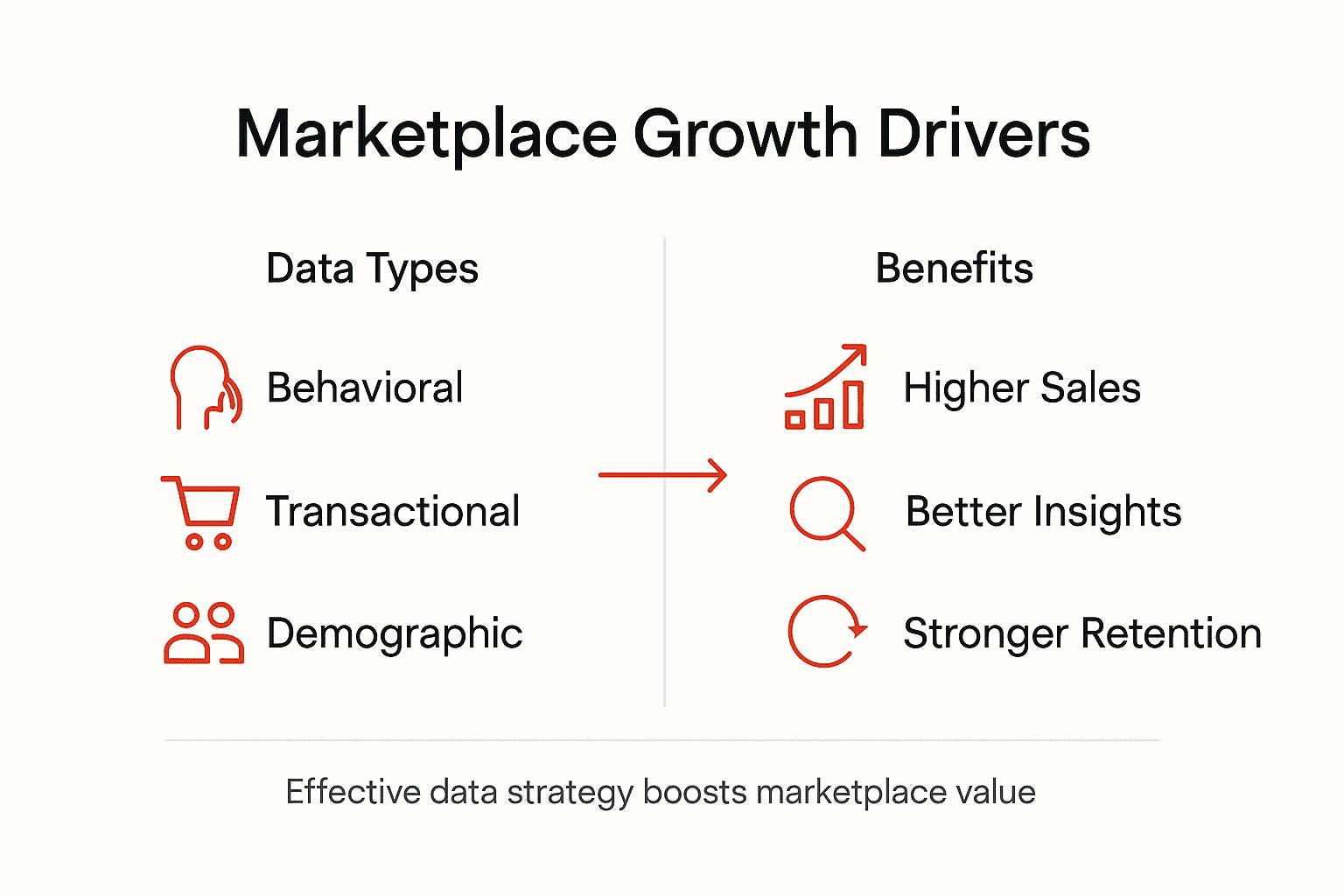
The primary data types shaping online marketplaces can be categorized into several key segments:
Each data type serves a unique purpose in understanding and optimizing marketplace performance. Behavioral data, for instance, allows businesses to create personalized recommendations, while transactional data helps predict future purchasing trends. Marketplace management strategies increasingly rely on these nuanced data insights to drive competitive advantage and operational efficiency.
The sophisticated integration of these data types enables businesses to develop predictive models, optimize user experiences, and make data-driven decisions that directly impact marketplace growth. By understanding the interconnected nature of these data streams, organizations can transform raw information into strategic intelligence that propels marketplace success.
Here’s a quick guide to key data types and their business benefits in online marketplaces:
| Data Type | Main Use Case | Key Benefit |
|---|---|---|
| Behavioral Data | Personalizing recommendations | Boosts engagement |
| Transactional Data | Predicting demand | Improves sales forecasting |
| Customer Profile Data | Tailoring marketing | Increases conversion rates |
| Operational Performance | Managing supply chain | Enhances efficiency |
| Financial Data | Monitoring profitability | Informs pricing strategies |
Pro tip: Implement a comprehensive data management system that can aggregate and analyze multiple data types, ensuring seamless integration and real-time insights across your marketplace platforms.
Data analytics has revolutionized the way businesses approach sales and operational strategies, transforming raw information into powerful strategic insights. Predictive analytics and machine learning technologies enable businesses to forecast demand and optimize complex operational workflows with unprecedented precision and efficiency.
The core impact of data analytics on sales and operations manifests through several critical mechanisms:
Business intelligence systems have become instrumental in supporting evidence-based decision-making across multiple organizational dimensions. These advanced analytics platforms integrate diverse data sources, providing comprehensive insights that enable businesses to streamline operations, enhance customer experiences, and drive sustainable growth. By transforming complex datasets into actionable intelligence, companies can make more informed strategic decisions that directly impact bottom-line performance.

The most successful organizations leverage data analytics not as a standalone tool, but as an integrated approach to understanding market dynamics, customer behavior, and operational efficiency. This holistic approach allows businesses to create adaptive strategies that respond quickly to changing market conditions, optimize resource allocation, and maintain a competitive edge in increasingly complex marketplace environments.
Pro tip: Invest in robust data analytics training for your team and select integrated analytics platforms that can provide real-time, cross-functional insights.
Data privacy regulations represent a critical framework that protects consumer rights while enabling responsible marketplace operations. Comprehensive legal guidelines govern how businesses collect, use, and protect consumer information, establishing clear boundaries that balance innovation with individual privacy protection.
Key legal compliance requirements for marketplaces include:
Specific regulations like Regulation S-P provide detailed mandates for safeguarding consumer financial information, establishing strict protocols for how businesses handle sensitive data. These legal frameworks require businesses to implement comprehensive privacy notices, restrict unauthorized information disclosure, and develop sophisticated security measures that protect consumer interests while enabling legitimate business operations.
The evolving landscape of data privacy demands continuous adaptation from marketplace businesses. Companies must proactively develop compliance strategies that go beyond minimum legal requirements, embedding privacy considerations into their core operational design. This approach not only ensures regulatory adherence but also builds critical consumer trust in an increasingly data-sensitive marketplace environment.
Pro tip: Conduct regular privacy impact assessments and maintain up-to-date compliance documentation to stay ahead of evolving regulatory requirements.
Data marketplace strategies are riddled with potential risks that can significantly impact business performance and consumer trust. Pricing algorithms and marketplace data management pose complex challenges requiring sophisticated risk mitigation approaches, with potential consequences that extend far beyond immediate financial implications.
The most critical risks in marketplace data management include:
Comprehensive data governance strategies are essential for addressing the multifaceted challenges inherent in marketplace operations. Organizations must develop robust validation mechanisms, implement transparent decision-making processes, and create agile frameworks that can quickly adapt to emerging technological and regulatory landscapes. The most successful marketplace businesses treat data risk management as a dynamic, ongoing process rather than a static compliance checklist.
The financial implications of poor data management can be catastrophic. Poorly designed algorithms, unchecked data collection practices, and insufficient risk management can lead to significant revenue losses, legal penalties, and irreparable brand damage. Marketplaces must invest in continuous monitoring, sophisticated validation technologies, and proactive risk assessment strategies that anticipate potential vulnerabilities before they manifest.
Pro tip: Develop a comprehensive risk management framework that includes regular algorithmic audits, real-time monitoring systems, and clear escalation protocols for potential data anomalies.
Marketplace sustainability requires a holistic approach that integrates technological innovation, strategic planning, and adaptive capabilities. Sustainable growth strategies must balance technological advancement with environmental and social considerations, creating resilient business models that can thrive in increasingly complex market environments.
Key strategic best practices for sustainable marketplace growth include:
Effective marketplace strategies require continuous adaptation and proactive policy development, ensuring businesses can respond quickly to emerging market dynamics. Organizations must create flexible frameworks that enable rapid technological integration, support continuous learning, and maintain strategic responsiveness to changing consumer demands and technological innovations.
Successful marketplace growth demands a multidimensional approach that transcends traditional business models. By embracing technological innovation, prioritizing sustainable practices, and developing adaptive organizational capabilities, businesses can create resilient ecosystems that generate long-term value. The most successful marketplaces will be those that can seamlessly integrate technological sophistication with strategic vision, human capital development, and responsible business practices.
The following table compares best practices for sustainable marketplace growth:
| Strategic Area | Best Practice Example | Outcome |
|---|---|---|
| Technology Integration | Invest in automation tools | Faster scaling capabilities |
| Environmental Focus | Reduce energy consumption | Improves brand reputation |
| Data Governance | Regular audits and training | Lower compliance risks |
| Collaboration | Cross-sector partnerships | Broader market reach |
| Inclusion | Support diverse sellers | Expands customer base |
Pro tip: Develop a comprehensive digital transformation roadmap that aligns technological investments with your organization’s long-term strategic objectives and sustainability goals.
The challenge many businesses face in today’s competitive marketplace is effectively harnessing data to fuel sustainable growth. This article highlights key pain points such as optimizing pricing strategies, predicting consumer behavior, and managing complex operational workflows through advanced data analytics. If you are seeking to transform raw data into actionable insights that drive omnichannel success, understanding and leveraging behavioral, transactional, and operational performance data is essential.
At Reddog Group’s Digital & Business Consulting Services, we specialize in empowering brands to overcome these challenges. Our proven expertise in marketplace management, Amazon FBA, and integrated sales strategies ensures your data works for you to boost sales, streamline inventory, and enhance customer engagement across channels. Visit our Home page to discover how we have supported over 50 brands managing 30,000 SKUs, consistently delivering measurable revenue growth.
Ready to transform your marketplace data into strategic intelligence and accelerate your brand’s success? Explore tailored growth solutions and expert guidance today at https://reddog.group. Don’t wait to leverage your data power for a stronger competitive edge.
Data plays a crucial role in marketplace growth by providing insights into consumer behavior, market trends, and operational efficiencies. It enables businesses to make informed decisions to optimize products, pricing, and customer experience.
Businesses can leverage data analytics for better sales by accurately forecasting demand, optimizing inventory, segmenting customers for targeted marketing, tracking performance metrics, and managing risks effectively.
Essential data types for online marketplaces include behavioral data (user interactions), transactional data (purchase history), customer profile data (demographics and preferences), operational performance data (inventory and shipping metrics), and financial data (revenue and profit margins).
Best practices for managing data in marketplaces include investing in digital transformation, developing robust data governance frameworks, ensuring compliance with data privacy regulations, and fostering cross-sector collaboration to enhance market reach.
Leave a comment: