
Published: March 2020 | Last Updated:November 2026
© Copyright 2026, Reddog Consulting Group.

Your advertising dashboard looks healthy, but the cash left after fulfillment, discounts, and replenishment doesn't match the sales growth. You're being asked to increase bids while the operations team is watching stock and the finance team is questioning margin.
That's where PPC bid management needs to start: contribution per order, not the platform's recommended bid. Work backward from what an order earns, then decide which clicks you can afford, which campaigns deserve more budget, and which problems advertising can't fix.
Say you sell a $30 CPG product with $12 of pre-ad contribution, after product cost, referral fees, fulfillment, storage, and expected returns. Its break-even ACOS is 40%, calculated as contribution divided by selling price; at 50% ACOS, the campaign generates sales but loses contribution on the first order, using the economics described alongside Amazon's advertising FAQ.
A deliberate launch investment might justify that loss. So might measurable repeat-purchase contribution or an independently tested organic-sales benefit. Neither should become an open-ended excuse for buying unprofitable orders.
Start with net selling revenue, not the list price before coupons. Subtract the variable costs of producing, selling, and delivering that order, including a reasonable returns allowance.
If those inputs aren't organized, use RedDog's guide to calculating contribution margin before changing campaign settings. For a useful distinction between advertising revenue ratios and broader business returns, Affiliate explains how ROI differs from ROAS.
The formulas are straightforward:
Break-even ACOS and max CPC by product
The following are illustrative calculations, not performance benchmarks. The product labels specify the assumed contribution so you can replace them with your own SKU economics.
| Product | Conversion rate | Break-even ACOS |
|---|---|---|
| $20 item with $7 contribution | 10% | 35.0% |
| $30 item with $12 contribution | 8% | 40.0% |
| $30 item with $12 contribution | 12% | 40.0% |
| $15 item with $4.50 contribution | 10% (illustrative) | 30.0% |
Under these hypothetical assumptions, the respective maximum CPCs are $0.70, $0.96, $1.44, and $0.45. The same product can support a different click price when conversion changes, even though its break-even ACOS stays unchanged.
A bid isn't automatically an expense. In a CPC auction, you pay for clicks rather than impressions; your budget controls total spending exposure, while your effective bid settings govern auction participation.
Account for placement adjustments and bidding behavior when applying the ceiling. A base keyword bid below your limit isn't enough if other settings can push the effective bid above it.
Go/no-go test: If the click price needed to win placement exceeds what the order can support, improve conversion, pricing, or costs before adding budget.
A $20 item with $7.00 in pre-ad contribution supports a 35% break-even ACOS before advertising. If fulfillment costs rise, the maximum ad spend per order falls, even when the selling price and campaign performance stay the same.
Amazon's announced 2026 US FBA fee changes include an average increase of $0.08 per unit, less than 0.5% of an average item's selling price. Amazon lists an average increase of $0.25 for small standard-size products priced $10–$50 and $0.05 for large standard-size products in that range, plus a 3.5% fuel and logistics surcharge beginning April 17, 2026.
These are published averages and an announced surcharge, not a substitute for calculating fees on your SKU. Package dimensions, weight, eligibility, and the applicable fee basis affect the actual charge.
How the 2026 FBA fee change moves break-even ACOS
These worked calculations isolate the stated per-unit increases and exclude a separate surcharge calculation.
| Scenario | Break-even ACOS |
|---|---|
| Before the 2026 fee change | 35.0% |
| Average FBA increase of $0.08 per unit | 34.6%, based on $6.92 contribution |
| Small standard increase of $0.25 per unit | 33.75%, based on $6.75 contribution |
| Walmart WFS | Pre-ad contribution after your account's WFS charges ÷ net sales |
| Google Shopping | Pre-ad contribution after destination-store fees ÷ net sales |
For Walmart WFS and Google Shopping, calculate the contribution after the applicable charges, then divide by net sales to get break-even ACOS. Don't substitute a channel-wide assumption for your own cost stack.
Low-AOV consumables have fewer contribution dollars available to absorb fee increases. That leaves less room for advertising, even if reported sales efficiency is unchanged.
Keep a SKU-level fee worksheet alongside your campaign export. RedDog's explanation of Amazon Fulfillment by Amazon fees can help you organize those costs.
Amazon, Walmart, and Google Shopping need separate break-even calculations. Google Shopping is an acquisition channel, so its order economics depend on the destination store and fulfillment arrangement.
For each channel, calculate:
Net sales minus product cost, channel or payment fees, fulfillment, discounts, expected returns, and other variable order costs.
For Walmart, include the applicable WFS and marketplace charges. For DTC orders acquired through Google, include payment processing, pick-and-pack, outbound shipping subsidies, and the actual promotional offer.
Customer relationships and repeat-purchase potential can affect how much you choose to spend to acquire an order. Keep projected value separate from observed contribution so a future possibility doesn't conceal a loss on the first purchase.
Rerun the channel break-even worksheet whenever a fee schedule changes, before the next bid cycle. An advertising report alone won't reveal that an operations cost has reduced the bid your margin can support.
Google's Smart Bidding guidance describes machine-learning strategies that optimize for conversions or conversion value in every auction, using contextual signals including query, device, location, browser, language, operating system, and time of day; Google recommends evaluation periods containing at least 30 conversions, or 50 for Target ROAS.
That changes the operator's job. You still control the objective, conversion definitions, value inputs, budget, and commercial constraints, even when you aren't choosing every auction bid.
The account review needs to connect those settings to order economics.
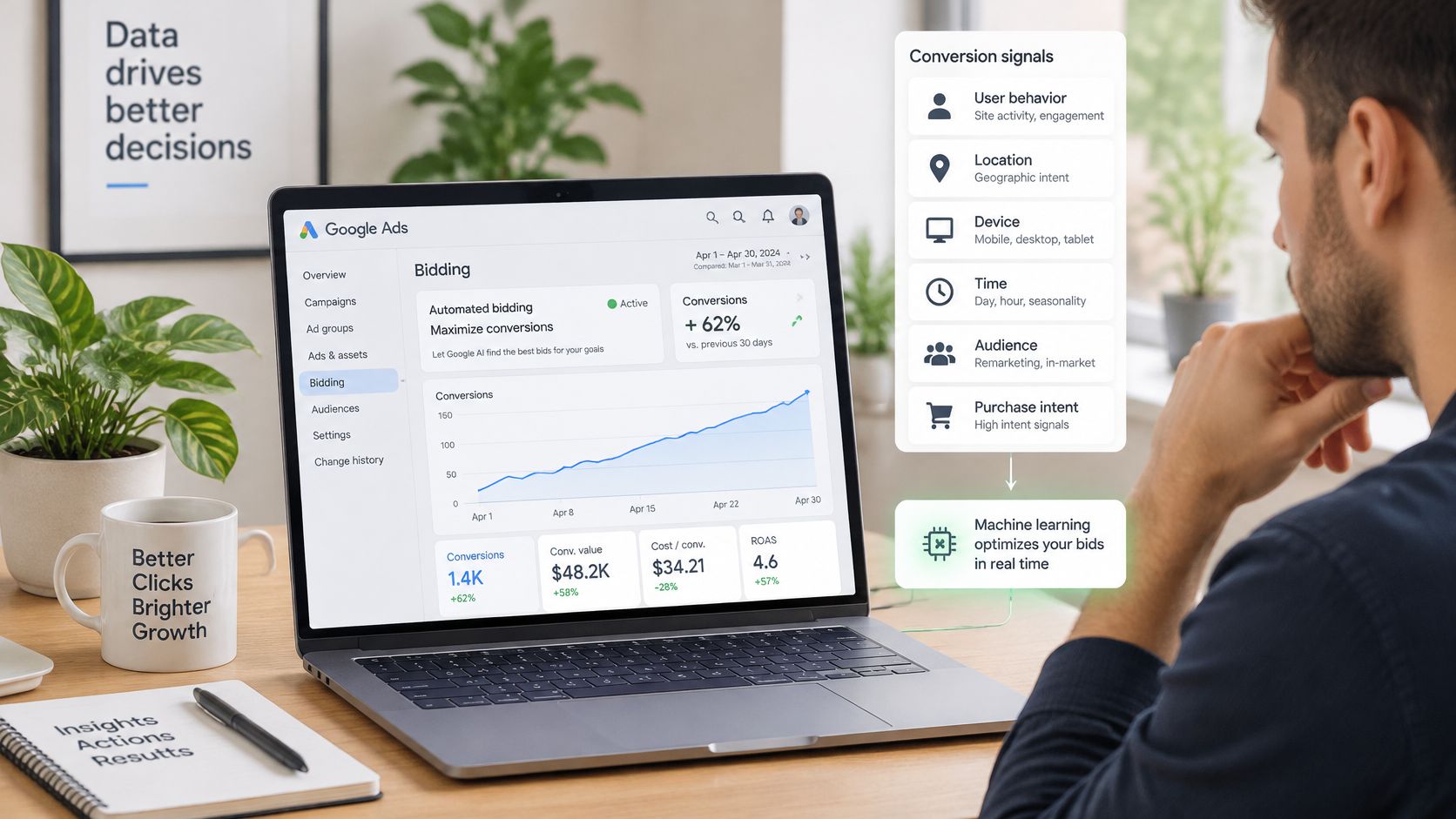
Using the hypothetical margin case above, $30 revenue divided by $12 contribution produces a break-even revenue ROAS of 250%. A lower revenue-based target permits first-order losses, assuming the contribution estimate holds.
Now suppose that item sells under a deep discount and is later returned, but tracking retains the original full-price purchase value. The bidding system receives a success signal for revenue the business didn't keep.
RedDog's guide to revenue attribution helps distinguish credited revenue from the commercial outcome you need to assess. For implementation context, Advisor Momentum's guide to conversion tracking for advisory firm websites addresses a different industry, but offers a useful tracking reference rather than a CPG profitability benchmark.
Keep the value definition consistent. If you switch from revenue values to contribution values, rebuild the target accordingly rather than retaining a revenue-based ROAS target.
Automation optimizes the event and value you define. It doesn't infer the profit you intended to protect.
Amazon's advertising guide defines ACOS as ad spend divided by attributed ad revenue: $5 of spend generating $25 of sales equals 20% ACOS. That ratio excludes product costs, fees, fulfillment, promotions, returns, and overhead, so it measures sales efficiency rather than profit.
Use it as an operating signal, then reconcile it with the contribution worksheet. A campaign can meet its advertising target while the underlying product becomes less profitable.
The visual summarizes that distinction before the weekly operating routine.
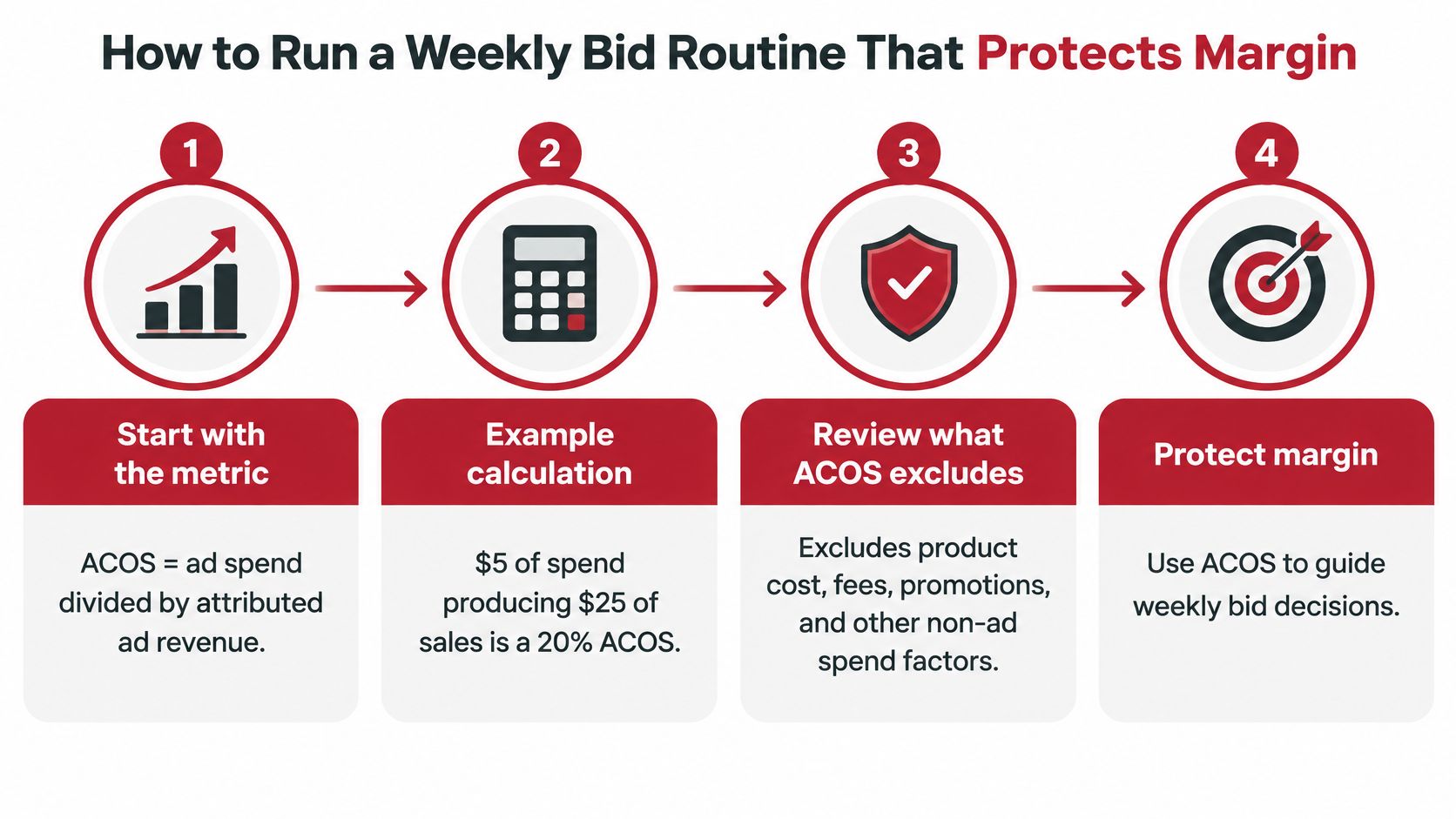
The following percentages are recommended operating guardrails, not platform rules or promised performance thresholds. Apply direct bid changes where manual bidding supports them; manage automated campaigns through their supported targets, budgets, and exclusions instead.
RedDog's Foundation → Optimization → Amplification framework fits this operating sequence naturally: establish clean data and campaign roles, improve search-term and bid decisions, then expand only where contribution holds.
Keep an owner and next review date against each unresolved issue. Pricing questions belong with the person who can change the offer; stock constraints belong with replenishment planning, not in a forgotten campaign note.
A cheaper click isn't necessarily a better purchase of demand. The important comparison is what the business earns from the additional orders, including the operational cost of fulfilling them.
Four risks deserve explicit attention:
Use a geo test, audience holdout, or controlled budget reallocation where the channel supports a credible comparison. Define the outcome as incremental contribution after advertising, with availability and promotional conditions recorded.
For retailer comparisons, use each destination's actual economics. A high-intent Amazon order, a Walmart order, and a DTC repeat purchase aren't interchangeable because each appears as a conversion.
Before paying a premium for an audience, ask whether you're acquiring additional demand or buying another claim on an order you were already likely to receive.
Scale, cut and escalate rules for PPC bids
These are recommended review rules for a manually controlled keyword program, not universal statistical thresholds. Use them as decision triggers, then account for conversion lag, query relevance, and the product's actual acquisition allowance.
| Signal | Threshold | Action |
|---|---|---|
| ACOS above break-even over 14 days with at least 30 clicks | Break-even exceeded for two review windows | Cut bid by 15% or pause the keyword |
| ACOS at least 20 points under break-even with stable conversion | Stable for two review windows | Raise bid by 10–15% and test a budget increase |
| Converting search term not in exact match | One sale or more in the window | Add as exact match and negate it in broad match |
| Conversion rate drops while bids are unchanged | 30% drop against prior four weeks | Check price, listing and stock before any bid change |
| Inventory cover below two weeks | Any product | Pause or reduce bids; do not scale |
A keyword reaching the click threshold deserves a decision, but it hasn't automatically accumulated enough evidence for a confident conversion-rate estimate. High-consideration purchases, delayed attribution, and sparse order volume require more caution.
Likewise, a converting search term earns controlled testing, not an unlimited budget. When moving it to exact match, confirm the destination is eligible and funded before adding the broad-match negative, so you don't unintentionally interrupt useful traffic.
Require the optimized setup to hold across two full review cycles before committing expansion spend. Positive contribution at the current bid is necessary, but the next increase still needs its own test because additional traffic may convert differently.
If ACOS remains above break-even after two bid rounds, stop treating the problem as an endless sequence of smaller bids. Review price competitiveness, listing content, offer clarity, availability, and fulfillment promises.
An unchanged bid alongside falling conversion is particularly important. Cutting bids may reduce the financial exposure, but it won't correct a suppressed offer, damaged listing, or delivery problem.
Log the SKU, channel, search term, review dates, actual CPC, conversion rate, contribution assumption, fee version, and stock position. Add the suspected cause, named owner, change made, and condition that would justify reopening or scaling the campaign.
That record lets the next review start with evidence rather than someone's memory of why the campaign was changed.
Before approving more spend, assemble the information that could change your acquisition ceiling. A campaign export without an up-to-date cost model is incomplete. So is a margin worksheet that overlooks incoming stock constraints.
The decision is whether the next orders can leave enough contribution, arrive through the right channel, and be fulfilled without creating an operational problem.
Before raising a product's bid, gather:
If an input is missing, resolve that gap before increasing the bid. The right move may be a listing correction, price adjustment, replenishment decision, or cleaner tracking.
Qualified CPG founders and operators can request a free quote from RedDog Consulting Group through its Get your Quote option. Bring your margin worksheet, campaign reports, and inventory position so the team can review break-even economics and bid decisions.
Reddog Consulting Group offers PPC advertising management and hands-on strategy implementation. Request a free quote through the Get your Quote option, with your margin worksheet, campaign reports, and inventory position ready for review before your next bid increase.
Leave a comment: