
Published: March 2020 | Last Updated:January 2026
© Copyright 2026, Reddog Consulting Group.

A powerful new product launch strategy is more than just a marketing plan—it's a detailed roadmap that aligns your entire company, from operations to sales, around a single, unified goal. It weaves together market research, competitive analysis, and clear KPIs to ensure your product not only finds its audience but also drives measurable growth across every channel, from your own Shopify store to marketplaces like Amazon and Walmart.

A successful launch doesn't start with flashy ads. It begins with a solid, strategic foundation—the blueprint for your entire campaign. Skipping this step is like building a house on sand; it’s guaranteed to crumble under pressure. This foundational work ensures every dollar you spend and every hour you invest drives tangible growth.
Many brands jump straight into tactics—PPC ads, social media posts—without defining the "why" and "who." This leads to wasted budget and missed targets. In fact, research shows a significant portion of product launches fail to meet expectations, often due to a disconnect between the product and market needs. This is why a strong foundation is non-negotiable.
Before you can sell anything, you must know exactly who you're selling to. This goes deeper than basic demographics. A winning launch strategy is built on a genuine understanding of your ideal customer's motivations, challenges, and buying habits.
Start by asking critical questions to build this profile:
You don't operate in a vacuum. Your product will sit on a digital shelf next to dozens of others fighting for the same customer. A thorough competitive analysis isn't about copying what others are doing; it's about finding the gaps they've left open for you.
Look for opportunities in your competitors' weaknesses. Do they have poor reviews citing a specific feature? Is their branding unclear or their shipping slow? These are your entry points. For emerging brands, our guide on go-to-market strategy for startups offers a deeper dive into finding that initial competitive edge.
Your Unique Selling Proposition (USP) isn't just a catchy tagline. It's the clear, compelling reason a customer should choose you over everyone else. It should directly address a pain point your competitors either ignore or solve poorly.
Finally, a strong foundation needs measurable goals. "Increasing sales" isn't a goal; it's a wish. A strategic objective is specific, measurable, achievable, relevant, and time-bound (SMART). This aligns your team and provides a clear definition of success.
These goals dictate the Key Performance Indicators (KPIs) you'll track—the hard numbers that prove your strategy is working.
Getting this foundational work right—understanding your customer, positioning against the competition, and setting clear goals—is the first pillar of growth. It turns your launch from a gamble into a calculated, strategic move.
| Task Area | Key Action | Primary Goal |
|---|---|---|
| Audience Definition | Develop detailed customer personas. | To deeply understand who you're selling to and why they buy. |
| Problem Identification | Clearly articulate the specific pain point your product solves. | To ensure your messaging resonates directly with customer needs. |
| Competitive Analysis | Identify 3-5 key competitors and analyze their SWOT. | To find market gaps and define your unique position. |
| USP Crafting | Create a concise Unique Selling Proposition (USP). | To communicate why customers should choose you over others. |
| Goal Setting | Establish SMART goals for revenue, market share, and awareness. | To create a clear, measurable definition of success for the launch. |
| KPI Selection | Define the specific metrics (KPIs) to track for each goal. | To enable data-driven monitoring and optimization of the launch. |
With these core elements locked in, you have a solid base to build the rest of your new product launch strategy. You're no longer guessing; you're executing a well-defined plan.
With your foundation set, it’s time to shift from the "why" to the "how." This is the optimization phase, where we focus on the operational details that make or break a launch. We're building the logistical and technical backbone that ensures your product can be sold efficiently across both online and offline channels.
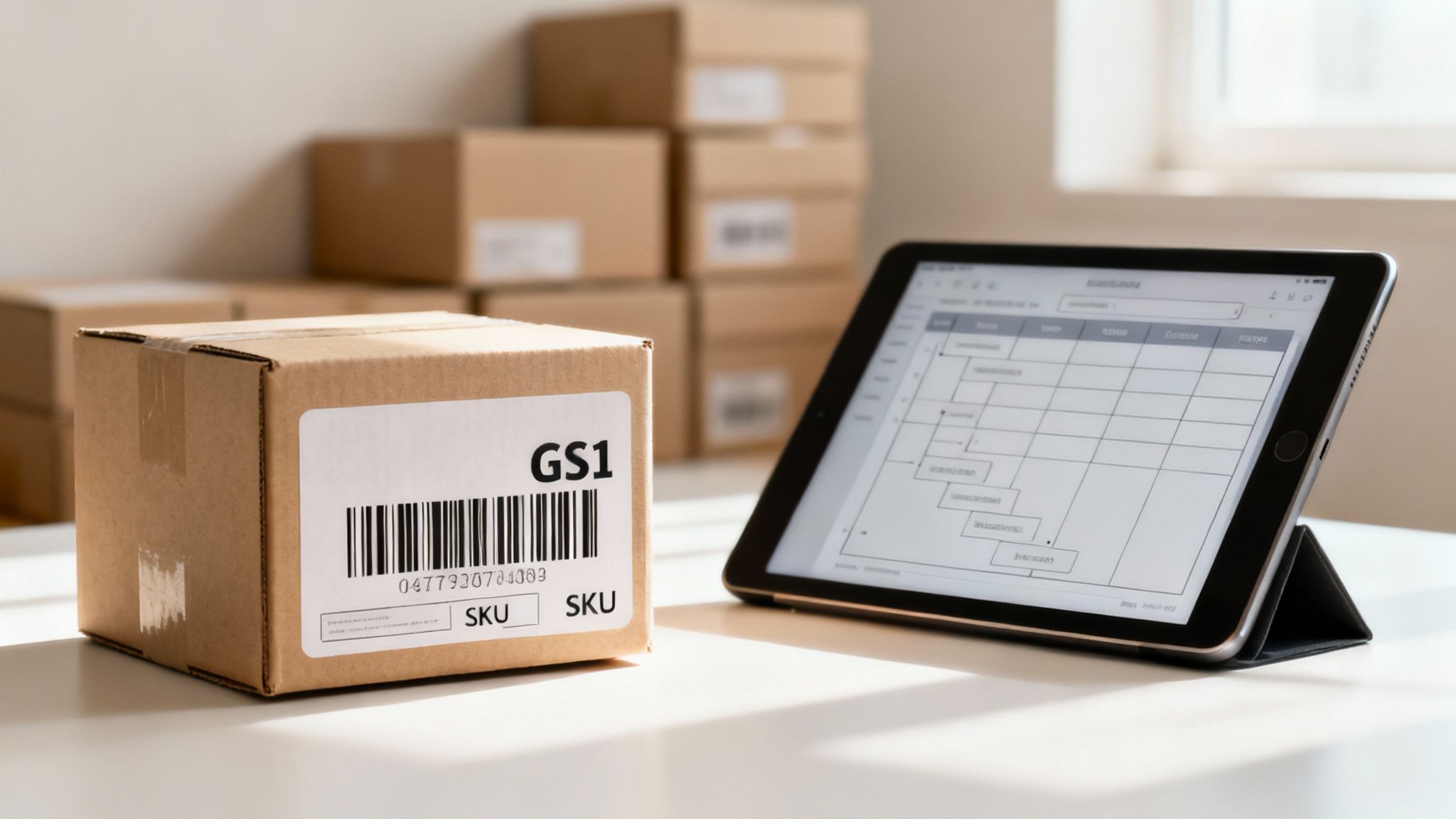
This stage is less about flashy ideas and more about execution. A misstep here can cause massive headaches—think rejected inventory at an Amazon FBA center, legal battles over your brand name, or a stockout on day one. Let’s get these pieces buttoned up for a smooth, integrated launch.
Your product catalog is the digital foundation of your entire operation. A clean, well-organized catalog with a logical SKU (Stock Keeping Unit) structure is non-negotiable for managing inventory and tracking sales across Amazon, Walmart, and your own Shopify store.
A good SKU should tell you something about the product at a glance. For instance, a SKU like TS-BLU-LG-001 could stand for T-Shirt, Blue, Large, Style 001. This system simplifies everything from warehouse picking to sales reporting.
Here's how to set up your catalog for success:
Your fulfillment strategy directly impacts your profit margins and customer satisfaction. The goal is to get your product to the customer quickly and cost-effectively, no matter where they buy it. The right model depends on your scale, product type, and operational capabilities.
With global e-commerce growing rapidly, sharp operations are critical. Yet, many companies focus on adding features instead of delivering real value, a key reason launches fail. A disciplined, customer-first approach to operations is essential.
To protect your products and build trust, consider integrating solutions like tamper evident packaging into your design. It's a small touch that can make a big difference in customer perception.
Choosing a fulfillment model isn’t just about logistics; it’s a customer experience decision. Slow, unreliable shipping can undo all the hard work you put into your launch marketing.
Let’s review the most common fulfillment options for omnichannel brands.
| Fulfillment Model | Best For | Key Consideration |
|---|---|---|
| Fulfillment by Amazon (FBA) | Brands heavily focused on Amazon. | You get the Prime badge and fast shipping, but you'll navigate complex fees and strict inventory rules. |
| Third-Party Logistics (3PL) | Brands selling across multiple channels (Shopify, Walmart, Amazon). | A good 3PL handles warehousing and shipping, freeing you to focus on growth. Vet partners carefully for reliability and tech integration. |
| In-House Fulfillment | Startups with low order volume or brands needing total control. | You control the customer experience, but scaling requires significant investment in space, staff, and technology. |
The final piece is demand forecasting. Use your market research to project initial sales volume. It’s always better to start conservatively and ramp up than to get stuck with excess inventory. Getting your operations right—from SKUs to shipping—is what turns a great idea into a sellable asset.
Once your operational house is in order, it's time to amplify your message. In omnichannel retail, applying the same strategy to Amazon, Walmart, and your Shopify store is a surefire way to leave money on the table.
Each platform is its own ecosystem with a unique audience, algorithm, and rules of engagement. A winning launch demands a distinct playbook for each.
This is the pivot point from a unified operational setup to diversified, channel-specific marketing. Think of it as speaking a different dialect in each market. A customer searching on Amazon has a different mindset than someone scrolling your brand's Instagram feed, and your tactics must reflect that.
Amazon is a search engine where people arrive ready to buy. Your primary goal is to drive sales velocity—the speed of your sales over time. It's the most critical factor in Amazon’s A9 search algorithm, meaning a strong start is essential.
To achieve this, your launch plan must be aggressive and multi-faceted.
For a deeper dive, our guide on how to launch a product on Amazon provides a comprehensive checklist.
Walmart’s marketplace may seem similar to Amazon, but its algorithm heavily rewards operational excellence and sharp pricing. Walmart shoppers are notoriously value-driven, so your positioning and listing quality must be on point.
The key is to master the fundamentals and leverage Walmart’s growing ad platform.
Walmart Connect, the marketplace’s retail media network, is often less crowded than Amazon Advertising. This can mean lower CPCs and a golden opportunity for early movers to grab market share.
Focus your energy on two main areas:
Your Shopify store is your home turf. It's where you control the entire narrative and customer experience. Here, the game shifts from winning a search algorithm to building brand relationships and driving your own targeted traffic.
Your direct-to-consumer launch should focus on creating buzz and owning the customer journey.
By tailoring your tactics to each channel, you build a powerful, integrated launch. Each platform works together, amplifying your reach and creating multiple, resilient revenue streams from day one.
With your channel-specific tactics defined, it's time to create a concrete timeline and a realistic budget. A great launch strategy runs on a smart calendar and an even smarter financial plan. This is where you map out every milestone, ensuring all moving parts align for a powerful—and profitable—launch.
Without this structure, launches become chaotic. Deadlines are missed, ad spend is wasted, and opportunities are lost. Think of your calendar and budget as your operational command center, aligning your team and resources for a coordinated push.
A solid launch calendar isn't just a list of dates. It's a strategic roadmap that visualizes the entire process, from pre-launch buzz to post-launch analysis. We recommend building a 90-day timeline that breaks the launch into distinct, manageable phases.
This provides a clear runway to build momentum before the big day and the structure needed to analyze performance afterward. A detailed timeline ensures your marketing, inventory, and operational readiness are perfectly in sync.
This timeline illustrates how these moving parts should flow together across your different channels.
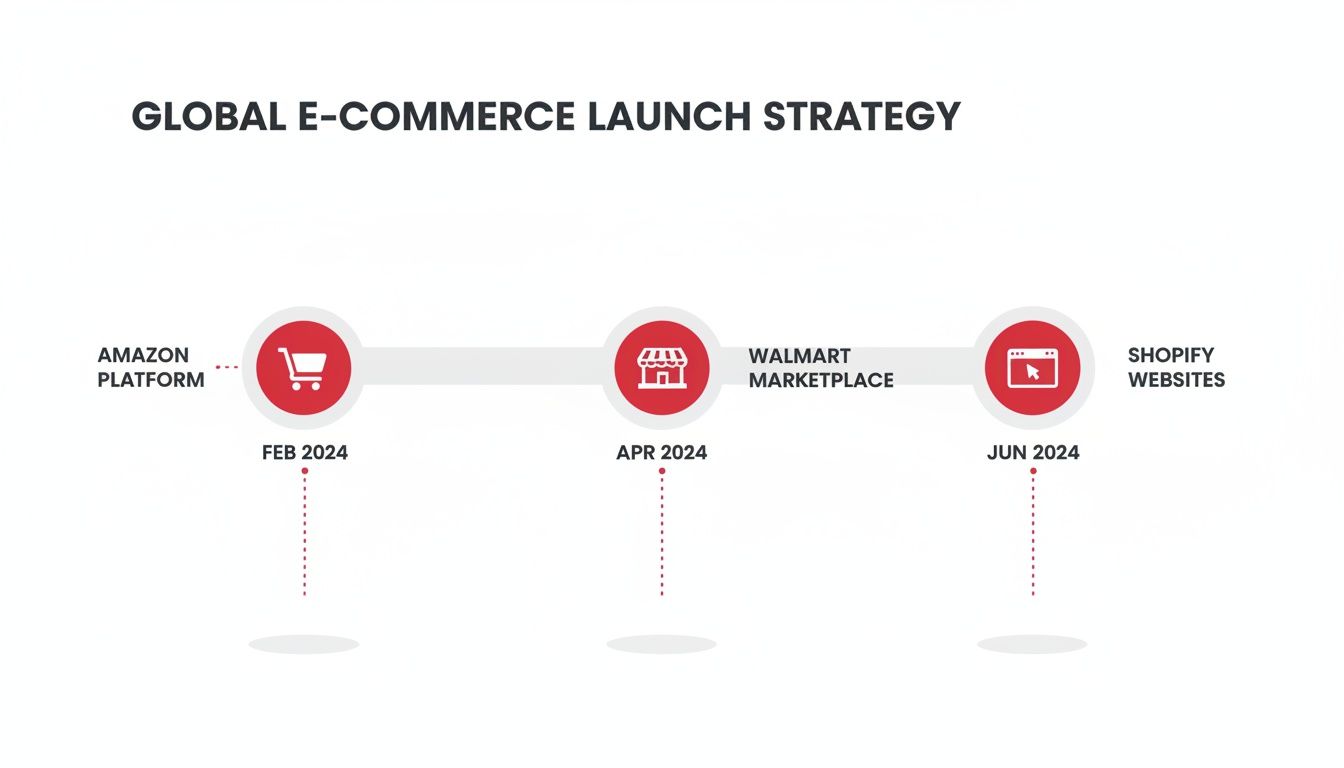
As you can see, integrated planning is key. Sequencing your efforts on platforms like Amazon, Walmart, and Shopify creates maximum impact.
Your budget is the fuel for your launch engine. A common mistake is underfunding the initial push, which can cause a great product to stall before it gains traction. A successful launch demands an aggressive investment, especially in the first 30-60 days.
A good rule of thumb is to allocate a launch budget that is 2-3 times your normal monthly marketing spend. This initial cash injection isn't just about driving immediate sales; it's about buying data, establishing your market position, and building momentum for long-term organic growth.
Your budget should be broken down into clear categories to ensure all critical activities are funded.
| Expense Category | Budget Percentage | Key Activities |
|---|---|---|
| Paid Media | 50-60% | Amazon & Walmart PPC, Google Ads, social media ads (Meta, TikTok) for Shopify traffic. |
| Content & Creative | 15-20% | Professional product photography, lifestyle videos, A+ Content design, social ad creative. |
| Influencer & PR | 10-15% | Seeding products to micro/macro influencers, affiliate commissions, PR outreach. |
| Contingency Fund | 10% | Unexpected shipping costs, last-minute creative needs, ad spend adjustments. |
This structure ensures you have dedicated funds for the most critical drivers of a successful launch.
By thoughtfully mapping your timeline and allocating your budget, you turn your strategy into an actionable plan. This ensures your launch is a well-orchestrated campaign designed for measurable, sustainable growth.
Launch day isn’t the finish line; it’s the starting pistol. The initial sales spike is exciting, but a successful launch is defined by what happens in the following weeks and months. This is where you pivot from a launch mindset to a sustainable growth mindset, using real-world data to build unstoppable momentum.
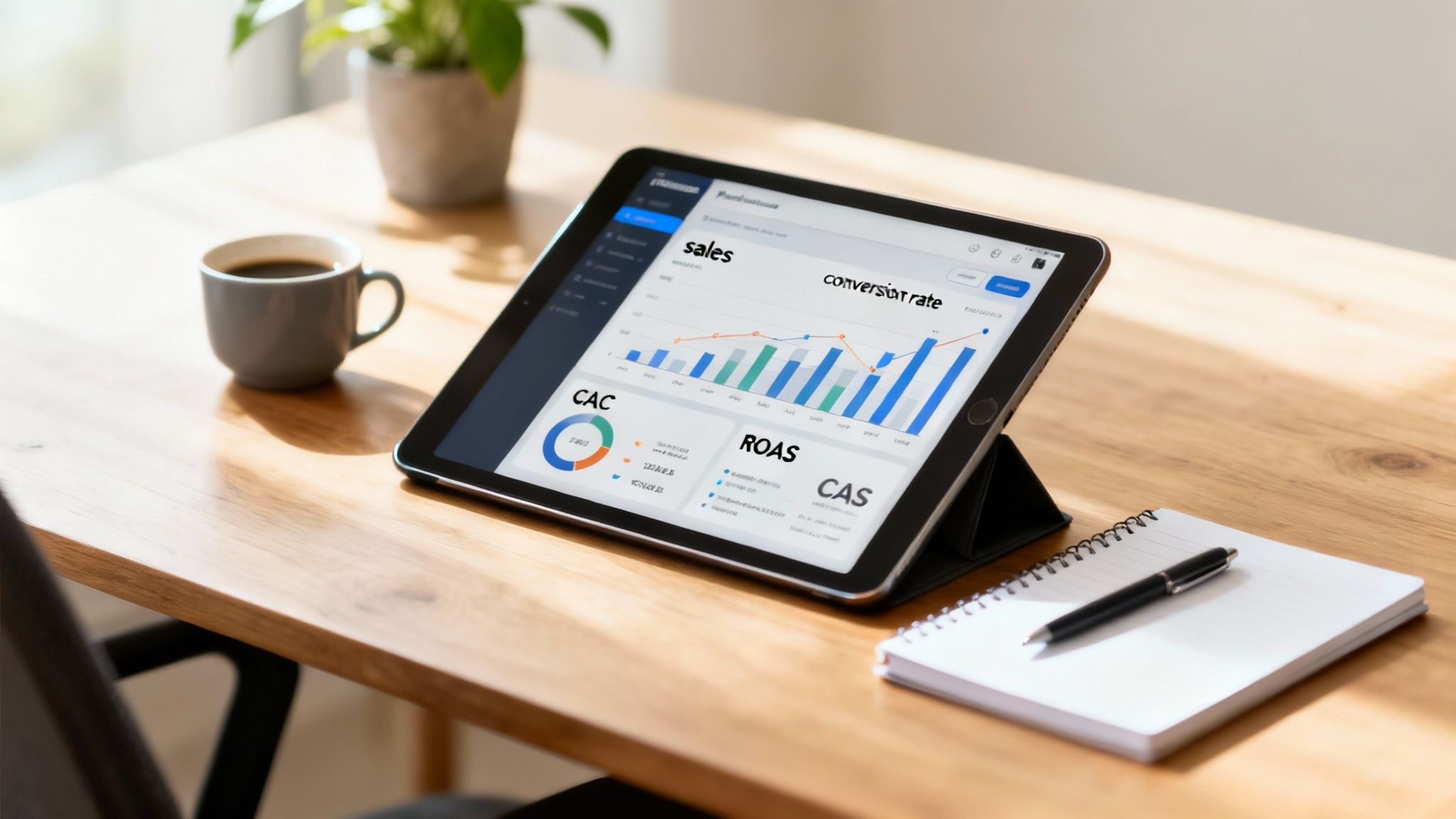
This final phase is about measurement and relentless improvement. It’s about listening to the market, understanding your performance, and making smart, data-backed decisions that drive long-term profit across all your channels.
You can't optimize what you don't measure. You need a consolidated performance dashboard to get a clear, unbiased picture of your launch. This isn't a data dump; it’s your command center for making strategic calls across your entire omnichannel operation.
Your dashboard should pull data from all sales channels—Amazon, Walmart, and Shopify—to provide a unified view of what’s working. This allows you to move beyond channel-specific anecdotes to a holistic understanding of your business, tracking the KPIs you established in the foundation stage.
Here are the non-negotiable metrics your dashboard must include:
Data tells you what is happening; customer feedback tells you why. The post-launch period is a golden opportunity to gather insights from your actual customers. Their feedback is your most valuable resource for improving your product, marketing, and overall customer experience.
Actively seeking and analyzing this feedback is a core part of the Amplification growth pillar. It creates a powerful loop where customer insights fuel your next wave of improvements, building a stronger product and a more loyal community.
Don’t just wait for reviews to trickle in. Proactively create channels for feedback. The insights from your first 100 customers are often more valuable than broad market research because they come from people who have invested their own money in your product.
Here are proven ways to gather and use this crucial feedback:
By combining the hard numbers from your dashboard with the real-world stories from customer feedback, you get a complete picture of your launch performance. This data-driven approach allows you to scale what works, fix what doesn't, and build a product that customers love for the long haul. That’s the core of a modern, effective new product launch strategy.
Launching a new product involves managing many moving parts, so it's natural to have questions. Here are some of the most common ones we hear, with straightforward answers to help you launch with confidence.
For a serious omnichannel launch, give yourself at least 6-9 months. This timeline provides the necessary breathing room for solid market research, product finalization, and securing your supply chain. It also allows enough time to create high-quality content and build pre-launch buzz. While the final marketing push may occur in an intense 90-day window, the foundational work must start much earlier to avoid costly delays and missed opportunities.
Hands down, the biggest mistake is jumping into marketing before the operational foundation is solid. Brands get excited and want to run ads, but they haven't stabilized their inventory, fully optimized their product listings, or prepared their customer service team. This often leads to stockouts, early negative reviews, and wasted ad spend. A successful launch requires integrating operations, merchandising, and marketing from day one.
With a tight budget, you must prioritize ruthlessly. Instead of spreading your funds thin across multiple channels, focus on mastering one or two to start, like your own Shopify store and Amazon.
Here’s where to allocate limited funds for the biggest impact:
This depends on your industry, price point, and channels. For launches driven by PPC on platforms like Amazon, you can start seeing a positive return within the first 30-60 days as your sales velocity increases and organic rank improves. For brand-building and organic marketing, the payoff is more gradual, often taking 3-6 months to see a real financial impact. It’s important to set realistic expectations and track both short-term sales metrics and long-term brand health.
A successful launch is just the beginning. At RedDog Group, we build the strategies that connect your brand to customers across every channel, turning launch day momentum into long-term, sustainable growth.
Leave a comment: