
Published: March 2020 | Last Updated:November 2025
© Copyright 2026, Reddog Consulting Group.

If you sell on Amazon, you’ve felt the ground shift beneath your feet. A product that was a winner one day is barely breaking even the next, and you’re left wondering what happened. This isn’t random—it’s a calculated, high-stakes ecosystem engineered to be the most competitive marketplace on earth.
This constant motion puts brands in a tough spot where agility is everything. Just reacting to a price drop or a new fee is a losing game. It keeps you on the defensive, always a step behind competitors and bleeding profit just to stay in the running. A proactive approach is the only way to drive measurable growth.
The changes hitting your bottom line usually fall into a few core categories. To build a resilient Amazon business, you need to stop reacting and start anticipating them. Each one requires a different playbook.
Here are the big three:
To help you get a handle on what to watch for, here’s a quick breakdown of the main types of pricing changes you'll encounter.
This table summarizes the primary categories of pricing changes that every Amazon seller needs to have on their radar.
| Change Type | Primary Impact Area | Typical Frequency |
|---|---|---|
| Fee Adjustments | Profit Margins, Unit Economics | Annual, Quarterly, Ad-Hoc |
| Algorithmic Shifts | Buy Box Win Rate, Competitive Pricing | Continuous (Daily/Hourly) |
| Promotional Rules | Discounting Strategy, Marketing ROI | Seasonal, Ad-Hoc |
| Policy Updates | Fulfillment Costs, Return Rates | Sporadic, As Announced |
Understanding these levers is the Foundation—the first step toward building a proactive pricing strategy that works for you, not against you.
The goal isn't just to survive these Amazon pricing changes; it's to build a strategy that anticipates them. Proactive management turns market volatility from a threat into a competitive advantage by letting you protect margins while others race to the bottom.
Simply dropping your price to match a competitor is a knee-jerk reaction, not a strategy. Real growth comes from understanding why a price changed and having a playbook ready to go.
Think about it. Did a competitor just run out of stock, giving you a golden opportunity to raise your price slightly without losing the Buy Box? Did a new FBA fee just make one of your top ASINs unprofitable, signaling it's time to bundle it or pull back on ad spend?
This is where you make the critical shift from reactive to proactive. It means building a system to monitor these changes, analyze their impact on every single ASIN, and make decisions backed by data. It's the only way to Optimize your business and find real growth on the platform. We’ll dive into exactly how to build that system next.

At the very core of the Amazon marketplace is a powerful and relentless engine: its dynamic pricing algorithm. Think of it as a high-frequency stock trader for your products, constantly scanning real-time market data to find the most advantageous price at any given moment. Its one and only mission is to maximize sales and win the Buy Box by being hyper-competitive.
This system isn’t just guessing; it's a sophisticated machine processing millions of data points every second. Those relentless adjustments are why your product’s price can swing multiple times in a single day, directly hitting your visibility, sales velocity, and, of course, your bottom line.
Amazon’s algorithm weighs several key factors to nail down the optimal price for a product. While the exact formula is a closely guarded secret, its behavior makes the most influential variables pretty clear. Getting a handle on these components is the first step toward building a strategy that works with the system, not against it.
These are the main inputs that drive automated Amazon pricing changes:
The sheer speed of these adjustments is what really sets Amazon apart. We're not talking about a few changes a day; this thing operates at a massive scale. On average, Amazon is said to change prices on its millions of products about every 10 minutes—leading to an absolutely staggering number of daily adjustments.
This rapid-fire approach means manual price management is completely off the table for most sellers in competitive niches. By the time you react to a competitor's price change, the algorithm has already made three more moves.
Amazon's pricing algorithm is fundamentally a data machine. It's built to react to market conditions faster than any human can. The only way to compete effectively is to adopt a similar mindset and let data guide your every move.
Understanding the mechanics of dynamic pricing is foundational. It explains why a "set it and forget it" approach will always fail and why a competitor can undercut you by a single penny to steal the Buy Box. Every price change is a calculated move based on the variables it’s tracking. At the heart of this is the ability to leverage information, a concept explored in data-driven decision making.
Once you recognize what the algorithm values—competitiveness, sales history, and stock availability—you can start building a smarter pricing strategy. Instead of just reacting, you can influence the inputs. This means managing your inventory like a hawk, monitoring competitor stock, and using intelligent repricing tools that protect your margins while still fighting for that top spot. This is the shift from playing defense to playing offense.
To win on Amazon today, you have to understand how its pricing game was built. The sophisticated, AI-powered system we see now didn’t just appear out of nowhere. It’s the result of a decades-long obsession with being the most competitive store on the planet, all centered around the customer. Understanding this history is key to seeing where Amazon is headed and building a strategy that can keep up.
Amazon's transformation from a humble online bookseller to a global retail giant was powered by its pricing technology. In the early days, from its 1994 launch into the early 2000s, price changes were done by hand and happened infrequently. But by the mid-2000s, Amazon unleashed automated algorithms that could adjust prices almost instantly, a move that changed e-commerce forever. You can learn more about this journey on the history of Amazon page.
This evolution rolled out in a few distinct phases, with each one adding more complexity and speed. Knowing these milestones helps explain why pricing on Amazon feels the way it does today.
Before diving deeper into Amazon's specific tactics, it’s helpful to have a solid grasp of the fundamental principles of product pricing.
So, why this relentless drive for automation and optimization? It all comes back to one thing: building unshakable customer trust by consistently offering the lowest price. By automating this, Amazon ensures it can compete at a scale no human team could ever dream of managing. This perception of being the cheapest option is a cornerstone of its entire growth strategy.
Every change, from the first automated repricer to today's complex AI, was designed to achieve one thing: win the customer's click with the most competitive offer. This reveals that Amazon's pricing isn't just a feature; it's a foundational pillar of its entire business model.
This history lesson shows that today's pricing rules aren't random. They're part of a calculated, long-term strategy. For sellers, this means that adapting isn't just a one-time fix—it's a constant process. You have to build your operations with the same data-driven approach.
Knowing how to effectively price match on Amazon is a critical skill in this environment, turning historical knowledge into a real-world advantage. When you understand the past, you're far better equipped to navigate the present and brace for whatever Amazon does next.
Amazon's pricing changes don't land the same way for everyone. The playbook for a third-party (3P) seller is completely different from what works for a first-party (1P) vendor selling wholesale directly to Amazon. Knowing which game you’re playing is the first step to building a pricing strategy that actually works.
If you're a 3P seller, you're in the driver's seat. It's all about direct control and agility, giving you the power to react to market shifts in real-time. For 1P vendors, it's more of a long game of influence and negotiation, since Amazon ultimately sets the final price the customer sees.
As a 3P seller, your biggest weapon is speed. You can adjust prices, launch promotions, and tweak your inventory to directly impact your sales and your shot at winning the Buy Box. The trick is to use that control strategically, not just reactively.
An effective 3P pricing strategy is built on a few core pillars:
For 3P sellers, pricing is a hands-on, active discipline. The goal isn't just to win the Buy Box—it's to win it profitably. Think of your repricer as an employee, not your boss. It works within the strict, margin-based rules you give it.
When you're a 1P vendor, your relationship with Amazon feels more like a constant negotiation. You don't get to set the final price, but you have some powerful levers to pull that can influence it and protect your wholesale margins. Your focus shifts from minute-to-minute repricing to smart account management.
Success as a 1P vendor means using a different set of tools:
Let's say a competitor suddenly drops their price by 15%.
A 3P seller using a smart repricer would see their price automatically follow—but only down to their preset floor of a 10% profit margin. The tool stops there, refusing to enter an unprofitable price war. The seller then checks the competitor's inventory, sees they only have 20 units left, and decides to hold firm, knowing they'll probably get the Buy Box back once the other guy sells out.
A 1P vendor in the same situation gets a purchase order from Amazon at a lower cost to match the new market price. Instead of just accepting it, their team gets on the phone with their vendor manager. They come armed with data on the product's marketing support and sales velocity to argue against eroding the price. At the same time, they make sure their own DTC site’s price is stable to avoid triggering even more automated price matches, protecting the brand's value everywhere.
Playing defense with your pricing—just reacting to Amazon’s latest fee change or a competitor's move—is a recipe for survival, not growth. The real magic happens when you go on the offensive. This is where you start using pricing as a strategic tool to hit specific business goals, whether that’s launching a new product, clearing out aging inventory, or dominating sales during Prime Day.
This is the final stage of our growth framework: Amplification. Once you’ve built a solid Foundation and Optimized your operations, you can finally use pricing as a lever to get exactly what you want. It’s all about making calculated moves that boost sales velocity, get more eyeballs on your brand, and ultimately pad your bottom line.
The secret to smart, proactive pricing isn't guesswork; it's data. Digging into your historical pricing information uncovers powerful truths about how your products perform and how the market behaves. This is what lets you move from "I think this will work" to "I know this will work."
Historical data shows that Amazon's pricing isn't random—it follows clear cycles tied to seasons and big promotional events. For example, consumer electronics and toys almost always see huge price drops after the holidays, with markdowns averaging 20-40% from their launch prices. Price tracking services confirm these products often have predictable 30 to 90-day price swings connected to inventory levels, Lightning Deals, and, of course, Prime Day. You can learn more about how to track these price cycles and use them to your advantage.
Once you’ve got your data game on point, you can start rolling out some seriously effective pricing tactics. Each one serves a different purpose, from grabbing market share to boosting the lifetime value of your customers.
Here are a few power plays to consider:
Proactive pricing is about making your price tell a story. For a new product, the story is "Try me, you'll love it." For aging inventory, it's "Get a great deal before it's gone." Each price point should have a clear purpose tied directly to a measurable business outcome.
One of the most powerful—and most overlooked—parts of proactive pricing is testing for price elasticity. That’s just a fancy way of saying you need to figure out how much demand for your product changes when you tweak the price. By making small, measured price adjustments, you can pinpoint the absolute sweet spot that maximizes your total profit.
For instance, you might find that dropping your price by $2 doubles your daily sales from 10 units to 20. Sure, your margin per unit is a little smaller, but your total daily profit just skyrocketed. On the flip side, you might discover that raising your price by $3 only costs you one sale per day, which would be a massive win for your overall profitability.
This constant cycle of testing, measuring, and refining is what separates the brands that thrive from those that just tread water. It turns pricing from a static number into your most dynamic growth tool, giving you the power to adapt to any market condition and keep pushing your business forward.
A proactive pricing strategy is built on vigilance. To stay ahead of the constant Amazon pricing changes, you need a repeatable system—a playbook—to monitor the market, analyze performance, and make data-driven decisions that protect your margins and amplify growth.
This isn’t about making frantic, daily reactions. It's about establishing a consistent rhythm for reviewing key metrics and understanding what they're telling you about your business. Without this structure, you're flying blind, unable to spot threats or jump on new opportunities. A solid monitoring system is your early warning signal, turning raw data into moves you can actually make.
To get a clear picture of your performance, break your monitoring into daily and weekly tasks. This cadence ensures you're agile enough to respond to immediate competitive threats while still keeping an eye on long-term profitability trends.
Daily Checks (5-10 Minutes):
Weekly Reviews (30-60 Minutes):
Manually tracking these metrics across a large catalog is pretty much impossible. The right tools automate the data collection, letting you focus on strategy instead of getting lost in spreadsheets. Your toolkit should have a mix of tools for looking back at historical data and making real-time adjustments.
A common mistake is investing in a powerful repricing tool without a clear strategy. The tool is there to execute your plan—protecting your floor price, targeting specific competitors, or aiming for a certain Buy Box win rate—not to make decisions for you.
A balanced toolkit includes:
This visual shows our process for turning monitoring into measurable growth, moving from analysis to testing and, finally, to amplification.
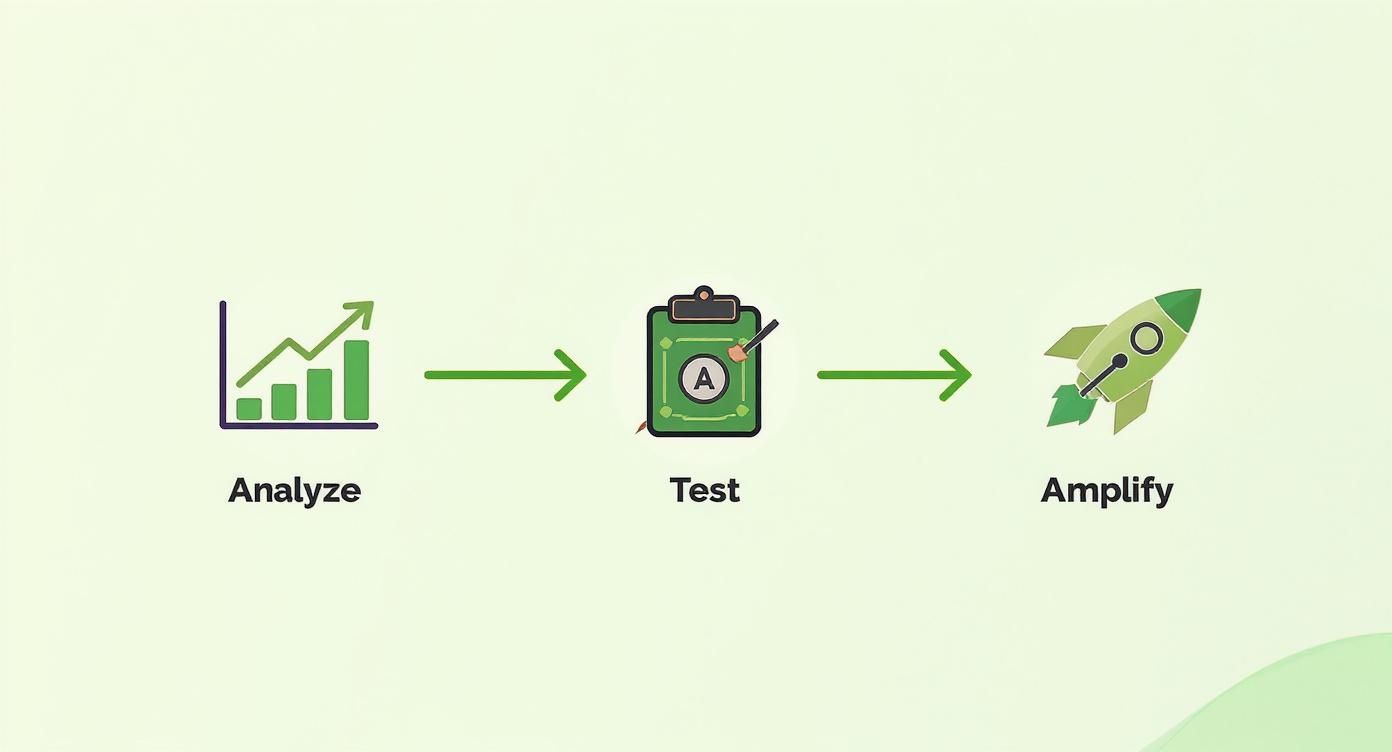
This simple, repeatable process ensures every pricing decision is informed by data, tested for impact, and scaled for maximum effect. By putting this playbook into action, you create a system for sustained success, turning the chaos of the Amazon marketplace into a predictable engine for your brand's growth.
Let's be honest: navigating Amazon's pricing landscape can feel like a full-time job. To cut through the noise, I've rounded up some of the most common questions sellers ask.
Think of this as your practical playbook—clear answers to help you apply everything we've talked about and build a stronger, more profitable pricing strategy.
This really boils down to how competitive your products are. If you're selling items where a dozen other sellers are fighting for the Buy Box, you almost have to use an automated repricer. Without one adjusting your price in near real-time, you're always going to be one step behind.
But for private label brands or products in a less crowded space, that's often overkill. A manual review once a week, or even every two weeks, is usually plenty. The point isn't just to change prices for the sake of it. The goal is making strategic adjustments based on data—whether that’s to drive sales or protect your hard-earned margins.
A price war is the dreaded "race to the bottom." It’s what happens when sellers just keep undercutting each other, usually because their repricing tools are set up poorly. It’s a vicious cycle that destroys profit margins for everyone until nobody is making a dime.
The only way to win a price war is to refuse to play. Never build your strategy around simply having the lowest price. Your guardrail has to be profitability. Compete on your full offer—feedback score, shipping speed, and stock levels—not just the dollar amount.
To avoid this trap, you need to set a firm minimum price floor in your repricing software. This isn't a suggestion; it's a hard stop calculated from your cost of goods, all Amazon fees, and the profit you need to make. This ensures your repricer never gives away the farm for you.
Every single FBA fee change—from the yearly adjustments to the new low-inventory-level fees or inbound placement charges—is a direct hit to your cost per unit. You can't just absorb these. They have to be baked into your pricing to protect your bottom line.
This means you need to be doing regular profit audits on your entire catalog. As soon as a new fee hits, recalculate your break-even point and minimum price floors for every ASIN it affects. Some products might need a price bump to stay profitable. For others, the new costs might mean it's time to bundle them or rethink your inventory strategy altogether. Ignoring these Amazon pricing changes is the fastest way to watch your profits disappear.
Keeping up with Amazon's constant shifts is more than a full-time job. At RedDog Group, we help sellers move from being reactive to becoming proactive leaders in their categories. Our team blends deep marketplace knowledge with a proven framework (Foundation → Optimization → Amplification) to build brands that are resilient, profitable, and ready to scale.
Ready to turn pricing chaos into your biggest competitive advantage? Let’s Talk Growth.
Leave a comment: