
Published: March 2020 | Last Updated:April 2026
© Copyright 2026, Reddog Consulting Group.

TL;DR:
- Emerging CPG brands often underestimate true costs, leading to razor-thin or negative margins.
- Optimizing listings, controlling costs, and ensuring compliance are key for profitable marketplace growth.
- Hybrid fulfillment and strategic pricing are crucial tactics to maximize margins and competitive advantage.
Scaling a CPG brand on Amazon or Walmart sounds straightforward until the first real margin statement hits. Hidden fees, platform rule changes, and ad costs quietly drain profits that looked healthy on paper. Many emerging brands hit strong revenue numbers only to discover their actual net margin is razor thin, or worse, negative. The platforms keep raising fees, adding requirements, and shifting algorithms in ways that catch operators off guard. This article cuts through the noise with field-tested strategies to help you control costs, optimize listings, stay compliant, and build a marketplace operation that actually generates profit, not just volume.
| Point | Details |
|---|---|
| Know your true margins | Real profit comes from tracking all fees and using net margin, not just top-line sales. |
| Optimize listings and ads | Smart optimization of product content and ads drives discoverability and bigger returns. |
| Monitor key metrics | Meeting platform compliance standards is vital for account health and growth. |
| Strategic tactics win | Mixing hybrid fulfillment and smart pricing turns marketplace rules into advantages. |
To maximize profit and avoid margin shocks, brands must understand what they’re really earning per sale. This is where most emerging CPG brands go wrong first. They look at gross margin and feel good. Then the real costs arrive.
Your gross margin tells you how much you make before platform fees and operating costs. Your net margin tells you what you actually keep. On Amazon, net margins of 12-20% represent viable CPG performance after all costs, including FBA fees, referral fees, advertising, and returns. A 45% gross margin sounds great until fees, ads, and logistics cut it nearly in half.
In 2026, Amazon FBA fees rose $0.08 per unit, and referral fees run 8-15% depending on category. Those numbers compound fast across volume. Understanding the full Amazon FBA fee breakdown is not optional. It’s the foundation of every pricing decision you make.
Here are the hidden costs every seller must account for in their model:
Here’s what a real unit economics model looks like for a hypothetical CPG product:
| Cost component | Amount |
|---|---|
| Sale price | $22.00 |
| COGS (product + packaging) | $6.00 |
| Referral fee (12%) | $2.64 |
| FBA fulfillment fee | $4.50 |
| Advertising (15% of revenue) | $3.30 |
| Returns and misc. | $0.80 |
| Net profit per unit | $4.76 |
| Net margin | ~21.6% |
That’s a healthy example. Many brands operate below that line without realizing it. Review the full fulfillment cost guide before you price any SKU.
Pro Tip: Stress-test every new SKU’s economics using the actual current fee schedules before launch. Build your pricing from the net margin backward, not from the gross margin forward.
Once you control your costs, increasing marketplace sales means mastering both how your products are presented and how you promote them. A well-priced product with a weak listing is invisible. A great listing with poor ad strategy burns cash.
Here’s a step-by-step approach to listing optimization that consistently improves conversion:
The results of combining listing quality with smart ad strategy are real. Farallon achieved 50% GMV growth on Walmart by combining lower CPC ad tactics with improving their Listing Quality Score from 81% to 90%. Mondelēz saw a 64% ROAS improvement on Walmart. TRUBAR moved 17,000 units through focused ad and content work.
“Brands that treat listing quality and advertising as separate functions leave significant margin on the table. The compounding effect of high-quality content and precise ad targeting is where real GMV growth happens.”
For CPG brands, the Amazon ad strategy that works is built on tight keyword grouping, negative keyword hygiene, and bid management tied to net margin targets. Not just ROAS. A high ROAS on a low-margin product still loses money. Think about margin-first advertising where every ad dollar is evaluated against contribution margin, not just top-line return.

Driving sales means nothing if your account gets warnings or is shut down for missing opaque requirements. Marketplace compliance is operational infrastructure, not a back-office concern.
Walmart’s required seller metrics are specific and unforgiving:
Failing these thresholds leads to listing suppression or account suspension. These aren’t soft guidelines.
Here’s how Amazon and Walmart compare on major performance standards:
| Metric | Amazon standard | Walmart standard |
|---|---|---|
| Order defect rate | Under 1% | Tracked but not publicly tiered |
| Cancellation rate | Under 2.5% | Under 2% |
| Late shipment rate | Under 4% | On-time delivery above 95% |
| Response time | 24 hours | 48 hours |
| Valid tracking | Required | Above 99% |
Amazon’s standards have more tiers and nuance, but Walmart is catching up with enforcement speed. Review the full Walmart vs Amazon metrics comparison to understand where your risk exposure sits.
Tactically, the brands that stay consistently compliant do a few things differently. They build a compliance dashboard that surfaces each metric daily, not weekly. They set internal thresholds 10-15% tighter than platform minimums so they always have buffer. And they treat supplier lead times and carrier performance as compliance inputs, not logistics afterthoughts.
With compliance in hand, strategic operators turn their focus to tactical maneuvers that give them an edge and unlock maximum margin. The brands winning in 2026 don’t just list products. They engineer their channel economics deliberately.
Here’s the tactical toolkit that separates reactive sellers from operators who play offense:
Pro Tip: Audit your current SKU roster and map each product to a fulfillment method and marketplace based on net margin, not convenience. Moving three slow SKUs from FBA to FBM can free up significant cash and improve your IPI score at the same time.
For a broader playbook, the advanced marketplace strategy framework and third-party growth lessons from established brand operators are worth reviewing before your next planning cycle.
Here’s the uncomfortable truth most consultants won’t say directly: high sales volume is not proof of a healthy business. We’ve seen brands doing $4M in Amazon revenue operating at negative contribution margin because they never rebuilt their unit economics after fee increases hit.
Most sellers react to platform changes. Top performers anticipate them. They model fee scenarios in advance, build pricing cushion, and have a SKU rationalization framework ready before costs spike. They treat marketplace compliance like a financial control, not a chore.
The brands generating sustainable net margin layer three things simultaneously: disciplined cost accounting at the SKU level, creative advertising tied to margin targets, and hybrid fulfillment matched to velocity. None of those elements alone is enough. Combined, they create a flywheel that competitors running on gross margin instincts can’t match.
The successful brand case studies prove it. The brands winning aren’t luckier. They’re more deliberate.
If you’ve read this far, you already know that winning on Amazon and Walmart is an operational discipline, not a marketing trick. The strategies above work. But implementation speed and execution quality are where most brands leave money behind.
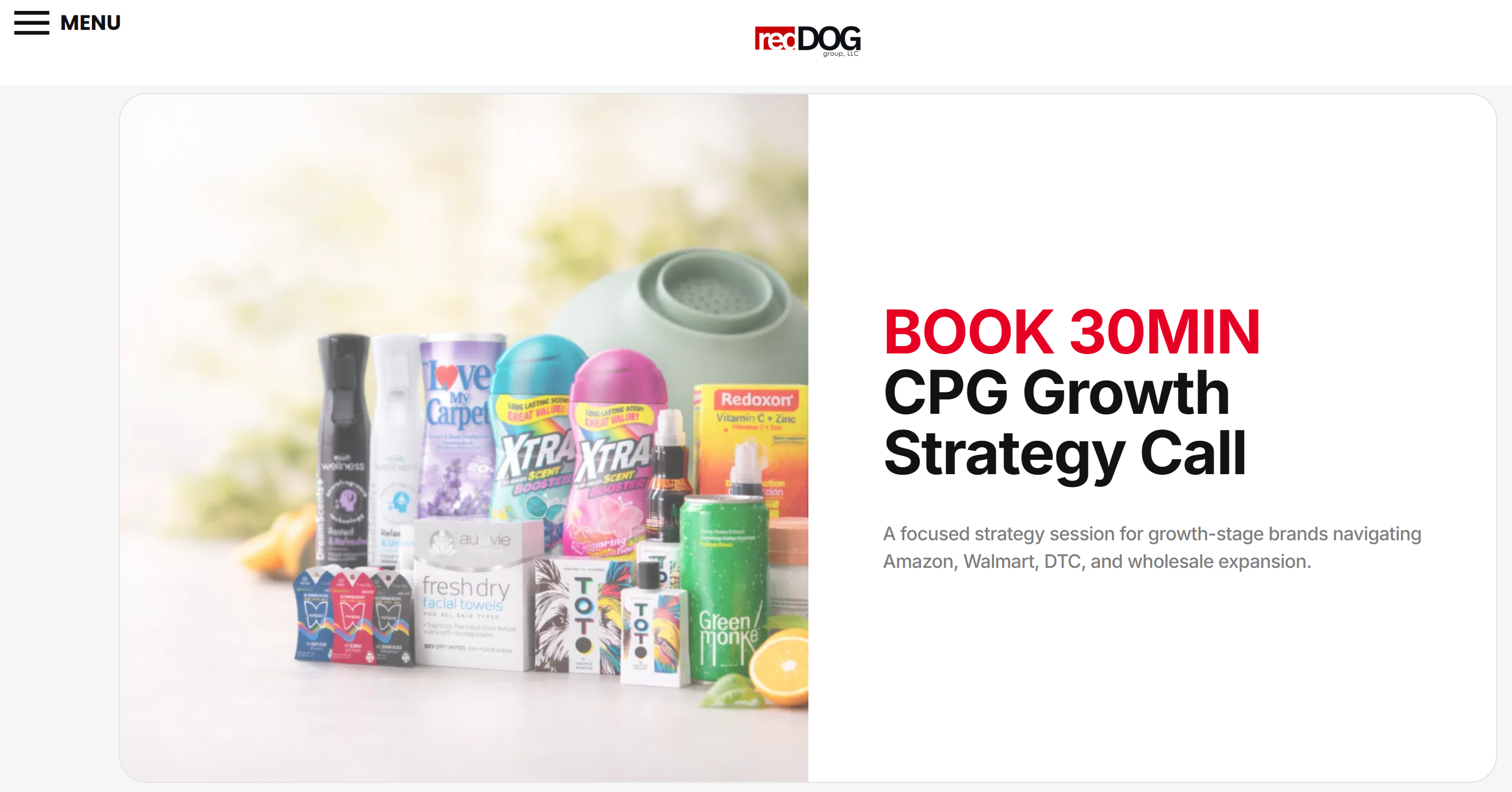
At RedDog Group, we work directly with CPG founders and operators to build margin-first marketplace systems across Amazon, Walmart, DTC, and wholesale. From fee modeling and listing audits to ad strategy and hybrid fulfillment planning, our approach is built around what actually moves the needle. If you’re ready to stop reacting and start engineering profitable growth, explore our CPG retail growth solutions and let’s talk about what’s eating your margin.
Net margin equals your profit after subtracting all Amazon fees, advertising spend, returns, and fulfillment costs from your sale price. With FBA fees up $0.08 per unit and referral fees at 8-15%, viable CPG brands typically land in the 12-20% net margin range.
You must maintain under 2% cancellation, above 95% on-time delivery, above 99% valid tracking, under 6% refund rate, and respond to customer inquiries within 48 hours. Missing any of these thresholds risks listing suppression or account suspension.
Hybrid fulfillment—matching each SKU to FBA, FBM, or Walmart Fulfillment Services based on velocity and net margin—is consistently underused. As outlined in unit economics guidance, this single change often unlocks major net profit gains without touching your top line.
Improve your Listing Quality Score first, then run lower-cost, high-intent ad formats. Farallon’s 50% GMV growth and Mondelēz’s 64% ROAS improvement both came from combining listing quality improvements with disciplined, targeted ad spend rather than simply increasing budget.
Leave a comment: