
Published: March 2020 | Last Updated:March 2026
© Copyright 2026, Reddog Consulting Group.

Amazon remains a powerful sales channel for CPG brands, but rising fees and intensifying competition are squeezing margins harder than ever. In 2026, simply hitting revenue targets isn’t enough. You need a profit-first approach that accounts for every fee, optimizes fulfillment, and builds resilient unit economics. This guide walks you through the operational realities, margin math, and strategic decisions that separate profitable Amazon sellers from those burning cash on growth that doesn’t pay. Whether you’re already on Amazon or planning your entry, these insights will help you maximize net margin and scale sustainably.
| Point | Details |
|---|---|
| Fee increases demand precision | Amazon FBA fees rose $0.08 per unit in 2026, tightening margin windows across all categories. |
| Net margin is the real metric | Gross margin alone misleads; net margin reveals true profitability after all Amazon costs. |
| Fulfillment choice impacts profit | Seller Fulfilled Prime offers margin control but requires 93.5% on-time delivery to maintain Prime status. |
| Category selection matters | Pet health supplements and similar niches show stronger net margins due to favorable unit economics and customer behavior. |
| Stress test before launch | Running a margin stress test before launching products prevents costly surprises and protects cash flow. |
Amazon’s fee structure evolved significantly in 2026, and these changes hit CPG brands particularly hard. FBA fees increased by an average of $0.08 per unit, which might sound minor until you calculate the annual impact across thousands of units. For a brand moving 50,000 units annually, that’s an extra $4,000 in costs eating directly into your bottom line. When you’re operating on thin margins already, every penny compounds.
The distinction between gross margin and net margin becomes critical here. Gross margin measures revenue minus cost of goods sold, giving you a surface-level view of profitability. Net margin, however, accounts for every Amazon fee: referral fees, FBA fulfillment, storage, outbound shipping, advertising costs, and returns processing. Gross margin alone is misleading because it ignores the operational reality of selling on Amazon. A product with 45% gross margin might deliver only 12% net margin after Amazon takes its cut.
Here’s what you’re actually paying Amazon on every sale:
These fees stack quickly, especially for products with complex packaging or seasonal demand patterns. A supplement brand selling a 12 oz bottle might pay $4.50 in FBA fees plus 15% referral on a $25 sale, leaving $16.75 before accounting for COGS, storage, or advertising. If your landed cost is $8 and you’re spending $3 on PPC to acquire the sale, you’re netting $5.75, a 23% net margin that looks healthy until a fee increase or PPC bid war compresses it further.
Fee increases demand immediate operational adjustments. You can’t simply absorb higher costs and hope volume compensates. Pricing strategies need recalibration to maintain margin targets without sacrificing competitiveness. Operational efficiency becomes non-negotiable: faster inventory turns reduce storage costs, better forecasting prevents long-term storage fees, and tighter PPC management protects customer acquisition economics. For a detailed breakdown of how each fee impacts your P&L, review this Amazon fee breakdown guide.
Operational simplicity and unit economics resilience are your margin drivers. Products with straightforward fulfillment, low return rates, and strong repeat purchase behavior naturally deliver better net margins. Complex products requiring extensive customer support or generating high return rates bleed margin even if gross profit looks attractive. Before launching any product on Amazon, model every fee scenario to understand your true profit per unit.
Choosing the right product category sets the foundation for sustainable profitability on Amazon. Not all categories offer equal margin potential. Pet health supplements, for example, consistently show stronger net margins because they combine favorable unit economics with high customer lifetime value and repeat purchase behavior. These products typically have lower return rates, manageable shipping costs relative to price point, and customer acquisition costs that pay back within one or two purchases. Categories with opposite characteristics, like electronics or apparel with high return rates, struggle to clear 15% net margins even with strong gross profit.
Sustainable 20%+ net margins require three non-negotiable conditions: operational simplicity, low customer acquisition cost to lifetime value ratio, and unit economics resilience. Operational simplicity means your product ships easily, requires minimal customer support, and generates few returns or complaints. Low CAC to LTV ratio means you’re spending less to acquire customers than they’ll generate in profit over their relationship with your brand. Unit economics resilience means your per-unit profit holds up under fee increases, competitive pricing pressure, and operational hiccups. Categories failing these conditions rarely clear 15% net margin regardless of top-line growth.
Margin stress testing before launch prevents expensive mistakes. This process involves modeling your unit economics under multiple scenarios: base case, fee increase, competitive price pressure, higher PPC costs, and elevated return rates. You input your COGS, expected selling price, all Amazon fees, estimated advertising spend, and return rate to calculate net margin. Then you stress test by increasing fees 10%, dropping price 15%, or doubling PPC spend to see if your margin holds. Products that fail stress testing under realistic scenarios will bleed cash at scale. Use tools like this retail profit margin calculator to run these numbers before committing inventory dollars.
Fulfillment method choice directly impacts your margin structure and operational complexity. Amazon FBA offers convenience and Prime eligibility but comes with higher fees and less control over customer experience. Seller Fulfilled Prime gives you margin control and operational flexibility while maintaining Prime badge benefits, but demands rigorous performance standards and significant logistics capability. The decision hinges on your operational maturity, margin targets, and growth stage. Early stage brands often start with FBA for simplicity, then graduate to SFP once volume justifies building fulfillment infrastructure.

Pro Tip: Validate your entire operational workflow and cost structure at small scale before committing to large inventory orders. Run a test batch of 500 units through your chosen fulfillment method, track every cost down to the penny, and verify your margin model matches reality. This small investment in validation prevents margin erosion at scale and identifies hidden costs your initial model missed. For strategic guidance on optimizing your Amazon approach, explore this Amazon selling strategies guide.
Operational basics extend beyond fulfillment to inventory management, forecasting accuracy, and cash flow timing. Overstocking drives storage fees and ties up working capital. Understocking causes stockouts that kill momentum and ranking. Accurate demand forecasting, safety stock calculations, and reorder point triggers keep inventory lean while maintaining availability. These operational fundamentals separate profitable sellers from those constantly firefighting inventory crises.
Pricing strategy requires balancing competitive positioning with margin protection. You need data on competitor pricing, customer price sensitivity, and your own margin floor to set prices that win the Buy Box without sacrificing profitability. Dynamic repricing tools help maintain competitiveness, but blindly matching lowest price destroys margins. Instead, establish a margin floor based on your stress-tested unit economics, then compete on value differentiation: better product quality, superior customer service, or enhanced brand experience that justifies premium pricing. For detailed approaches, review these Amazon pricing strategies.
Fulfillment method alignment with margin goals and customer promise determines long-term profitability. Seller Fulfilled Prime offers the most margin control because you manage warehousing, pick and pack, and shipping directly. This eliminates FBA fees but requires meeting Amazon’s strict performance standards: 93.5% on-time delivery minimum, less than 1% cancellation rate, and same-day or one-day delivery in qualifying regions. Missing these thresholds costs you Prime eligibility and tanks conversion rates. Traditional FBA simplifies operations but compresses margins through higher fees. The choice depends on whether you have fulfillment infrastructure and operational discipline to execute SFP successfully. Learn more about Seller Fulfilled Prime fulfillment requirements and benefits.
Maintaining Seller Fulfilled Prime standards demands operational excellence and real-time monitoring. You need reliable carrier partnerships, backup fulfillment options for peak periods, and systems to track performance metrics daily. One week of poor performance can trigger Prime suspension, immediately impacting sales velocity and profitability. Invest in warehouse management systems, carrier integrations, and performance dashboards that alert you to issues before they breach Amazon’s thresholds. The operational complexity is significant but the margin benefit justifies the investment for brands with sufficient volume.
Customer experience optimization reduces cart abandonment and boosts conversion rates. Average cart abandonment across studies sits around 70.22%, meaning most shoppers who add your product to cart never complete purchase. Reducing abandonment even slightly drives substantial revenue gains. Key tactics include optimizing product images and descriptions for clarity, ensuring competitive pricing relative to alternatives, streamlining the checkout process, and providing clear delivery timelines. Enhanced brand content, A+ pages, and strong review profiles build buyer confidence and reduce purchase hesitation.
In 2026, fulfillment is harder because customer expectations did not slow down, but costs increased. Meeting Prime delivery standards while controlling costs requires operational precision and strategic fulfillment partnerships.
Rising fulfillment costs make operational efficiency non-negotiable. Every hour your team spends on manual processes, every percentage point of picking errors, and every day of excess inventory holding costs you margin. Automation, process optimization, and strategic 3PL partnerships help control costs while maintaining service levels. For brands scaling beyond $2M in Amazon revenue, investing in fulfillment infrastructure or partnering with specialized 3PLs often delivers better unit economics than pure FBA reliance.
Customer retention through exceptional experience compounds profitability over time. Acquiring a customer costs significantly more than retaining one, so brands that deliver outstanding post-purchase experience build higher lifetime value and lower blended CAC. Proactive communication, fast issue resolution, and surprise-and-delight moments turn one-time buyers into repeat customers who cost nothing to reactivate. This customer-centric approach protects margins while building sustainable competitive advantage.
Tracking the right profitability metrics separates profitable growth from vanity metrics. Net margin shows true profitability after all costs. CAC to LTV ratio reveals whether your customer acquisition investment pays back. Unit economics resilience indicates whether your margin holds under stress. Monitor these metrics monthly, not quarterly, to catch margin erosion early. A product showing 22% net margin in month one but 16% in month three signals problems requiring immediate investigation: rising PPC costs, increased return rates, or competitive pricing pressure.
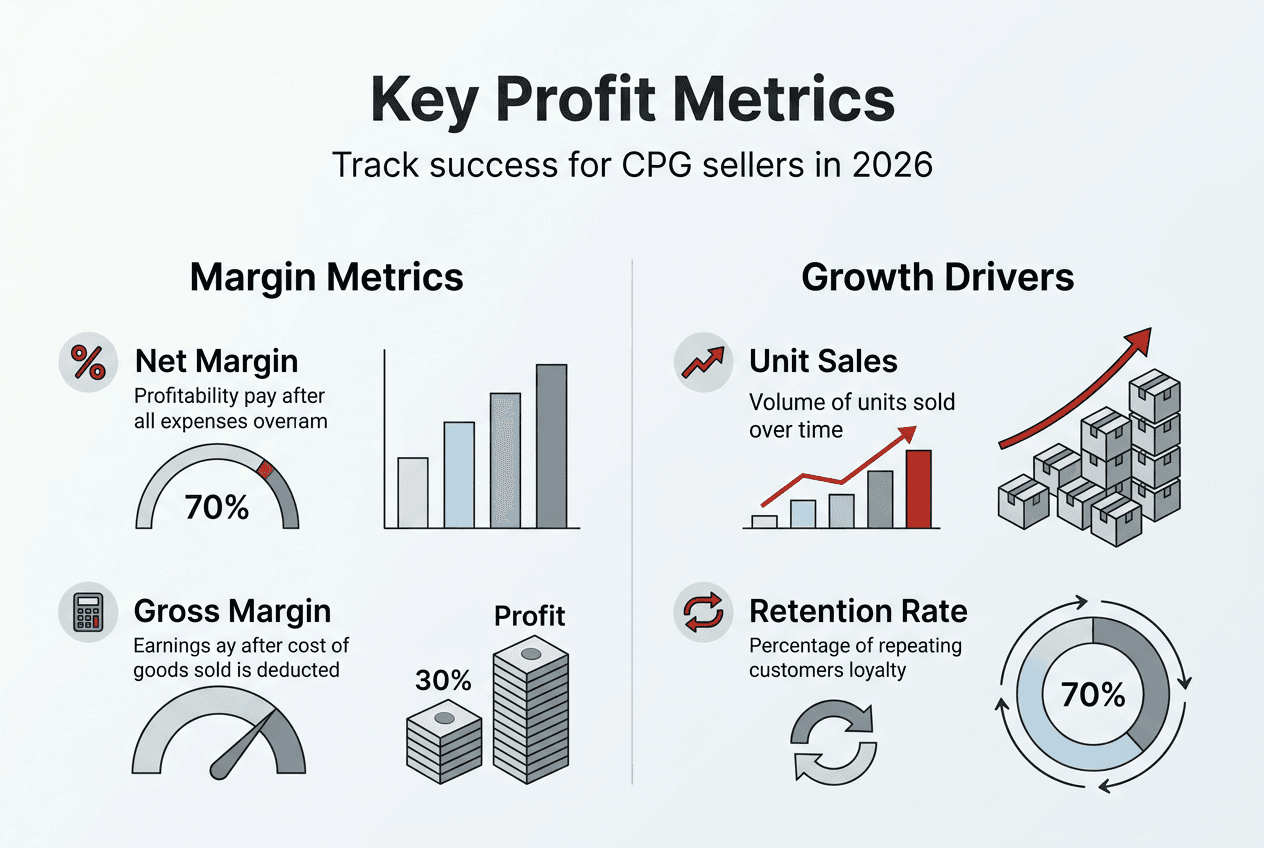
Here’s how different scenarios impact your margin profile:
| Scenario | Gross Margin | Net Margin | Key Driver | | — | — | — | | Base case | 45% | 20% | Optimized operations, stable fees | | 10% fee increase | 45% | 17% | Higher FBA and referral costs | | 15% price cut | 38% | 12% | Competitive pressure, margin compression | | Double PPC spend | 45% | 14% | Customer acquisition cost spike | | SFP vs FBA | 45% | 24% | Lower fulfillment fees, higher control |
This comparison illustrates how external factors and strategic choices impact profitability. The base case assumes optimized operations with current fee structure. A 10% fee increase drops net margin three points even though gross margin holds steady. Competitive price pressure requiring a 15% cut crushes both gross and net margin. Doubling PPC spend to maintain visibility cuts net margin nearly in half. Switching to Seller Fulfilled Prime adds four margin points by eliminating FBA fees, assuming you can meet performance standards.
Conducting margin stress tests before launching products protects against costly surprises. Run a margin stress test by modeling worst-case scenarios: fees increase 15%, you need to drop price 20% to stay competitive, PPC costs double, and return rates hit 8%. If your net margin survives these conditions, your product has resilient unit economics. If margin goes negative or drops below 10%, the product is too risky to scale. This exercise forces honest assessment of margin durability before committing significant capital.
Pro Tip: Create a monthly margin scorecard comparing actual performance against operational benchmarks. Track net margin, CAC to LTV ratio, inventory turn rate, and fulfillment cost per unit. When any metric drifts 10% from target, investigate immediately. Early detection of margin erosion allows corrective action before problems compound. Waiting for quarterly reviews means months of profit leakage before you identify and fix issues.
Sustainable scaling requires multichannel expansion beyond Amazon to reduce platform risk and access new customer segments. Relying solely on Amazon concentrates risk: algorithm changes, policy updates, or account issues can devastate revenue overnight. Expanding to Walmart, DTC, wholesale, and regional distribution diversifies revenue streams and builds brand resilience. Each channel has unique economics and operational requirements, but multichannel presence protects against single-platform dependency while opening growth opportunities. For comprehensive guidance on retail expansion, review this Amazon retail growth success resource.
Scaling sustainably means growing revenue while maintaining or improving net margin. Too many brands chase top-line growth at the expense of profitability, burning cash to hit revenue milestones that don’t translate to sustainable business value. Profitable scaling requires disciplined unit economics, operational leverage, and strategic channel expansion. Grow where you can maintain target margins, pause or exit channels that consistently underperform, and reinvest profit into initiatives that compound returns over time.
Navigating Amazon’s complex fee structure, optimizing fulfillment operations, and scaling profitably across multiple retail channels demands specialized expertise and data-driven strategy. RedDog Group helps CPG brands earning $500K to $20M annually build sustainable profitability on Amazon while expanding strategically into Walmart, DTC, wholesale, and distribution. We focus on contribution margin analysis, operational clarity, and retail expansion readiness, not just top-line growth.
Our approach combines marketplace performance optimization with physical retail strategy, helping you understand what each channel actually contributes to profit and where margin leaks are hiding. Whether you need Amazon fee structure analysis, fulfillment strategy optimization, or multichannel expansion planning, we provide the analytical frameworks and execution support to scale profitably. Explore our omnichannel growth solutions to see how we help brands like yours maximize profitability and build resilient retail operations.
Amazon increased FBA fees by approximately $0.08 per unit on average in 2026, adding meaningful cost pressure across all size tiers. This increase compounds with existing referral fees, storage costs, and outbound shipping to tighten margin windows significantly. For brands moving significant volume, this translates to thousands of dollars in additional annual costs that require immediate pricing or operational adjustments to maintain profitability.
Seller Fulfilled Prime offers the strongest margin control by eliminating FBA fees, but demands 93.5% on-time delivery performance to maintain Prime eligibility. Traditional FBA provides operational simplicity and guaranteed Prime badge but compresses margins through higher fees. The optimal choice depends on your operational capabilities, volume scale, and margin targets. Brands with established fulfillment infrastructure often achieve 3-5 percentage points higher net margin through SFP compared to FBA.
Optimize product listing quality with clear images, detailed descriptions, and competitive pricing to reduce buyer hesitation. Fast, reliable fulfillment with transparent delivery promises lowers abandonment by building purchase confidence. Enhanced brand content, A+ pages, and strong review profiles provide social proof that converts browsers into buyers. Cart abandonment averages 70.22%, so even small improvements in listing quality and customer experience drive substantial revenue gains.
Pet health supplements, specialty food products, and consumables with high repeat purchase rates consistently deliver stronger net margins due to favorable unit economics and customer behavior. These categories typically feature manageable shipping costs relative to price point, lower return rates, and strong customer lifetime value that justifies acquisition costs. Categories with opposite characteristics, like electronics or fashion with high return rates and low repeat purchase, struggle to maintain 15% net margins even with attractive gross profit.
Model your unit economics under multiple scenarios: base case, 10% fee increase, 15% price reduction, doubled PPC costs, and elevated return rates. Input your COGS, expected selling price, all Amazon fees, advertising spend, and return rate to calculate net margin for each scenario. Products that maintain 15%+ net margin across all stress scenarios have resilient unit economics worth scaling. Those that go negative or drop below 10% in realistic worst-case scenarios present too much risk for significant inventory investment.
Leave a comment: