
Published: March 2020 | Last Updated:October 2026
© Copyright 2026, Reddog Consulting Group.

Your shipment's checked in, your ads are ready, and your forecast says you should be selling. Instead, units sit in receiving, counts don't match the ASIN you expected, and someone on your team is opening a case while the replenishment window closes. That's the cost of weak Labels for FBA. It isn't the price of a sticker. It's inventory velocity, contribution margin, and days of sellable stock lost to a problem that started at the prep table.
A barcode can scan perfectly and still be the wrong barcode. It can sit on the wrong variation, carry the wrong condition, or identify another seller's inventory path. Amazon doesn't care that your printer worked. Receiving cares whether the physical unit in hand matches the catalog record the code points to.
Amazon requires every item shipped to a fulfillment center to have a barcode so it can be identified and tracked, and compliant label information connects that sellable unit to the correct catalog record, condition, and fulfillment workflow. Treat that as the definition of the job. A label is an inventory control, not packaging decoration.
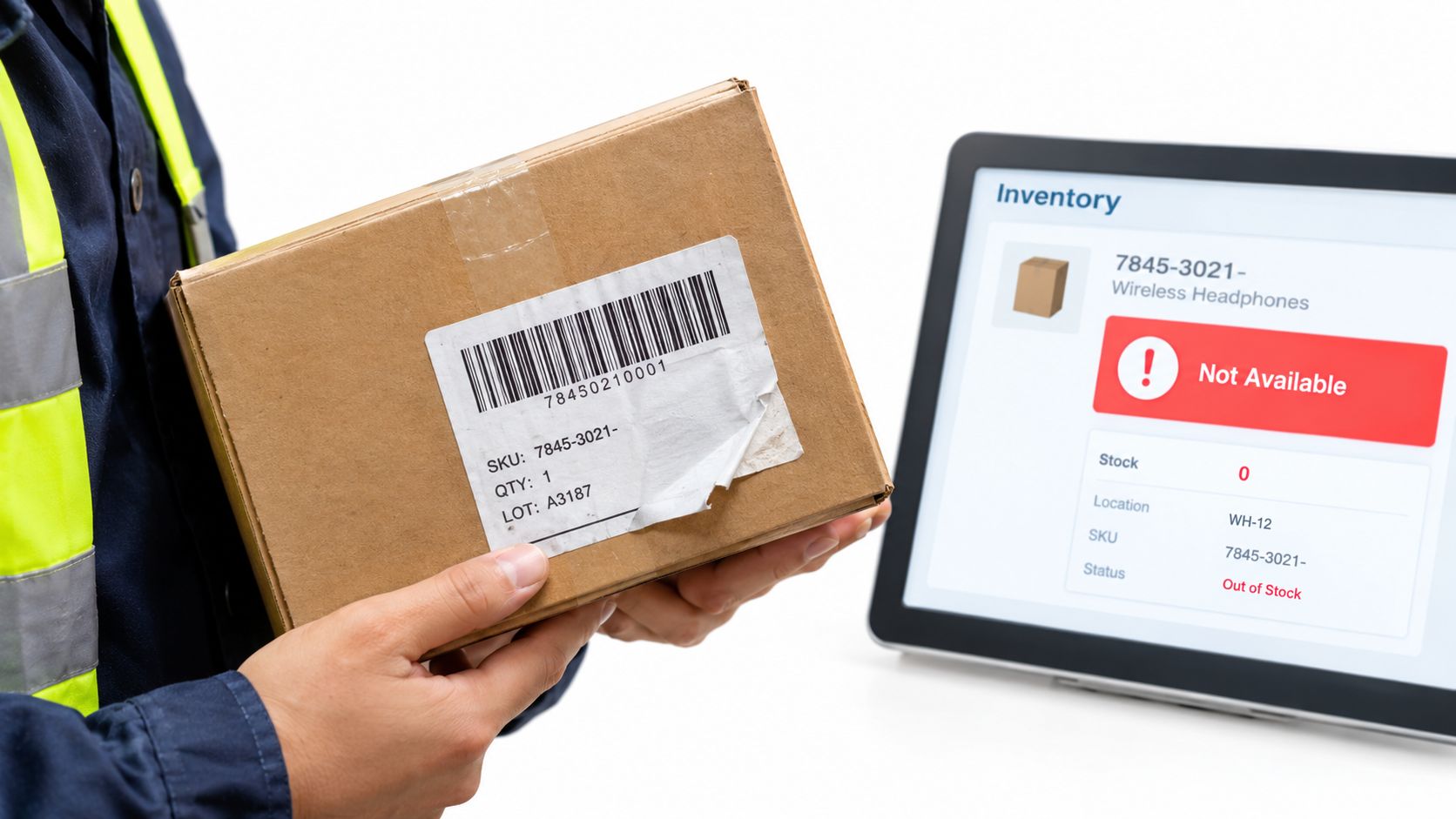
When identity breaks, you pay in layers. Your team pays for relabeling labor and freight decisions made under pressure. Amazon receiving takes longer, so sellable inventory arrives late. Advertising then pushes traffic to a listing with thin stock, or you throttle spend and lose rank momentum you already paid to build.
CPG products make this worse because the unit itself carries other critical information. A topical product is a good example. If you're reviewing how similar body care items present size, scent, and variant details before a co-packer run, you might browse rose shea butter options to see how much variant information a small jar has to communicate. On FBA, scent, size, and condition can't be left to visual recognition at receiving. The barcode has to settle it.
A label error rarely costs you a label. It costs you time the unit could have been selling.
That's why reliable SKU identity belongs in Foundation, the first stage of RedDog's Foundation to Optimization to Amplification framework. Pricing tests, PPC structure, and channel expansion don't fix units Amazon can't confidently identify. Get the unit identity right first, then optimize what's built on top of it.
Start with who you are in relation to the brand, not with what's already printed on the box. That's the shift many sellers still miss. The same physical SKU can require a different labeling workflow depending on seller role, Brand Registry status, product eligibility, inventory ownership, and destination marketplace.
Manufacturer barcodes are the identifiers applied for general retail use, including UPC, EAN, JAN, and ISBN. Amazon barcodes are different. They're the FNSKU labels Amazon generates for FBA, and they begin with the letter X. The manufacturer code identifies the product. The FNSKU ties that product to your seller specific FBA inventory record, including the exact ASIN and condition.
The image below frames that split before you generate anything in Seller Central.
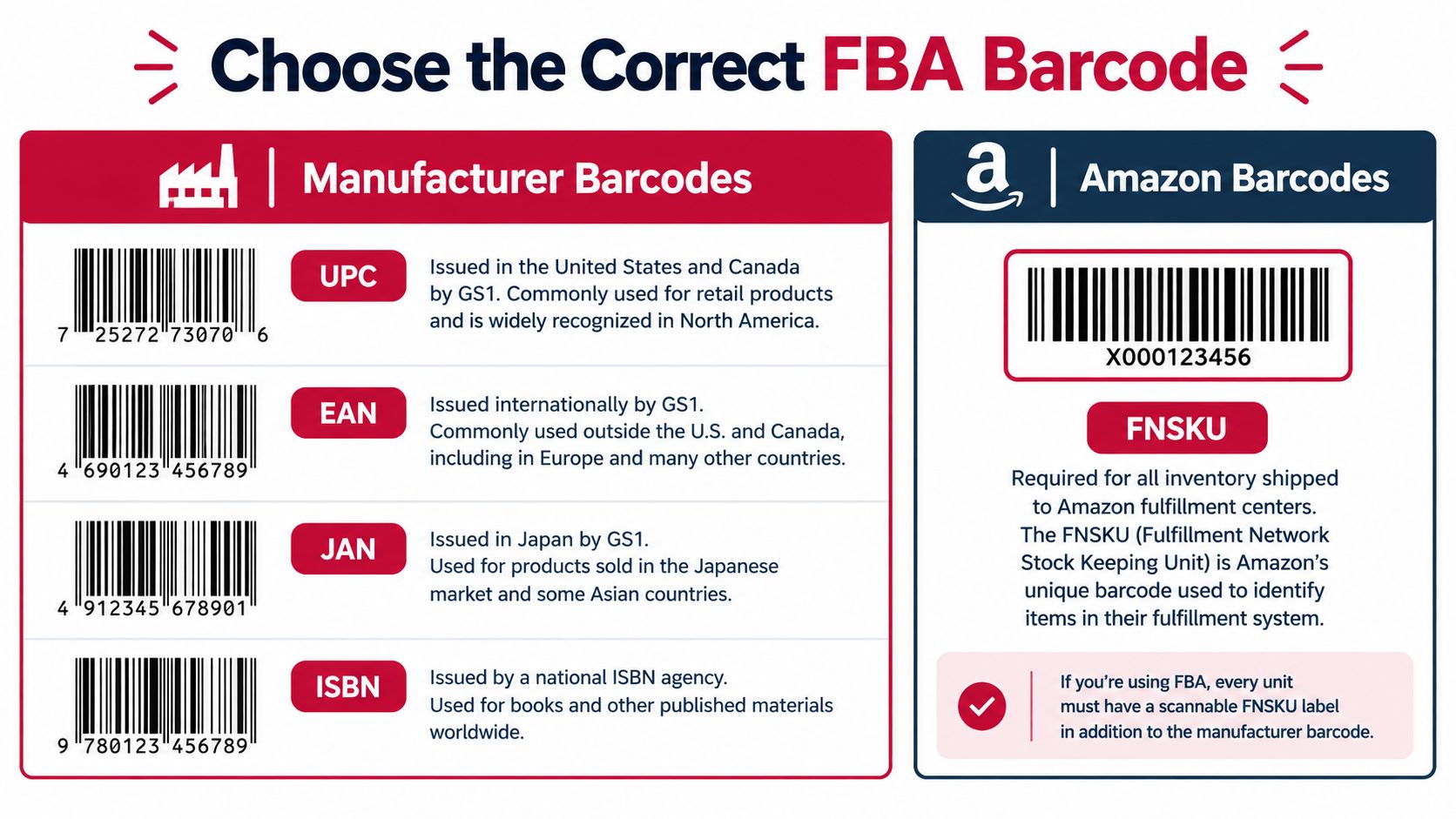
Beginning March 31, 2026, brand owners with the Brand Representative role in Brand Registry can continue using eligible manufacturer barcodes without stickers, while all resellers, including authorized resellers, must use Amazon barcodes even when a manufacturer barcode exists. Don't soften that distinction. Authorized doesn't mean exempt.
For brand owners, eligibility still isn't automatic. The product and account have to meet Amazon's conditions for manufacturer barcode tracking. If they don't, you use an Amazon barcode. For resellers, the decision is already made, so build the FNSKU step into your landed cost and prep timeline rather than treating it as an exception.
If your team still uses UPC, ASIN, SKU, and FNSKU interchangeably in internal documents, fix that language first with a clear breakdown of Amazon product identifiers. Sloppy naming at the desk becomes sloppy labeling at the bench.
| Seller Situation | Likely Label Path | Key Control |
|---|---|---|
| Brand Representative with eligible product | Manufacturer barcode without sticker | Confirm eligibility before each shipment plan |
| Reseller or authorized reseller | Amazon barcode, the FNSKU | Reconcile FNSKU to ASIN, SKU, variation, and condition |
| Product not eligible for manufacturer tracking | Amazon barcode | Don't rely on a visible UPC as proof of eligibility |
| Expiration dated, consumable, or topical item requiring Amazon tracking | Amazon barcode | Confirm date and prep requirements at the same time |
There's also a control trade-off behind the sticker decision. Manufacturer barcode tracking can expose eligible units to commingling with identical products from other sellers. An FNSKU gives you tighter unit level identity inside FBA. For a CPG brand managing lot integrity, packaging versions, or authenticity concerns, that separation can be worth more than the labor you save by skipping a sticker.
Operator rule: Choose the barcode based on seller role and eligibility first. Print cost comes last.
Reconcile the selected code against the exact ASIN, SKU, variation, and condition before anyone opens a label file. If those four fields don't agree in your shipment worksheet, you don't have a labeling plan yet. You have a receiving problem scheduled in advance.
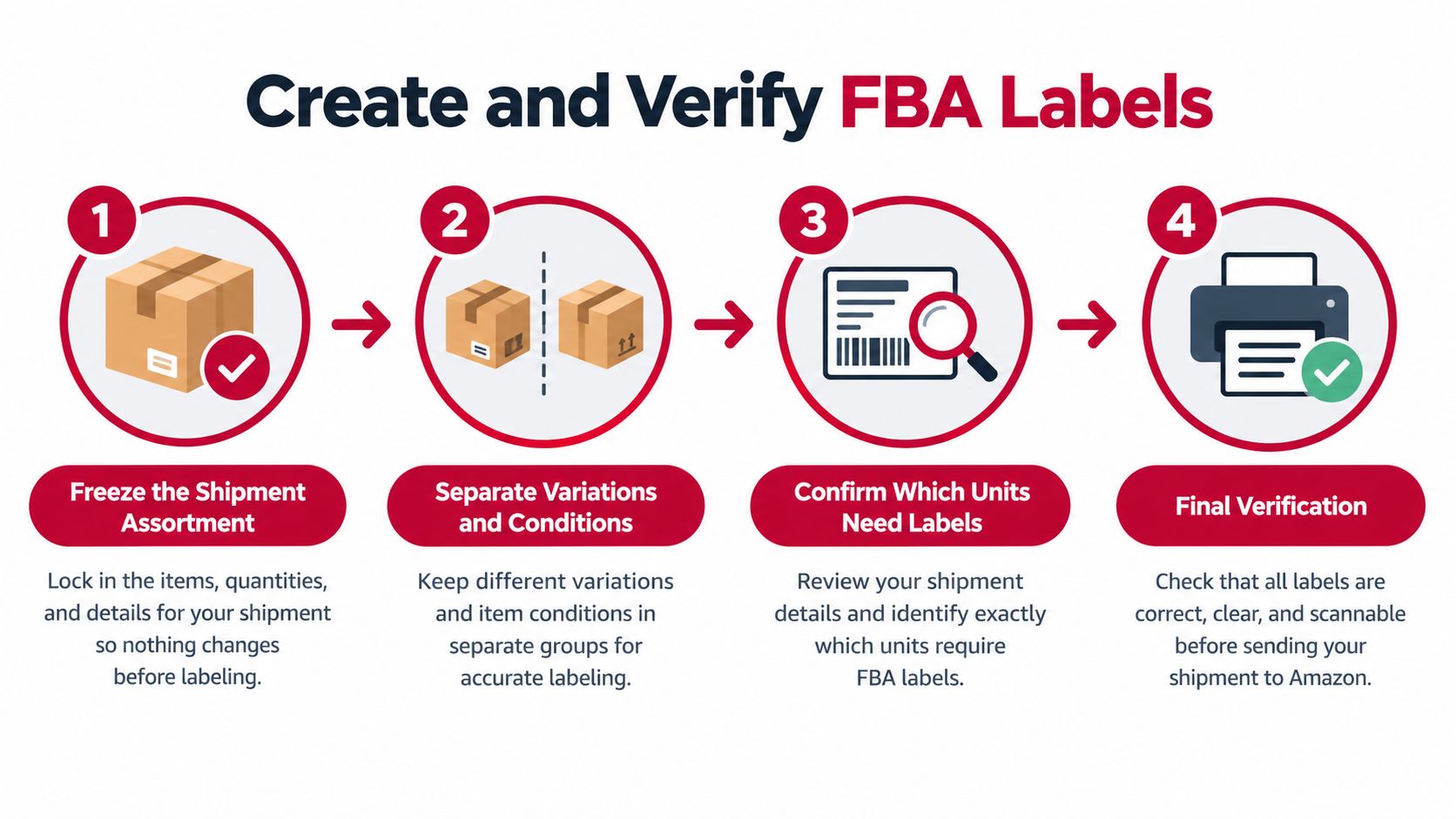
Freeze the assortment before you generate a single label. Lock quantities, variations, conditions, expiration lots where they apply, and carton assignments. Every change after labels print creates orphan labels, and orphan labels eventually find their way onto the wrong units.
Separate the work physically. Don't let two scents, sizes, or pack counts share an open bench, a label stack, or a half packed carton. Most mislabels I've seen weren't printer failures. They were changeover failures, where the product changed and the labels didn't, or the labels changed and a few old units stayed in the flow.
The process view below shows the control sequence your prep lead should run before application begins.
Generate Amazon barcodes from Seller Central for the exact listings in the shipment. Name files by SKU, variation, condition, and print date so your team isn't opening three PDFs called final labels. Print only the quantity needed for the released batch, plus a controlled overage for damaged labels that gets destroyed or logged at the end of the run.
Check the first sheet or first thermal labels before full production. Confirm the FNSKU, product name, and condition match the pick list in your hand, not just the file name on screen. If you're running multiple printers or shifts, repeat that first article check at every handoff.
Watch how that verification discipline looks in practice before you standardize your own bench routine.
The strongest practical control is simple and unforgiving. Scan the source inventory identifier. Scan the printed FNSKU. Compare both against the intended ASIN, SKU, variation, and condition. If the mapping isn't exact, block the unit and pull it from the flow.
A practical release gate is 100% barcode to ASIN agreement before shipment, and Amazon requires every unit in a case pack to carry the appropriate item barcode. A case level barcode is not a unit label, and treating it as one is a reliable way to create a carton full of unidentified sellable units.
Cover every competing visible product barcode when you're applying an Amazon barcode, except permitted serial number or Transparency codes. Preserve regulatory and safety markings while you do it. If your operator has to choose between covering a warning and covering a UPC, your packaging layout is the problem, and that needs escalation before the run continues.
Don't measure this process by labels printed per hour alone. Track first pass scan accuracy, relabel rate, and receiving exception rate. Those three numbers tell you whether speed at the bench is creating slower, more expensive work downstream.
Print quality and placement are packaging engineering problems. A compliant FNSKU that wraps over a bottle curve, sits under a sleeve edge, or gets distorted by shrink film isn't compliant in any way that matters at receiving. Amazon needs an exterior, accessible, scannable code after prep is finished.
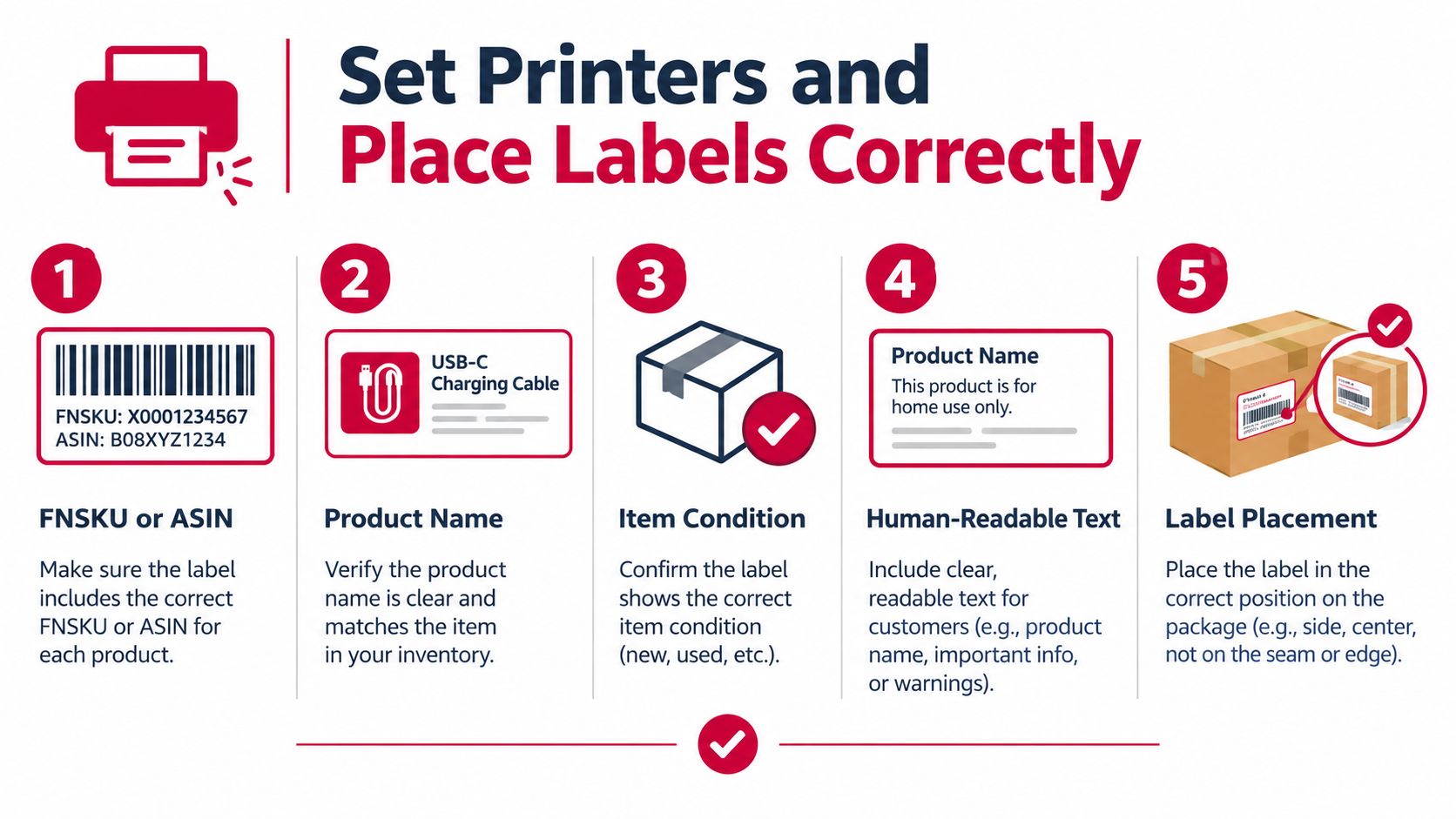
Amazon's Amazon barcode specifications require the ASIN or FNSKU, product name, and item condition, with clear space of at least 0.25 inch on the sides and 0.125 inch on the top and bottom. The label also needs the human readable numbers paired with the scannable code. Build those requirements into your dieline and prep photos, not just your printer settings.
Use the placement checklist in the image below as a bench reference for each packaging format you run.
A rigid carton, a flexible pouch, and a curved bottle don't accept labels the same way. Print a representative test for each format. Apply it where the operator will place it. Then handle the unit the way a warehouse will, stack it, bag it if required, and scan it again.
Thermal printers suit repeat volume because they remove ink variability and handle label stock cleanly. Sheet labels through a laser printer can work for small batches if alignment is controlled. The wrong choice is whichever setup your team can't calibrate consistently. Run a scan test at the start of each batch and after every media change.
Coverage decisions deserve the same discipline. If you're applying an FNSKU, other visible product barcodes must not compete with it. Serial number and Transparency codes stay visible where permitted. Required warnings and regulatory copy stay readable. Food brands face the same layout pressure outside FBA, which is why a resource like a packaging guide for bakery pickup day is useful context for thinking about what information has to survive handling, sealing, and display. On Amazon, that thinking has to include the scanner as a reader, not just the customer.
If the barcode only scans before prep, you haven't tested the condition Amazon will receive.
Photograph an approved finished unit for every SKU and format. Give operators that photo, not a paragraph of placement instructions. When packaging changes, retire the old photo the same day.
A scannable barcode does not rescue a unit whose expiration date disappears under a poly bag. For food, supplements, cosmetics, household chemicals, and temperature sensitive products, labeling and prep compliance are the same system. You can't approve them separately.
For ingestible and other expiration dated products, Amazon requires an expiration date or manufacturing date, and a lot number alone is insufficient. The expiration date entered for the shipment must match the date printed on each item. Any expiration label on the carton must match the product inside it.
Decide placement based on the unit after it's bagged, bundled, wrapped, or kitted. If a product needs poly bagging or bubble wrap, the expiration date needs to remain visible on the outside of that prep. If you're shipping a multipack, the bundle identity and the units inside can't tell two different stories.
Work through these questions for every CPG SKU before the run starts.
Expiration dated FBA inventory also requires an Amazon barcode in the situations covered by Amazon's guidance, so don't plan manufacturer barcode tracking and then discover the date rule at shipment creation. Build the date, lot, and barcode decisions into one SKU level prep sheet.
Consider a supplement brand shipping two lots to cover a replenishment quantity. The units look identical, the FNSKU is correct, and the cartons are neatly packed. If the shipment record says one expiration date and half the bottles carry another, you've created a receiving and inventory control problem before the truck leaves. FIFO discipline at your warehouse only works if lot capture and carton labeling are accurate enough for Amazon to maintain it.
Cosmetics create a different version of the same failure. A jar gets bubble wrapped for protection, the FNSKU goes on the outside, and the batch or date information ends up sealed underneath. The barcode scan passes. The compliance check doesn't. That's why your approved unit photo needs to show the finished, prepped state with barcode, date, and required markings all visible in one frame.
What brands underestimate: Prep materials don't just protect the product. They can hide the information that makes the product acceptable.
Standardize date printing, lot capture, and carton reconciliation before you scale volume. Mixed lots, short dated stock, and relabeling consume margin through labor, removals, and inventory that becomes harder to sell through before expiration.
The cheapest printing method is often the most expensive workflow. A low cost label that triggers receiving checks, relabeling, or delayed sellable inventory has a high total cost. Judge each option by SKU control, labor per unit, changeover risk, and exception cost, not by label stock price.
Beginning January 1, 2026, FBA no longer offers prep and item labeling services for US shipments, so brands have to build compliant labeling into manufacturing, kitting, or 3PL workflows. You can't budget Amazon as your exception handler anymore.
Manual in house printing fits a pilot or a narrow assortment where one trained operator controls the full batch. It breaks when volume, variations, or shift handoffs multiply faster than your checks.
Manufacturer applied labeling works when the assortment is stable and your co packer can apply the correct FNSKU during packaging with scan verification. You gain speed, but you need tight file control. A wrong label file sent to production becomes a wrong label at scale.
3PL or kitting partner labeling fits mixed CPG inventory, bundles, and date sensitive products, provided the partner works from your SKU level prep sheets and release gate. That's where a structured review of how FBA prep services handle labeling and related prep tasks helps you ask better questions before signing. Some brands bring in Reddog Consulting Group at this stage to connect prep decisions to margin and inventory planning, but the operational standard should be documented clearly enough that any qualified partner can follow it.
Geography adds another variable. If part of your operation prints carrier labels outside the US, reviewing an Australia shipping label workflow can help your team separate carrier label discipline from Amazon unit label discipline. They're related skills, but they aren't interchangeable controls.
Whatever route you choose, cost it. Include printer upkeep, label media, operator time, scan verification, rework, and the sellable days lost when Amazon can't receive cleanly. A workflow that protects contribution margin usually isn't the one with the lowest per label quote. It's the one with the fewest exceptions per thousand units shipped.
Make the final audit a release decision, not a casual glance at sealed cartons. One accountable person confirms the shipment is allowed to leave, or it doesn't.
Check the barcode pathway against seller role and eligibility. Match sampled units, and for higher risk runs every unit, to the intended ASIN, SKU, variation, and condition. Confirm barcode visibility, white space, and scan quality after prep. Review dates, warnings, and Transparency or serial codes on the finished unit.
Reconcile physical counts to the shipment record and carton contents. If freight handoffs are part of your inbound plan, align that reconciliation with how a freight forwarder fits into Amazon FBA inbound shipping so carton identity doesn't break between your dock and Amazon's.
Track first pass scan accuracy, relabel rate, and receiving exception rate by SKU and by labeling location. Amazon's requirements define compliance, but your own trend data tells you which packaging format, shift, or partner needs correction.
Accurate labeling is Foundation work. Once it holds, Optimization can improve pricing and advertising efficiency, and Amplification can push volume without multiplying receiving errors. If it doesn't hold, growth just ships the same defect faster.
If labeling exceptions, prep costs, or slow receiving are cutting into your Amazon margin, book a free 30 minute strategy call through Reddog Consulting Group and use it as a working session on your FBA controls, inventory velocity, and marketplace economics. Bring a current SKU prep sheet or a recent receiving problem, and we'll map the corrections that protect sellable inventory. You can start the conversation through the CPG retail growth strategy call page.
Leave a comment: