
Published: March 2020 | Last Updated:November 2025
© Copyright 2026, Reddog Consulting Group.

Think of an Amazon product identifier as your product's digital DNA. You start with a universal code like a UPC or GTIN to create a listing, and in return, Amazon gives you its own unique identifier: an ASIN. These codes are the lifeblood of your catalog, ensuring every item is tracked, found, and sold with precision.
Mastering Amazon’s product identifiers—ASIN, UPC, GTIN, EAN—is the absolute bedrock of your brand's success on the platform. These aren't just technical hoops to jump through; they are strategic tools that ensure your products are seen, tracked, and sold correctly. It’s the critical first step in our Foundation → Optimization → Amplification growth framework.
This is about much more than just barcodes. It's about building a clean, reliable, and scalable catalog that protects your brand and builds customer trust. Get this wrong, and you’re setting yourself up for a world of pain: duplicate listings, fragmented customer reviews, and a complete loss of control over your own product pages.
To help simplify these concepts, here’s a quick rundown of the most common identifiers you’ll encounter on Amazon.
| Identifier | What It Is | Primary Use on Amazon |
|---|---|---|
| ASIN | A 10-character alphanumeric code unique to Amazon's catalog. | The primary internal identifier for every product page on Amazon. |
| UPC | A 12-digit barcode widely used in North America. | The most common code used to create a new product listing for branded goods. |
| EAN | A 13-digit barcode, the European equivalent of a UPC. | Used to create new product listings, primarily for products from outside North America. |
| GTIN | A 12- to 14-digit global identifier. UPCs and EANs are types of GTINs. | The universal standard that Amazon uses to verify product authenticity against the GS1 database. |
Each code plays a specific role, but they all work together to keep Amazon's massive marketplace organized and trustworthy for buyers and sellers alike.
Amazon’s entire catalog—all billion-plus products—is built on a standardized system. Without it, the marketplace would be pure chaos. For sellers, this system offers mission-critical benefits that drive measurable results:
The Amazon Standard Identification Number (ASIN) was created in 1996 as a proprietary 10-character code to manage products beyond books. As the platform scaled, Amazon integrated universal identifiers to prevent duplicate pages from fracturing customer reviews and sales history—a system that now protects your brand’s growth.
Mastering these identifiers is a core part of our approach to marketplace product listing optimization. You'll also find this knowledge is non-negotiable when you're learning how to get ungated on Amazon to sell in restricted categories. This guide will get you from confusion to control, setting a rock-solid foundation for your brand’s growth.
While Amazon runs on ASINs, your product’s life begins with a code recognized across the globe: the Global Trade Item Number (GTIN). Think of a GTIN as your product’s universal passport—a unique fingerprint that identifies it on any retail shelf, in any warehouse, anywhere in the world.
This system is the essential link connecting your physical product to its digital listing. It’s not an arbitrary Amazon rule; it’s a global retail standard. Getting your GTINs right from day one is non-negotiable. It prevents a mountain of costly catalog headaches down the road and ensures your product is tracked seamlessly from the factory floor to the customer’s doorstep.
When you dive into the GTIN world, you’ll mainly encounter two types: UPCs and EANs. They serve the exact same purpose but are structured slightly differently for regional use.
A practical way to think about it is like different phone number formats. A U.S. phone number has a certain structure, while an international number adds a country code. Both get you to the right person, but they're formatted for their specific networks. Amazon accepts both, but choosing the right one aligns your business with your primary sales regions.
A valid GTIN is more than just a barcode; it’s your product’s proof of ownership and authenticity. It tells Amazon—and every other retailer—that your product is legitimate, belongs to your brand, and has a verifiable spot in the global supply chain.
A legitimate GTIN is the cornerstone of a healthy omnichannel brand. It’s the single number that ensures your product is identified consistently, whether it’s sold on Amazon, Walmart, your own Shopify store, or a physical retail shelf. That consistency is absolutely critical for accurate sales data, inventory management, and forecasting across all your channels.
Without it, you’re creating data silos that make it impossible to get a clear, unified view of your business performance. Investing in proper GTINs from the start isn’t just a box to check—it’s a foundational strategy that pays dividends in operational efficiency and brand integrity for years to come. It's the first step in building a catalog that can scale without friction.
Sourcing your UPCs is a critical decision that directly impacts your brand's future on Amazon. Making the right choice here is a key optimization step that secures your brand's foundation for years to come. You have two main paths: licensing directly from GS1, the official global standards organization, or buying from third-party resellers.
This decision isn't just about getting a barcode—it's about brand ownership and long-term security. While resellers might seem like a cost-effective shortcut, they introduce significant risks that can jeopardize your entire Amazon business.
GS1 (Global Standards 1) is the only official, globally recognized source for GTINs, including UPCs and EANs. Think of GS1 as the official registry for product DNA. When you license a GTIN from GS1, you create a permanent, verifiable link between that code, your company, and your specific product.
This link is precisely what Amazon checks. Amazon’s systems cross-reference the UPC you provide with the GS1 database to confirm that you are the legitimate brand owner. A direct GS1 license is your best defense against listing issues and counterfeit challenges, delivering a clear ROI in brand protection.
UPC resellers offer a faster, cheaper alternative, often selling individual codes for a few dollars. The problem is that these codes are almost always "recycled" or "subleased" from prefixes issued to other companies decades ago, before GS1's current licensing model existed.
Using a resold UPC creates a critical disconnect. The code will be registered to another company in the GS1 database, not yours. This mismatch can trigger a cascade of problems:
The initial savings from a resold UPC are not worth the potential long-term cost of lost sales, brand damage, or a suspended account. This is a foundational element where cutting corners creates exponential risk down the line.
To help you weigh the options, here's a side-by-side look at sourcing your codes from GS1 versus a reseller.
| Factor | GS1 Direct | UPC Resellers |
|---|---|---|
| Brand Ownership | Your company is the official licensee in the global database. | The UPC is registered to an unknown third-party company. |
| Amazon Compliance | Fully compliant. Amazon verifies your codes against the GS1 database. | High risk of rejection. Mismatched data flags your listing. |
| Cost Structure | Initial fee plus annual renewal fee for a prefix. | Low, one-time cost per code. |
| Long-Term Security | High. Protects against listing hijacks and brand disputes. | Low. Puts your listings and account at risk of suspension. |
| Business Scalability | Excellent. You own a block of codes for future products. | Poor. Requires buying new, risky codes for each product. |
While the upfront cost of GS1 might seem higher, view it as a one-time investment in your brand's legitimacy and security on the world's largest marketplace.
Ultimately, investing in GS1-licensed UPCs is one of the smartest decisions you can make when preparing your go-to-market strategy. It solidifies your ownership, protects your brand, and aligns with Amazon’s increasing focus on catalog authenticity. For more guidance on setting your products up for success from day one, check out our guide on how to launch a product on Amazon.
So, what happens when your product doesn't fit the standard retail mold? While GTINs are the default for most products, Amazon offers a smart workaround for unique items: the GTIN exemption. It’s a powerful tool that lets you list certain products without buying a UPC or EAN.
Think of it as a special permit for items that don't have a universal product code. This is common for private-label goods, custom product bundles, handmade items, or generic products where you are the sole manufacturer and seller. An exemption is Amazon's way of acknowledging that your product is unique to your brand and doesn't exist elsewhere in the global retail system.
Not every product gets a pass. Amazon only grants exemptions to sellers who can prove their products fall into specific categories. Getting this right is a crucial first step to listing your products correctly and avoiding the pointless expense of buying codes you don't need.
The most common scenarios where an exemption makes sense include:
For brands with a registered trademark, the path to a GTIN exemption is often smoother. It’s worth looking into the Amazon Brand Registry requirements, as this can streamline the whole process for listing your own products.
Applying for an exemption is a straightforward process you handle right inside your seller account. You'll just need to provide Amazon with some proof that your product and brand qualify.
This flowchart lays out the two main paths for getting a product identifier, highlighting why an exemption becomes the only logical choice when GS1 or reseller routes don't apply.
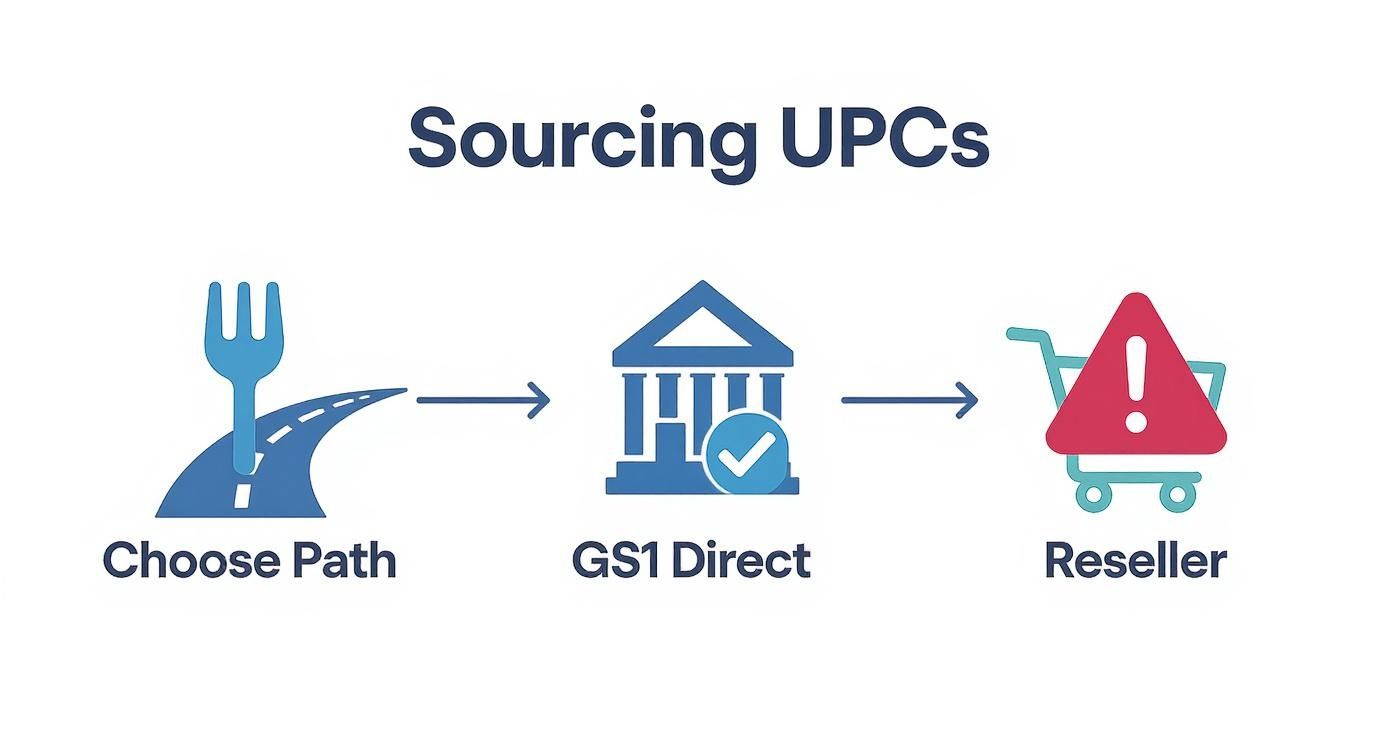
As you can see, for unique or non-standard products, the GTIN exemption is the official and correct path. It lets you bypass the need for external codes altogether.
Here’s a practical breakdown of the steps:
Once you hit submit, Amazon’s team will review your application. You’ll typically get a decision within 48 hours. For a deeper dive into the seller dashboard where all this happens, check out our guide on what is Seller Central and why it matters. Getting an exemption isn't just a workaround; it's a smart strategy that aligns your business with Amazon's rules, saving you both time and money.

Even with legitimate GTINs, listing errors can pop up and bring your sales momentum to a screeching halt. These issues are frustrating, but they’re almost always fixable. Learning to troubleshoot them turns a potential crisis into a simple catalog cleanup, letting you solve problems fast and get back to growing your brand.
This isn’t just about fixing a broken listing; it's about protecting your brand’s integrity and ensuring a seamless customer experience. Every product on Amazon is tracked with these unique identifiers, and the platform uses this data for everything from inventory management to analyzing shopper behavior. Knowing how to resolve these conflicts is key to maintaining clean, valuable data and can even offer insights for sellers and analysts, as you can learn more from this analysis of Amazon purchase data.
One of the most common roadblocks you'll hit is the "Invalid UPC" error, often flagged as Error 5665. This message usually appears when you try to list a product with a brand name that Amazon doesn’t recognize yet. It’s the platform’s way of saying, "Hold on, I don't know this brand. You need to prove you own it."
The fix requires a direct conversation with Seller Support. You’ll need to open a case and provide clear proof that the brand is yours.
Getting through this error is often a stepping stone to enrolling in Amazon Brand Registry, which gives you far more control over your listings down the road.
Another headache is a conflict where Amazon believes your UPC is already tied to another ASIN in its catalog. This usually happens if you bought resold UPCs or if another seller mistakenly used your GTIN. Your job is to prove to Amazon that your product is the rightful owner of that code.
A duplicate ASIN conflict is more than an inconvenience; it can fragment your sales data, split customer reviews, and dilute your brand authority. Resolving it quickly is crucial for maintaining a clean and powerful presence on the platform.
To get this sorted, you’ll have to open another case with Seller Support. This time, your proof needs to be airtight.
By systematically tackling these common product identifier Amazon errors, you reinforce your brand’s foundation and ensure your hard work isn’t derailed by correctable technical glitches.
Let's wrap up by tackling some of the most common questions sellers have about Amazon's product ID system. Think of this as a quick-reference guide to reinforce what we've covered and help you troubleshoot on the fly.
Here’s the simplest way to think about it: a UPC (Universal Product Code) is like your product's global passport. It’s a 12-digit code you get from GS1 that identifies your product anywhere in the retail world, whether on a shelf at Target or in your Shopify store. It's the key to omnichannel integration.
An ASIN (Amazon Standard Identification Number), on the other hand, is your product's ID card just for Amazon. It’s a 10-character code that Amazon assigns to your product detail page after you’ve created the listing using your UPC.
Practical takeaway: You use the universal UPC to create a listing on Amazon, and in return, they give you a unique ASIN to manage that product within their ecosystem.
While tempting, using cheap UPCs from a reseller is a high-risk gamble that rarely pays off in the long run. These codes are often old, recycled, or registered to a company that isn't yours.
Amazon’s systems constantly cross-reference UPCs with the official GS1 database to confirm that the brand name on the listing matches the brand name registered to the code. A mismatch can lead to:
The upfront cost of legitimate GS1 codes isn’t just an expense; it’s a foundational investment in your brand’s stability and future growth on the platform.
The tiny amount you save on a resold UPC is nothing compared to the risk of lost sales, brand damage, or getting your account shut down. Cutting corners here creates a massive, unnecessary risk.
A GTIN exemption is your go-to solution when you’re selling products that don't have a standard, globally recognized barcode. It’s a formal request to Amazon for permission to list your product without a UPC or EAN.
This is the ideal path if you sell:
Getting an exemption streamlines the listing process for these unique products, saving you the cost and hassle of obtaining UPCs that don't fit your business model.
Amazon Error 5665 is a common hurdle that appears when you try to list a product under a brand name that Amazon hasn’t approved yet. It's Amazon's automated check to say, "Prove you own this brand or have the right to sell under it."
To fix it, you must open a case with Seller Support and provide proof. This usually means sending clear photos of your product and its packaging showing the brand name permanently affixed to them. A sticker slapped on a box won't cut it.
Resolving this error is a critical first step toward enrolling in Amazon Brand Registry, which unlocks a powerful suite of tools to protect and grow your brand.
Mastering the product identifier Amazon requires is the first step toward building a scalable, resilient brand. At RedDog Group, we turn this foundational knowledge into measurable growth, helping you navigate everything from GS1 transitions to catalog optimization. If you’re ready to move from fixing problems to amplifying your success, let's talk. Let’s Talk Growth.
Leave a comment: