
Published: March 2020 | Last Updated:December 2025
© Copyright 2026, Reddog Consulting Group.

Nearly 60 percent of American shoppers start their product searches on Amazon before considering any other marketplace. For retail e-commerce managers, understanding how to fine tune your product listings is crucial when competing for visibility and driving sales in crowded online spaces. This guide reveals actionable methods to assess, improve, and monitor every element of your product listing so you can win more conversions and stand out from competitors.
| Key Takeaway | Explanation |
|---|---|
| 1. Assess Product Listing Metrics | Analyze conversion rates and customer ratings to identify performance strengths and weaknesses. |
| 2. Implement Effective Keywords | Use primary and secondary keywords to enhance visibility and attract qualified traffic to your listings. |
| 3. Craft Clear Titles and Descriptions | Create engaging titles and descriptions that balance SEO and customer appeal for better conversion. |
| 4. Use High-Quality Images | Invest in professional product images to improve first impressions and boost buyer confidence. |
| 5. Monitor Performance Analytics | Regularly track and analyze key metrics to refine your listing strategies and enhance sales outcomes. |
To optimize your online product listings for higher sales, you must first conduct a comprehensive performance assessment. This crucial first step allows you to understand your current positioning and identify specific areas for improvement across your marketplace presence.
Begin by gathering key performance metrics using analytics tools and marketplace insights. Evaluate product listing performance through structured data analysis that encompasses quantitative metrics like conversion rates, click through rates, and customer engagement scores. Look closely at indicators such as sales volume, average customer ratings, and how long products remain visible in search results. Pay attention to specific details like product image quality, title clarity, description comprehensiveness, and pricing competitiveness.
Analyzing these metrics will help you pinpoint exactly where your current listings are succeeding or falling short. Break down your assessment into clear categories like visual presentation, keyword optimization, pricing strategy, and customer feedback. Track historical performance data to understand trend lines and seasonal variations that might impact your sales potential.
Pro tip: Create a standardized tracking spreadsheet that allows you to compare performance across different product listings systematically, enabling you to quickly identify top performers and underperforming items.
Here’s a comparison of common product listing metrics and their business impact:
| Metric Name | What It Measures | Business Impact |
|---|---|---|
| Conversion Rate | Percent of visitors who buy | Direct link to sales growth |
| Click Through Rate | Visitors who view a listing | Indicates listing appeal and relevance |
| Customer Ratings | Average buyer scores | Impacts trust and future sales |
| Sales Volume | Total units sold | Reflects product popularity |
| Visibility Duration | Time visible in search | Affects opportunity for discovery |
Keyword research is the critical foundation for transforming your product listings from average to exceptional. Your goal in this step is to discover and strategically implement keywords that will dramatically improve your product visibility and attract potential buyers.
Mastering keyword research requires a strategic approach to targeting customer search behaviors that balances both short-tail and long-tail keyword strategies. Start by brainstorming terms your ideal customers would use when searching for products like yours. Utilize platform autocomplete features, analyze competitor listings, and leverage customer review language to uncover authentic search terms. Focus on keywords that demonstrate clear purchase intent rather than generic phrases that generate low quality traffic.
Divide your keyword strategy into two primary categories: primary keywords that describe your product directly and secondary keywords that capture peripheral search intent. Primary keywords should appear in your product title and first paragraph of description, while secondary keywords can be integrated more naturally throughout your listing. Pay close attention to search volume, competition level, and relevance to ensure you are selecting keywords that will genuinely drive qualified traffic to your product page.
Pro tip: Create a keyword tracking spreadsheet that allows you to monitor the performance of different keyword variations, enabling you to continuously refine and optimize your product listing strategy.
Use this summary table to understand how keyword types affect listing results:
| Keyword Type | Placement In Listing | Effect on Traffic | Example Purpose |
|---|---|---|---|
| Primary Keywords | Title, first description line | Boost qualified search hits | Product category focus |
| Secondary Keywords | Mid-description, image alt tags | Capture broader search intent | Related use cases, features |
Crafting an outstanding product title and description is your critical opportunity to convert potential buyers and stand out in a crowded marketplace. Your goal is to create clear, persuasive content that simultaneously speaks to both human readers and search algorithms.

Strategic title construction involves carefully balancing descriptive clarity with search engine optimization techniques that capture your product’s essential features and benefits. Begin by prioritizing the most important product characteristics in your title such as brand, model, size, color, or unique specifications. Use active language that creates excitement and clearly communicates your product’s value proposition. Avoid keyword stuffing but ensure you include primary search terms that potential customers are likely to use when searching for products like yours.
Your product description should tell a compelling story that goes beyond basic specifications. Break down complex features into easily digestible benefits that directly address customer needs. Use concise paragraphs, include bullet points for key attributes, and create a narrative that helps customers imagine how the product will improve their lives. Emphasize unique selling points that differentiate your offering from competitors and speak directly to your target audience’s pain points and desires.
Pro tip: Test multiple title and description variations using marketplace analytics to determine which versions generate the highest click through and conversion rates.
Visual presentation can make or break your product’s online success. Your images are the first and most critical interaction potential customers have with your product, serving as a virtual stand in for physical examination and driving purchasing decisions.
Advanced machine learning techniques demonstrate that strategic image selection dramatically influences consumer engagement and purchase confidence across digital marketplaces. Focus on creating professional product images that showcase your item from multiple angles, highlighting unique features and providing context for how customers might use the product. Invest in high resolution photography that captures intricate details, uses consistent lighting, and presents your product in its best possible presentation. Include lifestyle images that help customers visualize the product in real world scenarios, not just isolated product shots.
Ensure your primary product image follows marketplace guidelines while creating additional images that tell a comprehensive story. Your first image should be a clean, centered shot with a plain background, while subsequent images can demonstrate scale, functionality, close up details, and potential use cases. Consider including infographic style images that quickly communicate key specifications or comparative advantages. Maintain consistent image sizing, professional editing, and a cohesive visual style that represents your brand’s quality and aesthetic.
Pro tip: Create a standardized image template for your product line that ensures visual consistency while allowing enough flexibility to highlight each product’s unique characteristics.
Successfully optimizing product listings requires ongoing measurement and strategic analysis of performance metrics. This final step transforms your optimization efforts from guesswork into a data driven approach that continuously improves your marketplace results.
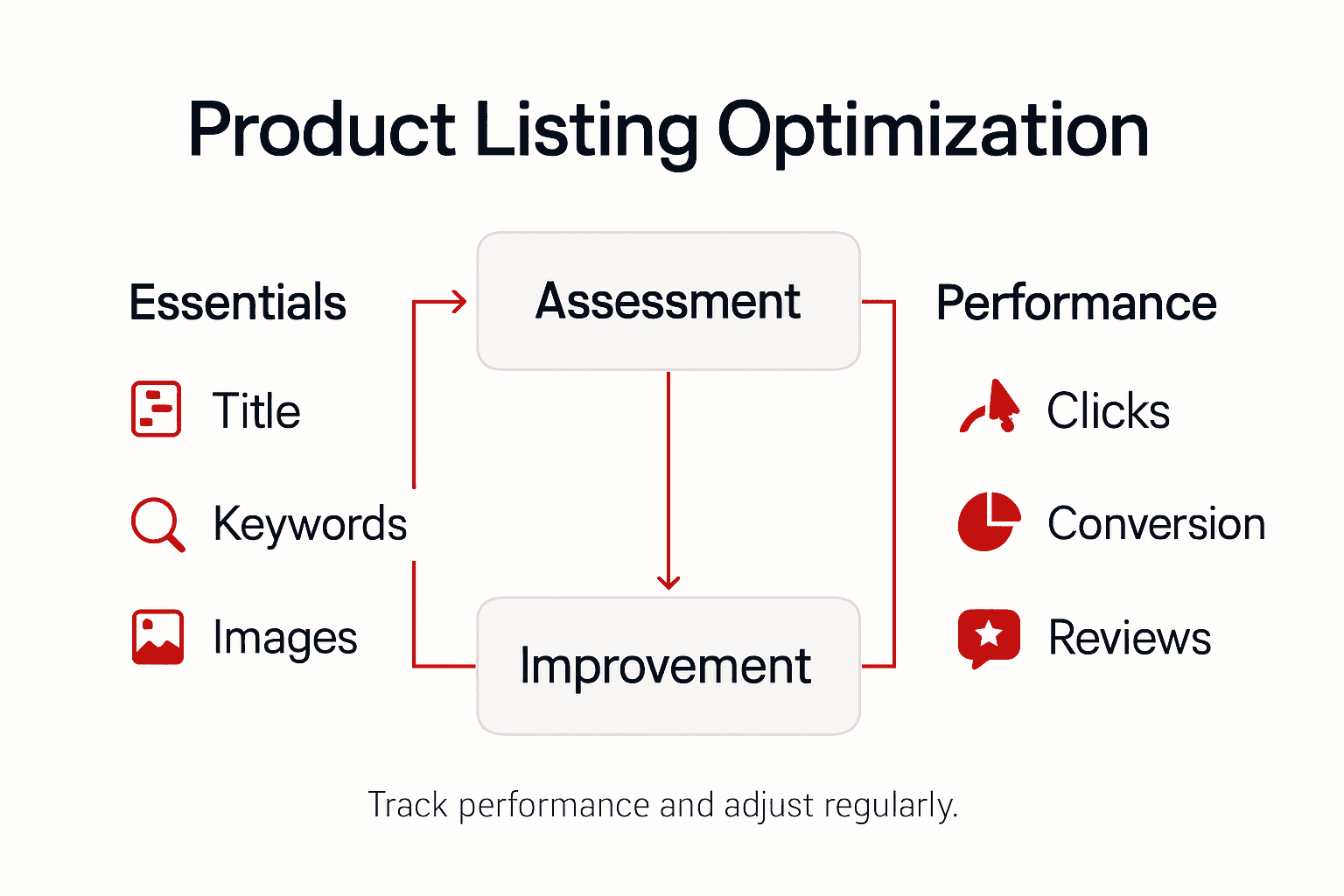
Advanced ecommerce performance analytics provide critical insights into user behavior and sales conversion dynamics across digital marketplaces. Track key performance indicators like conversion rate, average order value, click through rate, and customer acquisition cost to understand how your product listings are truly performing. Implement systematic A/B testing for titles, descriptions, images, and pricing to empirically determine which variations generate the most engagement and sales. Utilize marketplace analytics dashboards that offer granular insights into customer interactions, helping you identify precise areas for improvement.
Develop a regular review process where you analyze performance data at consistent intervals weekly or monthly. Compare your product listing metrics against industry benchmarks and your own historical performance. Look for trends in customer behavior such as time spent viewing listings, bounce rates, and conversion funnel drop off points. Pay special attention to how changes in keywords, images, or descriptions correlate with shifts in sales performance. Use these insights to make incremental optimizations that compound your listing effectiveness over time.
Pro tip: Create a performance tracking template that automatically calculates key metrics and highlights significant changes to streamline your ongoing optimization efforts.
Struggling to convert traffic into sales despite careful keyword research or stunning product images The key challenges you face from this article such as optimizing product titles, leveraging high-impact keywords, and verifying performance metrics can be overwhelming. You want clear wins in conversion rates, click-through rates, and customer trust but need proven strategies tailored for competitive marketplaces.
Reddog Group specializes in overcoming exactly these pain points with hands-on experience managing thousands of SKUs across Amazon FBA and omnichannel retail platforms. Our Digital & Business Consulting Services by Reddog Consulting offer you targeted solutions in product listing optimization, marketplace management, and integrated online-offline sales strategies that drive measurable growth year after year.
Enhance your marketplace presence by partnering with experts committed to boosting your listings through advanced analytics, keyword mastery, and compelling content creation. Visit our Home page to explore how our tailored consulting can transform your brand’s sales performance. Don’t wait for incremental gains when a strategic approach today at reddog.group can accelerate your growth and maximize your revenue potential.
To assess your current product listing performance, gather key performance metrics such as conversion rates, click-through rates, and customer engagement scores. Use analytics tools to analyze these metrics, ensuring to track historical data to identify trends over time.
Focus on primary keywords that clearly describe your product, and secondary keywords that capture related search intent. Conduct keyword research by brainstorming terms your potential customers are likely to use and integrate these strategically in titles and descriptions.
To craft compelling product titles and descriptions, prioritize essential product characteristics and create a narrative that addresses customer needs. Use active language to communicate value and keep the content engaging by utilizing bullet points and breaking down features into benefits.
Utilize high-quality images that showcase your product from multiple angles, providing context for use. Include lifestyle images and ensure your primary image adheres to marketplace guidelines while maintaining professional editing and consistent visual style.
To verify your product listings are optimized, regularly track key performance indicators like conversion rates and click-through rates. Implement A/B testing for different elements of your listings to determine which variations yield the highest engagement and sales, adjusting your strategy based on the data collected.
Establish a consistent review process to monitor your product listing performance over time. Create a tracking template that captures key metrics and analyze trends at regular intervals, such as weekly or monthly, to identify areas for continuous improvement.
Leave a comment: