
Published: March 2020 | Last Updated:December 2025
© Copyright 2026, Reddog Consulting Group.

Increasing your ecommerce conversion rate isn’t about guesswork; it requires a methodical approach. We break down omnichannel growth into three core phases: building a solid Foundation, driving data-led Optimization, and finally, strategic Amplification. This framework ensures you first understand where you stand, then improve the on-site and off-site experience, and finally use targeted tactics to drive measurable sales growth.
Before you can improve your conversion rate, you need an honest, clear picture of where you are right now. Many brands chase an arbitrary number they read in an article without understanding what that metric actually means for their business and its unique position in the market.
Conversion Rate Optimization (CRO) is a science, not a guessing game. It starts with building a solid foundation based on your own data. This is the first pillar of RedDog’s growth framework—Foundation—because without it, any changes you make are just shots in the dark. The process begins by defining what a "good" conversion rate is for you. A rate that’s incredible for a luxury watch brand would be a massive red flag for a CPG company selling snack bars.
Context is everything. While industry stats suggest the global average ecommerce conversion rate hovers between 2.5% and 3%, that figure is almost useless on its own. It’s an amalgamation of countless variables, from product type to traffic source.
For instance, food and beverage sites often see conversion rates around 6.11%, driven by repeat purchases and lower price points. In contrast, luxury goods might convert at only 1.19% due to the longer, more considered decision-making process. The channel matters, too. Referral traffic from a trusted blog can convert as high as 5.4%, while visitors from a social media ad might convert below 1%. You can learn more about these e-commerce benchmarks to see how different industries and traffic sources establish their own standards for success.
This chart illustrates just how different conversion rates can be across luxury, average, and food & beverage sectors, highlighting the importance of context.
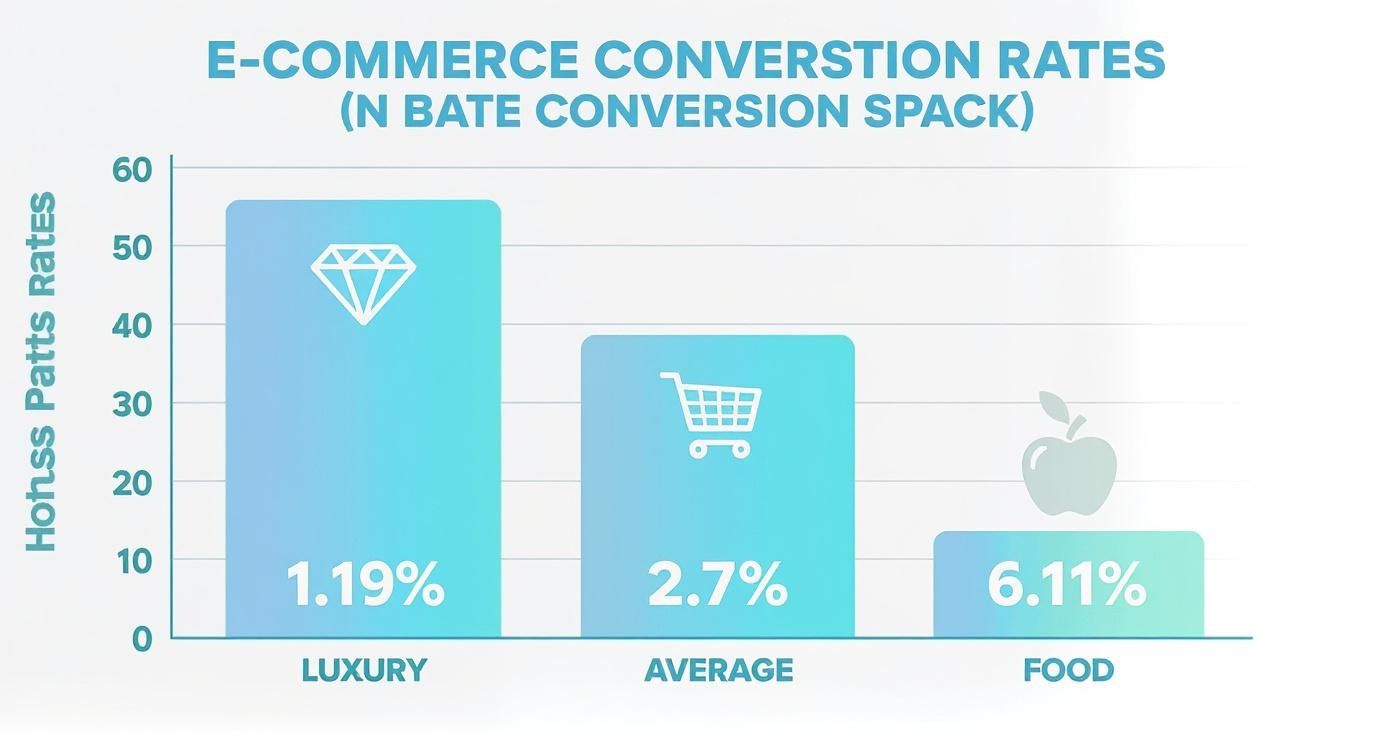
As you can see, high-volume, low-cost industries almost always have higher conversion rates than businesses selling high-ticket items that require more consideration.
Here's a look at some industry benchmarks to help you gauge your performance.
This table provides a snapshot of typical conversion rates, helping you benchmark your performance against industry and traffic source averages to identify strengths and weaknesses.
| Category/Source | Average Conversion Rate | Key Takeaway |
|---|---|---|
| Food & Beverage | 6.11% | High repeat purchase frequency drives strong conversions. |
| Health & Beauty | 3.08% | Loyal customers and routine purchases keep rates healthy. |
| Fashion & Apparel | 2.44% | Highly competitive; brand and user experience are critical. |
| Luxury Goods | 1.19% | Long consideration periods and high price points lead to lower rates. |
| Referral Traffic | 5.40% | Visitors arriving from a trusted source are already primed to buy. |
| Email Marketing | 3.30% | Engaged subscribers are a high-intent audience. |
| Organic Search | 2.80% | Shoppers actively looking for a solution convert well. |
| Paid Search | 2.70% | Highly targeted ads can capture purchase-ready customers. |
| Social Media | 0.90% | Often top-of-funnel; visitors are browsing, not necessarily buying. |
Use these numbers as a starting point, but remember that your own data is what truly matters for setting realistic goals and identifying the right opportunities.
Calculating your baseline conversion rate is straightforward. It’s your total number of sales divided by your total number of site visitors, multiplied by 100.
Formula: (Total Sales / Total Visitors) x 100 = Conversion Rate %
However, this site-wide number is just the tip of the iceberg. A true diagnostic requires segmenting your data to uncover the hidden stories. To get actionable insights, break down your conversions by:
By segmenting that single, generic rate, you transform one unhelpful metric into a detailed roadmap showing exactly where to focus your efforts. This deep-dive analysis is fundamental to understanding the complete guide to the role of analytics in business growth and building a CRO strategy that delivers measurable results.
Once you have a clear diagnostic of what’s working and what isn’t, it's time to act. Your website or product listing is your digital storefront, and today’s shoppers have zero patience for friction. This is the Optimization phase—making targeted technical and user experience (UX) improvements that directly influence buying decisions.
We'll move past generic advice like "improve your site speed." Instead, this is a practical audit of the customer journey, designed to turn your on-site experience into a powerful conversion engine. A seamless, intuitive journey isn’t a nice-to-have; it's the foundation of modern ecommerce.
Your product page is where the most critical buying decisions happen. It needs to do more than list features; it must anticipate questions, build trust, and create a genuine desire for your product.
Every element on the page should work together to answer one fundamental question for the shopper: "Is this product right for me?"
Here’s how to ensure the answer is a resounding "yes":
A great product page doesn't just sell a product; it sells confidence. By combining detailed descriptions, rich media, and authentic social proof, you eliminate the uncertainty that causes shoppers to hesitate and click away.
If a shopper can’t find what they’re looking for, they can’t buy it. It’s that simple. Your site's navigation should be so intuitive that customers don't have to think about it. The goal is to get them from the homepage to their desired product in three clicks or less.
A confusing menu or a weak search function leads directly to a bounced session. To fix this, focus on clarity and speed. Keep your main navigation clean and limited to core categories. Use descriptive labels—"Women's Running Shoes" is infinitely better than a generic "Footwear." Your on-site search bar is also a powerful conversion tool; a great search experience suggests popular products, corrects typos, and allows users to filter results instantly.
Understanding how customers shop on different devices is crucial. Desktop users often convert at nearly double the rate of mobile users—around 3.9% compared to just 1.8%. This gap highlights a massive opportunity for growth. Since mobile typically drives the majority of traffic, a clunky mobile experience is like closing your store to half your customers.
Optimizing for mobile goes beyond a responsive design. It means rethinking the entire journey for a smaller screen and a different user context. Check out our complete guide to learn why you need to optimize for mobile commerce and build a practical, mobile-first strategy.
These performance nuances also appear across product categories. For instance, beauty stores can see conversion rates as high as 6.8%, while home décor might hover closer to 1.4%. These differences are shaped by price points, purchase frequency, and regional habits. For industries like fashion, where fit is paramount, technology can bridge the online-offline gap. Innovations like understanding virtual fitting rooms give customers the confidence to buy, which is proven to reduce returns and boost conversions.
A customer adding an item to their cart is a win, but it’s far from a guaranteed sale. The journey from cart to "Thank You" page is where countless brands lose revenue. This final stretch isn't about more selling—it's about removing every piece of friction that could spark a moment of doubt.
Your mission is to make the final steps so seamless and reassuring that clicking "Complete Purchase" feels like the only logical next step. We're moving beyond page optimization and into the mechanics of the transaction itself. It's time to eliminate roadblocks and build unstoppable momentum toward a sale.

The single biggest conversion killer at this stage is surprise. Unexpected costs, mandatory account creation, and a confusing interface are the top reasons shoppers abandon their carts. A frictionless checkout tackles these problems head-on with total transparency and simple design.
Scrutinize every field, every click, and every page in your checkout process. Does it absolutely need to be there? If not, remove it. A cluttered, multi-step checkout feels like a chore, and customers will quickly decide it isn’t worth the effort.
Key Takeaway: Think of your checkout as an express lane, not an interrogation. The easier you make it for someone to give you their money, the more likely they are to do it. Simplify forms, reduce the number of steps, and keep the customer focused on the finish line.
In today's market, offering a single payment method is no longer enough. Customers expect choice and flexibility. Integrating multiple payment gateways caters to different preferences and builds immense trust at the final moment of decision.
Consider the modern shopper’s digital wallet:
By offering a variety of trusted payment options, you signal credibility and accommodate a wider range of customers, which has a direct and measurable impact on your ecommerce conversion rate.
Cart abandonment isn't just a lost sale; it's a clear signal that something in your process is broken. The average shopping cart abandonment rate hovers around a staggering 70%. The main culprit? Unexpected costs like shipping and taxes that appear at the very end.
This is a massive problem. With global online sales projected to hit $6.42 trillion in 2025, and mobile commerce accounting for 59% of that, a leaky checkout can cost you an astronomical amount of revenue. Optimizing this final step is non-negotiable. You can dive deeper into these trends in this in-depth analysis of ecommerce statistics.
To combat this, be proactive. Display all costs, including shipping estimates, as early as possible—ideally on the product page or in the cart itself. Another powerful tactic is enabling a guest checkout option. Forcing users to create an account is a major friction point that sends countless ready-to-buy customers elsewhere.
Even with a flawless checkout, some shoppers will still leave. That’s where a smart cart recovery strategy comes in. This isn’t about blasting people with aggressive "BUY NOW!" emails. It’s about sending timely, helpful reminders that gently nudge them back to complete their purchase.
A simple, effective sequence might look like this:
By turning cart abandonment from a dead end into a second chance, you can reclaim a significant portion of otherwise lost revenue.
You’ve established your foundation and optimized the user experience. The final hurdle is turning interest into a purchase. This is the Amplification phase—using targeted psychological triggers to give shoppers a compelling reason to buy now.
This is about building unshakable trust while creating authentic urgency. It moves beyond the technical aspects of your store and into the mind of your customer, answering the silent questions that cause hesitation: "Can I trust this brand?" and "Why should I buy this today?"
Before a customer will buy, they need to trust you. The most powerful way to build that trust isn't through marketing copy, but through the real voices of other customers. This is social proof, and it’s non-negotiable for boosting your ecommerce conversion rate.
Placing social proof at key decision points helps dismantle purchase anxiety. It’s about showing, not just telling, that your products deliver on their promises.
Urgency and scarcity are powerful psychological drivers that tap into our fear of missing out (FOMO). When used authentically, they encourage shoppers to stop browsing and start buying. The key is authenticity—fake countdown timers or misleading stock levels will destroy brand trust.
Effective urgency provides helpful context, it doesn't create false pressure.
Our Takeaway: Real urgency is rooted in truth. It informs the customer about a real constraint—limited inventory, a shipping deadline, or a sale end date—empowering them to make a timely decision that benefits them.
Here are a few honest ways to implement this:
A one-size-fits-all message rarely inspires action. Personalization makes the shopping experience feel relevant and designed for the individual, which is a direct path to higher conversions. By using data on a customer's browsing history, past purchases, or location, you can serve messages and offers that resonate.
Combine this with a smart promotional strategy to provide the final nudge. This isn’t about endlessly slashing prices; it’s about creating value that aligns with your brand and encourages larger purchases.
By amplifying trust, creating genuine urgency, and personalizing the experience, you give customers both the confidence and the motivation they need to click "buy." This final phase turns passive browsers into loyal customers, directly impacting your bottom line.
A generic CRO playbook only gets you so far. True omnichannel growth happens when you master the unique ecosystems where your customers shop. Driving conversions on your Shopify store requires a different set of tactics than optimizing a product listing on Amazon or Walmart.
Each platform has its own algorithm, customer expectations, and levers for growth. Applying a one-size-fits-all approach is a fast track to wasted resources. Instead, let’s break down the specific strategies that move the needle on each channel, following our core Foundation → Optimization → Amplification framework.
On Shopify, you own the entire customer experience. This gives you incredible control to build a branded journey from the ground up. The goal is to use apps and savvy theme customizations to create a shopping experience that is seamless, personal, and trustworthy—earning not just the first sale, but long-term loyalty.
Key Takeaway: Your Shopify store is your brand's home. Success comes from crafting an owned experience so intuitive and personalized that customers have no reason not to complete their purchase and return for more.
Think of Amazon as a search engine that sells products. Your CRO strategy must be laser-focused on two things: visibility and conversion in a fiercely competitive environment. The game is about mastering Amazon's A9 algorithm and building product listings that are conversion machines.
Your product detail page is your single most important sales tool on the platform. It has to grab attention, answer every potential question, and dismantle objections in seconds.
Your title, bullet points, and A+ Content are the foundation of a high-converting Amazon listing.
Your seller reputation is just as crucial. Proactively managing reviews and maintaining a high seller rating is fundamental to building the trust needed to win the sale. To go deeper on these tactics, check out our full guide to optimizing Amazon product listings for maximum growth.
Walmart Marketplace is a hybrid, blending elements of both a brand site and a competitive marketplace. The platform places a massive emphasis on competitive pricing and operational excellence to win the all-important Buy Box. A successful Walmart strategy is built on sharp pricing, solid performance, and smart visibility tactics.
Your success here is tied directly to your ability to meet Walmart’s strict performance metrics while leveraging its advertising tools.
To succeed in an omnichannel world, you must tailor your approach. The tactics that drive sales on your website won't necessarily work on a competitive marketplace. This table breaks down the top conversion levers for each platform, helping you focus your efforts where they'll make the biggest impact.
| Platform | Top CRO Lever | Implementation Focus | Key Metric to Track |
|---|---|---|---|
| Shopify | Owned Brand Experience | Theme customization, app integrations, personalization, and a frictionless mobile checkout. | Site-wide Conversion Rate |
| Amazon | Listing & Search Optimization | Keyword-rich titles/bullets, compelling A+ Content, and proactive review management. | Unit Session Percentage |
| Walmart | Price & Performance | Competitive dynamic pricing, flawless fulfillment metrics, and Walmart Connect ads. | Buy Box Win Percentage |
Ultimately, whether you're building a brand on Shopify, competing on Amazon, or scaling on Walmart, the goal is the same: understand the platform's rules and customer expectations, then execute flawlessly. By aligning your strategy with the unique dynamics of each channel, you can turn browsers into buyers more effectively across your entire business.
Diving into conversion rate optimization (CRO) naturally brings up questions about timelines, priorities, and what not to do. Getting clear, practical answers is the first step toward building a strategy that drives measurable results instead of just spinning your wheels.
Here are a few of the most common questions we hear from brands getting serious about CRO.
This is the million-dollar question, and the honest answer is: it depends.
You can often see a measurable lift from small, surgical changes—like rewriting a button's call-to-action or tweaking a form field—in just a few weeks, especially with consistent traffic. The data from these quick wins rolls in almost immediately.
However, bigger projects like a full site redesign or implementing sophisticated personalization are a longer-term investment. These can take several months to mature and show a clear, positive return. The key is to adopt a rhythm of iterative testing.
A/B testing is your best friend here. It allows you to validate every change with hard data, ensuring each adjustment is a step forward toward your conversion goals.
The single biggest mistake we see is making changes based on gut feelings or simply copying a competitor. It’s tempting to see a flashy feature on another site and rush to implement it, skipping the most important step: determining if it’s right for your audience.
Effective CRO is a disciplined, data-driven process. It always starts with analyzing your own data to find the actual friction points. Where are people dropping off? Which pages have high bounce rates? Only then can you form a hypothesis, test it, and measure the outcome. Jumping straight to a solution without a diagnosis is the fastest way to waste time and money.
For nearly every ecommerce brand today, the answer is a clear and simple: mobile-first.
Check your analytics, but it's highly likely your mobile traffic dwarfs your desktop traffic. At the same time, mobile conversion rates almost always lag behind. That gap represents your single biggest opportunity for growth.
Start by auditing your mobile experience from a customer's perspective. Is the navigation clumsy? Do product images load quickly and look great? Can you complete a checkout without frustration? Improving the mobile journey almost always enhances the desktop experience as well. The goal is a seamless omnichannel experience, but you'll achieve the greatest ROI by starting with mobile.
Ready to move from questions to action? At RedDog Group, we build growth strategies that connect every channel and deliver measurable results.
Let’s Talk Growth: https://www.reddog.group
Leave a comment: