
Published: March 2020 | Last Updated:September 2026
© Copyright 2026, Reddog Consulting Group.

Most American retailers struggle with wasted stock or empty shelves, yet effective inventory forecasting can cut excess inventory costs by up to 30 percent. The ability to predict demand accurately is not just a nice-to-have for modern retailers, it is a necessity in a highly competitive market. Understanding how inventory forecasting works helps brands — from small businesses to national chains — make smarter decisions, improve efficiency, and meet customer needs with confidence.
| Point | Details |
|---|---|
| Inventory Forecasting Enhances Efficiency | Utilizing advanced forecasting techniques allows retailers to better predict demand, leading to optimized inventory management and reduced costs. |
| Robust Data Sources are Essential | Successful inventory forecasting relies on comprehensive data collection from various channels to create accurate predictive models. |
| Advanced Technologies Transform Inventory Practices | The integration of machine learning and AI provides predictive capabilities that enhance operational efficiency for retailers of all sizes. |
| Awareness of Risks and Limitations is Crucial | Acknowledging potential forecasting pitfalls, such as over-reliance on historical data, is vital to improving accuracy and adaptability in inventory management. |
Inventory forecasting represents a strategic process where retailers predict future product demand using historical sales data, market trends, and advanced analytical techniques. This sophisticated approach enables businesses to optimize their inventory management, reduce operational costs, and improve overall supply chain efficiency.
At its core, inventory forecasting goes beyond simple guesswork. Advanced forecasting techniques help retailers understand complex market dynamics by analyzing multiple variables that influence product demand. These variables include seasonal fluctuations, consumer behavior patterns, economic indicators, and emerging market trends. By leveraging statistical models and machine learning algorithms, businesses can develop precise predictions about how much inventory they will need in upcoming periods.
The critical importance of inventory forecasting becomes clear when examining its potential impact on business performance. Research demonstrates that effective forecasting can significantly reduce inventory holding costs while simultaneously minimizing stockout risks. Companies that implement robust forecasting strategies typically experience more streamlined operations, improved cash flow management, and enhanced customer satisfaction. Small and medium-sized retailers can transform their operational efficiency by understanding and implementing strategic inventory forecasting methods that align with their specific business models and market conditions.

Retail businesses employ several fundamental inventory forecasting methods that range from traditional statistical approaches to advanced technological solutions. These methods help organizations predict future inventory needs with varying levels of complexity and precision, enabling more strategic decision making across their supply chains.
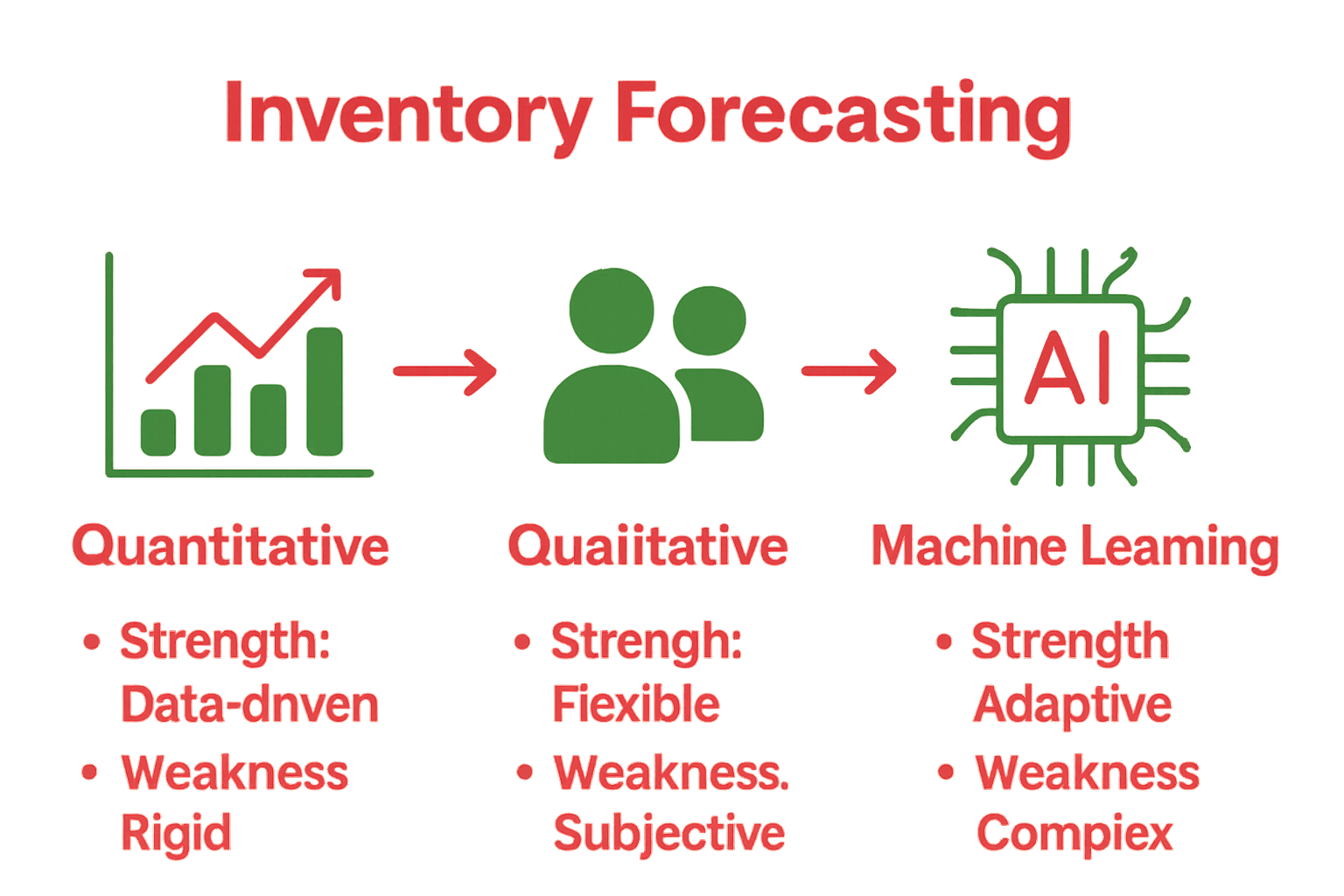
Quantitative forecasting techniques represent the most data-driven approach to inventory prediction. These methods include multiple sophisticated models like simple exponential smoothing, Holt’s exponential smoothing, and Brown’s double exponential smoothing. Each technique offers unique advantages in analyzing historical sales data and identifying underlying patterns. For instance, simple exponential smoothing works best with relatively stable demand, while more complex methods like Holt’s can accommodate trends and seasonal variations.
Advanced technological solutions have revolutionized inventory forecasting through machine learning and artificial intelligence. Innovative dual-model forecasting frameworks now leverage powerful combinations like ARIMA statistical models and Long Short-Term Memory (LSTM) neural networks. These cutting-edge approaches enable retailers to process massive datasets, recognize intricate demand patterns, and generate remarkably precise inventory predictions. Small and medium-sized businesses can now access predictive capabilities once reserved for enterprise-level organizations, transforming their operational efficiency and competitive positioning.
Inventory forecasting requires a robust ecosystem of data sources and technological tools that enable businesses to transform raw information into actionable insights. Retailers must strategically collect and analyze data from multiple channels to create comprehensive and accurate predictive models.
Machine learning models have revolutionized inventory management systems through advanced ETL (Extract, Transform, Load) integration techniques. These sophisticated technologies enable real-time data processing, allowing businesses to implement dynamic learning algorithms that continuously adapt to changing market conditions. Key data sources include point-of-sale systems, e-commerce platforms, customer relationship management databases, social media analytics, and historical sales records.
Advanced forecasting frameworks now provide unprecedented flexibility in model development, enabling businesses to rapidly experiment with different algorithmic approaches and seamlessly integrate new datasets. Small and medium-sized retailers can leverage cloud-based platforms, artificial intelligence tools, and statistical software to access powerful predictive capabilities. These technologies help organizations streamline their data collection, analysis, and forecasting processes, transforming complex information into strategic inventory management decisions that drive operational efficiency and competitive advantage.
Inventory forecasting represents a strategic capability that delivers transformative advantages for retailers operating across multiple sales channels. By implementing sophisticated predictive approaches, businesses can unlock significant operational improvements and competitive advantages that directly impact their bottom line.
Intelligent replenishment strategies enable retailers to optimize their inventory structure, dramatically reducing holding costs and minimizing the risks associated with overstocking or understocking. These advanced approaches allow businesses to develop precise safety inventory levels, ensuring they can meet customer demand while maintaining lean and efficient supply chains. Retailers can create more responsive inventory management systems that adapt quickly to market fluctuations and changing consumer preferences.
Advanced sales prediction models now provide unprecedented insights into product performance across multiple stores and channels. Omnichannel retail strategies benefit enormously from these sophisticated forecasting techniques, allowing businesses to synchronize inventory across digital and physical platforms. Small and medium-sized retailers can now access powerful predictive capabilities that were once available only to large enterprises, enabling them to make data-driven decisions that optimize inventory allocation, reduce waste, and improve overall operational efficiency.
Inventory forecasting is a complex process fraught with potential pitfalls that can dramatically undermine a retailer’s strategic planning. While powerful predictive technologies offer significant advantages, businesses must approach forecasting with a nuanced understanding of its inherent challenges and potential limitations.
Intermittent demand forecasting presents particularly challenging scenarios where traditional predictive models often fail. Retailers frequently encounter situations with sporadic sales patterns, irregular customer behavior, and unpredictable market fluctuations that can render standard forecasting techniques ineffective. Common mistakes include over-relying on historical data without considering emerging market trends, failing to account for seasonal variations, and using oversimplified linear projection models that cannot capture complex demand dynamics.
Advanced forecasting methodologies emphasize the critical importance of understanding potential spiral-down effects in demand estimation. Businesses must be vigilant about data quality, recognition of censored time series, and the potential limitations of their predictive models. Key risks include confirmation bias in data interpretation, neglecting external market factors, and assuming past performance guarantees future outcomes. Successful inventory forecasting requires continuous model refinement, rigorous statistical validation, and a willingness to adapt predictive strategies as market conditions evolve.
Struggling to balance demand and inventory costs? The article “Inventory Forecasting Explained: Boost Retail Success” highlights the critical challenges retailers face in avoiding overstocking and stockouts while adapting to complex market trends. If you want to harness sophisticated forecasting techniques like dual-model frameworks and intelligent replenishment strategies to gain a competitive edge, Reddog Group has tailored solutions designed specifically for small and medium-sized businesses operating in omnichannel environments.
Implementing precise inventory forecasting is essential not just for reducing holding costs but also for improving customer satisfaction and streamlining supply chains. Our expertise in marketplace management, Amazon FBA, and DTC channels can help you integrate these advanced methods into your daily operations. By leveraging data-driven insights and strategic guidance, we empower brands to optimize inventory allocation across online and offline platforms, ensuring you never miss a sales opportunity.
Discover how Reddog Group’s proven approach can transform your inventory challenges into measurable growth. Visit our professional consulting platform now to explore customized inventory management and marketing services. Take control of your inventory forecasting today and secure the future success of your retail business.
Inventory forecasting is the process of predicting future product demand using historical sales data and market trends. It is crucial for retailers because it helps optimize inventory management, reduces operational costs, and minimizes the risk of stockouts, leading to improved customer satisfaction and cash flow management.
Common inventory forecasting methods include quantitative techniques such as simple exponential smoothing and Holt’s exponential smoothing, as well as advanced technologies like machine learning and artificial intelligence models. These methods provide varying levels of complexity and precision for predicting future inventory needs.
Small and medium-sized retailers can access advanced forecasting technologies that were once reserved for larger enterprises. By implementing these predictive capabilities, they can make data-driven decisions that optimize inventory allocation, reduce waste, and enhance operational efficiency across their supply chains.
Retailers should be aware of challenges like intermittent demand, data quality issues, and potential biases in data interpretation. It’s important to continuously refine forecasting models to adapt to market changes and ensure accurate predictions, avoiding reliance solely on historical data without acknowledging emerging trends.
Leave a comment: