
Published: March 2020 | Last Updated:October 2026
© Copyright 2026, Reddog Consulting Group.

A competitor drops the price on the same CPG item you sell. Velocity looks healthier by Thursday. The weekly cash report does not. That gap is the whole pricing problem.
You matched the visible offer because the buy box, the Walmart listing, or a wholesale buyer made the lower number feel mandatory. Online price is not a digital shelf tag. Shoppers compare offers in seconds, and sellers can change a price far more often than a store can reprint a tag. That speed only helps if the new price still covers fees, freight, ads, and returns.
An ecommerce pricing strategy that starts with the lowest listing on the page will keep winning clicks and losing contribution. Lock the fully loaded cost and a margin floor first. Set channel-specific prices and packs. Write promotion rules that sales cannot rewrite. Then test one change at a time and govern who is allowed to move the number.
A competitor cuts the visible price on a CPG item. Matching it may lift clicks or unit sales, while leaving less cash to cover the work required to deliver each order. The list price is an output of the economics, not a sound place to begin.
Early research by Brynjolfsson and Smith found that internet prices were about 8% to 9% lower than prices at conventional retailers. The American Impact Review's account of that research describes the study. Its broader lesson is that shoppers can compare offers online with less effort, while sellers can adjust prices more readily. That changes the pace of competition, not the cost of serving an order.
Frequent price changes do not guarantee profit. A lower offer may improve conversion and velocity, yet leave too little to cover marketplace fees, fulfillment, advertising, returns, and acquisition costs. On Amazon and Walmart, the visible offer competes for attention; in DTC and wholesale, different fees, pack sizes, and buyer terms shape what a workable price looks like. Matching one channel's lowest price across all four can create conflict without improving total contribution.
A price that wins the click but fails the contribution test is a discount paid for traffic.
Use the list price to support channel-specific economics, not as a universal target. A different pack or promotion can protect the shopper's value perception without forcing every channel to match the lowest offer. Keep the trade-off visible: a promotion may help velocity, but its net effect depends on the costs and terms attached to that channel.
Before changing a tag, identify the costs beneath it:
When unit sales rise but cash falls, the list price has hidden the trade-off. Judge the offer by what remains after channel costs, not by how it compares on the shelf.
Foundation work is a per-SKU, per-channel stack, finished before any repricing tool is switched on. Contribution margin is price minus every variable cost that moves with the unit. If you can't name the floor for one hero SKU, you don't have a price. You have a guess.
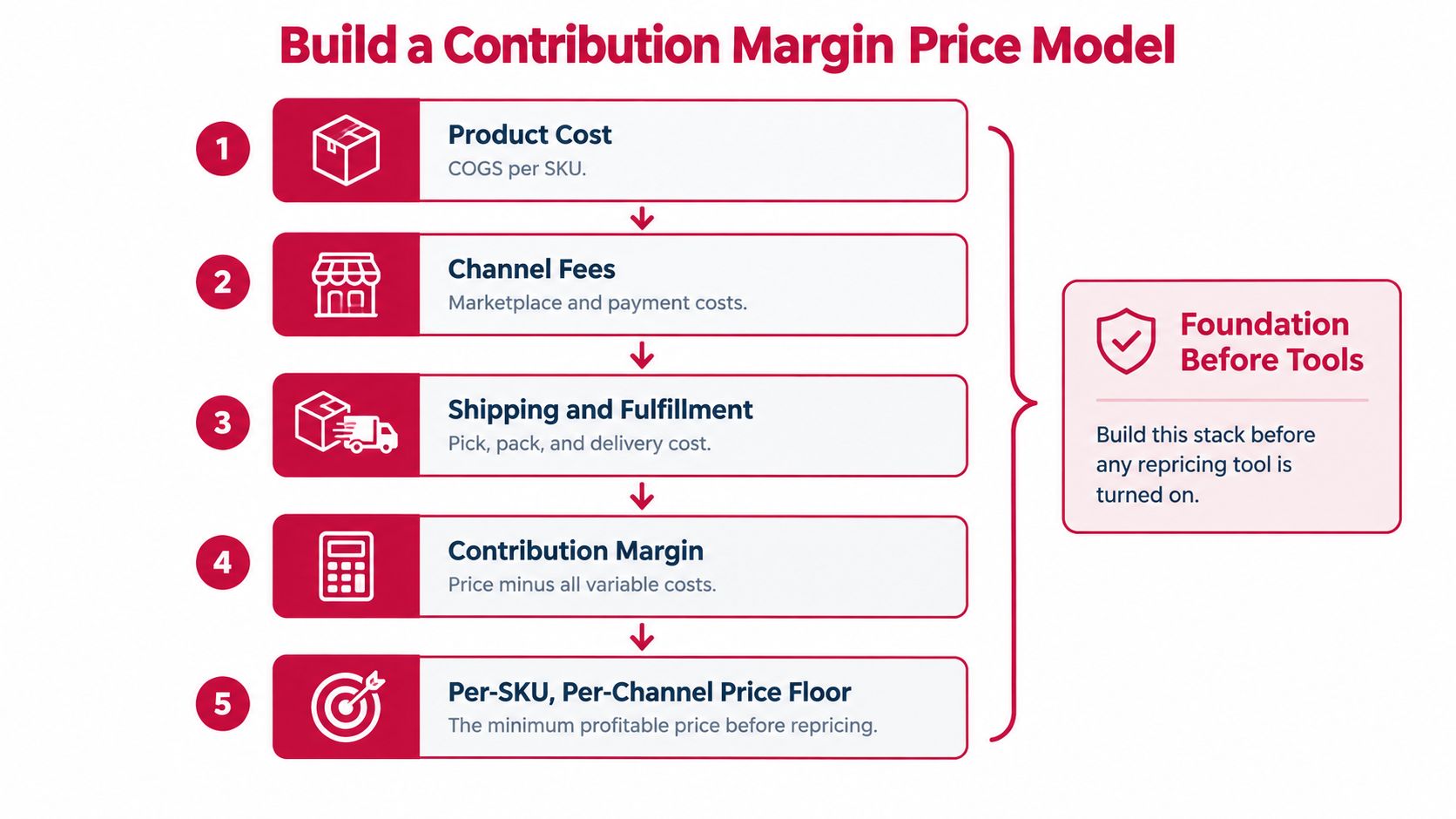
Walk one SKU through this sequence. Don't average the catalog and call it a model.
Amazon states that 2026 US FBA fulfillment fees will increase by an average of $0.08 per unit, less than 0.5% of an average item's selling price, per Amazon's 2026 US FBA fee reference. The average is a poor planning number. Small standard-size products priced between $10 and $50 are scheduled for an average $0.25 increase, while large standard-size products in that band move $0.05. Above $50, the scheduled averages are $0.51 for small standard and $0.31 for large standard.
A SKU with $2.00 of pre-ad contribution loses 12.5% of that contribution from a $0.25 increase. A SKU with $0.50 loses half. Same catalog, different survival.
Practical rule: If the floor after the new fee tier sits above the price sales wants to advertise, the pack or the channel is wrong, not the spreadsheet.
Each ASIN or pack needs its own tier. A flat catalog markup hides the SKUs that go negative first. Paid media has the same dependency. Scaling rules for Meta media buyers only hold after the contribution number is real, because a break-even return built on an old fee will green-light spend that no longer pays. Write the floor down. Sales and ads don't get to cross it in a meeting.
The same list price is not the same business. Marketplace fees, fulfillment, advertising, returns, distributor margin, and what a retailer expects to charge can turn one sticker into four different contributions.
Deloitte's 2025 retail outlook reports that 67% of executives expect shoppers to buy more often with smaller baskets, and 56% expect consumers to prioritize lower prices over brand loyalty. Shoppers also expect pricing to feel consistent online and in store. The harder question is the lowest channel-specific price that still holds contribution, avoids a damaging gap, and keeps wholesale intact. Channel conflict usually starts when a visible marketplace coupon undercuts a partner who was promised a floor.
Referral fee alone is not the Walmart decision. Walmart Fulfillment Services fee guidance sets a standard base of $3.45 for units at 1 lb. or less, $4.95 at 2 lb., and $5.45 at 3 lb. From 4 to 20 lb., the fee is $5.75 plus $0.40 for every pound above 4 lb. WFS also adds $1 per unit when the retail price is below $10, and $0.50 for hazardous-material products.
A $9.99 item at 1 lb. owes $3.45 plus the $1 low-price surcharge before product cost, commission, ads, storage, or returns. Crossing $10, or selling a multipack that spreads fulfillment across units, can improve contribution even if unit demand softens a little. Pack architecture is a foundation choice. It is not a cleanup you do after ads are live.
DTC swaps marketplace fees for shipping subsidies and acquisition cost. Wholesale is constrained by the retailer's margin and MAP, so the visible shelf price is partly someone else's number. Price parity should not mean identical net economics. Different pack sizes, bundles, and promo mechanics by channel beat blunt matching.
RedDog Consulting Group works with CPG brands on marketplace management, pricing, merchandising, and inventory velocity so each channel supports contribution instead of fighting the others. That is one way to staff the architecture. Any operator can still run the check below without a vendor.
| Channel | Main cost drivers | Pricing lever | Risk if prices are matched blindly |
|---|---|---|---|
| Amazon | Referral, FBA tier, ads, returns | Pack size and coupon depth under a floor | A thin contribution disappears inside the fee tier |
| Walmart | WFS weight fee, sub-$10 surcharge, ads | A price just over $10, or a multipack | The low list price looks competitive and is not |
| DTC | Shipping subsidy, payment, acquisition | Bundle, threshold, or subscribe offer | Matching a marketplace price ignores acquisition cost |
| Wholesale | Trade spend, retailer margin, MAP | Pack or deal structure, not the sticker | A marketplace coupon breaks the relationship |
Dynamic pricing is not a license to move the tag every hour. Fluctuating prices trace back to airlines in the 1970s, when seats were perishable. Later ecommerce work moved from fixed-price competition toward inventory-aware models. A 2022 review of 132 articles on competitive posted pricing found that dynamic models can outperform static ones when demand is estimated properly, especially with sound inventory management and elastic demand. The same research thread shows why online prices need high-frequency measurement. Germany's statistical office analyzed automatically collected 2019 consumer-product prices, and related work tracked roughly 2,700 products across 14 online shops, hourly, seven days a week, for nearly three months. That measurement gap doesn't mean you should reprice on the same cadence.
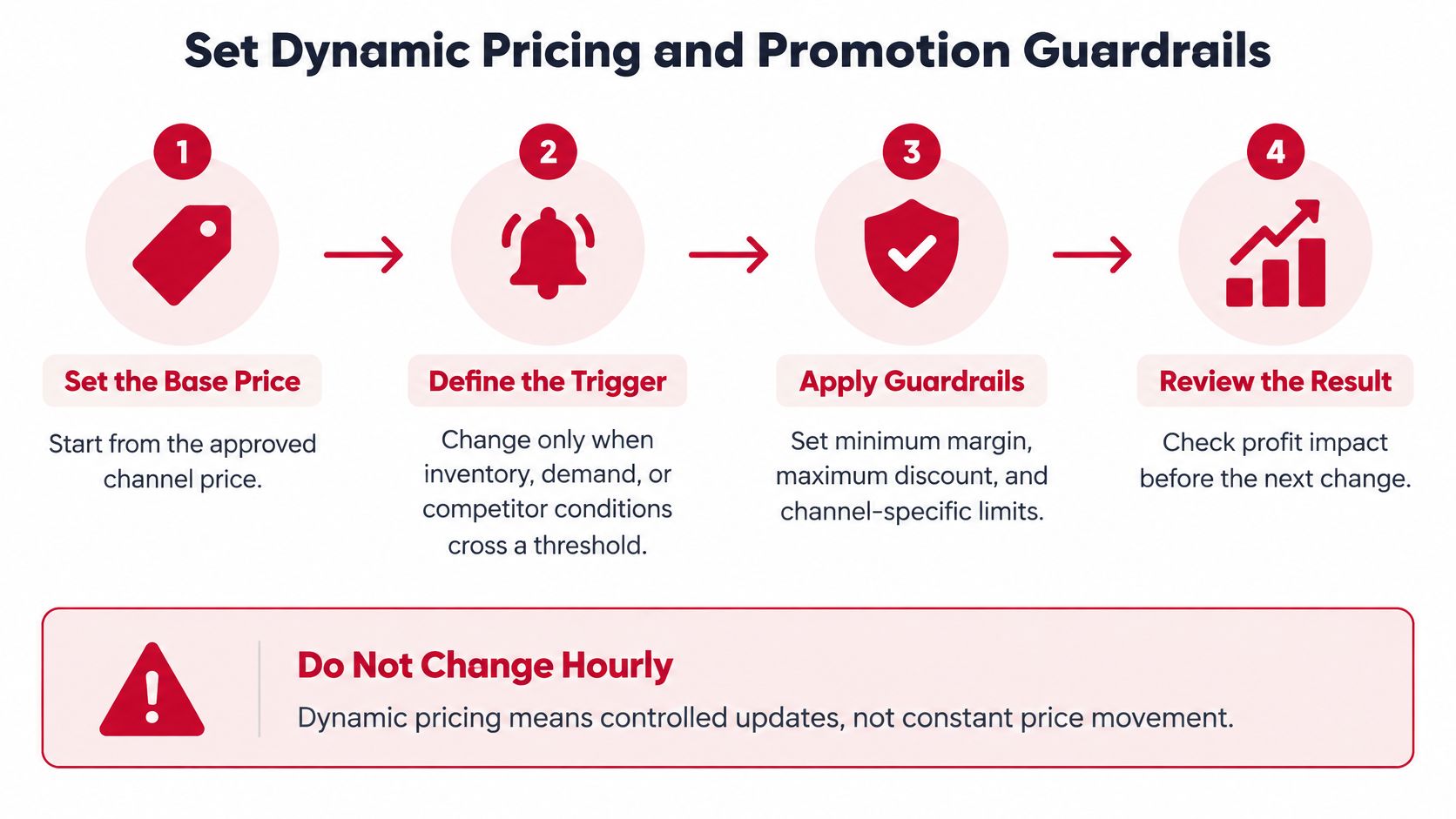
That body of work also includes an OECD experiment in which consumers generally viewed personalized pricing as unfair, while disclosures did little to help them identify or understand it. Your rule has to be explainable to a wholesale buyer and a DTC customer.
Change price when inventory, elasticity, or a planned event says so. A competitor tick by itself isn't a reason.
If demand is inelastic and stock is healthy, holding price is the profitable action. If a seasonal SKU is aging, a bounded discount beats a slow bleed into storage. Write the policy on one page. Whoever runs the software follows that page, not the default rules inside the tool.
Rules are not tests. Optimization is one controlled change, read against cash, not against a revenue chart.
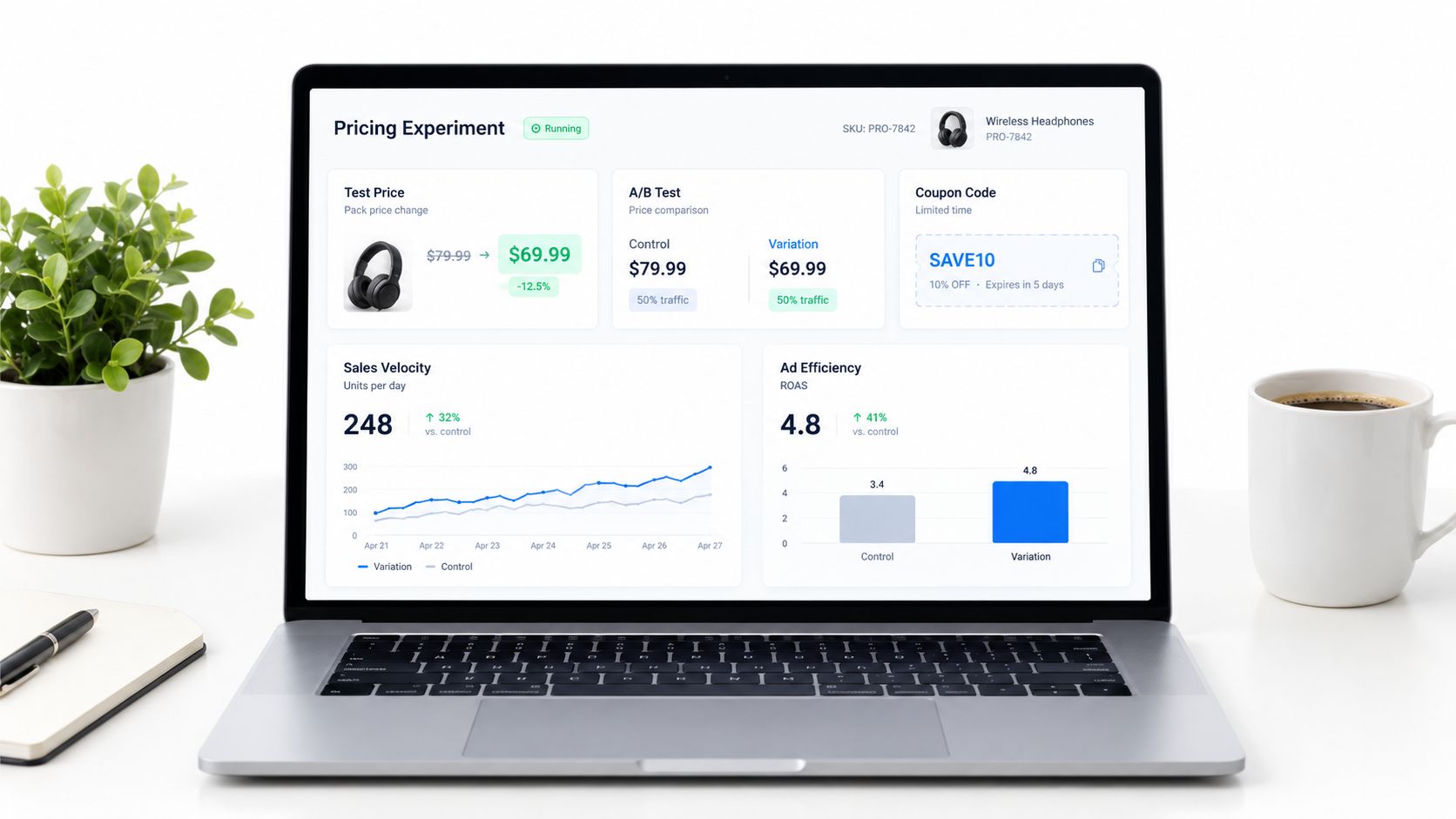
Pick one variable. Use a pack-price move or a coupon depth, not both. Hold the listing content and the traffic source as steady as the channel allows. Set a window long enough to see repeat purchase and returns, not only day-one conversion. A week of buy box wins will flatter a price that later comes back as returns and weaker second orders.
Judge the test on unit velocity, advertising efficiency, and cash left after fees. Rebuild break-even ACOS from the new contribution before you celebrate a unit lift. A test that sells more units while pushing ACOS past that new break-even failed, even if revenue rose. The pay-per-click report should show contribution after ads, not a blended ACOS that hides the SKU you just cheapened.
Fulfillment economics aren't flat across the year. Rerun the break-even before you raise spend into a peak calendar. Heavier ads on an old floor will scale a price that no longer clears.
Keep a short log so the next test doesn't restart from memory:
One variable, one window, three readouts. That habit beats another round of catalog-wide cuts.
A promo can lift orders while lowering contribution. The squeeze is sharpest when a brand raises ad spend during a period when fulfillment fees and storage costs also rise. Price each channel against its own fee stack, then decide whether the added volume still pays.
Amazon's notice lists a 3.5% fuel and logistics surcharge on US and Canada FBA fulfillment fees beginning April 17, 2026, and holiday peak fulfillment fees from October 15, 2026 through January 14, 2027 for the programs it specifies. Check the Amazon fuel and peak-fee notice for current program details before modeling these costs. Treat announced changes as upcoming costs, not charges already on an invoice.
For a $5.00 fulfillment fee, a 3.5% surcharge adds $0.175 per unit. At 10,000 units, that is $1,750 before any peak fee. Recalculate the contribution floor for each affected program and selling channel before increasing ad spend. A price that clears on DTC may not cover Amazon fulfillment and advertising.
Storage charges can turn a slow-moving SKU into a margin problem. WFS storage pricing lists $0.75 per cubic foot per month from January through September. From October through December, that rate covers inventory stored up to 30 days, with an extra $1.50 per cubic foot for inventory held longer. Items stored more than 12 months may incur $2.25 per cubic foot monthly.
As an example, 100 cubic feet held past 30 days in peak season adds $150 a month before ordinary storage. Cut replenishment, bundle aging units, or use a targeted discount before storage and markdown risk erode the margin. Check aging by SKU, not just total inventory, since a small group of slow items can absorb cash needed for replenishment.
A DTC flash sale or marketplace coupon can undercut a wholesale partner, even when the discounted order still earns a positive margin. Shoppers and retail buyers see the price, not your channel-specific fee stack. A cheaper visible offer can become the reference price, making the next wholesale negotiation harder.
Use different packs and promotion mechanics to protect channel roles instead of matching the lowest offer. A multi-unit DTC bundle, for example, can change the per-unit value without cutting the single-unit shelf price. Set a cap on promo depth, specify which SKUs can discount to improve velocity, and keep the remaining offers above their contribution floors. A low visible price is a deliberate choice, not a substitute for channel economics. The budget hair-care guide is a consumer example of value positioning; it does not establish how buyers respond to price gaps.
A model nobody owns will drift the first time a buyer asks for a deal. Assign the pen before the next price change.
Finance owns the cost stack and the floor. Marketplace and DTC owners propose tests inside that floor. They don't rewrite it in a launch channel. A weekly review, short enough to survive a busy quarter, checks four numbers by channel:
Keep the set this short on purpose. A dashboard with twenty rates won't get opened in November. Four numbers, one owner for the floor, and a written exception path when a retailer demands a price you can't support.
If a number isn't on that weekly page, it isn't steering the price.
That cadence is the growth sequence in operating form. Foundation is the cost stack and the floor. Optimization is the single-variable test inside the floor. Amplification, meaning more spend or a wider promo, comes only after the peak-period floor still clears. Spend on top of a stale price is how catalogs grow and cash thins.
The next margin review is a working session, not a tool demo. Walk one hero SKU across Amazon, Walmart, DTC, and wholesale. Mark fee exposure by calendar. Name the channel conflict you are already living with. Then decide which packs move and which prices stay put.
Reddog Consulting Group works with CPG founders and operators on price waterfalls, fee exposure, and channel conflict before spend gets amplified. If listed price is winning clicks while contribution slips, book a free 30-minute strategy call as a working session on margin and marketplace performance, not a pitch. Visit Reddog Consulting Group to set that review.
Leave a comment: