
Published: March 2020 | Last Updated:January 2026
© Copyright 2026, Reddog Consulting Group.

Nearly 90 percent of American retail leaders say they struggle to make quick decisions using raw sales numbers. For busy retailers and eCommerce directors, finding meaningful patterns in endless spreadsheets is a daily challenge. Data visualization offers a smarter way forward, turning complex metrics into clear visuals that reveal customer behavior and sales opportunities. Discover how this strategic approach can help American businesses transform data confusion into confident decisions.
| Point | Details |
|---|---|
| Data Visualization Enhances Decision-Making | Effective data visualization transforms raw retail data into clear visuals that support faster, intuitive decision-making for business leaders. |
| Diverse Tools Cater to Varying Needs | Retailers should choose data visualization tools that align with their technical skills and business objectives, ensuring ease of use and integration. |
| Focus on Customer Insights | Analyzing customer data visually helps retailers develop tailored marketing strategies and improve inventory management by identifying purchasing patterns and preferences. |
| Avoid Common Data Pitfalls | Establishing a culture of critical thinking and data literacy can prevent common pitfalls like confirmation bias and misinterpretation of data findings. |
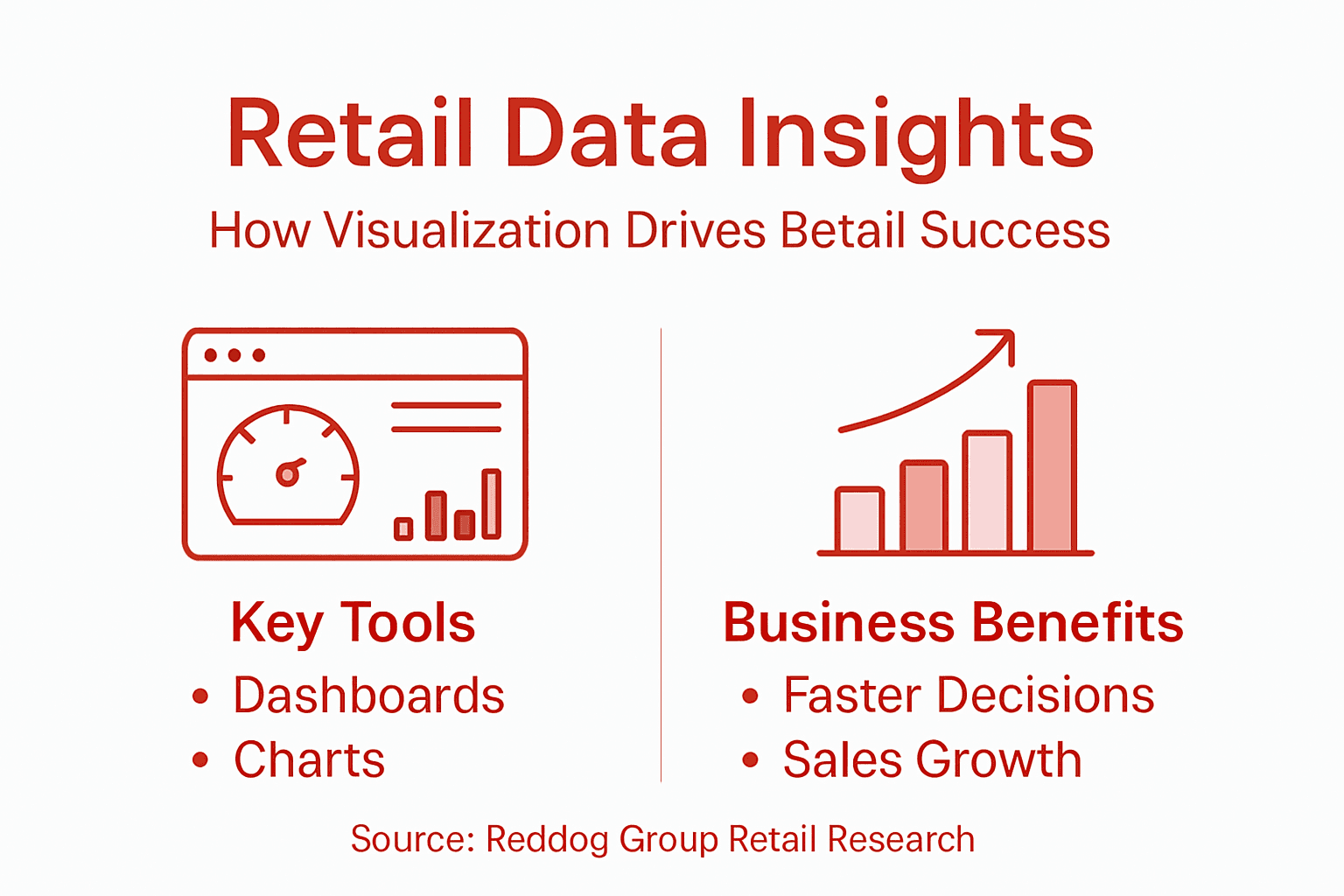
Data visualization is a strategic approach for transforming raw retail data into meaningful visual representations that enable faster, more intuitive decision-making. Effective data communication techniques allow retailers to translate complex sales metrics, customer behaviors, and operational insights into comprehensible charts, graphs, and interactive dashboards.
In the retail context, data visualization goes beyond simple graphing. It involves creating visual narratives that reveal underlying patterns, trends, and opportunities within massive datasets. Key visual representations might include heat maps showing customer foot traffic, line graphs tracking sales performance across different product categories, or pie charts illustrating market segment distributions. The goal is to transform numerical data into actionable intelligence that business leaders can quickly understand and leverage.
Visualization principles emphasize clarity, simplicity, and audience-focused design. Successful retail visualizations eliminate unnecessary complexity, highlight critical insights, and provide contextual understanding that raw numbers cannot. By carefully selecting appropriate chart types and maintaining visual integrity, retailers can communicate sophisticated business intelligence without overwhelming decision makers.
Pro Tip: When creating data visualizations, always prioritize clarity over complexity and design your visuals to answer specific business questions quickly and intuitively.
Retail businesses leverage a diverse range of data visualization tools to transform complex information into actionable insights. These tools span from user-friendly platforms like Microsoft Excel and Tableau to more advanced analytics environments such as Python libraries and Power BI. Each tool offers unique capabilities for breaking down massive datasets into comprehensible visual formats that help retailers make strategic decisions.
Enterprise-Level Visualization Tools provide comprehensive solutions for retail analytics. Tableau, for instance, enables interactive dashboards that can track sales performance, inventory levels, and customer behavior across multiple dimensions. Power BI integrates seamlessly with existing Microsoft ecosystems, offering deep data modeling and real-time reporting capabilities. These platforms allow retailers to create dynamic visualizations that update automatically, providing up-to-the-minute business intelligence.
Open-Source and Specialized Tools play a crucial role in retail data analysis. Free visualization platforms like Datawrapper and Chartbuilder offer accessible options for smaller retailers or those with limited technical resources. Python libraries such as Matplotlib and Seaborn provide more advanced users with powerful data manipulation and visualization capabilities, enabling custom analytics solutions tailored to specific retail challenges.
Pro Tip: Select a data visualization tool that matches your team’s technical skills and specific business requirements, prioritizing ease of use and integration with existing systems.
Here’s a comparison of popular retail data visualization tools and their key strengths:
| Tool Name | Primary Use | Integration Level | Ideal For |
|---|---|---|---|
| Tableau | Interactive dashboards | High (Multiple systems) | Large enterprises, analytics teams |
| Microsoft Excel | Basic charting | Moderate (Office suite) | Small businesses, entry users |
| Power BI | Real-time reporting | Deep (Microsoft stack) | Retailers using Microsoft systems |
| Datawrapper | Quick visual creation | Low (Standalone) | Small retailers, fast turnarounds |
| Python Libraries | Custom analytics | High (Requires coding) | Advanced analysts, tech teams |
Data visualization techniques transform raw sales information into strategic roadmaps that enable retailers to make precise, informed decisions. By converting complex numerical data into intuitive graphical representations, businesses can quickly identify market trends, customer preferences, and potential revenue opportunities that might otherwise remain hidden within spreadsheets and databases.

Performance Analytics represent a critical dimension of sales strategy visualization. Interactive dashboards allow sales teams to track key performance indicators in real-time, highlighting areas of strength and potential improvement. These visual tools can segment sales data by product line, geographic region, customer demographics, and seasonal variations, providing a multidimensional view of business performance that goes far beyond traditional reporting methods.
Business intelligence platforms empower retailers to predict demand and optimize inventory management through advanced data visualization. By analyzing purchase patterns and visualizing customer behavior, sales strategists can develop targeted marketing campaigns, adjust pricing strategies, and identify cross-selling opportunities with unprecedented precision. These insights enable proactive decision-making, transforming reactive sales approaches into predictive, data-driven strategies that anticipate market dynamics.
Pro Tip: Prioritize visualization tools that offer customizable dashboards and real-time data integration to ensure your sales strategy remains agile and responsive to market changes.
Customer insights techniques represent a sophisticated approach to understanding consumer behavior beyond traditional market research. By systematically collecting and analyzing both qualitative and quantitative data, retailers can uncover deep patterns that reveal customer preferences, purchasing motivations, and potential future buying trends. This strategic approach transforms raw data into actionable intelligence that drives targeted marketing and product development strategies.
Data Integration and Analysis play a crucial role in extracting meaningful retail insights. Modern businesses combine multiple data sources including transaction histories, online browsing behaviors, demographic information, and customer feedback to create comprehensive customer profiles. Interactive visualization tools help break down these complex datasets, enabling retailers to identify nuanced consumer segments, predict purchasing patterns, and develop personalized marketing approaches that resonate with specific customer groups.
Data science techniques enable retailers to move beyond descriptive analytics toward predictive and prescriptive strategies. Advanced algorithms can now anticipate customer needs, recommend personalized product selections, and help businesses proactively design experiences that meet emerging consumer expectations. By translating raw customer data into visual narratives, retailers can make more informed decisions about inventory management, marketing investments, and customer engagement strategies.
Pro Tip: Implement a robust data governance framework that ensures data quality, privacy, and consistent collection methods across all customer interaction points.
Data-driven decision challenges emerge when retailers approach analytics without a strategic framework. Many businesses fall into the trap of relying on intuition rather than systematic data analysis, leading to misguided strategies and missed opportunities. Understanding these potential pitfalls is crucial for developing a robust, insight-driven approach to retail management.
Critical Analysis Barriers frequently undermine data effectiveness. Common mistakes include confirmation bias, where teams selectively interpret data to support preexisting beliefs, and overgeneralization of limited datasets. Retailers must cultivate a culture of critical thinking that challenges assumptions and demands rigorous evidence. This means establishing cross-functional review processes, encouraging healthy skepticism, and creating mechanisms for independent data validation.
Data storytelling techniques play a pivotal role in avoiding misinterpretation. Successful organizations translate complex data into clear, actionable narratives that communicate insights without overwhelming decision makers. This requires developing strong data literacy across teams, ensuring that visualizations and reports are designed for clarity, context, and immediate strategic understanding. Transparency about data limitations and potential biases becomes as important as the insights themselves.
Pro Tip: Implement a mandatory peer review process for all data-driven recommendations, requiring team members to challenge underlying assumptions and validate the logical integrity of proposed insights.
Below is a summary of common pitfalls in retail data use and how to avoid them:
| Pitfall | How It Occurs | Avoidance Strategy |
|---|---|---|
| Confirmation Bias | Selective data interpretation | Peer review and diverse analysis teams |
| Overgeneralization | Limited dataset assumptions | Use comprehensive, validated data sources |
| Data Misinterpretation | Poor storytelling techniques | Clear, contextual visual narratives |
| Ignoring Data Limitations | Overconfidence in findings | Transparency about data weaknesses |
The article highlights the critical challenge retailers face in making complex sales and customer data clear and actionable. You need precise data visualization tools that turn raw numbers into strategic insights supporting real-time decision-making and predictive sales strategies. If your goal is to harness visual data storytelling to identify customer trends and optimize inventory and marketing efforts, you are not alone. Retailers often struggle with data misinterpretation and integrating diverse data sources effectively to drive measurable growth.
At Reddog Group, we specialize in bridging this gap by combining advanced data-driven insights with proven omnichannel retail strategies. Our tailored services help small and medium-sized businesses implement smart digital marketing, marketplace management, and seamless online-offline sales integration. We focus on transforming your customer and sales data into clear visual intelligence that empowers confident, insight-driven business decisions. With experience managing over 50 brands and thousands of SKUs, our expert guidance in Amazon FBA, DTC channels, and inventory optimization ensures you capitalize on every market opportunity.
Ready to turn your retail data into a powerful growth engine today
Explore how you can enhance your data visualization and omnichannel approach with Reddog Group. Visit https://reddog.group now and take the next step toward sustainable retail success.
Data visualization is crucial in retail as it transforms raw data into intuitive visual representations, enabling faster and more informed decision-making. It helps retailers identify trends, customer behaviors, and operational insights that might be missed in raw data formats.
Retailers commonly use tools like Tableau, Microsoft Excel, Power BI, and open-source options like Datawrapper. Each tool caters to different needs, from basic charting to advanced analytics and real-time reporting.
Data visualization drives sales strategies by allowing retailers to track performance metrics, predict demand, and optimize inventory management through visual representations of complex data, making it easier to implement data-driven marketing campaigns and sales initiatives.
Common pitfalls include confirmation bias, overgeneralization from limited datasets, poor data storytelling, and ignoring data limitations. Retailers should implement peer review processes and promote data literacy to mitigate these issues.
Leave a comment: