
Published: March 2020 | Last Updated:October 2026
© Copyright 2026, Reddog Consulting Group.

Digital and physical purchasing often overlap for CPG shoppers, so a brand's channel strategy should account for how customers move between them. That does not make every channel worth adding. Judge each one by whether it can contribute incremental profit after its costs, rather than by gross sales alone.
Say a household-cleaning brand launches on a marketplace while maintaining its retail business. Marketplace orders rise, but some come from customers who previously bought through the brand's own website. The team celebrates the new revenue without subtracting displaced DTC contribution, launch advertising, or the cost of splitting inventory.
The opposite mistake is possible, too. A shopper checks ingredients and usage instructions online, then buys in a store. The product page helped answer the purchase question, but its direct-sales report won't capture that value.
A useful CPG sales strategy makes connected decisions about price, pack, inventory, and promotion. Its purpose isn't to put the same assortment everywhere. It's to establish which channel and pack combination can generate additional contribution profit.
Contribution margin is what remains after the costs associated with selling the product: product cost, retailer or marketplace fees, fulfillment, freight, returns, promotions, retail media, and chargebacks. Keep the calculation consistent, and label whether you're looking at contribution before or after advertising.
That remainder still has to support overhead and operating profit. A positive contribution doesn't automatically make an expansion attractive, especially when the brand must commit cash to inventory before collecting payment.
For a finance-side companion to the SKU model, AmbitionCFO offers a practical framework for improving margins. Use that perspective to connect channel decisions with the broader business, rather than treating marketplace profitability as a separate exercise.
Operating rule: Don't add Amazon, Walmart, DTC, wholesale, or a distributor until the incremental unit clears a preset contribution floor after the costs required to sell it.
Set that floor before negotiating a launch. Otherwise, teams tend to adjust the definition of success after they've committed inventory and promotional funding.
Keep cross-channel influence separate from direct attribution. You can acknowledge that a listing supports retail discovery without assuming every store sale came from digital advertising. Require evidence for the claimed benefit, and don't use an unmeasured halo effect to excuse a channel that consistently loses money.
A channel can add sales and still reduce profit. Compare its incremental contribution with the contribution you could earn by using the same inventory and cash elsewhere.
Channel costs and trade-offs
| Channel | Main cost stack | Margin watch-out | Inventory effect | Wins when |
|---|---|---|---|---|
| Amazon FBA | Referral fees, fulfillment, and shipping or gift-wrap charges | Model current fees and returns against the selling price | Balance weeks of supply with storage costs and availability | Velocity supports Prime availability and advertising costs fit the channel's economics |
| Walmart WFS | Weight-based fulfillment fees, plus applicable surcharges | Low-priced items and special handling can erode contribution | Peak and aged storage can turn a positive sale negative | Delivered value works for shoppers and inventory turns at a sustainable pace |
| DTC | Media, shipping, returns, and payment processing | Customer acquisition costs must be supported by first-order or repeat contribution | The brand carries stockout and returns exposure | Price, bundle, or subscription economics cover fulfillment and customer acquisition |
| Wholesale | Trade spend, deductions, chargebacks, and slotting | Evaluate net invoice revenue after expected deductions | Case packs and forecast error can create excess stock | Velocity and terms support the commitment |
| Distribution | Distributor and retailer margins | An added margin layer can reduce the brand's net price | Longer pipelines can require more safety stock | The distributor reaches accounts the brand cannot serve economically itself |
On Amazon, build listings around clear product use, accurate pack quantities, and consistent pricing. FBA can support a Prime offer, but fulfillment eligibility does not make advertising profitable. Set bids against the contribution available for acquisition, rather than a blended revenue target.
On Walmart, check package weight and price architecture before launch. The WFS fee guide lists weight-based charges, a $1 surcharge below $10, a $0.50 hazardous-materials surcharge, and a $3 charge for certain oversize items. A price increase helps only if shoppers still see value in the delivered offer.
Keep pack descriptions comparable across both marketplaces. If prices differ, make unit counts and quantities easy to understand without requiring shoppers to calculate the difference.
DTC removes the retailer's margin, not the cost of reaching and serving customers. A first-order discount can look attractive until shipping, payment processing, returns, and acquisition spend are included.
Build bundles around a genuine usage occasion. Offer subscriptions when consumption supports replenishment, and time reminders around expected product depletion. Don't count on repeat purchases to justify a first order until repeat behavior is established.
In wholesale, model invoice revenue after expected deductions. Cap promotional commitments, document allowances, and choose case packs that won't leave the buyer with excess stock.
For cleaning brands evaluating business buyers, a practical guide to business cleaning purchases can inform how you translate buyer requirements into pack size, replenishment cadence, and delivered cost.
Distribution can extend reach when a brand cannot economically serve accounts itself. Compare the margin layer against the added account access, and use the distinctions between wholesale and distribution channels to clarify who holds inventory, services accounts, and absorbs deductions.
Small and midsize CPG brands grew 4.9% in 2024, versus 0.5% for companies above $1 billion in sales, according to BCG. Growth does not establish that a channel is profitable. Add one when its incremental contribution beats the practical alternative use of inventory and cash.
Use a SKU-by-channel worksheet, not an account-wide average:
Velocity helps establish replenishment requirements and the total contribution available to fund media. It doesn't, by itself, determine an affordable acquisition cost.
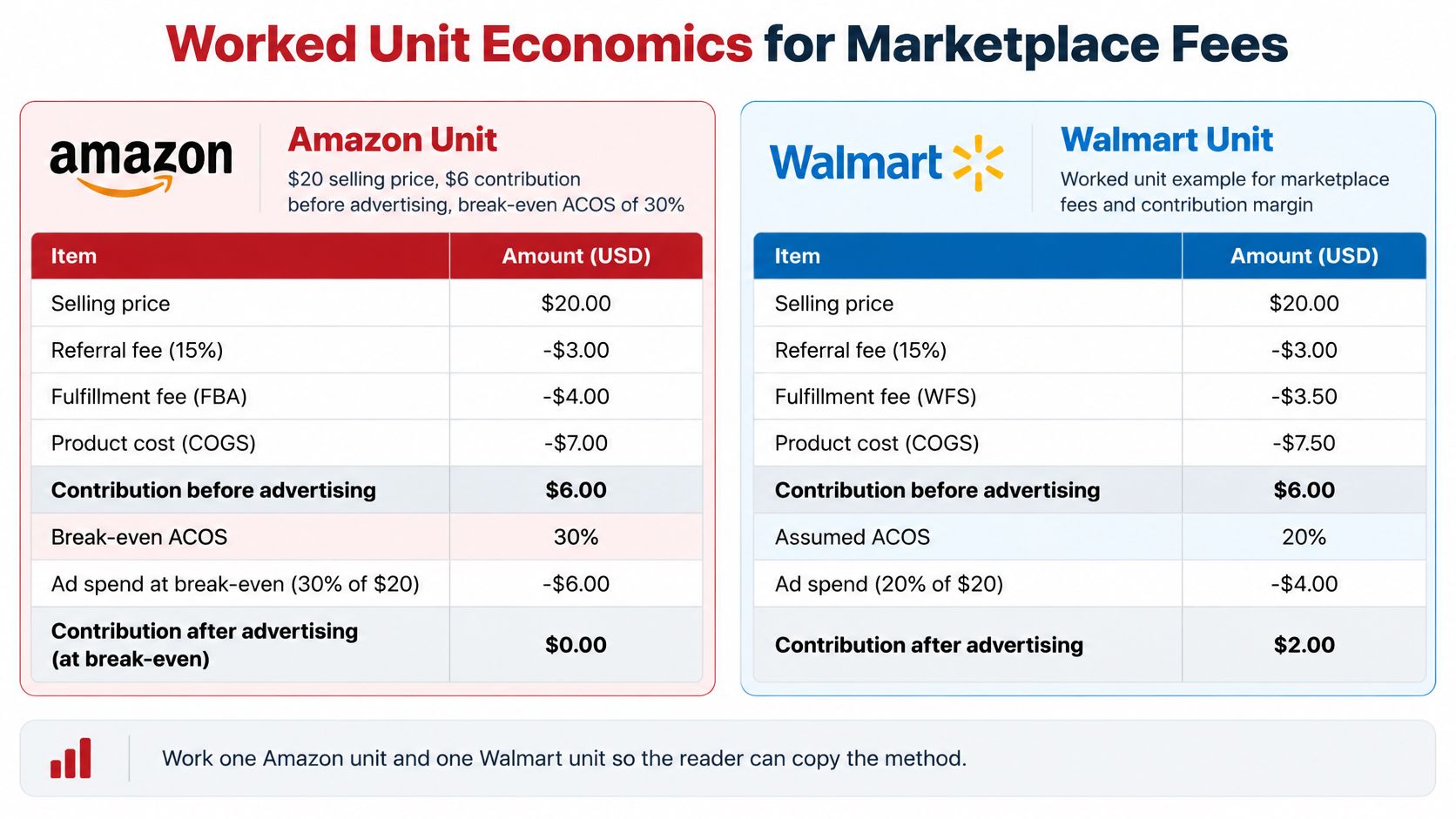
Amazon's 2026 U.S. fee update states an average $0.08 increase per FBA unit sold, generally effective January 15, 2026, with at least 90 days' notice before fee increases take effect. Using that update's worked economics, a $20 product with $6 contribution before advertising moves from 30% break-even ACOS to 29.6%, because contribution falls to $5.92; at 100,000 units, the increase totals $8,000 annually.
The decision isn't whether the fee looks small. It's whether the campaign still meets the required after-advertising contribution. Break-even ACOS leaves nothing from that attributed sale for overhead or profit, so the operating target should sit below it.
Check the referral-fee base as well. Amazon's referral-fee guidance includes item price, delivery, and gift wrap: its illustrated 15% rate on $24.99 plus $4.99 delivery produces $4.50, not $3.75, understating cost by $0.75 if shipping is excluded.
For a broader reconciliation checklist, use agentcentral's 2026 Amazon selling costs explained alongside a review of fees for Fulfillment by Amazon. Apply the actual SKU classification rather than substituting an average fee.
For the lightweight Walmart item in the comparison, add the standard fulfillment charge and low-price surcharge before calculating contribution. That combined charge still excludes referral fees, product cost, advertising, and returns.
Test whether a multipack or higher price improves total contribution, not merely contribution per order. A larger pack can reduce order frequency or increase shipping weight.
Update three worksheet lines whenever fees change:
A marginal campaign may need a bid reduction or pause even when the fee change appears minor.
A profitable SKU can become an unprofitable launch when the team changes its pack, fulfillment method, and advertising budget simultaneously. RedDog's Foundation → Optimization → Amplification sequence separates those decisions so operators can identify what improves the unit.
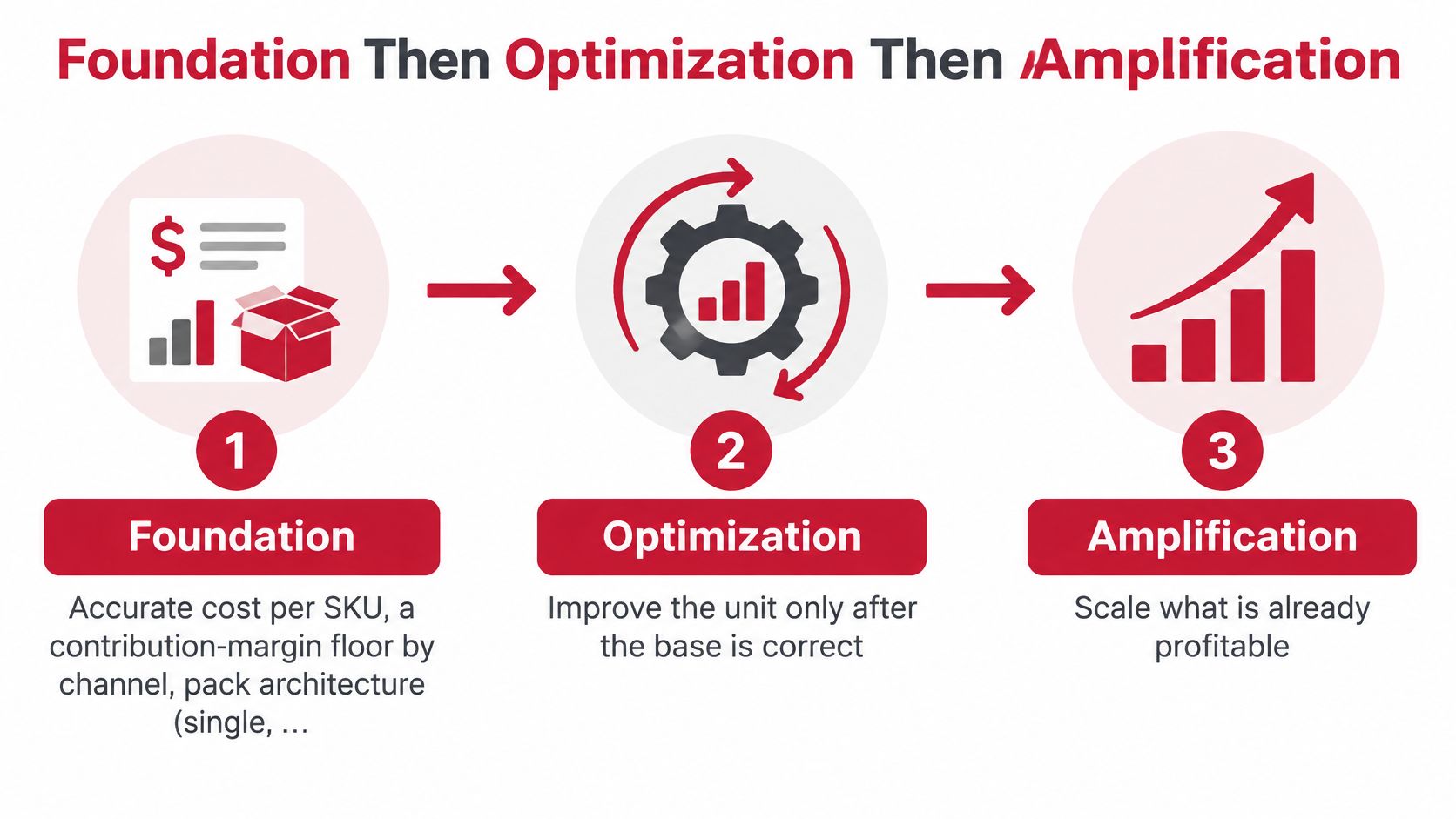
Build an accurate cost record for each SKU. Match the catalog identifier to the physical product, packaging dimensions, case configuration, fulfillment method, and channel-specific selling terms.
Then choose the pack architecture deliberately. A single unit may suit trial, a multipack may support marketplace shipping economics, and a wholesale case must work for the buyer's shelf and replenishment process. Don't duplicate packs across channels because the inventory already exists.
Price parity means understanding comparable value across channels, not forcing unlike packs into identical prices. Record unit price, promotional exceptions, and who funds each discount.
Foundation gate: Every SKU needs a populated cost model, contribution floor, pack specification, price position, listing-content checklist, and weeks-of-supply calculation. Unknown costs need an owner and a conservative allowance, not an empty spreadsheet cell.
Improve titles, images, keywords, and descriptions where shoppers misunderstand the product. If traffic converts but contribution misses the floor, prioritize price, pack, fulfillment classification, or deductions instead of buying more traffic.
For a Walmart item priced just below the low-price threshold, test a price above it and monitor conversion alongside contribution. In wholesale, reconcile deduction claims against agreements before concluding that the account needs a higher list price.
Don't change the offer, inventory commitment, and media budget together. You won't know which decision changed the result.
Shift scarce inventory only after accounting for the contribution lost in the channel being deprived. An attractive marketplace order isn't incremental profit if fulfilling it causes a more valuable retail replenishment to fail.
Optimization gate: Require contribution after fees to remain above the floor for two consecutive review periods. Treat that as an internal operating discipline, not an industry benchmark, and reconcile delayed costs before approving expansion.
Increase retail media and PPC only after the unit has an affordable advertising target. Broader awareness comes after repeat purchasing and availability are reliable enough to support the demand you're funding.
Amplification gate: Every promoted SKU must state its contribution floor, current weeks of supply, and break-even advertising rate. If the team can't produce those figures, keep the SKU out of the expansion budget.
The point isn't to delay growth. It's to prevent paid demand from creating expensive stockouts, emergency freight, or another replenishment order for a product that doesn't earn its place.
A positive sale can still be a poor inventory decision. Under Walmart's WFS storage pricing, standard storage is $0.75 per cubic foot per month from January through September, peak inventory stored beyond 30 days incurs an additional $1.50, and aged rates reach $2.25 at 366–450 days and $7.50 beyond 450 days.
Walmart WFS storage rates
| Storage condition | Rate per cubic foot per month |
|---|---|
| January through September | $0.75 |
| October through December, stored more than 30 days, additional | $1.50 |
| Held 366 to 450 days | $2.25 |
| Older than 450 days | $7.50 |
Set a weeks-of-supply cap before committing peak inventory. Separate expected demand from optimistic promotional demand, and check how much space oversized packs consume relative to the contribution they generate.
Assign a decision date for slow-moving stock. Compare removal, alternative-channel sales, markdowns, and liquidation before aged charges become the default outcome. Keeping inventory at its original price isn't protecting margin if the carrying cost makes recovery less likely.

Nearly 40% of consumers surveyed were shopping for deals during October Deal Days in 2023, according to NielsenIQ. That finding supports discount-led merchandising, but it doesn't establish that shoppers will replenish at the regular price.
Compare post-promotion baseline sales with the pre-promotion baseline, accounting for availability and seasonal changes. Look for purchases pulled forward from the following period, not just the orders recorded during the event.
Use trade-spend optimization to connect promotional commitments with deductions and realized contribution. A promotion isn't financially closed because the retailer removed the display.
Cash discipline: Don't fund the next promotion from an estimate of what the last promotion earned. Reconcile the actual costs first.
In 2023, 28% of CPG manufacturers surveyed by Advantage Solutions planned list-price increases within the following six months, down from 46% in its December survey, as reported by Supermarket News. That's a manufacturer-intent measure, not proof of consumer price tolerance.
Don't assume customers or buyers will absorb whatever increase makes your spreadsheet work. Check fulfillment errors, expensive pack configurations, unsupported deductions, and unproductive promotion funding first.
Then evaluate price against shopper response and retailer terms. Raising price while losing enough velocity can leave the brand with both weaker contribution dollars and more aging inventory.
Circana reported that innovations represented 5.2% of CPG products in 2024, down from 6.2%, while new-product sales fell from €28.9 billion in 2023 to €24.1 billion in 2024; new products represented 19% of sales for companies generating $100 million–$500 million, compared with 9% for companies generating $500 million–$1 billion.
Launch performance deserves attention, but launching more items isn't a substitute for disciplined commercialization. Fund a focused assortment through an evidence gate rather than spreading launch media across every available SKU.
When to scale, revise, or kill a CPG item
| Decision | Evidence to require | What to do next |
|---|---|---|
| Scale | Repeat holds, contribution after launch media stays above the floor, and in-stock rate supports replenishment | Add distribution or a second channel in limited quantity |
| Revise | Trial or first purchase converts, but repeat is weak or margin misses the floor | Change pack, price, or promo before adding doors |
| Kill | Contribution after media is negative, or velocity cannot earn replenishment | Stop media, halt reorders, and liquidate aged stock |
DTC retention becomes useful once the underlying order economics hold. Tinuiti's 2023 CPG Customer Journey study found that at least 20% of shoppers across beauty, food and beverage, and over-the-counter health categories had joined more loyalty programs during the prior year for special offers or discounts.
Design the retention offer around profitable replenishment. Track contribution after rewards and distinguish customers who would have reordered anyway from purchases the program adds.
A new channel, pack, or advertising dollar earns its place only if it adds contribution profit after fees, fulfillment, trade spend, and inventory risk. Before committing cash, define the expected return and the evidence that would change the decision.
Bring the SKU list, fee statements, channel pricing, advertising results, and inventory position to the initial consultation. If wholesale or distribution is under consideration, include the proposed terms and case configuration.
A fulfillment charge, unclear listing, weak reorder pattern, or inventory assigned to the wrong channel calls for a different response. More advertising will not fix every margin problem.
RedDog's process moves through Foundation, to establish the operational, sales, and marketing base; Optimization & Expansion, to improve and scale existing operations; and Amplification, to build awareness, engagement, and conversions through targeted marketing. The sequence keeps operational and inventory decisions connected to marketing investment.
CPG founders and operators with live SKUs can book a free initial consultation. The consultation assesses the current retail strategy and offers guidance on how Reddog can support the business. Hands-on implementation is available for brands that want the plan executed.
Reddog Consulting Group connects marketplace operations, pricing, inventory, and advertising to contribution-margin-first growth. Visit Reddog Consulting Group to arrange a free initial consultation, and bring your SKU list and fee statements to discuss the channel decision in front of you.
Leave a comment: