
Published: March 2020 | Last Updated:November 2026
© Copyright 2026, Reddog Consulting Group.

Match the competitor and you'll win the sale. That's the most popular advice in pricing, and it's the fastest way to turn a healthy SKU into a low-margin problem. A rival's sticker tells you what shoppers see. It doesn't tell you what you keep after referral fees, fulfillment, freight, coupons, returns, and advertising.
A useful competitive pricing strategy starts in the opposite direction. You set a contribution margin floor by channel, pack, and fee tier first, then you decide how close to a rival you can afford to get. Sometimes the right move is to match. Sometimes it's to hold price, change the pack, fund a targeted coupon, or let a competitor take units you'd lose money selling.
A competitor scrape can tell you where prices sit. It cannot tell you whether a price change will improve contribution. Build a testing process that separates the economics of each offer from the demand assumptions behind it.
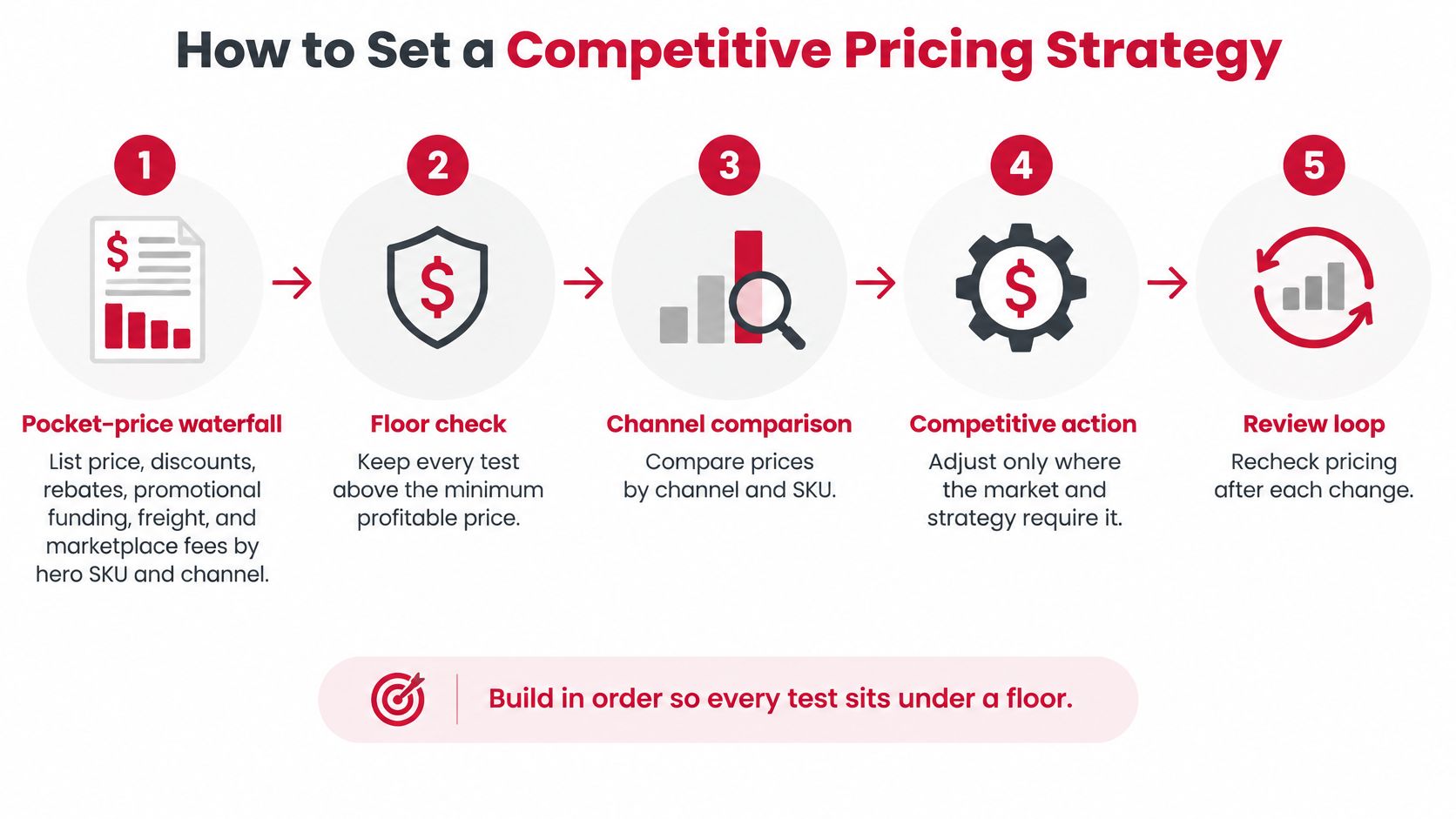
For each hero SKU and channel, start with list price and subtract the costs and deductions that determine what you keep: discounts, rebates, promotional funding, freight, marketplace referral fees, fulfillment, storage, returns, and variable advertising. The result should be contribution per unit, not revenue per unit.
The McKinsey analysis of pricing power describes a pocket price approach that calculates realized revenue after deductions at the SKU, channel, customer, and transaction level. Two offers with the same shelf price can leave different contribution once coupons and fees are included.
Set a minimum contribution per unit below which a sale is not worth taking at normal velocity. Also set a days-of-supply band that prevents discounting when inventory is healthy and selling at an acceptable rate.
These thresholds make price requests answerable. If a proposed cut gives up contribution, calculate how many additional units it must generate to make up the difference. If the required conversion lift is unrealistic, do not launch the cut.
Practical rule: No repricer, coordinator, or agency should publish a price below the floor without a named approver and a written reason.
Compare net prices for products with similar pack sizes, counts, use cases, and shopper missions. A 12-count trial pack, a 24-count replenishment pack, and a club size may appear together in a price scrape, but shoppers evaluate them differently, and their costs differ.
The discipline behind rental pricing insights from CS Outsource reinforces the distinction between a published price and what the transaction earns after fees and timing. CPG has different mechanics, but the pricing question is the same: compare what you keep, not just the sticker price.
Estimate demand response by pack size, brand strength, channel, and shopper mission. Account for seasonality, promotions, competitor moves, and cannibalization across your own sizes. Keep base price elasticity separate from promotion elasticity: a shopper who responds to a temporary coupon may not respond the same way to a permanent list-price change.
A small price increase can lift operating profit disproportionately if volume holds. Treat that as a scenario, not a forecast. Test how shoppers respond before assuming the added price will translate into added contribution.
Choose comparable test and control SKUs or markets. Record baseline unit velocity and contribution, make one limited price move, then measure incremental contribution dollars while monitoring traffic, advertising, inventory availability, and competitor changes. Set the stop rule before launch. If contribution falls below the agreed threshold, revert on schedule.
Scale only after the tested price still clears the floor with the added advertising, wholesale, or distribution costs that come with more volume. A price that works at low spend may not hold once the business expands.
Start with a unit you could reprice today. Say an Amazon product sells for $24.99 with a 15% referral fee, $5.50 in fulfillment, $6.00 in landed cost, and $3.00 in variable advertising. Contribution before advertising is $9.74, and contribution after advertising is $6.74, based on the fee mechanics in Amazon's seller pricing explanation, which states that referral fees are a percentage of total sales price subject to category rules and minimums.
Cut that price by $2 to $22.99 and the referral fee falls by only about $0.30. You give up roughly $1.70 of contribution per unit before any conversion benefit arrives. That gap is the hurdle every price cut must clear, and it is often overlooked in planning.
Break-even advertising cost of sales is contribution before ads divided by price. Here that's $9.74 divided by $24.99, or about 39%. The $6.74 left after the assumed $3.00 of ad spend equals about 27% of price, which is your realized contribution margin in this example, not your break-even ACOS. Keeping those two figures separate prevents a common reporting error. If ACOS runs at 30% on a $24.99 item, ad spend is about $7.50 per unit, and contribution after ads falls to roughly $2.24. A cut only works if better conversion pushes ACOS down enough, for example from 30% toward 20%, to replace the dollars surrendered on price. If ACOS stays flat, rank can improve while profit falls. For a plain-language refresher on the underlying math, see our guide to what contribution margin means for pricing decisions.
Now place a similar item at Walmart for $10.49. With a 15% referral fee of about $1.57, a $3.45 base fulfillment fee, $4.00 landed cost, and $2.00 in advertising, contribution is already about negative $0.53 per unit under Walmart's published marketplace pricing table, which also lists a $1 additional fee for items priced below $10. Dropping to $9.99 to match a rival doesn't just reduce revenue. It can trigger that extra dollar and push an already negative unit further underwater.
Marketplace fee schedules also move under you. Amazon's 2026 U.S. fulfillment fee update states that FBA fees will increase by an average of $0.08 per unit sold with most changes effective January 15, 2026, while small standard size products priced between $10 and $50 increase by an average of $0.25 per unit. At 20,000 units a year, that $0.25 removes $5,000 from contribution before advertising, returns, or storage enter the picture.
| Scenario | Price | Main deductions | Contribution | What to do |
|---|---|---|---|---|
| Amazon base case | $24.99 | 15% referral $3.75; FBA $5.50; landed $6.00; ads $3.00 | $9.74 before ads; $6.74 after ads | Hold unless a test lowers ACOS enough to replace lost dollars |
| Amazon $2 list cut | $22.99 | Referral falls only about $0.30 | About $1.70 less per unit before any conversion gain | Cut only if ACOS can fall, for example from 30% to 20% |
| Walmart near $10 | $10.49 | Referral about $1.57; WFS $3.45; landed $4.00; ads $2.00 | About -$0.53 | Do not match lower until cost, pack, or ad spend changes |
| Walmart under $10 | $9.99 | Extra $1 low-price fee plus a lower selling price | Roughly $1 worse before the price gap | Stay at $10 or above, or use a multipack or controlled coupon |
| FBA small standard 2026 | $10-$50 band | Average fulfillment fee up about $0.25 from January 15, 2026 | About $5,000 a year across 20,000 units | Remodel price and pack before matching rivals |
The table makes the operating point clear. The cheapest visible offer isn't always the most competitive one once fees are loaded. On Walmart, a multipack that holds list price above $10 can beat a $9.99 single every day of the week, even if the single converts slightly better.
Floors only protect you if they're written as rules a coordinator or a tool can follow without interpretation. Each rule needs a trigger, an allowed move, and a hard stop. Anything softer becomes a judgment call under pressure, and judgment calls made during a sales dip usually favor revenue over contribution.
Match only in stock offers of the same pack, count, and condition. Ignore a rival price that's a one day coupon, a likely MAP breach, or a listing with no buyable inventory behind it. Cap automated changes at one match per SKU per day, and never let a rule cross the contribution floor to chase a scrape.
Where a minimum advertised price applies, keep ads, strikethroughs, and subscribe offers at or above MAP. A checkout coupon is acceptable only when it's permitted and the brand has agreed to fund it. Our breakdown of how Amazon price adjustments work in practice covers the mechanics operators need before they automate any of this.
Every promotion needs an owner. Name who pays in advance, whether that's brand trade spend, retailer markdown money, or a shared fund, and set a depth cap, an end date, and a unit velocity goal. A promo without a velocity goal can't fail, which means it can't be evaluated either. If you want a structured way to think through short promotional windows, it helps to run flash sales without sacrificing margins by tying depth and duration to a margin floor up front.
Consumer behavior supports restraint. In 2025 research across 18 markets, 79% of consumers said they were trading down and more than half reported looking for deals on every purchase. Yet UK FMCG promotional spending on multibuy offers for crisps fell from 28% to 8%, and cereal multibuy spending dropped from 18% to 5%. Shoppers want value, but broad permanent discounting isn't the only way to deliver it. A targeted coupon, a smaller opening pack, or a loyalty price often protects list price while still giving price sensitive shoppers a path in.
Trust matters too. According to Gartner research reported by Consumer Goods, in 2025 68% of surveyed U.S. consumers said dynamic pricing made them feel taken advantage of, while 80% said consistent pricing made brands more trustworthy. Hold your DTC list steady where you can, and brief wholesale buyers before a marketplace move so they aren't surprised by a screenshot from a store visit.
| Rule | Trigger | Allowed move | Hard stop |
|---|---|---|---|
| Same-offer match | In-stock rival, same pack, count, and condition | Step toward that price while staying above the contribution floor | One automated match per SKU per day |
| Bad competitor read | Out of stock, wrong pack, or a MAP-breaking listing | No match; drop it from the index | Do not let the scrape set the floor |
| Funded promo | Coupon with an owner, a depth cap, and an end date | Temporary advertised discount inside the floor | Revert if velocity misses the goal or the date hits |
| Walmart under $10 | A planned price below $10 | Multipack or a coupon that keeps the list at $10 or above | No list cut that triggers the extra $1 fee |
| MAP display | An ad, strikethrough, or subscribe offer would show below MAP | Keep the advertised price at MAP; a checkout coupon only if the brand funds it | No public breach the retailer can screenshot |
| Storage clearance | High days of supply and rising aging fees | Cut price only when lost contribution is smaller than storage avoided | Otherwise cut the purchase order, not the price |
Use the table as an operating card. If a proposed move doesn't fit a row, it isn't approved yet.
Parity sounds tidy, and shoppers do compare channels. The image below captures the behavior every operator now has to plan around, a shopper checking a price on a screen while standing in front of the shelf.
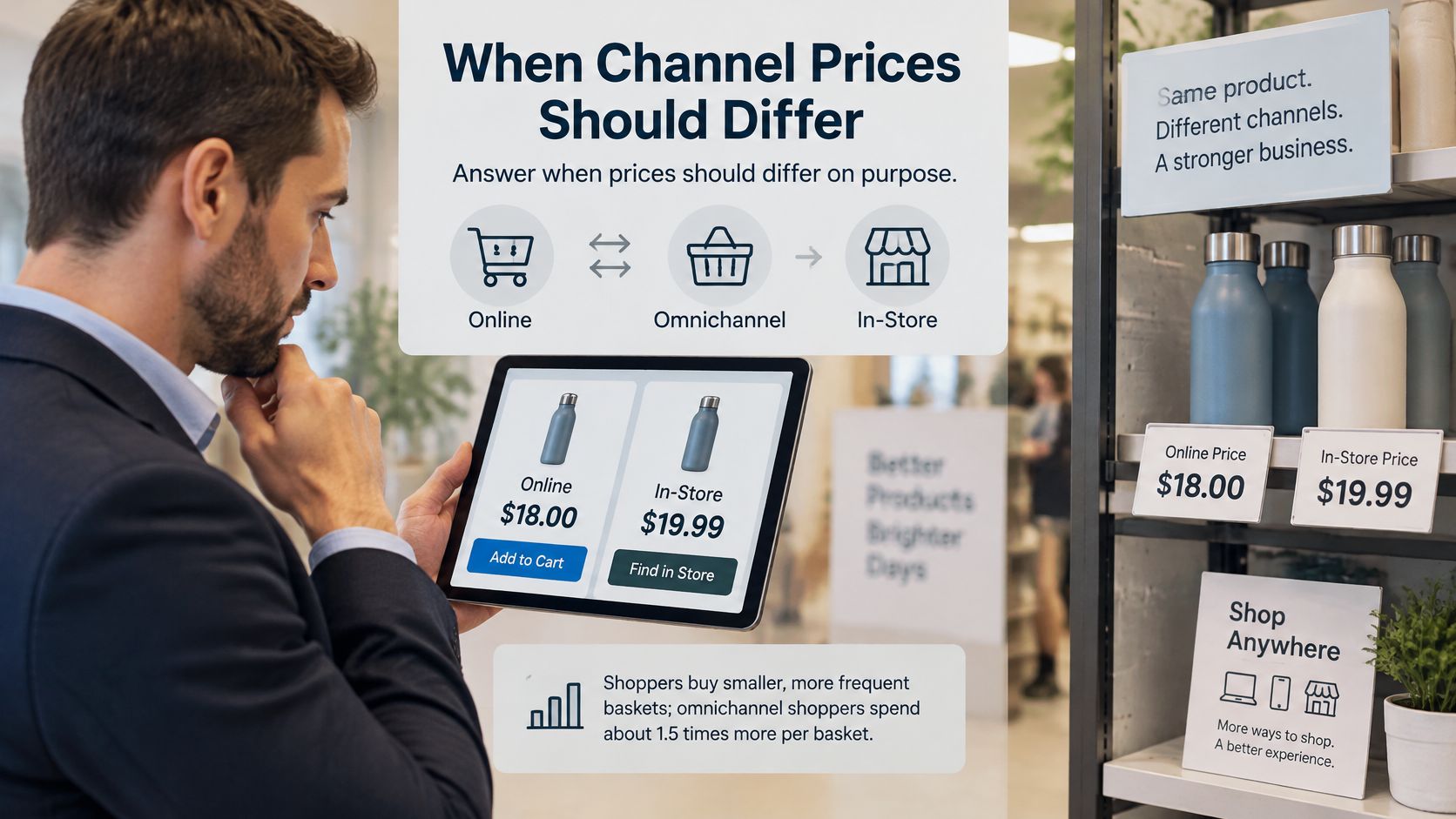
Comparison doesn't require identical prices. It requires prices shoppers can make sense of. Deloitte's 2025 retail outlook reported that two thirds of retail executives expected smaller, more frequent baskets in 2025, that omnichannel shoppers spend 1.5 times more per month than single channel shoppers, that 80% of executives expected price wars to intensify, and that three quarters expected AI to support dynamic pricing. Those expectations raise the cost of sloppy gaps, but they don't erase real differences in cost to serve.
The short video below is worth watching with those three decisions in mind, because it frames price as a coordinated architecture rather than a single number copied everywhere.
Allow gaps you can explain in one sentence. Faster delivery, a larger club pack, a loyalty benefit, a bundle, or a higher cost to serve are defensible reasons. Disallow gaps that exist only because one channel updated late or an unauthorized seller undercut everyone. Check for unauthorized sellers weekly, and map your live assortment before promising parity to a buyer. We work across Amazon, Walmart, Target, NewEgg, and Shopify, and the practical deliverable is always the same. One page per hero SKU showing the floor, the advertised price, and the stated reason each channel is allowed to differ.
A clean model can still miss what happens next. The biggest pricing risks usually arrive after the spreadsheet looks finished, when the market, the fee schedule, or your own inventory position changes underneath a price that used to work.
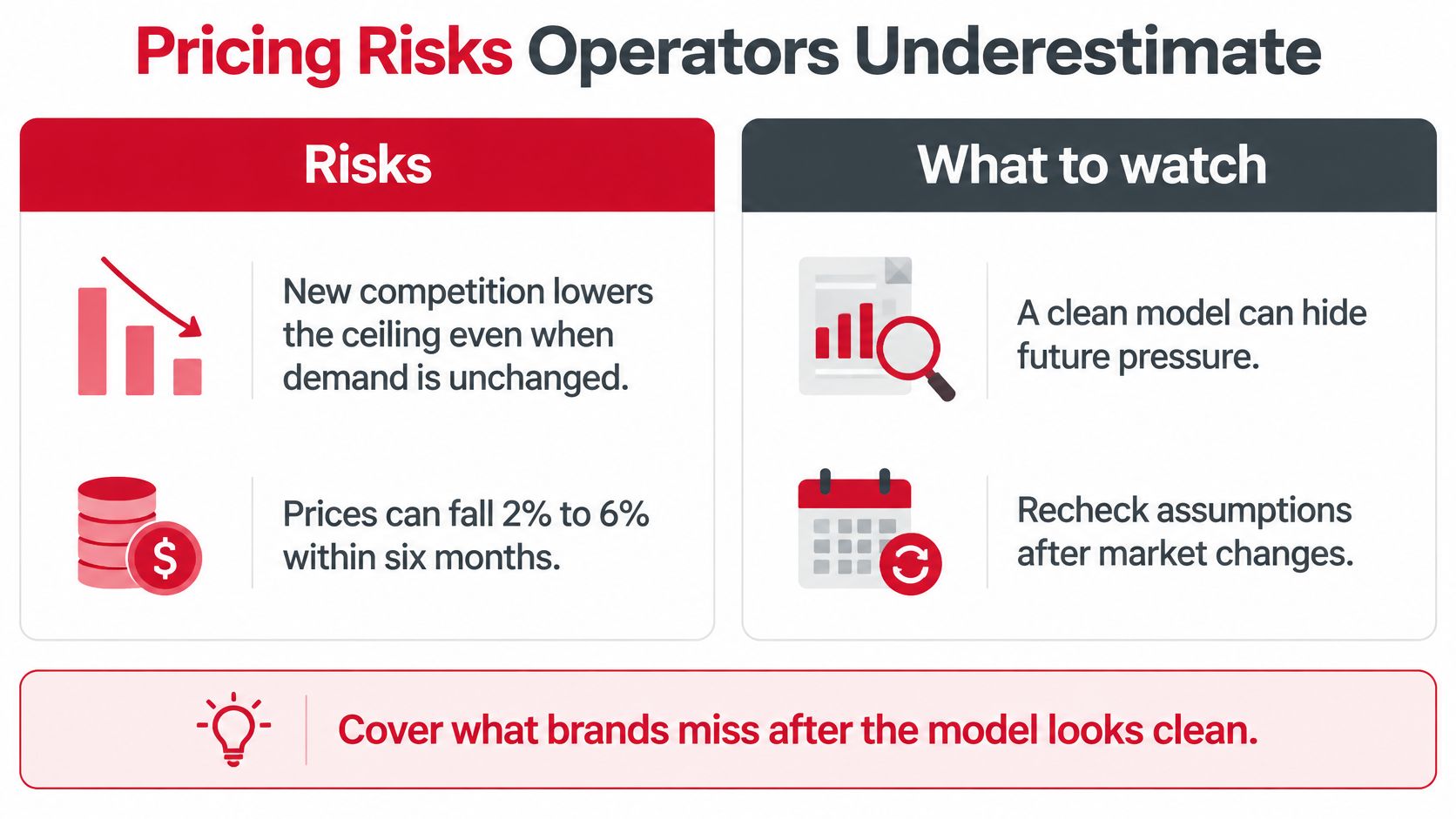
Additional competition puts measurable pressure on incumbent prices even when demand hasn't changed. In a randomized retail experiment in the Dominican Republic published by NBER, researchers introduced 61 firms into 72 markets, and six months after entry prices declined by approximately 2% to 6%, with larger reductions where more firms entered. Consumers also reported better service quality, which is the part operators should notice. The response to a new low price can be assortment, availability, or service, not only an automatic match that compresses everyone's margin.
A new marketplace seller, a private label launch, or a wholesale account pushing your product into a new banner can all reset what shoppers expect to pay. Unmanaged, that turns into the kind of friction described in our explainer on what channel conflict looks like between sellers. Monitor entrant count and strength alongside price, not after margin has already slipped.
Price led clearance feels decisive, and it often destroys more value than it saves. Under Walmart's WFS pricing schedule, storage is charged at $0.75 per cubic foot per month from January through September, inventory aged 366 to 450 days is charged $2.25 per cubic foot per month, and inventory older than 450 days is charged $7.50 per cubic foot per month. For a compact item occupying 0.10 cubic feet, that's about $0.075 a month at the standard rate and about $0.75 a month once stock is older than 450 days.
Run that comparison before you discount. If a cut plus the advertising needed to move units costs more per unit than the storage you'd avoid, hold price and cut the next purchase order instead. Moving units isn't the same as recovering dollars.
A clearance that spends a dollar of contribution to save a dime of storage is not inventory management. It's a transfer from your margin to the shopper.
The opposite error is repairing margin with a silent increase on every SKU. According to Boston Consulting Group's 2024 consumer surveys, 30% of shoppers who switched from their preferred retailer cited price increases as the primary reason in 2024. RRD's 2024 CPG and grocery research found that 58% of consumers ranked fair prices as the most important factor in selecting a retail brand or retailer. The same program reported that 88% of U.S. consumers expressed frustration with rising prices across groceries, gas, and restaurants in 2024.
Fee schedules will keep moving your floor without any competitor lifting a finger, so rebuild waterfalls before peak season rather than reacting after compression shows up in a monthly close. When you need margin back, reach for pack architecture, a funded feature, or a smaller entry size before a blanket hike. Those tools change the value conversation. A blunt increase only changes the number.
A competitive pricing strategy stays real through a short scorecard reviewed on a fixed rhythm. Track the same measures every week, in the same order, so a breach is visible before it becomes a month end surprise.
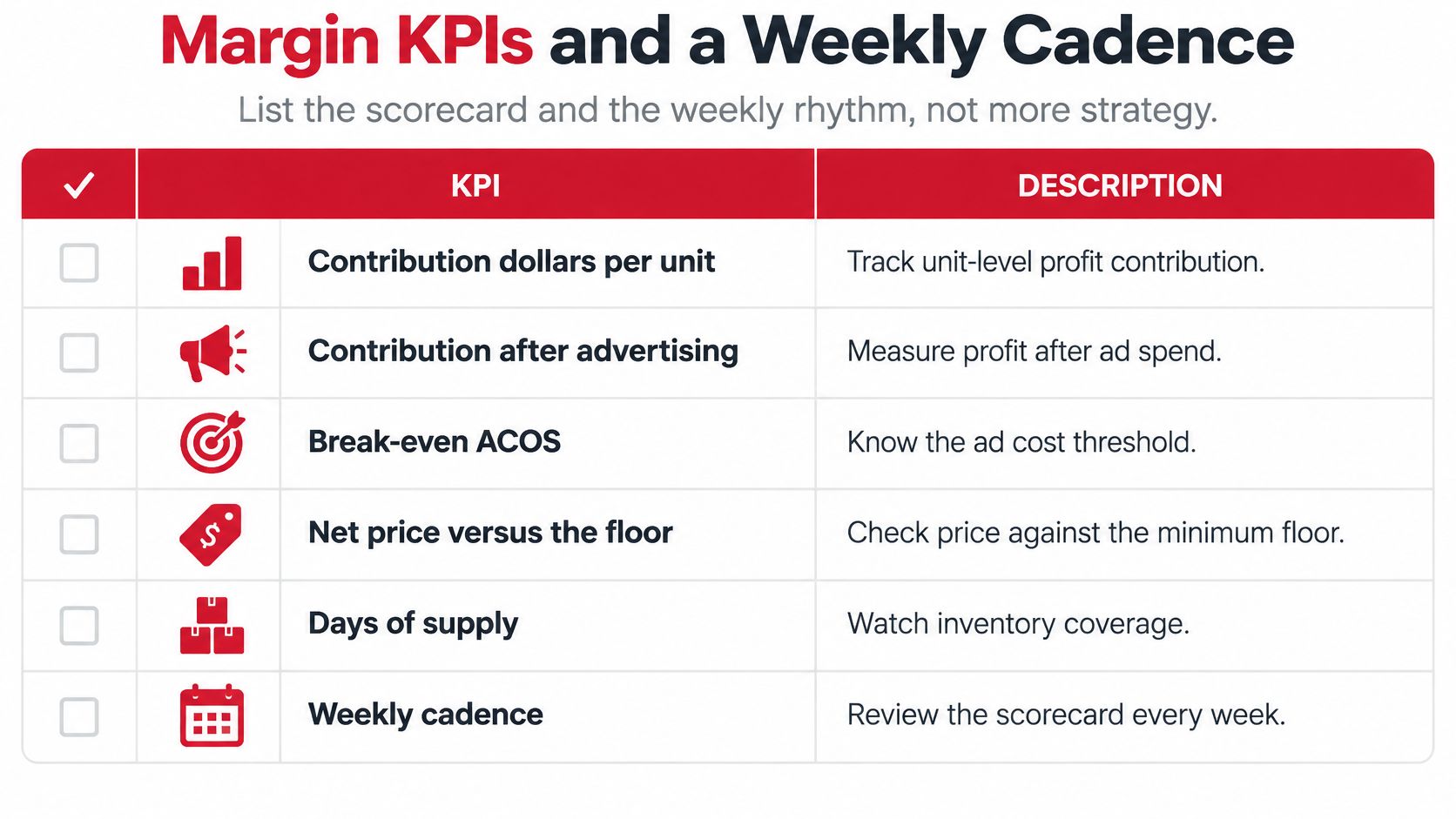
Buy Box percentage and sales rank belong on the sheet as constraints, not as the goal. Judge moves on contribution dollars per unit of traffic or per unit of inventory, with the stop rule written before the test starts. When ad reports look strong, compare ROAS benchmarks with actual profitability before you scale, because a return on ad spend can look healthy while contribution after fees is thin or negative.
On Monday, review SKUs that breached the floor or jumped in days of supply, and assign one owner per exception. Midweek, audit the competitor feed and remove out of stock and wrong pack matches so bad data doesn't drive Thursday's decisions. On Friday, read each live test against its baseline and make one of three calls: keep, revert, or extend with a new end date.
For small catalogs, confidence can stay practical. If a move can't cover its own fee and advertising change, don't scale it while waiting for statistical elegance. Our competitive insights work includes deep market and competitor analysis to identify opportunities and gaps, and our analytics and reporting provide insights to optimize retail strategies across all platforms. In your own operation, that translates to three tools: one repricer that accepts a floor input and blocks changes below it, one competitor feed that flags bad matches, and one shared sheet holding waterfalls, days of supply, and test logs. Assign owners clearly. The pricing lead maintains floors, a coordinator runs the Monday and Friday reviews, and the channel manager checks MAP and unauthorized sellers. Keep Amplification spend off until two weekly cycles show the floor intact.
Choose one hero SKU sold on at least two channels. Bring its recent pocket price, referral and fulfillment fees, advertising cost, and days of supply. One SKU can make the cost of matching a competitor's visible price clearer.
A margin review should start with the channel's contribution floor, then account for the pack and any fee thresholds that affect it. RedDog offers a free initial consultation before sign-up to assess your current retail strategy and provide guidance on how it can support your business. Request a consultation.
RedDog Consulting Group helps CPG brands connect pricing, operations, merchandising, and marketing across Amazon, Walmart, DTC, wholesale, and distribution. Before matching a price, check whether the channel's net proceeds still cover fees and advertising while protecting contribution dollars.
Leave a comment: