
Published: March 2020 | Last Updated:February 2026
© Copyright 2026, Reddog Consulting Group.

Struggling to pinpoint what drives or drains your brand’s performance on Amazon and Walmart is a familiar challenge for many Texas CPG founders. The search for higher marketplace conversion rates feels urgent, especially with national retail sales trends offering vital context for strategic decisions. This guide highlights concrete steps, from detailed data audits to advanced pricing strategies, giving you actionable tools to uncover hidden barriers and unlock smarter growth opportunities.
| Key Insight | Explanation |
|---|---|
| 1. Conduct a Comprehensive Audit | Analyze retail performance data to identify growth opportunities and establish a performance baseline. |
| 2. Identify Margin Leak Areas | Focus on key cost structures that erode profit, such as shipping and commissions, to optimize margins. |
| 3. Optimize Product Listings | Craft compelling product descriptions and visuals to drive customer engagement and conversion rates. |
| 4. Implement Dynamic Pricing | Use data-driven pricing strategies that reflect market conditions and enhance perceived customer value. |
| 5. Establish a Continuous Testing Process | Regularly measure and refine strategies through A/B testing and performance reviews for ongoing growth. |
Successfully optimizing your CPG brand’s marketplace conversion rates starts with a comprehensive data audit. This crucial first step involves systematically analyzing your current retail performance metrics to identify opportunities and potential growth areas.
To conduct an effective marketplace performance audit, you’ll need to gather data from multiple sources. Start by pulling detailed sales reports from your primary retail channels like Amazon and Walmart. Advance retail sales data provides critical insights into national retail trends that can contextualize your brand’s performance.
Key metrics to track during your audit include:
Pay special attention to channel-specific performance nuances. Amazon and Walmart have different algorithms, fee structures, and customer behaviors that impact your overall marketplace strategy. Cross-reference your internal sales data with platform-specific analytics to uncover hidden performance insights.
A robust marketplace performance audit reveals more than just sales numbers - it exposes the strategic levers for sustainable growth.
Documenting these metrics systematically allows you to establish a performance baseline and track improvements over time. Use spreadsheets or analytics dashboards to create visual representations of your data for easier interpretation.
Pro tip: Conduct your marketplace performance audit quarterly to maintain an agile and responsive growth strategy.
Navigating the complex landscape of CPG marketplace performance requires a strategic approach to uncovering hidden profitability challenges. Your goal in this step is to systematically diagnose the financial and operational barriers preventing optimal conversion and margin optimization.

Retail profitability challenges reveal that modern brands must look beyond surface-level metrics to truly understand their margin dynamics. Start by conducting a comprehensive analysis of your current cost structures, focusing on key areas that typically erode profit potential.
Critical margin leak areas to examine include:
Pay special attention to channel-specific nuances. Each marketplace like Amazon and Walmart has unique fee structures and algorithmic behaviors that can dramatically impact your net profit margins. Develop a granular breakdown of expenses across each sales channel to pinpoint precise areas of potential margin compression.
Here’s a quick comparison of common CPG marketplace margin leaks and their financial impact:
| Margin Leak Area | Typical Financial Impact | Recommended Solution |
|---|---|---|
| Shipping & Fulfillment | Erodes per-order margin | Negotiate better carrier rates |
| Platform Commission Rates | Reduces net profit | Optimize channel strategy |
| Product Returns | Drives up reverse logistics cost | Enhance product quality |
| Storage/Holding Fees | Decreases inventory ROI | Streamline inventory turnover |
| Customer Acquisition Expense | Increases overhead | Target low-cost channels |
| Pricing Inefficiencies | Reduces competitiveness | Employ dynamic pricing |
Identifying margin leaks is not just about cutting costs - it’s about understanding the complex economics of your retail ecosystem.
Utilize advanced analytics tools to track conversion rate performance and map the customer journey. Look for drop-off points, abandoned cart rates, and conversion bottlenecks that indicate potential barriers in your sales funnel.
Pro tip: Create a monthly margin leak dashboard that tracks your most critical financial metrics to maintain real-time visibility into your brand’s economic performance.
Transforming your CPG brand’s marketplace performance hinges on crafting compelling product listings that capture attention and drive conversions. Your mission is to create visual and descriptive content that not only showcases your products but also speaks directly to your target customer’s needs and desires.
Effective product promotion strategies emphasize the importance of understanding your product’s unique value proposition and communicating it clearly. Begin by developing a comprehensive listing optimization approach that addresses multiple critical elements.
Key components of high-converting product listings include:
Focus on creating visual storytelling assets that go beyond basic product images. This means developing lifestyle photos, action shots, and detailed close-ups that help potential customers imagine the product in their daily lives. Each image should serve a specific purpose - demonstrating functionality, showing scale, or highlighting unique product attributes.
Great product listings transform passive viewers into active buyers by creating an immediate emotional connection.
Pay special attention to your product title and description optimization. Use clear, benefit-focused language that addresses customer pain points while incorporating relevant search keywords naturally. Avoid generic descriptions and instead craft narrative-driven content that differentiates your product from competitors.
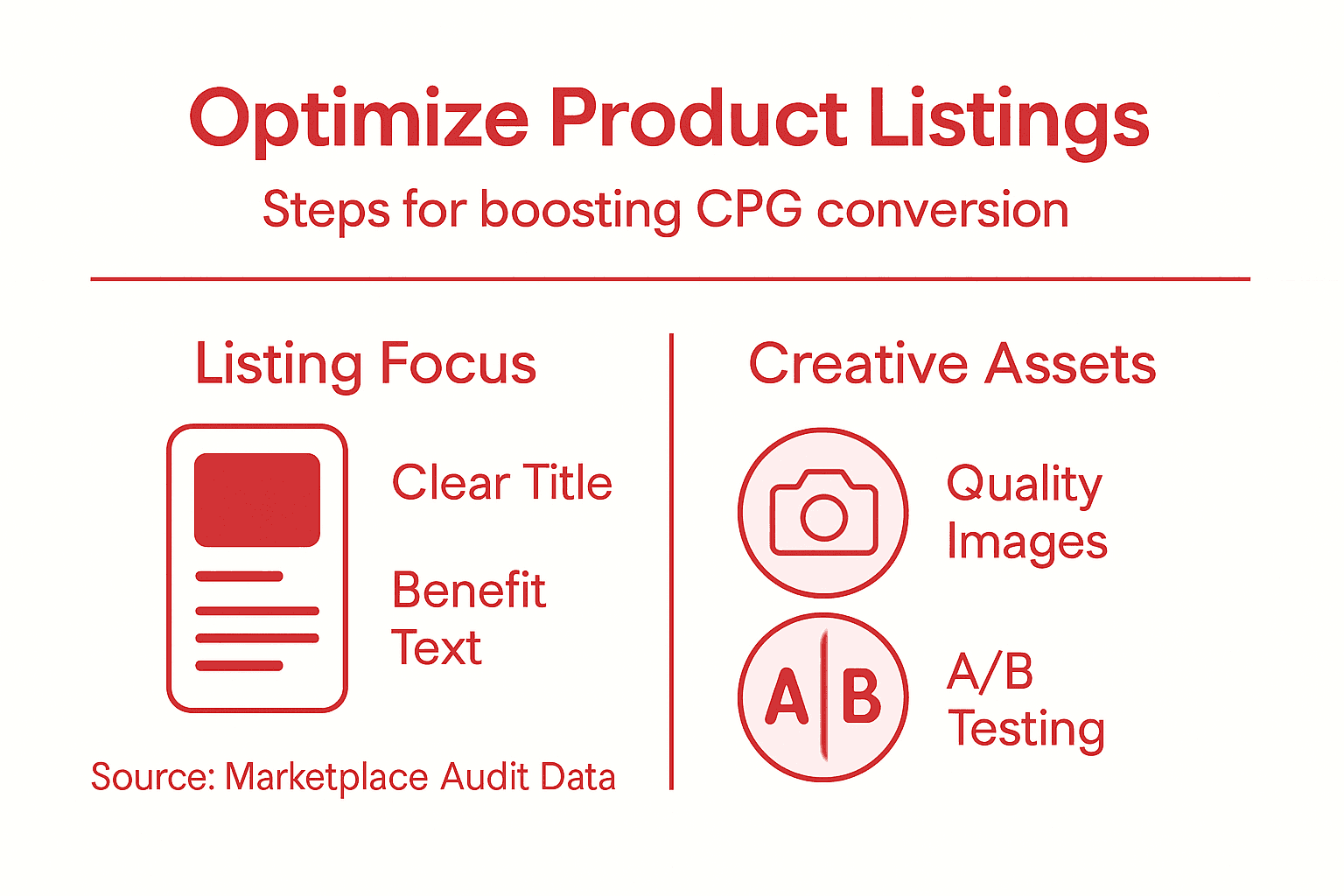
Pro tip: Conduct monthly A/B testing on your product images and descriptions to continuously refine your listing performance and conversion rates.
Designing a sophisticated pricing strategy is critical for CPG brands seeking to maximize marketplace conversions and profitability. Your objective is to develop a nuanced approach that balances customer perception, competitive positioning, and margin protection.
Pricing strategies for maximizing profitability reveal the importance of dynamic, data-driven pricing models that respond to market conditions and customer behaviors. Start by developing a comprehensive pricing framework that goes beyond simple cost-plus calculations.
Key elements of conversion-focused pricing include:
Focus on creating strategic price positioning that communicates value while remaining attractive to potential buyers. This means understanding your target customer’s willingness to pay and designing pricing tiers that match different customer segments’ expectations and budgets.
Effective pricing is not about being the cheapest, but about demonstrating the most compelling value proposition.
Utilize advanced analytics to track price sensitivity and conversion performance. Implement A/B testing methodologies that allow you to experiment with different pricing strategies and quickly identify the most effective approaches for your specific product lines.
Pro tip: Develop a dynamic pricing dashboard that tracks competitor pricing, customer conversion rates, and margin performance in real-time.
Successful CPG marketplace optimization is an ongoing journey of continuous improvement, not a one-time project. Your goal is to develop a systematic approach to testing, measuring, and iteratively refining your conversion strategies across different retail channels.
Retail analytics for sustained growth provides critical insights into creating a data-driven optimization framework. Establish a robust measurement system that tracks key performance indicators and enables rapid, informed decision-making.
Essential components of an effective testing and refinement process include:
Focus on building comprehensive performance dashboards that provide real-time visibility into your marketplace metrics. These dashboards should integrate data from multiple sources, allowing you to quickly identify trends, anomalies, and opportunities for strategic intervention.
The table below summarizes key testing and measurement methods for CPG marketplace growth:
| Method | Primary Benefit | Typical Application |
|---|---|---|
| Quarterly Reviews | Track long-term progress | Company-wide KPI assessment |
| A/B Testing | Optimize conversion rates | Product listings, pricing |
| Customer Feedback | Reveal shopper insights | Survey, ratings analysis |
| Benchmarking | Identify competitive gaps | Compare against peers |
| Performance Dashboards | Enable real-time decisions | Unified analytics view |
Continuous improvement is not about perfection, but about making consistent, incremental advancements that compound over time.
Implement a disciplined experimental approach to optimization. This means developing clear hypotheses, designing controlled experiments, and rigorously analyzing results before scaling successful strategies across your product lines.
Pro tip: Create a standardized quarterly review process that systematically documents insights, experiments, and learnings to build institutional knowledge and drive continuous improvement.
Struggling with identifying margin leaks and improving conversion rates across Amazon and Walmart marketplaces is a common challenge for emerging CPG brands. This guide highlights the crucial need for a margin-first strategy and clear operational insights to navigate complex marketplace economics like FBA fees, WFS margin pressure, and pricing inefficiencies. If you want to transform your product listings, pricing, and sales funnels into powerful profit drivers, you need expert guidance that bridges digital growth with physical retail realities.
Explore how Digital & Business Consulting Services by Reddog Consulting deliver tailored solutions designed for CPG brands ready to scale smartly across multiple channels.
Don’t let hidden costs and conversion barriers stall your retail expansion. Visit our comprehensive CPG Retail Growth Offer to start optimizing your marketplace economics today. Whether you’re improving your listing performance or seeking operational clarity on inventory and cash flow, our margin-focused approach will help you unlock sustainable growth. Get started now and see how strategic consulting can transform your retail outcomes.
Conducting a marketplace performance audit involves pulling detailed sales reports from your primary channels and analyzing key metrics such as total sales volume, conversion rates, and customer acquisition costs. Start by gathering data from platforms like Amazon and Walmart and document these metrics systematically to establish a performance baseline.
Common margin leaks include high shipping and fulfillment expenses, platform commission rates, and product return processing costs. Identify these areas by analyzing your current cost structures and develop a plan to optimize these expenses to improve profitability.
To optimize your product listings, focus on high-quality images, benefit-driven descriptions, and strategic keyword integration. Create visual storytelling assets that showcase your product effectively, and regularly test different variations of your listings to refine and enhance their performance.
Effective pricing strategies include competitive price benchmarking, dynamic pricing models, and volume-based discounts. Develop a pricing framework that reflects your target customer’s willingness to pay, and continually monitor your pricing effectiveness to ensure it aligns with market conditions.
You should conduct quarterly performance reviews and continuously measure key metrics to refine your strategies effectively. Implement a regular schedule for A/B testing and customer feedback analysis to ensure that your optimization efforts lead to sustained growth.
Track key metrics such as conversion rates, average order value, inventory turnover rate, and customer acquisition costs. Establish a performance dashboard to provide real-time visibility into these metrics and identify trends that may indicate areas for improvement.
Leave a comment: