
Published: March 2020 | Last Updated:February 2026
© Copyright 2026, Reddog Consulting Group.

Managing multichannel sales can feel like juggling a dozen moving parts, especially as customers expect speed and consistency whether they shop online or walk into your Texas store. For CPG founders aiming to protect margins while growing revenue, the process often breaks down when systems operate in silos and data never lines up. Unified Commerce offers a single integrated solution, connecting online, offline, and logistics operations so you can deliver real-time inventory, pricing, and seamless service at every touchpoint.
| Point | Details |
|---|---|
| Unified Commerce Defined | It integrates all retail channels into a single ecosystem, allowing for real-time synchronization of data and customer interactions. |
| System Integration Importance | Successful implementation requires integrating various business systems to ensure cohesive operations and consistent performance across channels. |
| Differences from Omnichannel | Unlike omnichannel, Unified Commerce offers fully integrated systems, real-time data sharing, and a seamless customer experience across all touchpoints. |
| Common Implementation Challenges | Organizations must address technological gaps, ensure collaboration, and enhance training to fully realize the potential of Unified Commerce. |
Unified Commerce represents a transformative approach to retail strategy that breaks down traditional channel barriers. Unlike legacy systems that manage online, offline, and mobile sales separately, Unified Commerce creates a single integrated retail ecosystem where all customer interactions, inventory, and transactions happen in real time.
At its core, Unified Commerce is about creating seamless, consistent experiences across every customer touchpoint. This means a retailer can provide the same pricing, product availability, and personalized service whether a customer is shopping online, via mobile app, or in a physical store. The key difference from traditional omnichannel approaches is the real-time synchronization of data and operations.
The fundamental components of Unified Commerce include:
Unified Commerce transforms fragmented retail operations into a cohesive, customer-centric strategy that drives operational efficiency and enhances consumer satisfaction.
Retail brands leveraging Unified Commerce can respond more dynamically to customer needs. For instance, a customer could check product availability online, reserve an item for in-store pickup, and have a personalized shopping experience that reflects their entire purchase history across channels.
Pro tip: Invest in a robust technology platform that can integrate data from all your sales channels to unlock the full potential of Unified Commerce.
Unified Commerce demands a comprehensive approach to system integration that combines multiple retail platforms into a seamless operational ecosystem. This integration involves connecting critical business systems like point-of-sale (POS), e-commerce platforms, inventory management, customer relationship management (CRM), and payment processing technologies to create a unified data environment.
The core components of successful system integration typically include:
Effective system integration ensures real-time data synchronization and consistent performance across all retail channels.
Technical integration requires sophisticated middleware and application programming interfaces (APIs) that enable different software systems to communicate seamlessly. These integration layers translate data between platforms, ensuring that inventory levels, customer information, pricing strategies, and transaction details remain consistent whether a customer purchases online, through a mobile app, or in a physical store.

Retail organizations must also consider the vertical and horizontal dimensions of system integration. Vertical integration involves aligning systems from supply chain to sales, while horizontal integration focuses on creating consistent experiences across different customer interaction points.
Pro tip: Conduct a comprehensive audit of your existing systems before integration to identify potential compatibility challenges and optimization opportunities.
To clarify the systems needed for successful unified commerce integration, here’s a summary of their business roles:
| System Type | Primary Function | Impact on Operations |
|---|---|---|
| ERP Platform | Manages core business processes | Improves organizational agility |
| Customer Relationship Mgmt | Centralizes customer interaction data | Enables personalized marketing |
| Inventory Management | Tracks real-time stock levels | Reduces out-of-stock incidents |
| Payment Processing | Handles transactions across channels | Streamlines checkout experience |
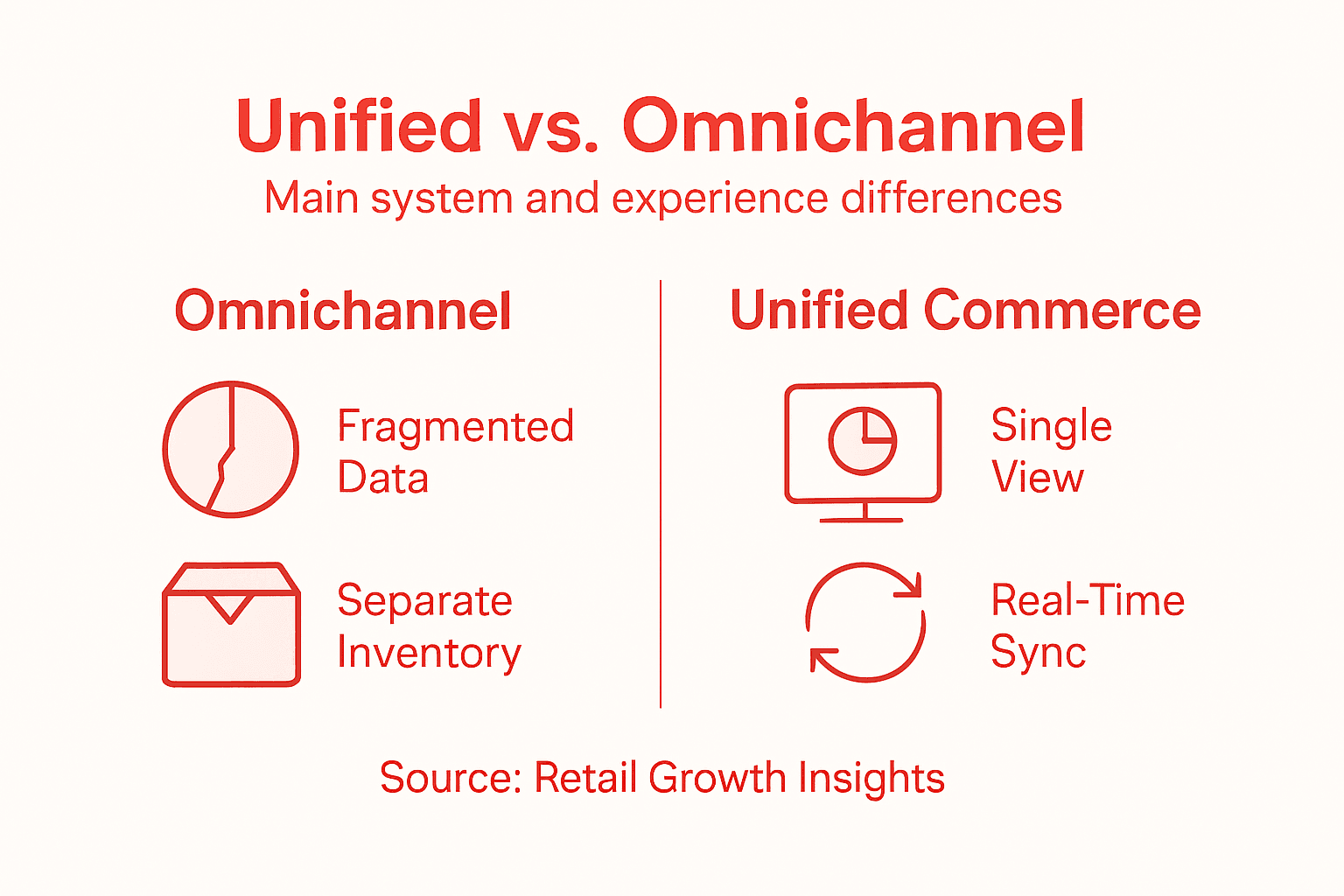
While omnichannel and unified commerce might seem similar, they represent fundamentally different approaches to retail strategy. Omnichannel systems often operate with disconnected backend platforms that create inconsistent customer experiences across different sales channels.
Key differences between omnichannel and unified commerce include:
Unified Commerce transforms disconnected retail channels into a cohesive, intelligent ecosystem that adapts to customer needs in real time.
The fundamental distinction lies in how these approaches handle data and customer interactions. Omnichannel strategies typically create multiple touchpoints but fail to provide a truly integrated experience. Unified Commerce, by contrast, creates a comprehensive system where inventory, pricing, customer data, and transaction histories are synchronized across all platforms.
Pro tip: Evaluate your current retail technology stack to identify potential integration gaps that could be hindering your unified commerce strategy.
Here’s a side-by-side comparison showing how unified commerce and omnichannel retail models affect consumer experience and business outcomes:
| Criteria | Omnichannel Retail Model | Unified Commerce Model |
|---|---|---|
| Shopping Experience | Varies by channel | Seamless across all platforms |
| Data Handling | Fragmented, often duplicated | Synchronized and centralized |
| Revenue Potential | Missed cross-channel opportunities | Maximized through integration |
| Operational Insight | Delayed, channel-specific reports | Real-time, unified analytics |
Unified Commerce significantly transforms operational economics by enabling data-driven strategic decision-making across retail platforms. This approach fundamentally reshapes how businesses manage inventory, pricing, and customer interactions to maximize profitability.
Key operational improvements driving profit margin enhancements include:
Unified Commerce transforms complex retail operations into a synchronized, profit-generating ecosystem that adapts dynamically to market conditions.
The integration of digital technologies allows businesses to implement sophisticated pricing models, optimize inventory allocation, and create more responsive supply chain strategies. By breaking down traditional operational silos, companies can reduce waste, minimize redundant processes, and create more agile business models that directly contribute to improved profit margins.
Pro tip: Conduct a comprehensive audit of your current technology infrastructure to identify potential integration opportunities that can streamline operations and enhance profitability.
Unified Commerce implementations face significant challenges when organizations fail to address digital transformation comprehensively. Understanding and proactively mitigating these risks is critical for successful technology integration and operational effectiveness.
Common pitfalls that can derail Unified Commerce strategies include:
Successful Unified Commerce requires a holistic approach that addresses technological, operational, and cultural transformation simultaneously.
Effective mitigation demands a comprehensive strategy that goes beyond mere technological implementation. Organizations must develop robust change management processes, invest in employee training, and create flexible technological architectures that can adapt to evolving business requirements.
Pro tip: Conduct a comprehensive diagnostic assessment of your current technological ecosystem before attempting full-scale Unified Commerce integration to identify potential implementation barriers.
Unified Commerce promises a seamless, real-time integration of retail channels but navigating the complex technological and operational challenges can be overwhelming. If your brand struggles with disconnected systems, margin leaks, or unpredictable inventory velocity across platforms like Amazon and Walmart, you are not alone. The article highlights key pain points such as real-time data synchronization, pricing consistency, and unified customer experiences that impact profitability and growth.
At RedDog Group, we specialize in helping emerging and growth-stage CPG brands overcome these exact challenges. Our margin-focused strategies empower you to optimize contribution dollars on every channel by bridging digital marketplace intricacies with physical retail realities. Whether it’s managing Amazon FBA fees or Walmart WFS margin compression, our deep understanding of retail ecosystems ensures you achieve operational clarity and scalable expansion.
Don’t let fragmented systems and unclear channel performance hold your brand back. Visit our CPG Retail Growth Offer to learn how comprehensive unified commerce integration combined with strategic margin management drives sustainable profitability. Act now to gain the competitive edge in real-time inventory management, pricing strategy, and channel-specific profit insights.
Partner with RedDog Group today to transform your retail operations into a cohesive, growth-driving engine. Explore how we enable CPG brands to thrive across Amazon, Walmart, DTC, wholesale, and beyond by visiting our CPG Retail Growth Offer and let us help you scale with precision and confidence.
Unified Commerce is a retail strategy that integrates online, offline, and mobile sales into a single, real-time ecosystem, allowing for a seamless customer experience across all channels.
Unified Commerce provides real-time visibility of inventory across all sales channels, reducing out-of-stock incidents and improving demand forecasting, leading to more efficient inventory management.
The main differences include backend system integration, data synchronization, customer experience, and operational flexibility, with Unified Commerce offering a fully integrated, real-time platform compared to the siloed nature of Omnichannel systems.
Common challenges include technology infrastructure gaps, organizational resistance to change, strategic implementation errors, and data management issues, all of which can hinder successful integration and operational effectiveness.
Leave a comment: