
Published: March 2020 | Last Updated:September 2026
© Copyright 2026, Reddog Consulting Group.

Most CPG brands don't stall because demand disappears. They stall because one channel starts carrying too much weight.
It usually starts with a win. Amazon gets traction. Or DTC finally finds a repeatable paid media angle. Then growth flattens, fees creep up, inventory gets tighter, and the obvious move seems to be “add more channels.” That's where a lot of brands make an expensive mistake. They expand distribution before they understand what the next channel needs to contribute.
A real channel expansion strategy isn't about showing up everywhere. It's about deciding which channel should drive growth, which one should protect margin, and which one should function as a controlled test bed. That's a different conversation than “should we launch Walmart?” or “should we go wholesale?”
The timing matters. Consumers don't buy in a straight line anymore. A large retail survey summarized in omnichannel retail research found that 73% of shoppers engage across multiple channels, omnichannel shoppers use an average of six touchpoints, and shoppers using more than one channel account for about 27% of retail sales. The same research reports those shoppers can spend 30% more than single-channel shoppers. That explains why one-channel brands feel pressure to expand. The pressure is real. The answer still can't be sloppy.
A common pattern shows up once a brand finds product-market fit in one place. Sales look healthy on the surface, but the operating model gets fragile. Amazon starts absorbing more ad spend. DTC keeps demanding content, retention work, and discount discipline. Wholesale conversations pick up, but the margin structure doesn't resemble the marketplace P and L. Suddenly the brand has revenue concentration risk and no clean plan for what comes next.
That's why one winning channel isn't enough. It can be your launchpad, but it shouldn't be your whole system.
The first question isn't “what channel should we add?” It's “what problem are we trying to solve?”
Sometimes the problem is growth concentration. Sometimes it's margin compression. Sometimes it's inventory exposure because one channel can't absorb enough depth across the catalog. Sometimes it's customer access, especially when shoppers move between marketplaces, stores, and brand sites before they buy.
If you need a sharper definition of channel architecture before expanding, this breakdown of what channel strategy means in practice is a useful starting point.
Practical rule: Expansion only works when the next channel has a job. “More doors” isn't a job. “Absorb trial packs at healthy velocity” is a job.
The operating view matters. Amazon, Walmart, DTC, wholesale, and distribution don't just differ in traffic sources. They differ in fee structures, fulfillment demands, price constraints, content requirements, retailer expectations, and inventory behavior.
Brands that scale well usually move through three phases. Foundation comes first. Get one core channel operationally stable and financially legible. Optimization follows. Tighten pricing, listings, fulfillment, ad efficiency, and inventory turns. Amplification comes last. Add channels that strengthen the system instead of draining it.
That sequencing is what keeps channel expansion from turning into channel dilution.
A channel expansion strategy is a deliberate plan for where to sell next, why that channel exists in the mix, what resources it needs, and how it will operate without damaging the rest of the business.
That's more specific than “multichannel.” Plenty of brands are technically multichannel and still have no strategy. They list products in new places, copy over the same assortment, use the same price logic, and hope volume covers the mistakes.
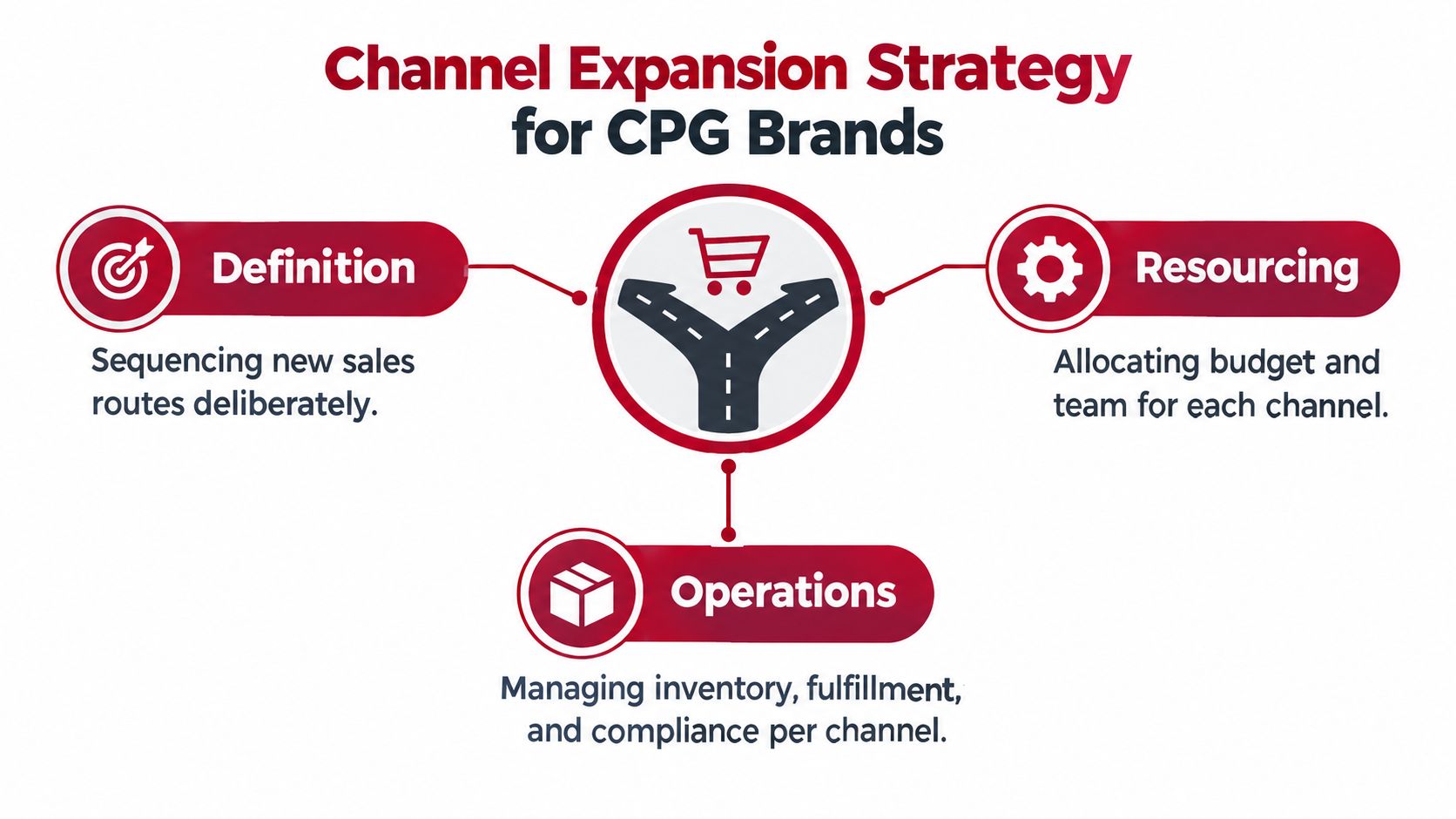
The simplest way to frame it is this. Every channel is a storefront with its own rent, staffing model, service standard, and shopper expectation.
Amazon might have high purchase intent and strong velocity potential, but it also comes with referral fees, fulfillment fees, inbound placement considerations, and a constant ad tax if the category is competitive.
DTC gives you the most control over brand, bundles, retention, and customer data, but you fund the traffic and absorb the operational burden directly.
Wholesale and distribution can move meaningful volume, yet they introduce trade spend, compliance requirements, retailer negotiation, and less control over execution at shelf.
A channel expansion strategy also connects to route-to-market, assortment, and pack-price architecture. A pack that works on Amazon may not belong in wholesale. A premium bundle that converts on DTC may break in mass retail. A marketplace hero SKU may need a different case configuration or promotional rhythm in distribution.
Bain's Asia-Pacific consumer products work argues that brands need fit-for-purpose business models to achieve new channel growth, and that channel strategy should reflect where demand is fulfilled rather than treating every outlet the same in its 2025 consumer products report.
That matters beyond Asia-Pacific. The same logic applies anywhere a brand expands too quickly without adjusting the offer.
It's not just omnichannel marketing. Marketing supports demand across touchpoints. Channel expansion decides whether your business can serve that demand profitably.
Use a simple checklist before calling a launch “expansion”:
If those answers are fuzzy, you don't have a strategy yet. You have distribution intent.
The fastest way to make a bad channel decision is to model only gross sales. Revenue can go up while contribution margin gets weaker.
KPMG's channel-mix guidance is useful here because it frames expansion around profitability, true cost-to-serve, and execution scalability rather than volume alone, as outlined in its CPG channel mix growth guidance.
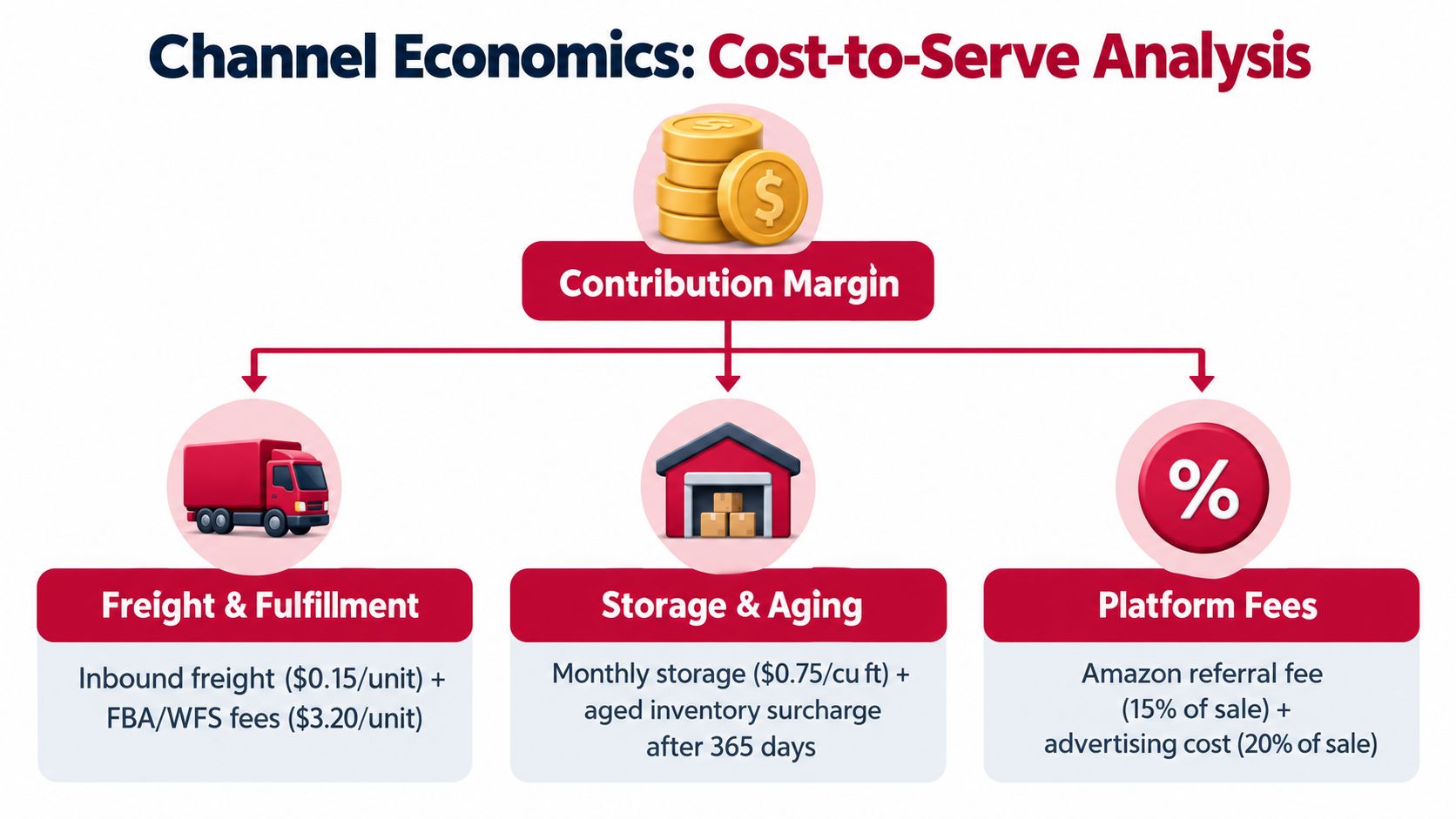
Before adding any channel, build the unit economics below gross revenue:
One extra channel can create duplicate safety stock, slower turns on long-tail SKUs, and more markdown pressure if the assortment isn't properly configured. Often, brands get tripped up here.
If you want a deeper operating framework for this, the model in this guide to channel profitability analysis is the right place to start.
Amazon's 2026 U.S. fee update says standard-size products using the minimal-splits option will see the inbound placement service fee rise by $0.05 per unit on average, and large standard-size products between 3 and 20 lb will get five new shipping weight bands, according to Amazon Seller Central fee guidance.
That sounds minor until you apply it to a SKU with thin contribution dollars and inconsistent ad efficiency. A small fee increase doesn't hurt much when inventory turns fast and conversion is strong. It hurts a lot when the product is bulky, margins are already compressed, and you're buying rank with paid traffic.
If a channel only works when every fee assumption stays perfect, it isn't ready for scale.
I separate channels into three jobs:
Use this role when a channel can add demand quickly and you're willing to accept lower near-term contribution margin in exchange for scale, ranking, or customer acquisition.
Use this role when the channel protects dollars after variable selling costs. This is often where disciplined DTC bundles, selected wholesale accounts, or a mature marketplace hero SKU can outperform.
Use this role when the channel lets you trial pack sizes, messages, or assortment with controlled risk. A test bed should have limited SKU depth and a clear review window.
A lot of bad expansion decisions come from expecting every new channel to do all three jobs at once. It won't.
A channel looks attractive until the full cost stack hits the P&L. I've seen the same SKU produce healthy dollars on DTC, break even on Amazon, and lose money in wholesale once trade spend, freight, and deductions show up. Channel expansion only works when each route has a defined role and a contribution margin target.
| Channel | Best Role | What usually decides contribution margin | Operational load |
|---|---|---|---|
| Amazon | Growth engine or test bed for proven hero SKUs | Referral fees, FBA fees, inbound placement fees, ad spend, returns, storage exposure | High |
| Walmart | Secondary growth engine with selective profit potential | WFS fees, ad spend, content quality, lower traffic on long-tail SKUs, pricing pressure | Medium to high |
| DTC | Profit hub and control layer | CAC, discounting, parcel cost, bundle mix, retention rate, site conversion | High |
| Wholesale | Volume layer or profit hub when terms stay disciplined | Trade spend, freight, compliance chargebacks, retailer deductions, promo funding | Medium |
| Distribution | Reach layer for fragmented retail | Distributor margin, smaller reorder patterns, lower visibility into sell-through, execution variance | Medium to high |
The mistake is treating these as interchangeable. They are not. Amazon can create demand fast. DTC can protect dollars if repeat purchase is strong. Wholesale can absorb volume, but only if net price after trade still leaves room for profit.
Amazon is usually the fastest way to scale a hero SKU, but it is rarely forgiving. Brands get into trouble when they launch too many ASINs, rely on paid traffic to force velocity, or ignore packaging that drives up fulfillment cost.
Broad catalog expansion is where margins usually slip. Slow sellers tie up cash, storage exposure rises, and ads become a tax on weak conversion. A SKU that clears your gross margin hurdle can still fail contribution margin once FBA, referral fees, placement fees, and returns are fully loaded.
Amazon is a strong growth engine. It is not automatically a profit hub.
Walmart Marketplace is often a cleaner second marketplace than brands expect, especially for items that already have proof of demand. The trap is buying inventory depth as if traffic and conversion will match Amazon on day one.
Storage age matters more than many teams model. Walmart Fulfillment Services charges storage by age, with inventory held 366 to 450 days billed at $2.25 per cubic foot per month and inventory held more than 450 days billed at $7.50 per cubic foot per month, based on WFS fee documentation.
That changes launch math. Walmart usually rewards a tighter assortment, cleaner item setup, and more conservative opening buys than Amazon.
DTC gives the brand the most control over pricing, bundles, merchandising, email capture, and retention. That control has value if the brand can convert traffic efficiently and keep repeat purchase high enough to support acquisition cost.
I treat DTC as a profit hub only when the numbers support it. If paid social CAC is unstable, parcel costs are rising, and discounting is doing the conversion work, DTC can look better on a topline report than it does in contribution dollars.
Bundles often fix more than branding does. They raise AOV, spread pick-pack and parcel cost across more units, and give the brand room to protect margin without depending on constant discounting.
Wholesale is useful when a SKU already has velocity and the retailer can move volume without crushing net margin. Door count alone means very little. The better question is whether the account can produce clean reorders after promos, freight, compliance costs, and deductions.
Distribution buys reach, especially in fragmented regional retail. It also adds distance from execution. The brand gives up margin and visibility in exchange for coverage, which means distribution works best for proven items with simple replenishment patterns and less need for hands-on merchandising control.
The right next channel is the one that can do a specific job at acceptable contribution margin with manageable operational strain. Sometimes that means using Amazon to find velocity, DTC to protect profit, and wholesale only after the SKU has earned working capital. Sometimes it means saying no to a channel that adds revenue but weakens cash flow.
Most brands don't fail because they chose the wrong channel. They fail because they launched too many channels before the business was ready to support them.
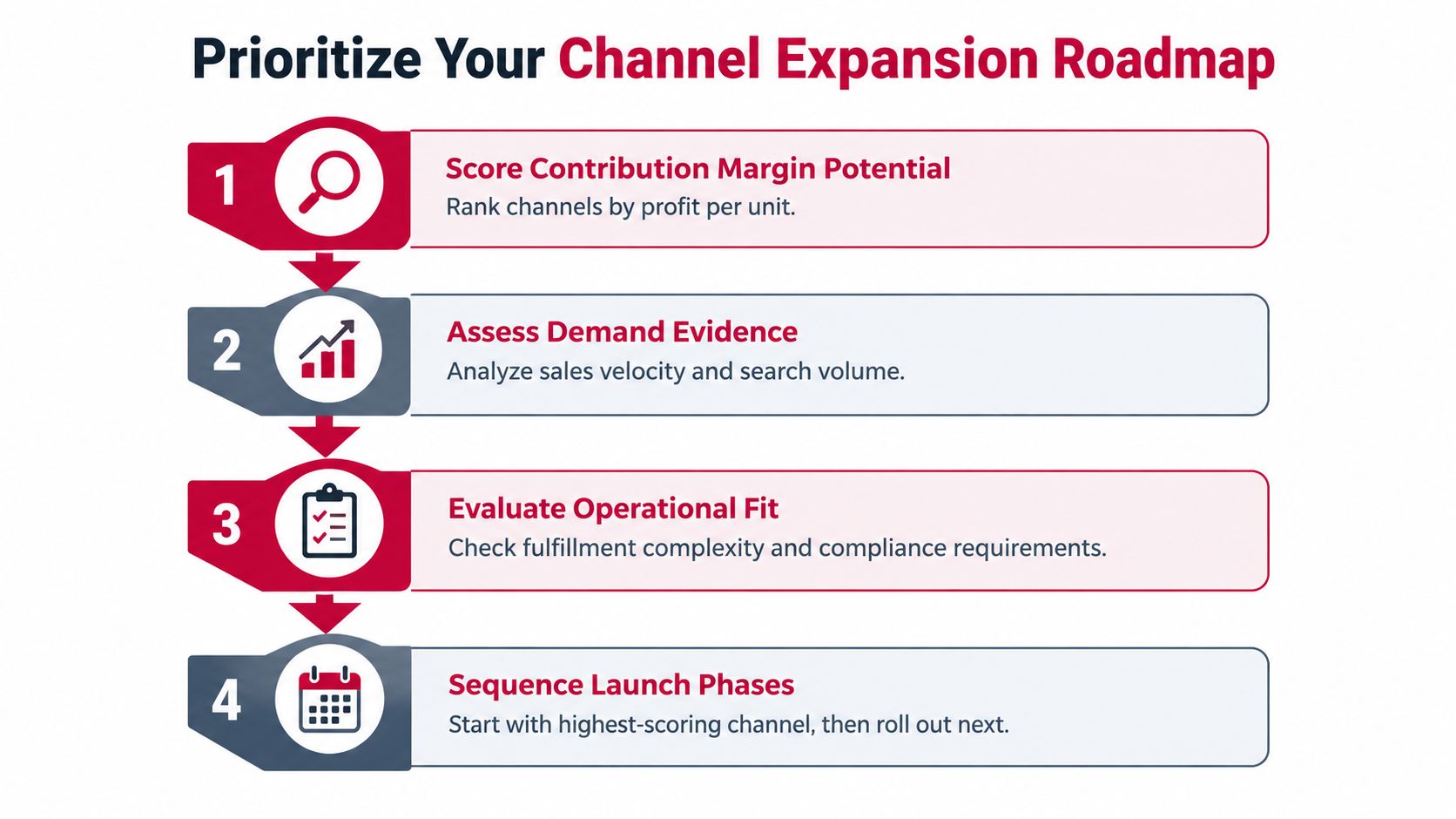
The sequence should be simple.
Foundation means one channel is stable enough to produce usable operating data. Pricing works. Inventory planning is credible. Listings or sales materials are conversion-ready. Customer service and replenishment aren't breaking.
Optimization means you improve the engine before adding more weight. Tighten assortment. Reduce fee leakage. Improve inventory velocity. Get clearer on which SKUs deserve working capital.
Amplification means you expand from strength. The next channel gets resources, inventory, and a role because the first one already taught you something reliable.
I like a four-part scorecard:
A channel that looks exciting but scores poorly on readiness and capital intensity usually needs to wait.
McKinsey's CPG guidance is directionally right here. Winning companies expand channels by allocating resources to high-growth channels, building “power partnerships,” refining route-to-market models, and using advanced analytics to target growth pockets rather than pushing blanket distribution in this consumer packaged goods analytics report.
That's exactly how sequencing should work in practice.
Pilot one channel with a controlled SKU set. Don't move the whole catalog. Don't launch every flavor, count, and size.
Set review checkpoints around margin, inventory movement, content readiness, and operational strain. If the pilot creates more inventory drag than contribution, pause. Expansion should earn the next dollar of working capital.
One practical option for brands that need outside support in this phase is Reddog Consulting Group, which works on marketplace management, inventory velocity modeling, retail expansion planning, and channel economics for CPG operators.
A channel plan can look smart in a spreadsheet and still fail in the warehouse.
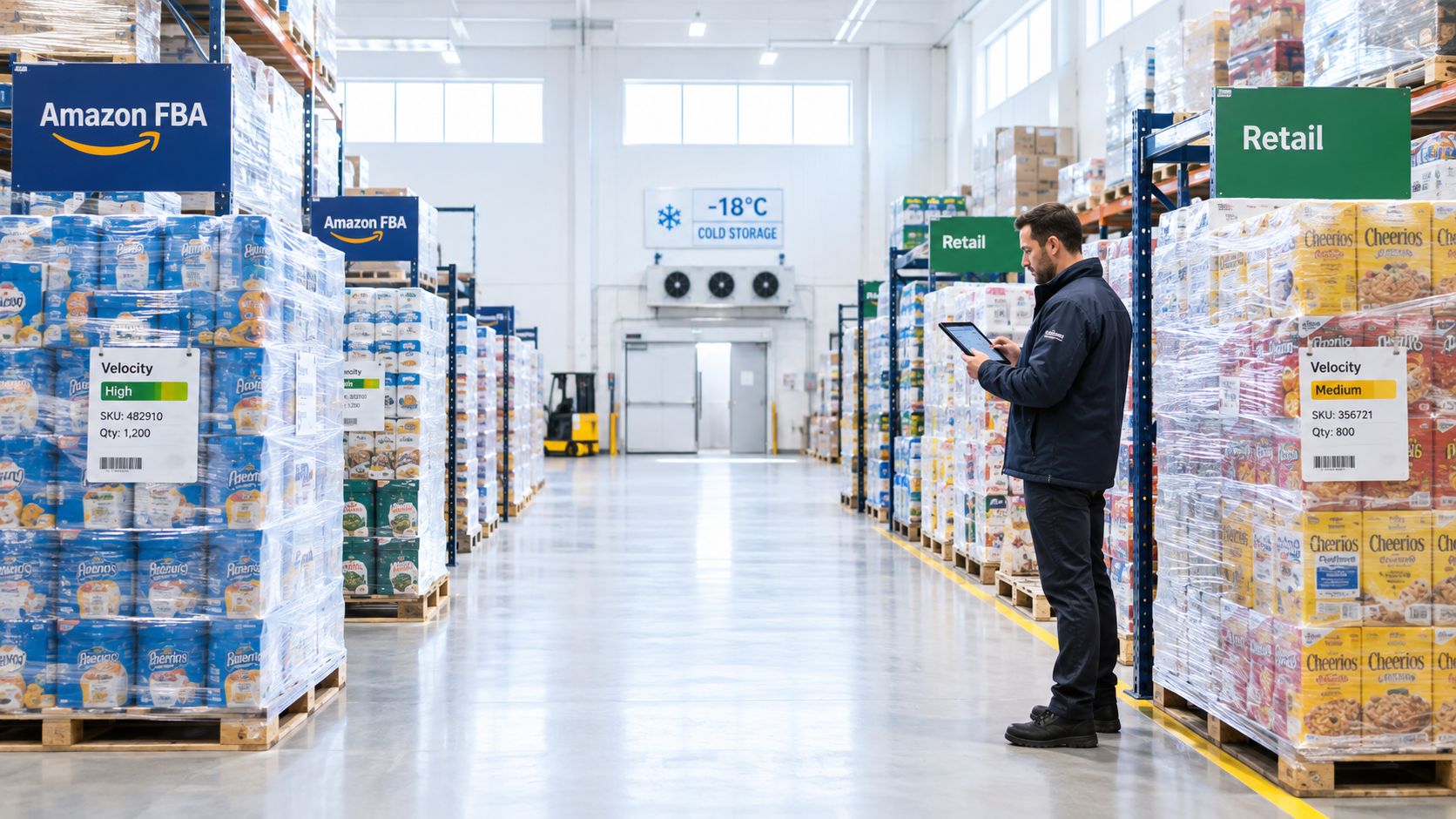
Every new channel competes for inventory. That sounds obvious, but the operational effect is bigger than many teams expect. The moment you split inventory across Amazon, Walmart, DTC, and wholesale commitments, you lose flexibility. Safety stock goes up. Transfer decisions get slower. Slow movers hide longer.
That's why multi-channel planning has to happen at the SKU level, not just the channel level. This guide to multi-channel inventory management is useful if your replenishment logic is still being managed separately by channel owners.
A lot of channel conflict starts because the same product gets pushed into every route with the same pack, the same price logic, and the same expectations.
Use channel-specific structure where needed:
If local or regional fulfillment becomes part of the mix, it also helps to understand the hidden cost drivers in local delivery. Last-mile assumptions can wreck a margin model that looked solid at launch.
The launch checklist needs to include more than listings and POs.
A channel is operationally ready when inventory, pricing, content, fulfillment, and ownership are all assigned before launch.
Make sure these are covered:
Brands usually blame the channel when the launch underperforms. More often, the issue was execution debt.
The biggest myth in expansion is that more channels automatically mean more profit. They don't. More channels usually mean more complexity first.
Deloitte's retail outlook points to a real tension. Omnichannel shoppers spend 1.5 times more each month than single-channel shoppers, yet many retailers still haven't solved omnichannel profitability, and nearly half plan further investments in store remodels or new locations in 2025, according to Deloitte's retail distribution outlook for 2025.
That gap shows up in three places fast.
Marketplace growth can look healthy while referral fees, fulfillment charges, storage, and ad dependency strip out the contribution. Retail growth can look impressive while trade spend and deductions eat the gain.
Brands that chase volume without a channel role usually notice the problem late, after they've already committed inventory and promo calendars.
If DTC runs frequent discounts, wholesale partners notice. If Amazon pricing isn't controlled, Walmart gets harder. If a distributor is carrying broad assortment with weak turns, pressure builds for markdowns or deal support.
This isn't a marketing issue. It's a channel governance issue.
That's especially true in emerging formats like social commerce, quick commerce, and indirect retail models serving price-sensitive shoppers. A lot of brands assume they can copy the same SKU architecture everywhere. They can't.
If the route requires a different pack-price relationship, fulfillment promise, or content model, treat it like a different operating business. If you can't support that, delay the launch.
A channel expansion strategy is working when margin quality improves along with reach. Not just when orders show up.
Track KPIs that tell you whether the channel is earning its role:
If a growth engine isn't producing a path to healthy contribution, it needs intervention. If a profit hub starts relying on discounts to move, it's drifting.
Use a short launch checklist:
The brands that expand well usually look boring from the outside. They launch fewer things, measure harder, and protect margin earlier.
If you're a CPG founder or operator planning your next channel, book a free 30-minute working session focused on contribution margin, marketplace performance, and expansion sequencing at Reddog Consulting Group. We'll look at where fees, inventory pressure, or channel mix are holding growth back and help you pressure-test the next move before you commit more spend or stock.
Leave a comment: