
Published: March 2020 | Last Updated:April 2026
© Copyright 2026, Reddog Consulting Group.

TL;DR:
- Effective omnichannel workflows synchronize inventory, customer data, and fulfillment processes across channels.
- Conducting a thorough audit identifies operational gaps and informs prioritized, impactful improvements.
- Continuous review, flexible processes, and strong team discipline are key to scaling profitability.
Running sales across Amazon, Walmart, DTC, and wholesale simultaneously sounds like a growth strategy. For most CPG brands in the $500K to $20M range, it quietly becomes a profitability problem. Orders fall through the cracks, inventory data lives in three different spreadsheets, and nobody can tell you which channel actually makes money after fees and fulfillment costs. Without a structured omnichannel workflow connecting your channels, you are not scaling a business. You are managing organized chaos. This guide walks you through a practical, step-by-step process to build workflows that actually hold up under real operational pressure, so your growth translates into margin, not just revenue.
| Point | Details |
|---|---|
| Map before you build | Always assess your brand’s unique needs and channels before designing any workflows. |
| Start small, scale fast | Pilot workflows on select products, optimize, then expand across your business. |
| Focus on real results | Measure improvements not just by sales, but also by retention, accuracy, and margins. |
| Embrace continuous change | The best workflows evolve with your brand, market, and technology shifts. |
Before you can fix your operations, you need a clear definition of what you are actually building. An omnichannel workflow is the connected set of processes, people, and platforms that allow your brand to serve customers consistently across every sales channel. It is not just about selling everywhere. It is about making sure every channel shares the same inventory truth, the same customer data, and the same fulfillment logic.
Most CPG brands confuse omnichannel with multichannel. Multichannel means you sell on multiple platforms. Omnichannel means those platforms talk to each other. The difference matters enormously for profitability. A multichannel brand might oversell on Amazon because its Shopify store already committed the inventory. An omnichannel brand prevents that because its systems are synchronized. Omnichannel commerce basics explain this distinction well, and understanding it is the first step toward building something that scales.
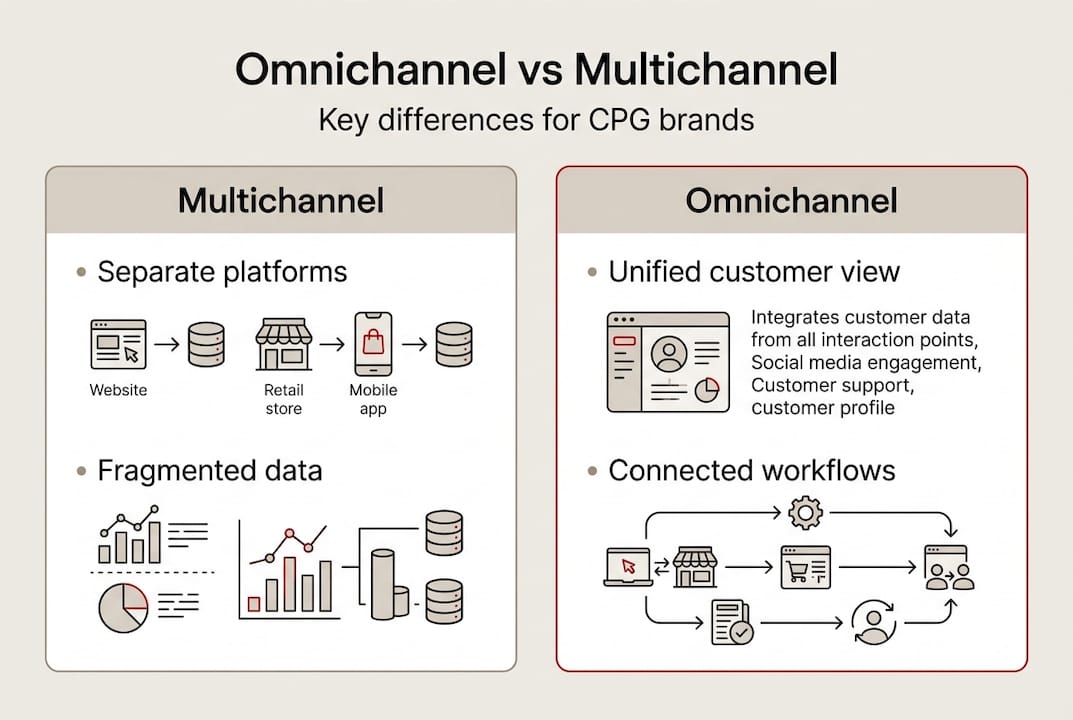
Effective omnichannel workflows have three core components: people who own each process, platforms that connect and share data, and documented procedures that remove ambiguity. Without all three, you get partial solutions that break under volume. The Shopify omnichannel overview outlines how commerce platforms fit into this structure, but technology alone never solves an operational problem.
Here are the key elements every effective omnichannel workflow includes:
Think of your workflow like plumbing in a building. Each pipe serves a different room, but they all connect to the same water source. If one pipe leaks, the whole system loses pressure. Your retail strategy guide should reflect this kind of interconnected thinking from the start.
| Workflow component | Primary function |
|---|---|
| Order management system | Routes and tracks orders across all channels |
| Inventory sync layer | Maintains accurate stock counts in real time |
| Customer data platform | Unifies purchase and behavior data |
| Fulfillment logic engine | Decides where and how to ship each order |
| Returns management process | Handles reverse logistics consistently |
| Reporting and analytics | Tracks performance and margin by channel |
The most expensive mistake CPG brands make is skipping the audit. They jump straight into new software or new channel expansion without understanding where their current operations actually break down. Assessment is essential for designing workflows that fit your specific business, not some generic template.
Here is a step-by-step evaluation checklist to diagnose your current state:
Most brands doing this audit for the first time find the same gaps. Inventory data is not synchronized. Customer orders from DTC and wholesale are managed by different teams using different tools. Returns from Amazon FBA are not reconciled against actual inventory counts. These are not technology failures. They are process failures that technology cannot fix on its own.

Pro Tip: When auditing your channels, pull 90 days of channel-specific data before drawing conclusions. Seasonal patterns and promotional spikes can make a weak channel look strong or a strong channel look broken. Good data hygiene at the audit stage saves you from designing workflows around the wrong problems.
Once you have your audit results, prioritize issues by their impact on margin and customer experience. A broken returns process on Amazon costs you more than a clunky manual reporting step in your wholesale workflow. The Harvard Business Review omnichannel strategy research reinforces that brands who prioritize based on customer impact outperform those who prioritize based on internal convenience. Use your audit to sequence your workflow improvements in order of real business impact.
With a clear picture of your current operations, you can start building. Good workflow design follows three principles: simplicity, scalability, and flexibility. Simple enough that your team can execute it without a manual. Scalable enough to handle 3x your current volume. Flexible enough to absorb a new channel or a new fulfillment partner without breaking everything else.
Workflow mapping aligns your business processes to your channel strategy, and it starts with defining the key stages every order moves through. Here are the core workflow stages to map for your CPG brand:
Assigning ownership is where most workflow designs fail. Every stage needs a named owner, not a department. A department cannot be accountable. A person can. Document who approves exceptions, who escalates issues, and who reviews performance weekly.
| Workflow approach | Best for | Risk level |
|---|---|---|
| Fully automated | High-volume, standardized SKUs | Low operational, high setup cost |
| Hybrid automated/manual | Mid-volume with complex exceptions | Medium on both dimensions |
| Fully manual | Early-stage or low-volume brands | High operational, low setup cost |
The Deloitte retail workflows research shows that brands moving from manual to hybrid automation see the fastest margin improvement because they eliminate the highest-cost errors without overinvesting in technology before they are ready.
Pro Tip: Do not try to automate everything at once. Start with one product line, map its complete workflow from order capture to financial close, and run it cleanly for 60 days. Then replicate the model. Brands that try to automate all channels simultaneously almost always end up with a half-working system across the board instead of a fully working system on one line.
Designing a workflow on paper and running it in the real world are two very different things. The implementation phase is where most brands either build lasting operational advantage or create expensive new problems. Move carefully and methodically.
Here is a step-by-step rollout sequence that works for CPG brands at your scale:
The metrics that matter most during and after implementation are order accuracy rate, inventory discrepancy rate, fulfillment cost per order by channel, return rate by channel, and contribution margin trend. These tell you whether your workflow is actually working or just running.
Critical note: Cross-channel data accuracy is not a nice-to-have. A single inventory discrepancy that causes an oversell on Amazon can trigger a suppressed listing, a customer service spike, and a margin hit all at once. Build data accuracy checks into your workflow at every stage, not just at the end.
Continuous refinement drives long-term omnichannel ROI, and the brands that win are the ones that treat their workflows as living systems. The McKinsey omnichannel research shows that CPG brands with iterative workflow improvement programs outperform static operators by a significant margin over a three-year period. Build the review habit from day one. If you are getting started with omnichannel for the first time, the pilot-first approach removes most of the risk.
Most omnichannel guides focus on technology stacks. Buy this platform, integrate that tool, and your channels will magically align. That framing misses the real driver of workflow success for fast-scaling CPG brands.
The brands we see win consistently are not the ones with the most sophisticated software. They are the ones with the clearest operational culture. Their teams know what good looks like. They know who owns what. They review performance data weekly and adjust without waiting for a quarterly business review to tell them something is broken.
Rigid workflow frameworks break fast in CPG because the channel landscape shifts constantly. Amazon changes its FBA fee structure. A new retail buyer wants EDI compliance you have never set up before. A 3PL partner goes out of business. The brands that survive these disruptions are the ones whose teams are trained to adapt, not just trained to follow a script.
The uncomfortable truth is that expert strategy insights matter less than execution discipline. A mediocre workflow run with consistency beats a perfect workflow run inconsistently every single time. Build the habit of frequent review and honest assessment into your culture from the start, and your workflows will improve themselves.
You now have a practical roadmap for building omnichannel workflows that connect your channels, protect your margin, and scale with your growth. The frameworks in this guide work because they are built around how CPG brands actually operate, not how consultants wish they did.
At RedDog Group, we work directly with CPG brands in the $500K to $20M range to design and implement the exact kind of margin-focused omnichannel systems this guide covers. Whether you need help with your initial audit, workflow mapping, or full-scale implementation, we are built for this work. As your omnichannel growth partners, we bring the operational clarity your brand needs to scale without margin bleed. Explore custom CPG workflow help and find out what structured omnichannel execution can do for your bottom line.
You need a commerce platform, data integrations, and order management tools that support cross-channel processes. The right tool stack depends on your channel mix and current volume, so start with your biggest operational gaps before choosing software.
Brands can pilot basic workflows in a few weeks, but full integration and optimization often take several months. The rollout timeline depends heavily on how many channels you are connecting and how complex your fulfillment logic is.
Track improvements in customer retention, order accuracy, and margin growth across all sales channels. The strongest ROI indicators are contribution margin by channel and reduction in fulfillment errors, because both directly affect your bottom line.
Many brands rush into technology decisions without first mapping their customer journeys and operational needs. Skipping the audit phase means you are automating broken processes instead of fixing them, which makes the problems faster and more expensive.
Leave a comment: