
Published: March 2020 | Last Updated:April 2026
© Copyright 2026, Reddog Consulting Group.

TL;DR:
- Most ecommerce brands leave 20 to 30% of cart revenue unrecovered due to weak retargeting. Retargeting delivers significantly higher ROAS and engagement compared to cold ads. Effective retargeting requires segmentation, creative refreshes, privacy compliance, and continuous optimization.
Most ecommerce brands leave 20 to 30% of cart revenue on the table simply because their retargeting is weak, misconfigured, or completely missing. Meanwhile, retargeting recovers abandoned carts and delivers 4x higher return on ad spend (ROAS) compared to cold prospecting ads. For CPG founders and marketing managers running growth-stage brands, that gap is not a minor inefficiency. It is a structural revenue leak. This article breaks down what retargeting actually is, what drives real performance, where most brands go wrong, and how to build a future-proof retargeting system that works across Amazon, DTC, and every other channel you operate.
| Point | Details |
|---|---|
| Retargeting recaptures lost sales | Serving ads to store visitors who didn’t buy recovers up to 30% of abandoned carts. |
| Outperforms cold traffic | Retargeting ads deliver higher click-through rates, conversions, and return on ad spend than prospecting. |
| Privacy compliance matters | Success now depends on first-party data, ethical consent practices, and cookieless technologies. |
| Frequency and segmentation boost ROI | Capping ad frequency and excluding past converters increases efficiency and cuts wasted spend. |
| Continuous optimization wins | Top brands constantly refresh creative and adopt new tech to maintain retargeting performance. |
Retargeting is the practice of serving personalized ads to people who have already visited your store, viewed a product, or added something to their cart but did not complete a purchase. It is not cold advertising. You are not introducing your brand to strangers. You are re-engaging people who already showed buying intent.
This distinction matters enormously for CPG brands. A shopper who browsed your protein bars on your DTC site and bounced is fundamentally different from someone who has never heard of you. They know your product. They just needed a nudge, a better offer, or a reminder at the right moment.
Retargeting works by placing a small piece of code (called a pixel) on your website or product pages. When a visitor leaves without buying, that pixel fires and logs their behavior. Ad platforms like Meta, Google, and Amazon DSP then use that data to serve your ads to those specific people as they browse elsewhere online.
Here is how retargeting fits into a broader CPG ecommerce strategy:
A common misconception is that retargeting is just “ads that follow you around.” That framing undersells the strategy. Done well, retargeting is a precision tool for improving ecommerce conversion rates by matching the right message to the right person at the right stage of their buying journey.
Retargeting delivers up to 10x CTR compared to standard display ads. That performance gap exists because retargeted audiences have already self-selected as interested buyers.
For growth-stage CPG brands managing tight ad budgets, that CTR advantage translates directly into more efficient spend. You are not paying to educate cold audiences. You are closing warm ones.
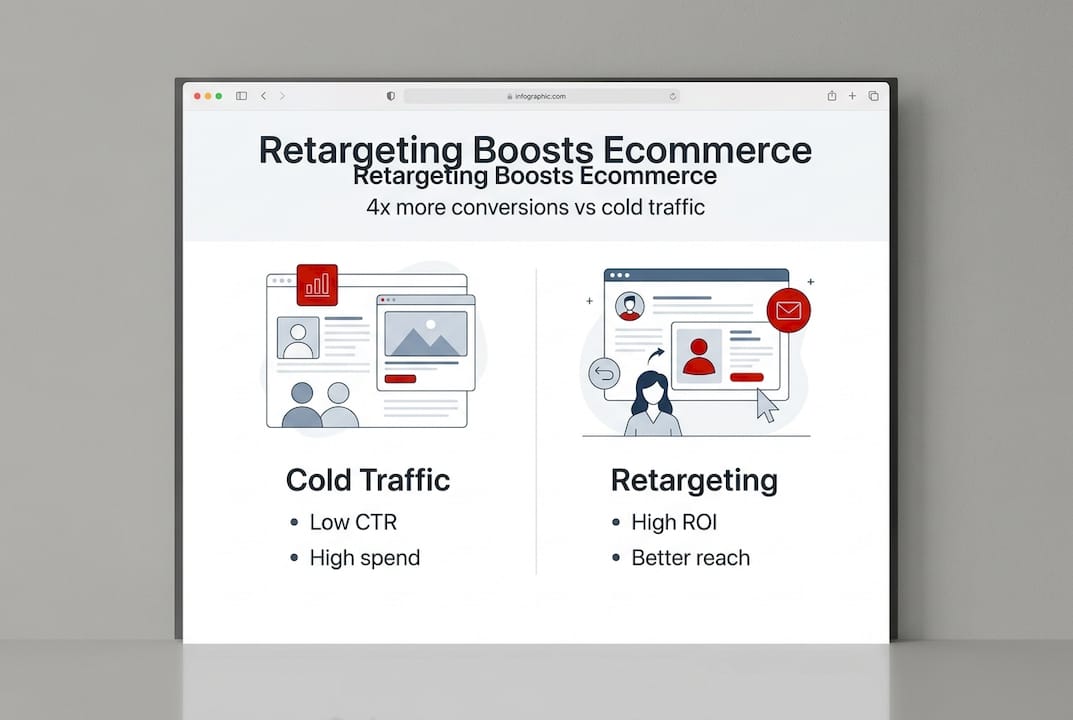
The numbers behind retargeting performance are not subtle. Retargeting increases conversions by 70%, lowers cost per acquisition (CPA) by 50 to 55%, and delivers an average ROAS of 4:1 compared to cold traffic campaigns. For a brand spending $10,000 per month on ads, that difference in CPA alone could mean thousands of dollars in recovered margin every single month.
Let’s look at how the retargeting journey actually works in practice:
That sequence sounds simple. But the execution details, the creative, the timing, the offer, the audience segment, determine whether you capture that sale or lose it to a competitor.
Here is a benchmark comparison to frame the opportunity:
| Metric | Cold traffic ads | Retargeting ads |
|---|---|---|
| Click-through rate (CTR) | 0.07% avg | 0.7% avg (10x higher) |
| Conversion rate | 1 to 2% | 3 to 5% |
| Cost per acquisition (CPA) | High baseline | 50 to 55% lower |
| Return on ad spend (ROAS) | 1.5x to 2x | 4x average |
These benchmarks explain why scaling profits with growth strategy almost always includes retargeting as a core lever, not an afterthought. And from a performance marketing standpoint, retargeting is one of the few tactics where you can directly attribute spend to recovered revenue with reasonable confidence.
For CPG brands on Amazon or Walmart, the same logic applies through platform-native tools like Amazon DSP and Walmart’s onsite retargeting. The mechanics differ slightly, but the principle is identical: re-engage warm audiences before they buy from a competitor.

Higher returns do not happen automatically. Success requires a thoughtful approach. Here is what distinguishes winning retargeting from wasted spend.
Audience segmentation is non-negotiable. The single most common mistake growth-stage brands make is running one retargeting audience for everyone. Treating a cart abandoner the same as someone who spent 10 seconds on your homepage is a waste of budget. Segment by behavior, recency, and intent level. And always exclude recent converters. Failing to do so means you are spending money showing ads to people who already bought, which wastes 15% of retargeting spend on average.
Ad fatigue is real and expensive. When the same person sees your ad 15 times in a week, they stop clicking and start ignoring or worse, hiding your ad. Proper frequency capping keeps impressions in the 3 to 5 per week range for most audiences. Beyond that, performance drops measurably.
Here is a quick comparison of best practices versus common mistakes:
| Area | Best practice | Common mistake |
|---|---|---|
| Audience exclusions | Exclude buyers, exclude low-intent visitors | Retarget everyone who touched the site |
| Frequency | Cap at 3 to 5 impressions per week | No cap, leading to fatigue |
| Creative | Refresh every 2 to 4 weeks | Same creative running for months |
| Attribution | Use lift testing alongside last-touch | Rely solely on last-click attribution |
| Privacy | Consent management platform in place | No consent layer, risking compliance issues |
Privacy regulations like CCPA (California Consumer Privacy Act) and GDPR (General Data Protection Regulation) are reshaping what data you can collect and how you can use it. Brands operating across states or internationally need a consent management platform to stay compliant and maintain audience quality.
Pro Tip: Set a calendar reminder to audit your retargeting creative every 30 days. Stale creative is the silent killer of retargeting performance. Pair that with a frequency cap review and you will sustain results far longer than competitors who set campaigns and forget them.
A multichannel growth workflow makes segmentation easier because you have clearer data on where each customer came from and what they engaged with before converting.
The retargeting landscape is changing fast. Google has been phasing out third-party cookies in Chrome, Apple’s App Tracking Transparency (ATT) framework has already reduced mobile tracking significantly, and regulators worldwide are tightening data use rules. The brands that adapt now will outperform those that wait.
Here is what is driving the shift:
The good news is that cookieless contextual strategies deliver 80 to 90% of the performance that cookie-based retargeting achieves. The transition is manageable if you start building the right infrastructure now.
First-party data tactics are your best investment heading into 2026 and beyond:
AI in ecommerce is also reshaping retargeting through predictive audience modeling and contextual targeting that does not rely on individual user tracking. These tools analyze content context and behavioral signals at scale to serve relevant ads without needing a cookie.
Pro Tip: Brands that invest in data ownership today, building email lists, using consent management platforms, and testing server-side tagging, will have a structural advantage as privacy rules tighten. This is not a technical nice-to-have. It is a competitive moat.
For data-driven marketing to remain effective, the foundation has to shift from borrowed third-party data to owned first-party signals.
Here is the uncomfortable truth: most growth-stage CPG brands chronically underinvest in retargeting not because they do not understand it, but because chasing new traffic feels more exciting. New audiences, new reach, new revenue. It is a compelling story to tell investors and internal stakeholders.
But optimizing retargeting loops is where the real margin lives. A brand spending $50,000 per month acquiring cold traffic while running a neglected, stale retargeting campaign is leaving a significant portion of that acquisition spend on the table.
The “set it and forget it” mindset is the biggest culprit. Teams launch a retargeting campaign, see decent early results, and move on to the next initiative. Six months later, the creative is stale, the audience segments have not been updated, converters are still being retargeted, and frequency caps were never set. Performance has quietly eroded.
Top performers treat retargeting as a living system. They run structured experiments, refresh creative on a schedule, segment audiences by intent tier, and measure incrementality rather than just last-touch attribution. They also think omnichannel ecommerce success, connecting retargeting signals across Amazon, DTC, and retail touchpoints rather than running siloed campaigns.
The challenge for this quarter is simple: audit your retargeting setup. Check your frequency caps, exclusion lists, creative age, and attribution model. Set specific improvement targets. That audit alone will likely reveal margin you did not know you were losing.
Retargeting is one of the highest-leverage tools available to CPG brands, but only when it is built on the right strategy, data infrastructure, and ongoing management. Most brands are not running retargeting at its full potential, and the gap between average and excellent execution is measurable in real revenue.

At RedDog Group, we help growth-stage CPG brands build retargeting systems that are margin-aware, privacy-compliant, and integrated across every channel they sell on. Whether you are scaling on Amazon, building a DTC engine, or expanding into wholesale, our omnichannel growth solutions connect the dots between ad spend and contribution margin. If you are ready to stop leaving revenue on the table, explore our CPG retail growth offer and see how structured retargeting strategy fits into your broader growth plan.
Retargeting re-engages shoppers who already showed buying intent, delivering up to 4x better ROAS and 10x higher click-through rates compared to cold audience ads.
Privacy laws like CCPA and GDPR require brands to shift toward consent-based, first-party data approaches. Cookieless methods maintain 80 to 90% of traditional retargeting performance when implemented correctly.
The most costly mistakes are failing to exclude recent buyers, skipping frequency caps, and running stale creative. Excluding converters saves 15% of retargeting spend that would otherwise be wasted.
By connecting retargeting signals across Amazon DSP, Meta, Google, and DTC channels, CPG brands create a consistent re-engagement experience. Multi-channel retargeting outperforms single-channel approaches in both conversion rate and overall ROAS.
Leave a comment: