
Published: March 2020 | Last Updated:April 2026
© Copyright 2026, Reddog Consulting Group.

TL;DR:
- Consumer-generated content is seen as more authentic and influential than traditional brand ads.
- UGC can increase conversion rates by 20-35 percent and significantly boost revenue.
- Brands should strategically collect, curate, and legally manage UGC to leverage its growth potential.
Polished brand ads used to rule the shelf. But 86% of consumers now find user-generated content more authentic than anything a brand produces in-house. That single fact should reshape how mid-sized CPG brands think about their marketing budgets. User-generated content, or UGC, is any photo, video, review, or post created by real customers rather than your marketing team. For brands competing in crowded categories on Amazon, Walmart, and DTC channels, UGC is no longer a nice-to-have. It is a core conversion asset. This guide covers how to collect it, use it legally, and deploy it in ways that actually move product.
| Point | Details |
|---|---|
| UGC builds trust | CPG brands using UGC appear more authentic and trustworthy to their target audience. |
| Boosts sales metrics | UGC in marketing can increase conversions and overall revenue for mid-sized CPG brands. |
| Strategic collection matters | Effective UGC programs rely on well-designed collection tactics and clear guidelines. |
| Legal compliance is essential | Brands must secure rights and follow legal rules to safely use UGC in ads and social content. |
UGC stands for user-generated content. It is any content created by your customers, fans, or community members rather than your internal team or paid creators. Think customer reviews, unboxing videos, recipe posts featuring your product, Instagram photos, and TikTok hauls. It is raw, real, and often imperfect. That is exactly why it works.
Traditional brand content is produced, polished, and controlled. Your creative team picks the lighting, the model, the copy, and the message. UGC flips that script. A real person in their real kitchen using your hot sauce carries a social proof signal that no studio shoot can replicate. Consumers know the difference, and they respond to it.
For mid-sized CPG brands, this matters even more. You are not Procter and Gamble. You cannot outspend the category leaders on paid media. But you can out-authenticate them. Shoppers browsing a crowded Amazon category or scrolling Instagram are looking for signals that a product actually delivers. A grid of polished product shots says “we have a marketing budget.” A stream of real customer photos and reviews says “people love this.”
The most common types of UGC in CPG marketing include:
“UGC enhances trust and authenticity for CPG brands, with 86% perceiving it as more real than brand-produced content.”
This trust advantage compounds over time. As you build a library of authentic customer content, every new shopper who lands on your product page or social profile sees evidence of real people making real purchase decisions. That is a compounding asset, not a one-time campaign win. Explore how UGC for CPG brands can be built into your broader growth strategy from the start.
Authenticity is valuable, but you need numbers to justify the investment. The data on UGC and conversion is strong. UGC can drive conversion rates up by 20 to 35 percent and increase revenue by up to 18 percent. These are not marginal gains. For a brand doing $3 million in annual ecommerce sales, an 18 percent revenue lift is $540,000 in additional top-line revenue.
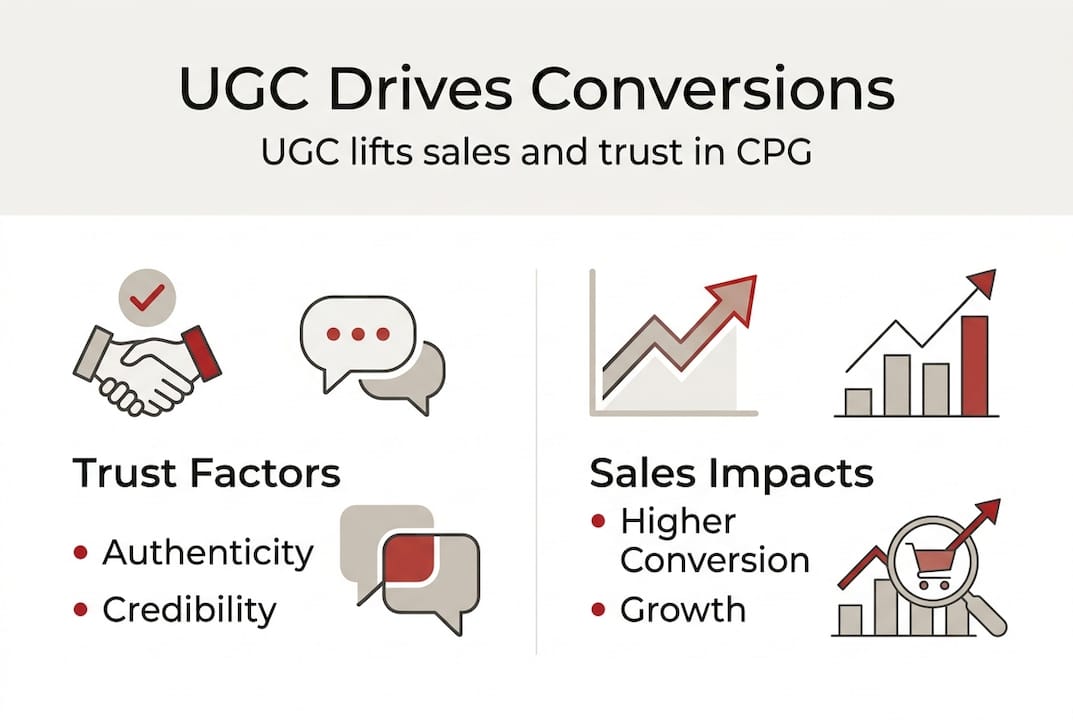
Here is how those gains show up across your channels:
| Channel | UGC application | Impact || |—|—|—| | Amazon product pages | Customer photos and reviews | Higher conversion rate, lower return rate | | Paid social ads | Real customer video clips | 4x higher click-through rate vs. branded creative | | DTC product pages | Review carousels, photo galleries | Increased time on page, lower bounce rate | | Email campaigns | Customer photos in newsletters | Higher open-to-click conversion | | Retail displays | QR codes linking to UGC | Bridges online social proof to in-store decision |
The paid ad application deserves special attention. Most CPG brands default to polished creative in their Meta and TikTok campaigns. But authentic customer footage, even filmed on a smartphone, consistently outperforms studio content in click-through rates. The algorithm rewards engagement, and real content gets more of it.
Here is a practical sequence for deploying UGC across your sales funnel:
Pro Tip: When testing UGC in paid ads, create two ad sets with identical targeting. Run your polished brand creative in one and a raw customer video in the other. Most CPG brands are surprised to find the customer video wins within the first week.
Understanding the sales impact of UGC is the first step. The next is building the systems to capture it consistently. For a broader view, the digital marketing benefits of integrating UGC across channels are well documented, and your ecommerce growth checklist should include UGC as a core conversion lever.
Knowing UGC works is one thing. Building a reliable pipeline of it is another. Most mid-sized CPG brands struggle here because they wait for UGC to appear organically rather than engineering the conditions for it.

Branded hashtags, contests, and ambassador programs are the three most proven mechanics for generating consistent UGC. Each has a different cost, effort level, and risk profile:
| Tactic | Cost | Effort | Risk | Best for |
|---|---|---|---|---|
| Branded hashtag | Low | Low | Low | Ongoing, passive collection |
| Social contest or giveaway | Medium | Medium | Medium | Volume spikes, new product launches |
| Ambassador program | Medium to high | High | Low | Consistent quality, long-term relationships |
| Post-purchase email ask | Low | Low | Very low | Review and photo collection on DTC |
| Sampling campaigns | High | High | Low | Pre-launch seeding, retail sell-in |
A branded hashtag costs nothing to create but requires consistent promotion. Put it on your packaging, in your email footer, and in every social bio. Over time it becomes a searchable library of customer content you can draw from.
Social contests work well for volume. A simple mechanic, post a photo with your product using our hashtag to win a gift card, can generate hundreds of posts in a week. The key is keeping the barrier to entry low and the prize relevant to your customer.
Ambassador programs take more investment but produce the most usable content. When you build relationships with real customers who genuinely love your product, the content they create is more authentic and more on-brand than anything a paid influencer delivers.
Once you have content coming in, curation matters. Not every post belongs in your paid ads. Build a simple review process: does the content show the product clearly, does it reflect your brand values, and is the creator someone you want associated with your brand? Filter for quality, not just quantity.
Pro Tip: Always request explicit written permission before reusing customer content in paid ads or on your website. A simple direct message template asking for permission takes 30 seconds to send and protects you from significant legal exposure.
Strong brand positioning strategies inform what kind of UGC you should be collecting and how it should reflect your category story.
UGC is powerful, but it comes with real legal exposure that CPG marketers often underestimate. UGC brings risk of copyright infringement, privacy violations, and FTC non-compliance. Ignoring these risks is not just careless. It can result in fines, takedowns, and brand damage.
Here are the four main legal areas to manage:
“Using UGC without proper permissions creates serious exposure to copyright claims, privacy lawsuits, and FTC enforcement actions.”
To build a compliant UGC process, follow this checklist:
Building these steps into your workflow from the start is far cheaper than managing a copyright dispute after the fact.
Most CPG brands treat UGC as a content tactic. We think that framing misses the bigger opportunity. The brands that win in 2026 are the ones building UGC collection into every customer touchpoint, not just running a contest once a quarter and calling it done.
Here is what we see consistently: brands that rely on influencer campaigns alone get awareness but struggle with conversion efficiency. Influencers are great for reach. But UGC is cheaper and more authentic for driving actual purchase decisions. The smartest play is a hybrid approach where influencer content builds the audience and UGC closes the sale.
Mid-market CPG brands have a structural advantage here that most do not use. Your customers are often more passionate and more vocal than those of a legacy brand. That passion is a content engine waiting to be activated. The brands that figure out how to systematize building UGC-driven trust across Amazon, DTC, and retail channels are the ones that build defensible market positions. Authenticity at scale is not a contradiction. It is a repeatable system.
Building a UGC program that consistently drives conversions, stays legally compliant, and scales across channels is not a weekend project. It requires the right systems, the right permissions workflow, and a clear strategy for how UGC fits into your broader channel mix.
At RedDog Group, we help mid-sized CPG brands turn UGC from a scattered tactic into a structured growth asset. Whether you are scaling on Amazon, expanding into retail, or building your DTC engine, we connect the dots between content strategy and contribution margin. If you are ready to build a smarter approach to omnichannel CPG growth, explore our CPG retail growth offer and see how we help brands like yours compete on authenticity and win on margin.
Customer reviews, product photos, unboxing videos, and authentic everyday usage posts perform best for CPG brands because they show real people using the product in real contexts.
Brands should use social contests, branded hashtags, and ambassador programs to inspire engaging and on-brand UGC submissions from their most loyal customers.
Yes. UGC in ads risks copyright and privacy issues unless brands secure explicit written permissions and follow FTC disclosure guidelines before running any paid campaigns.
UGC is cheaper and more authentic for driving conversions, while influencer content is better suited for building awareness and reaching new audiences at scale.
UGC can be integrated across ecommerce product pages, social ads, email flows, and even in-store displays to amplify campaign consistency and reinforce social proof at every shopper touchpoint.
Leave a comment: