
Published: March 2020 | Last Updated:February 2026
© Copyright 2026, Reddog Consulting Group.

The best inventory management software for your e-commerce business is the one that actually improves your contribution margin. While platforms like Settle and Cin7 pack a serious punch for scaling brands, the right tool for you comes down to your specific business model, sales channels, and cash flow—not just a long list of features.
Most CPG operators see inventory software as just another operational expense—a line item on the P&L for keeping track of widgets. This is a huge mistake. Your inventory management system is one of the most powerful financial levers you have. It's the central nervous system connecting your sales channels, warehouse operations, and, most importantly, your cash.
A poorly chosen or outgrown system actively bleeds profit. It creates predictable—and totally preventable—margin erosion through scenarios every operator knows all too well:
The job of modern inventory software isn't just counting units; it's to give you the data you need to make profitable decisions. This is where you build your operational foundation. Choosing the right software goes hand-in-hand with your fulfillment strategy; understanding options like working with Amazon fulfillment companies is critical for keeping costs and logistics in check.
The market for these tools is exploding for a reason. The global inventory management software market is expected to jump from $2.7 billion in 2026 to $9.4 billion by 2036. That growth is fueled by brands demanding systems that deliver real-time tracking, forecasting, and automation—the core ingredients of a profit-first operation. You can learn more about these market growth projections and trends.
The real question isn’t, "How much does this software cost?" It's, "How much margin will this software protect and unlock?" If a system prevents just one major stockout or helps you dodge a round of long-term storage fees, it’s already paid for itself many times over.
A system built for your business stage should connect inventory velocity directly to your channel economics. It should help you answer the tough questions. Should you fulfill that DTC order from your 3PL or from FBA? What’s your break-even ACOS on a product with constantly changing fulfillment fees? Getting these answers right requires a system designed for profit, not just tracking.
Before you even think about looking at software demos and pricing sheets, you need a solid evaluation framework. The flashy dashboards and AI-powered forecasting tools are useless if the core functions don’t solve the day-to-day headaches of running a CPG brand. The best inventory management software for e-commerce isn’t the one with the most bells and whistles; it’s the one that plugs your biggest, most expensive operational leaks.
Let's break down the must-have criteria from an operator's perspective, focusing on how each feature directly impacts your margins and your ability to grow.
To help structure your thinking, we've put together a simple framework. Don't just look at a feature's name; dig into what it actually does and how it solves a real problem for your business.
| Feature Category | What It Actually Does | Key Question for Your Business |
|---|---|---|
| Integrations & Sync | Connects all your sales channels (DTC, Amazon, etc.) and locations (3PL, FBA) into one unified system. | Can it sync inventory in real-time across every place we sell and store products without fail? |
| Order Routing | Automatically decides which warehouse or fulfillment center should ship an order based on rules you set. | Can we create rules to ship orders from the cheapest or fastest location to protect our margins? |
| SKU Scalability | Handles a large and growing number of SKUs, including variations, without slowing down or crashing. | Will the system buckle when we launch 50 new product variations next quarter? |
| Kitting & Bundling | Tracks inventory for individual components and finished "bundle" SKUs simultaneously. | Can it automatically deduct component stock when a bundle sells so our inventory counts stay accurate? |
| Returns Management | Processes returns, updates inventory levels for sellable vs. damaged goods, and integrates with returns portals. | How does it handle a returned item? Does it put sellable stock back on the digital shelf automatically? |
| Reporting & Analytics | Provides clear, actionable data on sales velocity, stock turn, COGS, and profitability by SKU/channel. | Can I easily see which products are making or losing us money, and where? |
| Pricing & Value | The total cost of ownership (subscriptions, implementation fees, transaction fees) relative to the problems it solves. | Is the price justified by the time and money we'll save on stockouts, overselling, and manual work? |
This framework isn't about finding a system that does everything perfectly. It's about identifying which of these functions are non-negotiable for your brand right now and which ones you can grow into.
This is the absolute bedrock. If a system can’t sync inventory accurately and in near real-time across every place you sell and store goods, just walk away. This isn't just about stopping oversells; it's about protecting your channel health, cash flow, and sanity.
Think about the classic DTC flash sale disaster. You oversell a SKU that’s also stocked at Amazon FBA. Now you have to cancel DTC orders (goodbye, customer trust) or try to pull FBA inventory to fulfill them, which is a logistical nightmare. While you're scrambling, your Amazon listing is out of stock, killing your sales velocity and tanking your Best Seller Rank (BSR)—a hole that can take weeks to dig out of.
This has become a non-negotiable as e-commerce goes global. The demand for these sophisticated inventory platforms is surging, with markets like India alone seeing platforms hit a gross merchandise value of $60 billion in fiscal year 2023. As brands add more channels, a single source of truth for inventory is no longer a luxury. Find out more about the growing demand for integrated inventory platforms.
Once you start growing, you’ll have inventory sitting in multiple places: your main 3PL, Amazon FBA, maybe Walmart WFS, and even a small back office for special orders. Smart order routing is the brain that decides which location should fulfill an order to maximize your contribution margin.
It’s all about trade-offs.
A solid system lets you build simple rules to automate these choices based on shipping cost, delivery speed, and real-time inventory levels. Every order gets fulfilled the most profitable way possible, no manual thinking required.
For CPG brands, kitting isn't some niche feature—it's a core merchandising and marketing strategy. You might be selling a "starter pack," a variety bundle, or running a "buy two, get one" promo. Your software has to keep up.
This means the system must track inventory on two levels:
When a bundle SKU sells, the software must instantly and automatically reduce the inventory of its component SKUs. If it can't, your component stock counts will be completely wrong, leading to massive stockouts and a COGS reporting nightmare at the end of the month. A failure on this one feature can create reconciliation headaches that cost you dozens of hours in manual spreadsheet hell.
This is exactly where most entry-level systems fall flat. To get a better handle on making these stock levels work for you, check out our guide on the importance of inventory optimization. Real optimization is impossible without accurate data at the most granular level.
Choosing the right inventory management software isn't about picking a brand off a list—it's about understanding the fundamental trade-offs between different categories of tools. This decision defines your operational agility and directly hits your contribution margin for years. An operator juggling a multi-channel brand with inventory at FBA, WFS, and a 3PL has completely different needs than a DTC-only startup.
Getting this wrong at a critical growth stage is a classic, costly mistake. You might pick a simple app-based tool for its low cost, but six months later, it can’t handle FBA and 3PL inventory pools separately. The result? A chaotic, expensive migration to a more robust system, all while you're trying to manage peak season demand.
Let’s break down the three primary tiers of software so you can make a strategic decision based on your operational reality, not just a sales pitch.
These are the simple, often cheap or free, plugins you find in the Shopify or BigCommerce app stores. They're built to solve one problem well: syncing inventory for a single storefront and maybe one or two other channels.
For a brand in its earliest days—selling only through a DTC site with one warehouse—these tools often get the job done. They give you a basic, unified view of stock and stop you from overselling on your website. Their simplicity, however, is also their greatest weakness.
Operational Trade-Off: You trade low cost and easy setup for a complete lack of scalability. These apps are built on shallow integrations and rigid logic. The moment you introduce multi-location fulfillment (like adding FBA) or require complex kitting, they break. They create dangerous data silos and offer minimal reporting, leaving you blind to your true channel profitability.
This category is the sweet spot for most scaling e-commerce brands. Platforms like Cin7, Skubana, or Settle are purpose-built for the headaches of modern multi-channel retail. They are designed from the ground up to be the central hub for your entire operation, acting as the single source of truth for inventory, orders, and purchasing data.
Their strength is in deep, native integrations with marketplaces (Amazon, Walmart), DTC platforms (Shopify), 3PLs, and accounting software. This allows for sophisticated order routing logic, multi-location inventory tracking, and accurate landed cost calculations—all non-negotiable functions for optimizing your margins.
This is a look at the core functions a best-of-breed system must master: sync, routing, and kitting.
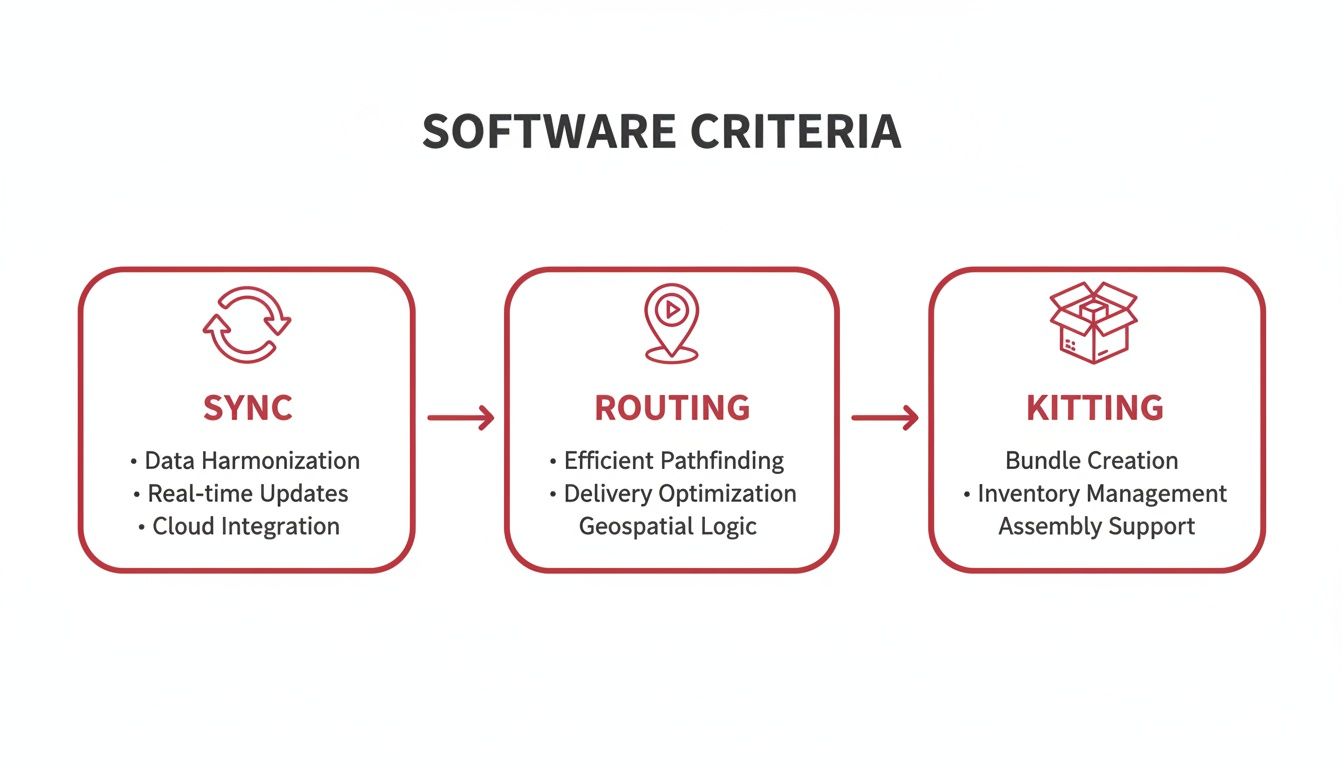
These three pillars are non-negotiable for any brand serious about scaling profitably across multiple channels and fulfillment centers.
The move toward these flexible, powerful systems is picking up steam. Cloud deployment has completely changed inventory management, now commanding 61.20% of the market share and climbing at an impressive 13.95% CAGR. For CPG brands managing operations across Amazon, Walmart, and DTC, cloud-based solutions eliminate the burden of maintaining expensive server infrastructure while providing the real-time visibility needed to make smart financial decisions. You can learn more about the rapid adoption of cloud inventory solutions.
Operational Trade-Off: You gain immense operational capability and margin control, but you take on the responsibility of managing an integrated "tech stack." While these systems are the hub, they still rely on connections to other specialized software. If an API connection to your 3PL goes down, you are responsible for troubleshooting it, which requires a more technically adept team.
At the highest end of the spectrum are Enterprise Resource Planning (ERP) systems like NetSuite or Odoo. These aren't just inventory tools; they are comprehensive business management platforms that aim to control everything: inventory, finance, CRM, HR, and manufacturing, all in one monolithic system.
The theoretical appeal is a single, unified data source for the entire company. For large, complex enterprises with manufacturing arms and extensive B2B operations, this unified approach can provide incredible control and visibility.
However, for most agile CPG and e-commerce brands, this is often overkill and can be operationally restrictive.
Operational Trade-Off: You gain a single source of truth but sacrifice flexibility and speed. ERPs are notoriously expensive, with implementation often costing tens or even hundreds of thousands of dollars and taking 6-12 months. Their e-commerce and marketplace modules are often less capable than those of specialized IMS platforms, requiring costly customizations to match the functionality that a best-of-breed tool offers out of the box. The rigidity of an ERP can stifle a brand’s ability to quickly test new channels or pivot its fulfillment strategy.
To make this clearer, let's look at the strategic trade-offs for CPG brands specifically. The table below outlines how each software category impacts your margins and exposes you to different operational risks based on where your business is today.
| Software Category | Best For (Use Case) | Contribution Margin Impact (Example) | Operational Risk |
|---|---|---|---|
| Tier 1: App-Based | Single-channel DTC startups with one warehouse. | High. Low software cost, but manual workarounds for complex orders (e.g., kitting) eat into labor margins. | High. Easily outgrown. Data silos lead to stockouts, overselling, and poor purchasing decisions as you add channels. |
| Tier 2: Best-of-Breed | Multi-channel brands using FBA, 3PLs, and DTC fulfillment. | Optimized. Automates order routing to the lowest-cost fulfillment center, saving on shipping. Tracks landed costs for true COGS. | Medium. Dependent on API stability. Requires an operator who understands how to manage an integrated tech stack. |
| Tier 3: ERP-Lite | Large enterprises with manufacturing and complex B2B/B2C ops. | Variable. High upfront and ongoing costs can hurt margins if the full feature set isn't used. Customizations are expensive. | Low (but rigid). Creates a stable, single source of truth but makes it slow and costly to adapt to new sales channels or fulfillment models. |
Ultimately, choosing the right tier is a direct reflection of your growth stage. The goal is to select a system that solves today's problems while providing a clear runway for the operational complexity you anticipate in the next 18-24 months.
The theory is nice, but let's get real. The only question that matters is which system solves your operational headaches right now, while still giving you some runway for the future. The "best" inventory management software is a moving target—it changes as you scale, add channels, and get smarter about your operations. A system that’s a lifesaver for a DTC-only startup will absolutely cripple a brand juggling FBA, WFS, and a dozen wholesale accounts.
This is where you need to be brutally honest about where your business stands today. Are you just building your Foundation, trying to get your DTC operations under control? Are you deep in the Optimization phase, wrestling with the messy profitability of multiple channels? Or are you pushing into Amplification, scaling into complex B2B and retail partnerships?
The right tool fits your current reality, not a future fantasy.
This is the classic startup operator. You're laser-focused on one primary channel, probably a Shopify or BigCommerce store, and fulfilling orders from a single 3PL or your own small warehouse. Your top priorities are simplicity, keeping costs down, and finding a tool that isn't a massive headache to learn. The main goal here is to finally ditch the spreadsheets and establish one single source of truth for your inventory.
This is where most scaling CPG brands live. You’re juggling inventory across FBA, maybe WFS, your main 3PL, and your own DTC store. Your biggest nightmares are figuring out channel profitability, tracking accurate landed costs, and—the classic—stocking out on one channel while being buried in inventory on another.
A brand at this stage simply cannot run efficiently without a dedicated IMS. The financial drag from sloppy fulfillment—like paying sky-high FBA multi-channel fulfillment fees for a DTC order when your 3PL had plenty of stock—will cost you far more than the software subscription.
This brand has hit serious scale. Now, you're managing complex B2B relationships right alongside your DTC and marketplace business. Your world involves case packs, pallet shipments, and adhering to the rigid logistical rules of major retailers like Target or Walmart.
Picking your software is a direct reflection of how mature your operations are. Getting this wrong is expensive. You either end up paying for features you'll never use or—far worse—you try to scale on a system that fundamentally can't support your channel mix, forcing a chaotic and costly migration later on.
The sales deck for any inventory management software paints a beautiful picture of seamless integration and instant ROI. But operator-to-operator, the reality is that the subscription fee is just the down payment.
The real costs—the ones that blindside brands and kill momentum—are buried deep in the implementation. Total cost of ownership (TCO) is the only metric that matters here, and it goes way beyond the monthly bill.
That sticker price almost never accounts for the operational drag of switching systems. You should absolutely expect a productivity dip as your team learns a new platform. Workflows that were pure muscle memory now require conscious thought, slowing down everything from order processing to receiving. This temporary slowdown has a real, tangible cost, especially if the switch happens during a busy sales season.
The single biggest underestimated cost is, without a doubt, data migration. Your historical sales data, supplier info, and product catalogs are probably trapped in a tangled mess of spreadsheets. Getting all that data cleanly into a new, structured system is a monumental task.
A botched data migration is a massive contributor to these hidden costs. Reports suggest a huge number of migrations fail, so it's critical to understand the best practices for data migration to avoid major setbacks.
If you have poor data hygiene going into a new system, you're guaranteed to get poor performance coming out of it. If your COGS data is off in the spreadsheet, it’ll be just as useless in the new software—it'll just look more official. Cleansing and mapping all that data requires dozens of hours of focused, detail-oriented work from your most knowledgeable people.
Another hidden risk is the constant upkeep of integrations. Your inventory software is the hub, but it’s completely dependent on API connections to your 3PL, your accounting software, and all your sales channels. These connections can and do break, often without any warning.
Think about this very realistic scenario:
In this all-too-common situation, the brand spent $12,000 on emergency fixes—double their annual software cost—all because they prioritized the sticker price over stable, core integrations. This is a classic case of winning the battle on price but losing the war on profitability.
This is exactly why a foundational approach to technology is so critical. A slightly more expensive system with rock-solid, native integrations and excellent support is infinitely cheaper than a "bargain" platform that needs constant, expensive life support. Accurately assessing these hidden costs is a key part of building a resilient operation, much like understanding the nuances of inventory forecasting and its impact on your bottom line.

Before you put ink on any contract, it's time to rigorously pressure-test the software and the provider's promises. Sales demos are designed to look flawless; your job is to find the breaking points before they crater your operations. Think of this final procurement step as the ultimate gatekeeper protecting your profitability.
Don’t rush this. This is where you finalize your operational Foundation and ensure you're making a decision based on reality, not a polished sales pitch. Use this checklist to make sure you’re covered.
Demo Your Most Complex SKU: Don't let them show you how easy it is to manage a simple t-shirt. Insist on a live demo using your most complicated product—whether it’s a multi-component bundle, a product with a dozen variations, or a SKU that needs batch tracking. This move alone will immediately expose the system's true capabilities and limitations.
Get a Firm Data Migration Quote: Ask for a written, not-to-exceed quote for the entire data migration process. This needs to include cleansing your existing data, mapping it to their system, and validating the final import. Vague estimates are a massive red flag for hidden costs waiting to ambush you down the line.
Request a Relevant Reference: Don't just settle for their happiest customer. Ask to speak with a brand that has a similar channel mix and order volume. When you get them on the phone, ask specifically about their onboarding experience, support response times during a crisis, and any unexpected integration headaches they ran into.
This is the step where you confirm a system can handle the messy, chaotic reality of your business. Your inventory platform is the backbone of your contribution margin. Choosing wrong compromises your entire foundation, stalls any optimization efforts, and makes future growth impossible. For a deeper dive, check out our guide on the essential steps for your inventory management checklist.
If your current operational stack feels more like a liability than a lever for growth, it’s time for a professional review.
Is your inventory system truly driving profitability, or just creating more work? Book a free 30-minute strategy call with our team. We’ll dig into your operational stack, identify margin leaks, and map out a clear path to building a scalable foundation for growth.
Book Your Free Margin & Operations Strategy Session
When you're choosing a system that will become the financial backbone of your business, you're going to have questions. Here are some straight answers to the most common concerns we hear from CPG founders and operations leaders.
The tipping point is when your manual tracking starts costing you real money or serious time—whichever pain you feel first. If you’re constantly overselling on one channel, running out of your best products, or your team is burning more than 5-10 hours a week just trying to make the numbers match up in a spreadsheet, you're already behind.
It’s simple: when inventory management feels more like frantic firefighting than a strategic part of your business, it's time to upgrade. The margin you lose from just one major stockout on Amazon over a peak weekend can easily pay for a year's subscription to a proper system.
You could, but only if you plan on selling exclusively on that one channel forever. The second you add a DTC store, a Walmart account, or a wholesale portal, you’ve created disconnected islands of inventory that can’t see each other.
Amazon Seller Central has zero clue what’s in your Shopify inventory, and vice versa. That blindness is a recipe for manual work, guaranteed overselling, and a complete lack of a unified view of your business. A real inventory management system is the central hub that syncs everything, and that’s non-negotiable for building a multi-channel brand that can actually scale.
The most common—and costly—mistake we see is brands choosing a system for the business they have today, not the one they'll have in 18-24 months.
Sure, that cheap, simple tool for your DTC-only store feels like a smart move right now. But it will completely fall apart the minute you expand to Amazon FBA and wholesale. The cost and chaos of replatforming in two years will absolutely dwarf whatever you saved upfront. Always choose software based on where you're headed, not just where you are.
Book a free, 30-minute working session with us to map out your channel economics and inventory strategy. This isn't a sales pitch—it's a practical planning call designed to give you actionable insights you can use to scale your CPG brand.
Leave a comment: