
Published: March 2020 | Last Updated:September 2026
© Copyright 2026, Reddog Consulting Group.

Your core ASINs are still selling, but the economics are getting tighter. FBA fees compress contribution margin, inventory velocity flattens on products that used to move predictably, and the marketing team starts asking for a bundle because it looks like a fast way to raise order value without adding packaging, labor, or new inventory.
Amazon virtual bundles can help, but they aren't free growth. They change how customers buy, how Amazon fulfills orders, and how you read the resulting sales. The brands that profit from them treat the feature as a controlled merchandising test, not a shortcut around weak pricing, excess inventory, or poor contribution margin.
A skincare brand has a cleanser ASIN with steady demand, a moisturizer that moves more slowly, and a refill product that customers often discover only after buying the core item. The obvious move is to combine them into one offer. The brand already has the inventory at FBA, so there's no new carton, no kitting run, and no separate finished-good forecast.
That logic is sound as far as it goes. Amazon introduced virtual bundles in late 2020 for eligible Brand Registered sellers, allowing brands to combine two to five existing FBA products into one sellable bundle without physically repackaging inventory (Amazon's virtual bundle documentation). The brand gets a new listing and a way to present complementary products together.
The trouble starts when the team evaluates the bundle using revenue alone. A larger basket can still produce a weaker order if the bundle discount, FBA handling, advertising cost, and return exposure consume the incremental gross profit. The bundle also creates a reporting problem, because the bundle sale may not appear cleanly in the same reporting views the team uses for individual ASINs.

The useful question isn't, “Can we launch a bundle?” It's, “Does this combination increase contribution margin per customer order after every variable cost?”
That requires more discipline than comparing the bundle price with the combined component prices. You need to understand whether the offer improves inventory velocity without starving the individual ASINs, whether the products have a genuine usage relationship, and whether the team can reconcile sales across the bundle and component listings.
Amazon virtual bundles are attractive because the launch feels lightweight. The financial decision isn't lightweight. A bundle can create a new demand path, or it can add catalog maintenance and advertising work while shifting demand between products you already sell.
Practical rule: Treat the first bundle as a merchandising experiment with a margin hurdle, not as a guaranteed growth program.
Amazon virtual bundles connect existing FBA products through one customer-facing offer. The buyer sees a single bundle listing, while Amazon continues storing the component products as separate inventory. Eligible brands can combine two to five existing FBA products without creating a physically repackaged unit.
That structure determines the operating cost. Amazon picks and packs each component separately when the order ships, so fulfillment follows the component products' standard fulfillment fees. You avoid the labor and packaging work required to create a physical kit, but you do not get the efficiency of one pre-built unit. The bundle can improve merchandising without reducing every order-level handling cost.
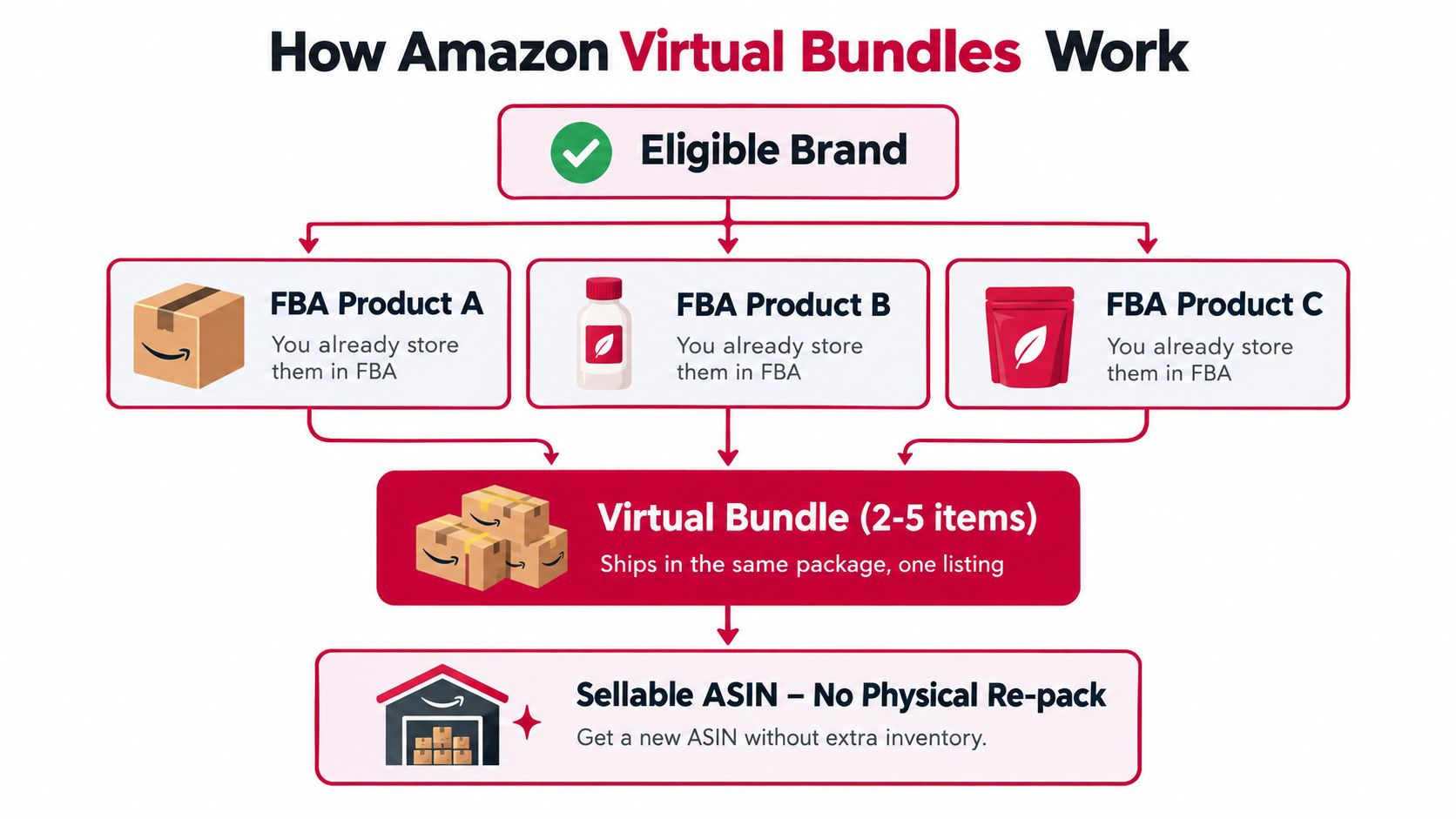
Amazon publishes the offer as a separate listing. The title must include “Bundle,” the description must identify each included item, and the main image must show all products in the offer, according to Amazon's virtual bundle requirements.
The listing must sell the product relationship, not just announce a combination. Use the image to make the contents immediately clear. Use the title to identify the use case without making the offer sound like a mystery pack. The description should remove uncertainty around sizes, variants, flavors, and included accessories.
For a complicated combination, a clear product description keyword strategy can explain the offer while retaining relevant search language. Copy cannot fix a weak pairing. Start with products customers have a clear reason to buy together, then use the listing to make that reason obvious.
Amazon still manages the component ASINs separately. Inventory does not become a new finished unit, and the brand does not receive a separate pool of bundle stock. If one component runs out, the bundle can become unavailable even when the other products remain well stocked.
Virtual bundles therefore provide catalog speed, not physical control. A physical kit gives the brand control over packaging, presentation, labeling, and the exact unit sent into the fulfillment network. A virtual bundle keeps those products in their existing FBA structure, which simplifies setup but leaves inventory dependency and component-level fulfillment costs in place.
Check eligibility before developing bundle concepts. Amazon positions virtual bundles for Brand Registered sellers, and availability can vary by store, brand structure, and fulfillment-channel combination. Confirm access in Seller Central before assigning creative, catalog, or inventory work to the project.
The feature operates in the US store, with creation and editing handled in Seller Central. Amazon does not provide API or feed integration for virtual bundle management, so teams that rely on bulk catalog workflows or connected systems must plan for manual ownership (Amazon's virtual bundle help page).
Manual setup is manageable for a small assortment. It becomes a recurring operating cost once a brand tests combinations across sizes, flavors, routines, or seasonal use cases. Each offer needs a clear customer rationale, compliant copy, image review, inventory monitoring, and a margin check after component-level fulfillment economics.
Treat the first launch as an operational test, not a catalog expansion exercise. Select combinations with an obvious buying reason and known component economics. Then monitor availability, sales attribution, and contribution margin before adding more.
A large bundle matrix creates more records to maintain without guaranteeing incremental profit. Keep the catalog controlled until the team can evaluate each offer accurately and respond when a component falls out of stock.
The right choice depends on what you're trying to optimize. A virtual bundle optimizes speed and reversibility. A physical bundle optimizes presentation and unit control. A multi-pack optimizes simplicity, especially when customers already want more of the same item.
| Strategy | Margin Impact | Operational Complexity | Best For |
|---|---|---|---|
| Virtual bundle | Avoids new packaging and kitting work, but component-level fulfillment economics still apply | Seller Central setup, component inventory dependency, limited reporting visibility | Testing complementary products quickly |
| Physical bundle or kit | Can improve presentation and unit handling, but adds packaging, prep, labeling, and finished-good inventory work | New sellable unit, physical assembly, inventory planning, quality control | Gift sets, curated routines, retail-ready offers |
| Multi-pack | Can simplify the customer proposition and support repeat consumption, but may change storage and fulfillment economics | New pack configuration, packaging decisions, barcode and catalog management | Consumables where buyers naturally purchase multiples |
| Subscription | Can support replenishment behavior, but requires dependable supply and a compelling repeat-purchase proposition | Recurring demand planning, retention management, customer service, inventory continuity | Products with predictable consumption cycles |
A virtual bundle is usually the fastest way to test whether two products belong together. It lets you merchandise existing inventory without committing to a new package or building a separate finished-good position. That flexibility has value when demand is uncertain.
Physical kitting becomes more attractive when the set itself is the product. A premium gift box, a controlled skincare routine, or a retail-ready collection needs one presentation, one label, and a predictable customer experience. If the customer expects a unified package and receives separate component handling, the virtual model may save setup money while weakening perceived value.
A simple multi-pack can beat both options when the buyer's need is repetition rather than discovery. Selling several units of the same replenishable product may require less explanation, less complex content, and less cross-sell logic than pairing products with different usage rates.
Virtual fulfillment still involves separate component picks and packs. Physical kits add upstream labor and inventory commitments, but they can reduce the complexity of handling a multi-item order once the kit is built. A multi-pack may simplify the offer, but it can also create new packaging, labeling, and catalog requirements.
Use the product bundling guide from RedDog to frame the commercial decision, then validate it against your actual component costs, fulfillment charges, and customer expectations. No strategy wins by definition. The winner is the one that produces the strongest contribution margin with an operating model your team can maintain.
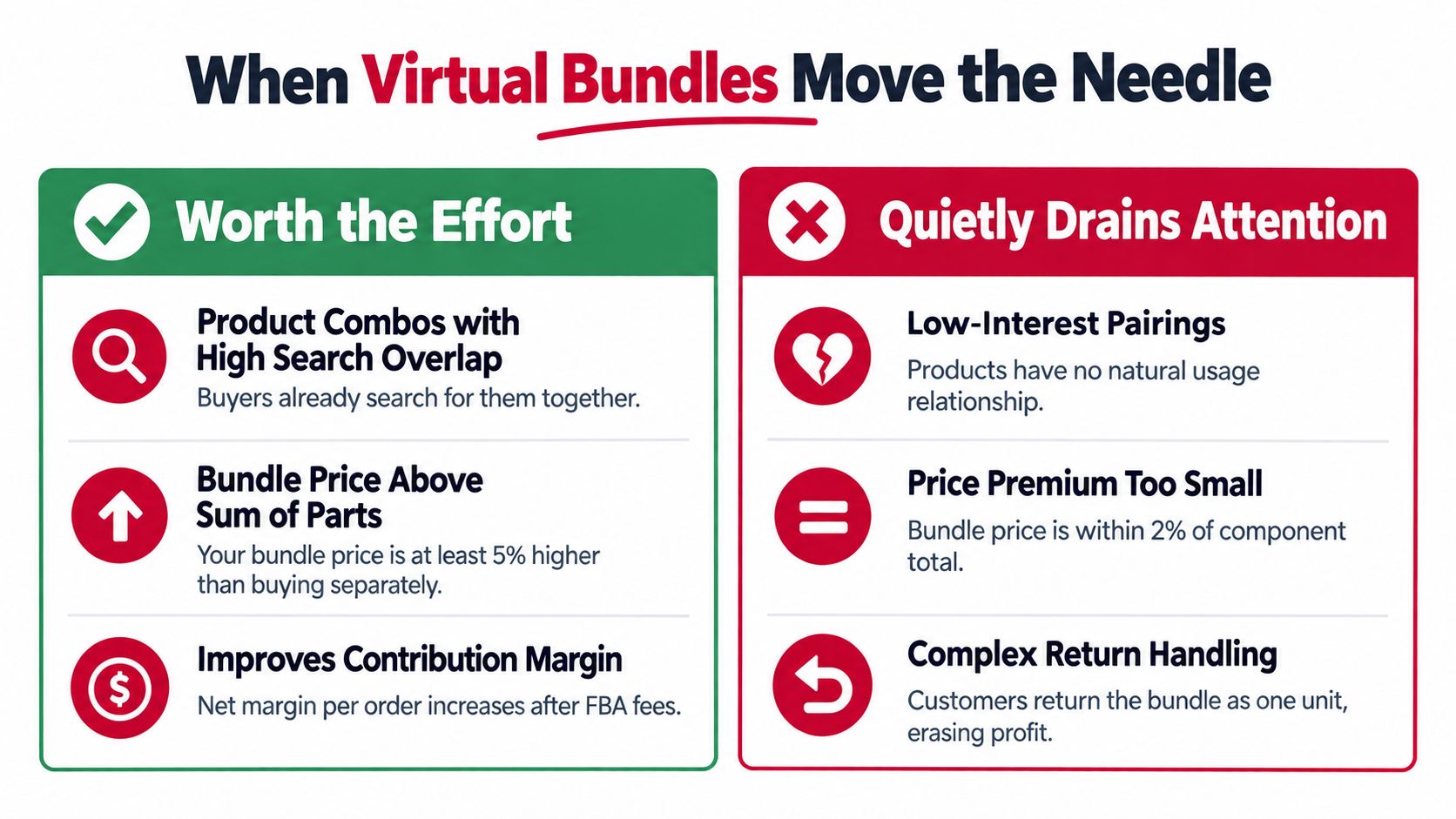
A virtual bundle should earn its place by solving a defined commercial problem. The strongest candidates pair adjacent products for the same audience and give customers a clear reason to buy them together. A cleanser and moisturizer can support one routine. A pantry staple paired with an unrelated accessory needs a stronger use case and will usually demand more explanation, content, and advertising.
Price architecture determines whether the extra order value helps or hurts. A discount that consumes too much gross profit turns a larger basket into a larger low-margin transaction. Set the price too close to the combined component total, and customers have little reason to change their buying behavior. Model the offer against contribution margin before building the listing.
Judge the order, not the listing. Start with bundle revenue, then subtract product costs, Amazon referral and fulfillment charges, promotional discounts, advertising cost, and expected customer-service or return burden. Compare the remaining contribution margin with the margin from the same customer buying the component products separately.
Bundle reporting can distribute sales through component ASINs rather than giving the bundle a complete view in standard Seller Central reporting. Amazon also provides a weekly email report covering bundle activity and total units sold. Treat that report as a reconciliation input, not as a substitute for an order-level profit model.
The test needs a defined review window. Reconcile bundle orders with component inventory movement, separate organic demand from sponsored demand, and record advertising and promotional costs against the bundle order. A higher average order value does not prove that the offer is profitable.
Test a bundle when:
Skip the test when the products lack a natural connection, the discount does all the selling, or the team cannot reconcile performance. A bundle also becomes a poor use of operating attention when the core ASINs have unresolved pricing, content, or availability problems.
Listing quality still affects conversion, so review Amazon product listing optimization guidance alongside the financial model. Stronger content can clarify the use case and improve the offer's presentation. It cannot rescue an order that fails the margin gate.
A virtual bundle can look profitable while the reporting hides the operational cost. Amazon may route bundle sales through the component ASINs, while the bundle-level total arrives through a weekly email report instead of appearing fully in standard Seller Central views. That split makes the listing an incomplete source of truth.
Reconciliation then becomes a manual finance task. The finance owner sees component movement, the advertising owner sees campaign results, and the marketplace manager sees a separate bundle listing. Unless one person joins those views, the team can overstate bundle demand, misread contribution margin, or miss the inventory consumed by each order.
A shopper may discover the bundle through an ad and later buy one component. Another shopper may purchase a component first and choose the bundle later. The brand needs a consistent method for assigning revenue, product cost, advertising cost, and inventory consumption across those paths.
ACOS can become misleading. Advertising spend may sit with the bundle campaign while sales appear in component reporting, making campaign efficiency look better or worse than the actual order economics. Judge the bundle at the order level, then maintain a separate reconciliation file or reporting view that connects the bundle, components, spend, and inventory movement.
That work affects decisions about replenishment and advertising, not just month-end reporting.
The detail page presents one combined purchase, but Amazon fulfills the components through the existing FBA process. Each item is picked and packed separately, so the customer experience may not match a physical kit. Packaging, arrival timing, and item presentation can differ from what the hero image implies.
The operational risk isn't only a fee. It's a mismatch between the promise on the detail page and the order the customer receives.
Inventory creates another constraint. The bundle depends on every included component, so a slow-moving item can take the offer offline while the faster item continues selling independently. Customer questions, substitutions, damaged components, and returns also require handling across a combined offer. The virtual listing does not create one warehouse unit or one simple service workflow.
Before launch, review the FBA fulfillment fee guidance and map the handling economics for every component. Virtual setup removes physical kitting work. It does not remove FBA fees, inventory dependencies, reconciliation work, or the need to understand how each item in the order is fulfilled.
Virtual bundles belong in the Amplification stage of a disciplined marketplace plan. They shouldn't carry the burden of fixing a weak Foundation. If the core ASIN has poor conversion, unstable availability, unclear positioning, or negative contribution margin, adding a bundle usually spreads the problem across another listing.
RedDog's growth framework starts with Foundation, moves through Optimization, and then uses Amplification to expand what already works. For virtual bundles, that sequence means:
Test combinations that solve a clear customer need. Set a margin hurdle before launch. Track bundle orders, component depletion, advertising cost, discounts, returns, and availability together. If the bundle lifts order value but lowers contribution margin, it isn't a growth win.
Virtual bundles are useful because they let brands test demand without committing to new physical inventory. They're dangerous when teams mistake low setup effort for low operating cost. Use the feature to gather evidence, protect cash, and identify combinations worth deeper investment.
Reddog Consulting Group helps CPG founders and operators review marketplace performance, contribution margin, inventory pressure, and growth planning across Amazon and other retail channels. Book a free 30-minute strategy call with Reddog Consulting Group to work through whether virtual bundles can improve your economics, or whether your assortment needs a different path.
Leave a comment: