
Published: March 2020 | Last Updated:September 2026
© Copyright 2026, Reddog Consulting Group.

A CPG founder sees the same pattern every month. FBA fees rise, a fast-selling variant approaches a stockout, and the team starts asking whether FBM would save enough money to justify the operational burden. The spreadsheet usually compares Amazon's fulfillment fee with a carrier quote, then stops before accounting for conversion, advertising, inbound placement, or the cash tied up in inventory.
That approach can produce the wrong answer.
Amazon FBA vs FBM is a contribution margin decision, not a preference about who puts the product in a box. The choice affects fulfillment expense, storage exposure, Prime eligibility, Buy Box performance, advertising efficiency, replenishment risk, and working capital. A model that looks cheaper per unit can still produce less profit if it converts poorly or forces the brand to carry too much operational complexity.
FBA is the dominant model in Amazon's third-party seller ecosystem. A widely cited seller survey found that 82% of sellers use FBA in some capacity, while 34% use FBM. The same breakdown showed 64% use FBA only, 14% use both models, and 22% use FBM only (Jungle Scout's FBA and FBM comparison). FBM remains meaningful because some products don't fit Amazon's cost and handling structure.
Consider a compact, replenishable snack or personal-care SKU. FBA may add fulfillment and storage charges, but Prime access can support stronger conversion and faster sell-through. Now compare that with a bulky seasonal bundle. Amazon storage and fulfillment can consume margin while the inventory sits, making merchant fulfillment more attractive even if the seller has to manage carrier and warehouse costs.
The right question is not, “Which model has the lower fulfillment fee?” It's, “Which model produces the stronger contribution margin after the complete cost stack and the operational consequences?”
This is especially important for brands building an Amazon channel alongside DTC, wholesale, Walmart, or distribution. The economics of selling on Amazon only become clear when marketplace revenue is evaluated against the cash and labor required to support it.
A practical operator works in sequence. Foundation means clean catalog data, reliable costs, inventory visibility, and accurate fee assumptions. Optimization means choosing FBA, FBM, or a hybrid by SKU and improving conversion without sacrificing margin. Amplification means scaling advertising, assortment, and channels only after the economics hold under pressure.
FBA and FBM assign responsibility to different parties. That sounds straightforward, but the distinction affects the entire customer experience.
With Fulfillment by Amazon, the seller sends inventory into Amazon's network. Amazon stores the units, picks and packs orders, ships them, and processes customer service and returns for that inventory. The merchant gives up some direct control in exchange for a standardized fulfillment system that can support Prime eligibility automatically.
With Fulfilled by Merchant, the seller, warehouse, or third-party logistics partner stores the inventory and manages the order cycle. That includes pick and pack, packaging, carrier selection, shipment tracking, returns, and the service processes attached to the order. FBM gives the brand more control, but it also makes the brand accountable for execution on every shipment.
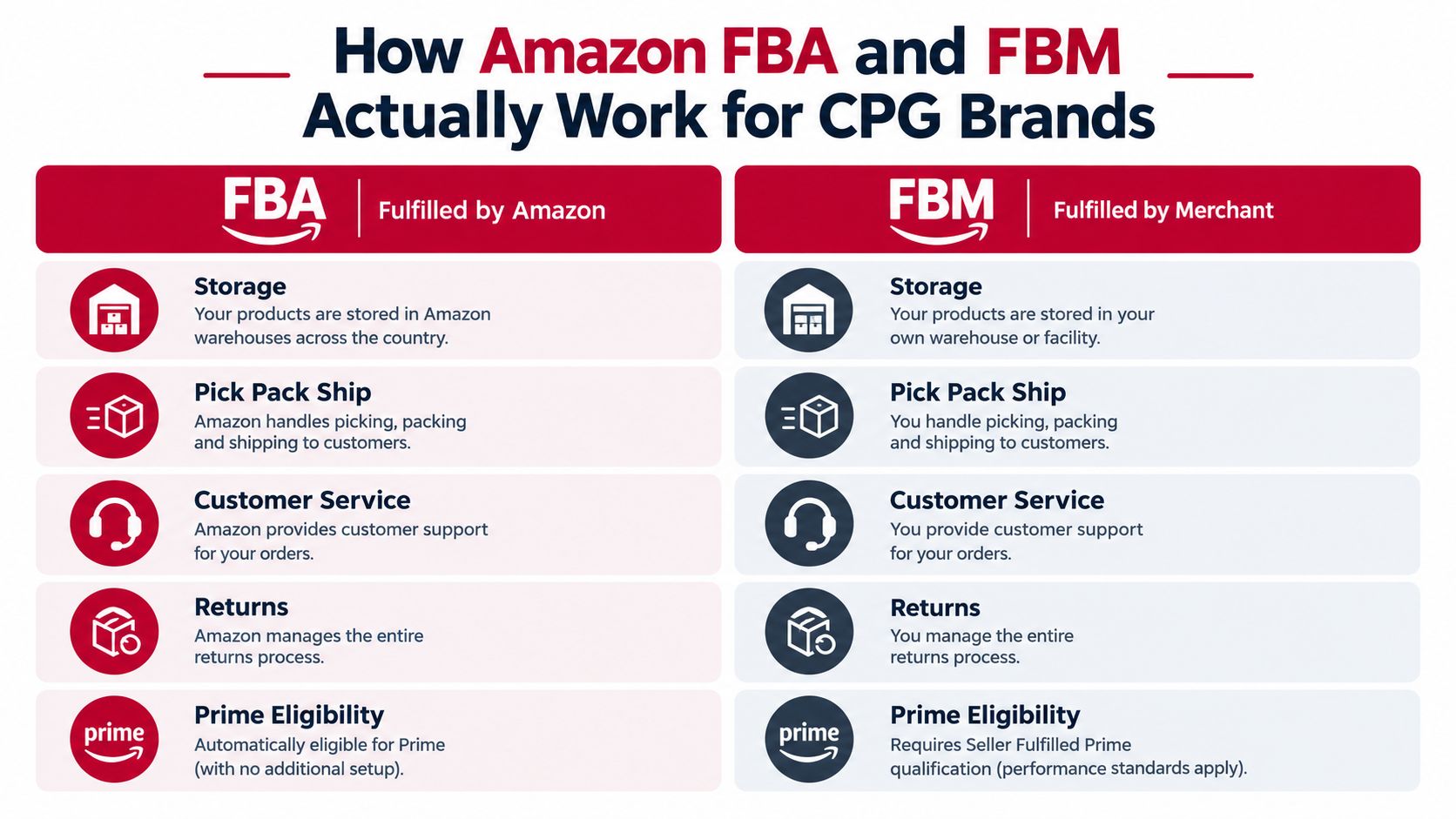
FBA works well when a CPG team wants to concentrate on merchandising, retail readiness, pricing, and demand generation instead of running warehouse workflows. It's particularly practical for standardized, compact products with dependable demand and packaging that can withstand Amazon's handling requirements.
FBM becomes more useful when the product needs special handling, branded packaging, custom inserts, lot control, or a delivery process the brand already operates efficiently. It can also protect margin for products whose dimensional footprint or slow sell-through makes Amazon storage expensive.
Prime is the major operational difference. FBA listings receive automatic Prime eligibility. Standard FBM listings don't, unless the seller qualifies for Seller Fulfilled Prime, which requires the merchant to meet Amazon's performance requirements. That program can bridge control and speed, but it demands reliable inventory, warehouse processes, carrier performance, and order discipline.
The Foundation stage matters. Before switching a catalog to FBM, document the actual workflow. Who releases orders? Who handles late scans? Who approves replacements? Who processes returns? If those answers aren't clear, the apparent fulfillment savings may move into labor, customer service, and account-health risk.
A useful overview of the Seller Fulfilled Prime operating model can help teams assess whether their infrastructure is ready rather than treating SFP as a shortcut.
FBA is convenience with less control. FBM is control with more responsibility. Neither model is automatically scalable. Scalability depends on whether the operating system can maintain service quality as order volume, SKU count, and promotional demand increase.
Both FBA and FBM share Amazon's referral fee. The economics separate after that point.
FBA adds Amazon fulfillment fees and ongoing storage fees. For standard-size products, 2026 fee guides cite FBA fulfillment costs at roughly $2.43 to $6.12 or more per unit, depending on size and weight, with storage around $0.78 to $2.40 per cubic foot per month (2026 FBA and FBM fee comparison). FBM avoids those Amazon fulfillment and storage charges, but the seller pays for warehouse space, pick-pack labor, packaging, shipping, and returns elsewhere.
A $25 item makes the issue easier to see. One 2026 comparison estimated FBA at about $7.50 to $8.20 all-in before advertising, versus FBM at about $5.80 to $7.10 on the same item (2026 Amazon fulfillment comparison). Those ranges aren't universal quotes. They're decision inputs that show why the seller's own cost model matters.
| Cost Component | FBA Estimate | FBM Estimate |
|---|---|---|
| Amazon referral fee | Shared by both models | Shared by both models |
| Fulfillment or shipping | Included in FBA estimate, driven by size and weight | Included in FBM estimate, driven by carrier and service level |
| Storage | Amazon storage charges apply | Seller or 3PL warehouse cost applies |
| Pick, pack, and packaging | Included in Amazon fulfillment structure | Seller absorbs labor and packaging |
| Inbound placement | May apply based on shipment strategy | Not an Amazon FBA placement charge |
| Returns handling | Amazon manages the process | Seller or 3PL manages the process |
| Total before advertising | About $7.50 to $8.20 in the cited $25-item comparison | About $5.80 to $7.10 in the cited $25-item comparison |
The table doesn't establish a winner. It establishes where the winner is decided.
A compact SKU with strong velocity can justify FBA because inventory turns quickly and the fulfillment network supports customer expectations. A bulky, slow-moving, or low-margin SKU can favor FBM because storage and dimensional costs dominate. In one comparison, FBA was estimated to save about $5.24 on a mid-size 6-pound product, demonstrating how size and weight can reverse the result (FBA and FBM cost comparison).
The margin model should include product cost, referral fee, fulfillment, storage, inbound freight, inbound placement, prep, returns, discounts, and advertising. Use contribution margin before overhead as the operating score. A cheap fulfillment line means little if the listing needs more advertising to compensate for weaker conversion.
For a broader view of Amazon fulfillment costs, build the model at the SKU level instead of applying one blended rate to the entire catalog.
For a CPG SKU, fulfillment speed is a contribution-margin decision. FBA listings receive automatic Prime eligibility, while FBM listings need Seller Fulfilled Prime qualification to offer comparable access. That difference can change detail-page conversion, delivery confidence, and Buy Box participation. The question is whether the added orders generate enough contribution profit to cover FBA's higher fulfillment cost.
The Prime badge is valuable only when the incremental orders produce more contribution profit than the incremental fulfillment cost.
Independent 2026 analyses reported that Prime-eligible FBA listings outperformed non-Prime FBM offers by about 15% to 23% in conversion in competitive categories. The same SellerSprite's 2026 FBA and FBM analysis cited another analysis of 50,000 orders, where FBA conversion was 18.7% versus 8.9% for FBM, with FBA converting about 2.1 times higher despite costing 23% more. Treat these findings as directional. Category, price, reviews, delivery promise, and listing quality can change the result.
Start with contribution profit from one incremental order. If a $25 product retains a healthy margin after product cost, Amazon fees, fulfillment, and advertising, a Prime-driven conversion lift may support FBA. If the SKU is already near break-even at its current advertising efficiency, added volume will not repair weak unit economics.
Model four variables:
A seller may accept a higher landed cost when Prime access improves both session-to-order conversion and Buy Box participation. FBM can produce better economics when a capable 3PL maintains delivery reliability, inventory control, and Seller Fulfilled Prime fulfillment without surrendering marketplace performance.
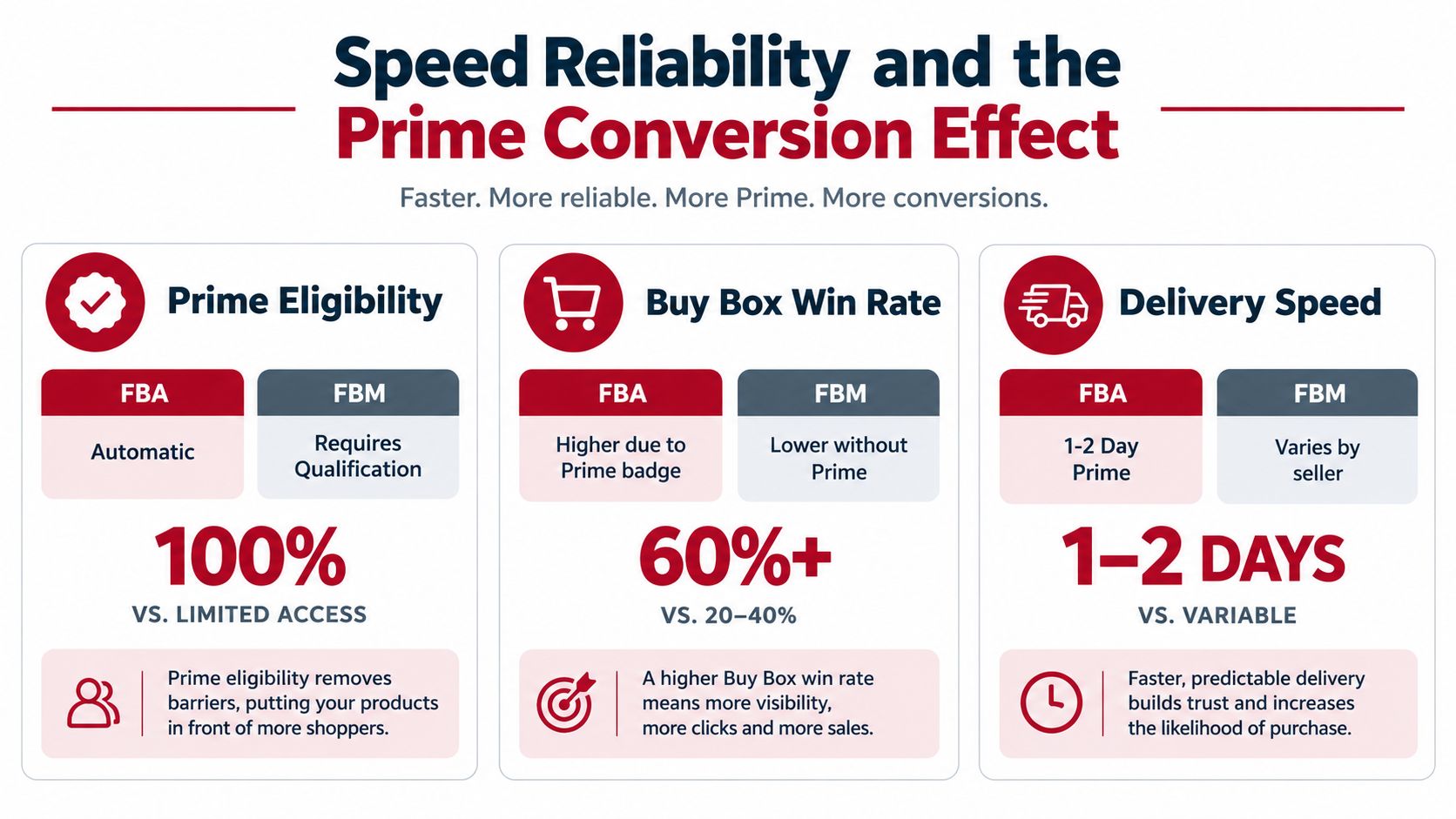
Track conversion and contribution together. A higher conversion rate is not automatically profitable when the SKU has thin gross margin, high returns, expensive replenishment, or working capital tied up in FBA inventory.
A SKU can look profitable in a static spreadsheet, then lose contribution margin through stockouts, low inventory fees, or inbound placement costs. For FBA, replenishment timing, child-level availability, and shipment design belong in the margin model. FBM removes some Amazon charges, but shifts the exposure to warehouse stock, labor, carrier capacity, and service reliability.
Amazon's 2026 low-inventory-level fee applies when both the trailing 30-day and 90-day historical days of supply are below 28 days. Amazon measures this at the seller FNSKU level, not the parent ASIN level, and the fee ranges from $0.32 to $1.11 per standard-size unit and can reach $2.09 per Large Bulky unit, depending on days of supply and size tier (Amazon's low-inventory-level fee guidance). A parent listing may have ample stock while one flavor, size, or pack configuration runs thin and incurs the charge.
Inventory reviews often stop at the parent ASIN. Customers purchase individual child listings, so a stockout on the leading flavor or size can redirect demand, weaken the catalog's retail presence, and create fee exposure while slower variants remain available.
Review each FNSKU's days of supply, inbound units, forecasted velocity, and promotional calendar. A blended catalog average can hide the exact variant that will run short during a demand spike.
Inventory software can compare demand, purchase orders, warehouse stock, and marketplace availability. Brands evaluating tools should choose inventory management with Wistec according to the decisions the team must make, rather than adding another dashboard that does not change replenishment action.
Amazon's 2026 inbound placement service fee also changes the unit economics. Seller Central states that the average increase for standard-size products is $0.05 per unit. For Large Bulky products using the minimal splits option, the average increase is $0.27 per unit, while optimized shipment splits still carry no fee (Amazon's inbound placement fee guidance).
Shipment design therefore affects landed cost. A cheaper operational route may carry a higher placement charge, while optimized splits may require more preparation and coordination. Model inbound freight, carton configuration, prep, placement, and timing at the SKU level. A small per-unit change can matter when velocity is high or margin is thin.
Inventory planning isn't separate from profitability. It decides whether the fulfillment model earns the margin shown in the original forecast.
FBA concentrates risk in Amazon's fee structure and replenishment requirements. FBM avoids these specific FBA charges, but the seller still funds warehouse inventory, labor, shipping capacity, and the cost of inaccurate demand planning.
There isn't one winning model for an entire catalog. The right answer often changes by SKU, package size, demand pattern, and operational capability.
A lightweight, standardized CPG product with steady demand is usually a strong FBA candidate. Amazon can handle repetitive fulfillment while Prime access supports the buying experience. This is the type of SKU that fits the Foundation stage once costs, packaging, replenishment, and listing data are reliable.
The risk is margin blindness. If the product sells quickly but leaves little contribution after fulfillment and advertising, velocity is hiding a weak economic model. FBA makes sense only when the added conversion and operational simplicity justify the full cost.
Large multipacks, oversized household goods, and seasonal bundles often deserve an FBM review first. Amazon storage and fulfillment can become disproportionate when the product occupies space or moves irregularly. A seller with an efficient warehouse or 3PL may preserve more contribution by shipping these orders directly.
That decision requires reliable service. If the warehouse can't maintain delivery promises, the seller may lose the conversion advantage that made Amazon attractive in the first place.
Fragile products can favor FBM when packaging requires careful handling or when damage claims are expensive. Direct control lets the brand choose protective materials, inspect orders, and manage presentation more closely. The trade-off is that the seller owns the operational outcome, including returns and replacements.
A capable 3PL can make FBM viable, but the brand should validate accuracy, carrier performance, packaging consistency, and escalation procedures before moving meaningful volume.

Made-to-order goods, personalized products, and low-volume seasonal items generally need more control over timing and inventory. FBM lets the seller align production with demand instead of committing finished units to Amazon's network.
The same logic applies to products with unusual presentation requirements. If the unboxing experience, inserts, lot handling, or bundle assembly matters, merchant fulfillment may protect the brand experience more effectively.
For a low-margin SKU, small cost changes can erase contribution. Compare the FBA and FBM landed cost, then evaluate the conversion difference. If FBA's Prime advantage doesn't create enough incremental profit, FBM may be the better model even when it requires more management.
Growth-stage brands can also use a hybrid approach. Keep fast-moving core SKUs in FBA, test FBM for bulky or slow variants, and consider Seller Fulfilled Prime only when the operation can meet its requirements. That is Optimization by SKU, not a forced decision for the entire catalog.
Use a SKU-level contribution model before changing fulfillment. The calculation should begin with selling price and subtract product cost, referral fee, fulfillment or shipping, packaging, storage, inbound freight, inbound placement, returns, discounts, and advertising. The remaining contribution margin is the number that should guide the decision.
Then pressure-test the model against operating conditions:
Stay with FBA when the SKU is compact, fast-moving, operationally standardized, and materially benefits from Prime. Choose FBM when the product is bulky, fragile, customized, slow-moving, or better handled through an existing fulfillment operation.
Use a hybrid catalog when the economics differ across products. FBA can support the high-velocity hero items, while FBM protects margin on long-tail, oversized, or presentation-sensitive SKUs. Review the split after meaningful changes in price, advertising, velocity, packaging, or Amazon fees.
The sequence matters. Build the Foundation with accurate costs, catalog structure, inventory controls, and operational ownership. Move into Optimization by testing fulfillment and improving conversion at the SKU level. Use Amplification only after the contribution margin remains healthy through promotions, replenishment pressure, and fee changes.
For qualified CPG founders and operators, Reddog Consulting Group offers a free 30-minute strategy call focused on Amazon margin, marketplace performance, and growth planning. Visit Reddog Consulting Group to schedule a working session and review whether FBA, FBM, or a hybrid structure best supports your catalog.
Leave a comment: