
Published: March 2020 | Last Updated:July 2026
© Copyright 2026, Reddog Consulting Group.

Product bundling is the deliberate offer design that sells two or more SKUs together as a single purchase, typically at a combined price that feels like a deal to the buyer. For CPG brands, it is a growth lever when the math is built around contribution dollars per order — and a margin trap when it is built around AOV alone.
Three signals that a bundle is worth testing right now:
The primary goals of a well-designed bundle are to increase contribution dollars per order, improve attach rate, accelerate inventory velocity, and create a natural on-ramp to subscription or repeat purchase. AOV is a useful headline number, but it tells you nothing about what the order actually contributed to profit after COGS, fulfillment, fees, and returns.
Bundles typically raise AOV (average order value) by roughly 15–35% in DTC and CPG when designed correctly, but a practitioner analysis shows a bundle can lift AOV while leaving contribution per order flat if the discount is too deep. The correct scorecard is contribution dollars per order, post all variable costs. Measurable outcomes operators typically track include AOV lift, attach rate (target: 20%+ of orders), subscription conversion from variety packs, and sell-through rate on slow-moving SKUs.
Bundle formats are not interchangeable across channels. Fulfillment structure, listing constraints, and margin compression differ enough that the wrong format on the wrong channel destroys the contribution math before a single unit ships.
Common bundle formats:
Channel fit in brief: DTC handles build-a-box and variety packs well because you control the page and the fulfillment. Amazon FBA works for pre-kitted starter kits and replenishment multipacks, but listing rules require a GTIN for every bundle SKU and virtual bundles are only available to brand-registered sellers. Walmart WFS margin compression makes deep-discount bundles risky; shallow-discount replenishment packs tend to hold contribution better. Retail and wholesale buyers want clean pack sizes, EDI-compliant labeling, and predictable case pack counts — seasonal gift sets and variety packs with strong shelf presence are the formats that earn placement.
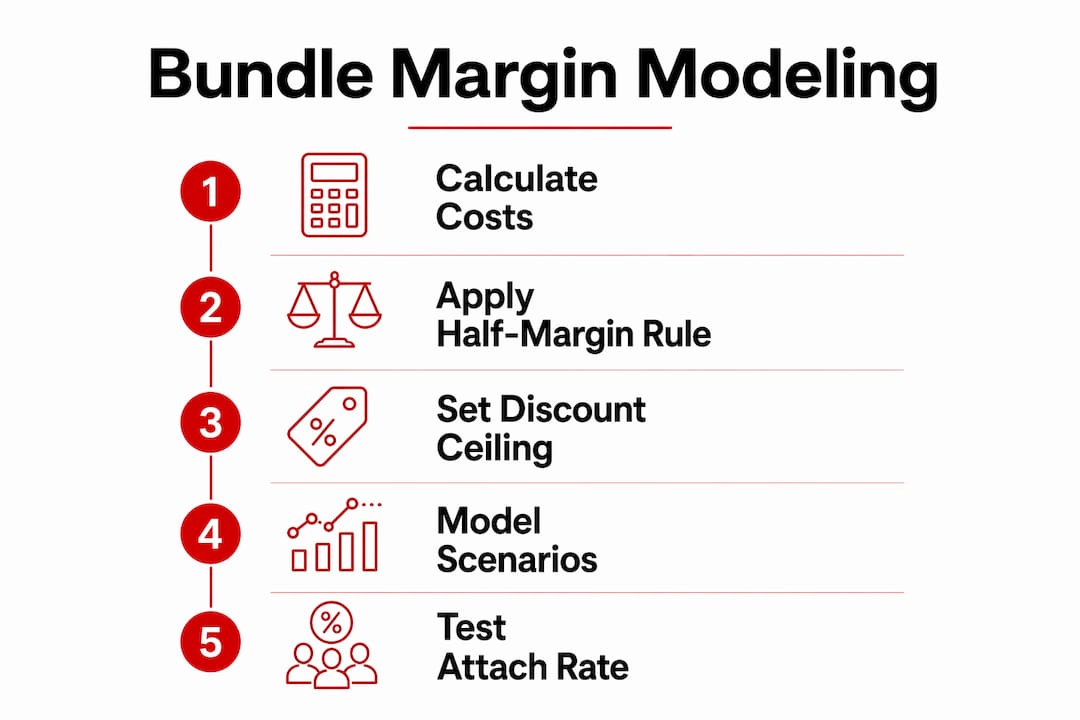
Model for contribution dollars per order. Gross margin alone is insufficient because it ignores fulfillment costs, marketplace fees, payment processing, and return rate changes that bundles often trigger.
Step-by-step inputs:
The Half-Margin Rule sets your discount ceiling: never discount more than 50% of your gross margin percentage. With a 40% gross margin, the maximum bundle discount is 20%. For brands under 50% gross margin, keep discounts in the 5–10% range to protect contribution.
The worked example below shows a 3-SKU bundle at three discount levels. The 10–15% discount range preserves most of the contribution lift; discounts past 20% typically give the win back to the buyer.
| Scenario | Bundle Revenue | Blended COGS | Fulfillment + Fees | Contribution $ | vs. Single-Item |
|---|---|---|---|---|---|
| No discount | $48.00 | $18.00 | $12.00 | $18.00 | +$4.50 |
| 10% discount | $43.20 | $18.00 | $12.00 | $13.20 | +$1.50 |
| 20% discount | $38.40 | $18.00 | $12.00 | $8.40 | –$1.10 |
(Assumes $16/order blended contribution on equivalent single-item sales. Fulfillment includes FBA fee estimate and 2.5% payment fee.)
Pro Tip: Test attach rate before deepening the discount. A 10% discount with a 25% attach rate almost always outperforms a 25% discount with a 10% attach rate — and it protects your full-price perception.
Getting the bundle live without margin leaks requires clean execution across SKU selection, fulfillment, catalog setup, and logistics.
Pro Tip: Run a dim-weight check on your proposed bundle box before finalizing packaging. A box that triggers a higher FBA size tier can cost $2–4 more per unit in fees — enough to flip a marginal bundle from profitable to breakeven.
Run a controlled test for 30–90 days depending on your traffic volume. Limit the initial rollout geographically or to a single channel so you can isolate the signal. For bundle attach rate improvement, test placement on the product page, cart, and post-purchase upsell separately.
Mandatory KPIs:
| KPI | Pass Threshold | Red Flag |
|---|---|---|
| Attach rate | ≥20% of orders | <10% after 60 days |
| Contribution $ per order | ≥ single-item baseline | Below single-item baseline |
| Repeat-customer cannibalization | <30% of bundle buyers | >30% were prior full-price buyers |
| Subscription conversion | >25% for variety packs | <15% after 90 days |
| Sell-through (slow SKU) | >60% in 90 days | <40% — bundle not moving it |
If more than 30% of bundle buyers are existing customers who previously bought at full price, you are cannibalizing profitable sales, not generating incremental revenue.
The most common failure modes are margin erosion from variable cost surprises, attracting one-time price shoppers who never return, and creating channel price parity conflicts that anger retail buyers.
Pro Tip: Always model the two-parcel scenario before finalizing contribution math. If the bundle triggers a split shipment on FBA or at your 3PL, recalculate contribution at that cost before you go live.
A beverage brand launches a 4-flavor variety pack at a discount off the sum of individual prices. Blended COGS, fees, and bundle revenue result in higher contribution per order compared to single-flavor orders. Attach rate improves within weeks. Subscription conversion from variety-pack buyers is consistent with ranges seen across well-run CPG brands. The bundle adds contribution dollars and seeds the subscription funnel simultaneously.
A personal care brand bundles a hero SKU with a slow-mover at a combined deep discount to clear inventory. Blended COGS, fulfillment, and fees result in substantially lower contribution per order compared to single-item sales. A significant portion of bundle buyers are existing customers who previously bought the hero at full price, indicating high cannibalization. AOV appears higher — typically rising by 15–35% — but contribution is nearly gone.
| Scenario A (Variety Pack) | Scenario B (Deep Discount) | |
|---|---|---|
| Bundle revenue | $35.20 | $29.00 |
| Blended COGS | $9.60 | $14.00 |
| Fulfillment + fees | $10.80 | $13.50 |
| Contribution $ | $14.80 | $1.50 |
| Attach rate | 28% | 19% |
| Cannibalization rate | 14% | 38% |
Contribution dollars per order, not AOV, is the only metric that tells you whether a bundle is actually working for your business.
| Point | Details |
|---|---|
| Model contribution first | Calculate blended COGS, fulfillment, and fees before setting any bundle price or discount. |
| Apply the Half-Margin Rule | Cap your bundle discount at 50% of your gross margin percentage; under 50% margin, stay in the 5–10% discount range. |
| Watch the cannibalization threshold | If more than 30% of bundle buyers were prior full-price buyers, pull back or restructure the offer. |
| Test attach rate before scaling | Hit 20%+ attach rate in a 30–90 day test before committing to pre-kitted inventory or deeper discounts. |
| Reddog’s approach | Reddog models contribution math and channel economics for CPG brands before any bundle goes live, preventing margin leaks at the design stage. |
Most brands we see come to bundling from the wrong direction. They see a competitor running a bundle, or a Shopify app suggests “frequently bought together,” and they launch without ever modeling what the bundle actually contributes after fees. The result is an AOV number that looks good in a dashboard and a margin that quietly deteriorates.
The brands that get bundling right treat it as value architecture, not a discount mechanism. They pair a high-margin hero with a lower-velocity SKU, set a shallow discount that respects the Half-Margin Rule, and measure attach rate and contribution dollars from day one. They also think about the channel before they think about the product — because a bundle that works on DTC can destroy margin on Amazon FBA if the box dimensions trigger a higher size tier.
For brands in the $500K–$20M range, the biggest risk is not that bundling fails. It is that bundling appears to succeed on the wrong metric while margin quietly erodes. The contribution-margin-first approach to pricing that Reddog applies to every channel engagement is the same framework that makes bundles either worth scaling or worth stopping early.
Reddog works with CPG founders and operators who want to know exactly what each channel and each SKU configuration contributes to profit — before they commit inventory, packaging, or ad spend to a bundle that may not hold margin.
A free 30-minute strategy call with Reddog covers the contribution math behind your current or planned bundles, channel economics across Amazon, Walmart, DTC, and retail, and inventory velocity flags that signal where bundling can genuinely help. We work with brands typically in the $500K–$20M range that need structured analysis, not generic tactics.
If you are ready for a practical review of your bundle economics, book your strategy call and we will show you exactly where the margin opportunity sits — and where the traps are hiding.
Leave a comment: