
Published: March 2020 | Last Updated:October 2026
© Copyright 2026, Reddog Consulting Group.

A procurement buyer asks for a business price, and the instinct is familiar: open Seller Central, apply a discount that looks competitive, and wait for larger orders. The problem appears later, in the margin report. Referral fees, FBA fulfillment, storage, advertising, freight, and channel costs have turned an apparently attractive Amazon Business order into a weak contribution event.
That's why Amazon for Business pricing shouldn't be treated as a simple discount setting. For a CPG brand, it's a decision about contribution margin, fee eligibility, inventory velocity, pack architecture, and channel discipline. The right price is usually not the lowest price a buyer will accept. It's the smallest concession that creates useful business demand while preserving the economics needed to keep the SKU in stock and profitable.
A mid-stage CPG brand selling cleaning concentrates wanted more procurement orders without changing its consumer list price. The team set an Amazon Business discount that looked commercially reasonable, expecting larger baskets to offset the lower unit price.
Early orders increased. Contribution did not.
The brand had measured the discount against retail price rather than the complete order economics. Referral fees applied to the sale, FBA charged by unit size and weight, storage reduced contribution while inventory remained in fulfillment centers, and advertising still supported the same product detail page. Product cost and inbound freight came out before those marketplace charges. The order looked larger in revenue terms, yet the contribution left after fulfillment was materially thinner.
The same margin leak can affect supplements, snacks, household products, and personal care. Amazon reports that Amazon Business generated more than $60 billion in annualized gross sales, served over 11 million organizations worldwide by April 2023, operated across 11 countries, and was used by 97 of the Fortune 100 companies (Amazon's seller pricing overview). That demand creates opportunity, but volume alone cannot make an unprofitable SKU profitable.
Amazon Business pricing should be approved against contribution margin, not against the discount visible to the buyer. A lower business price reduces revenue per unit immediately. The order only works if purchasing behavior, fulfillment economics, and inventory velocity compensate for that reduction.
Three effects need to be modeled together:
Operator rule: Approve an Amazon Business discount from the contribution margin remaining after every cost attached to the order, not from retail price alone.
The CFO-level question is not whether the brand can offer a business discount. It is what the order contributes after product cost, freight, referral fees, fulfillment, storage, advertising, expected returns, and the opportunity cost of losing another channel sale. That break-even threshold determines whether a business price creates profitable demand or gives away margin on a larger order.
A procurement manager can see two prices for the same SKU, and each serves a different purpose. Treating them as one discount decision is how brands build ladders that look attractive but fail their contribution-margin test.
The first layer is a business-only price. It applies to eligible Amazon Business buyers regardless of order quantity. The second is a quantity discount, which lowers the per-unit price after defined purchase thresholds are reached. Sellers can set tiers as percentage reductions from the business price or as fixed per-unit prices, with up to five quantity thresholds available (Amazon's quantity discount guidance).
A grocery example clarifies the operating logic. A retailer may give a club-card price to an eligible shopper, then offer a separate case price to a restaurant buying enough units to change handling and replenishment economics. The first price is customer-specific. The second is volume-specific. Amazon Business keeps those choices separate, so each should have its own margin rationale.
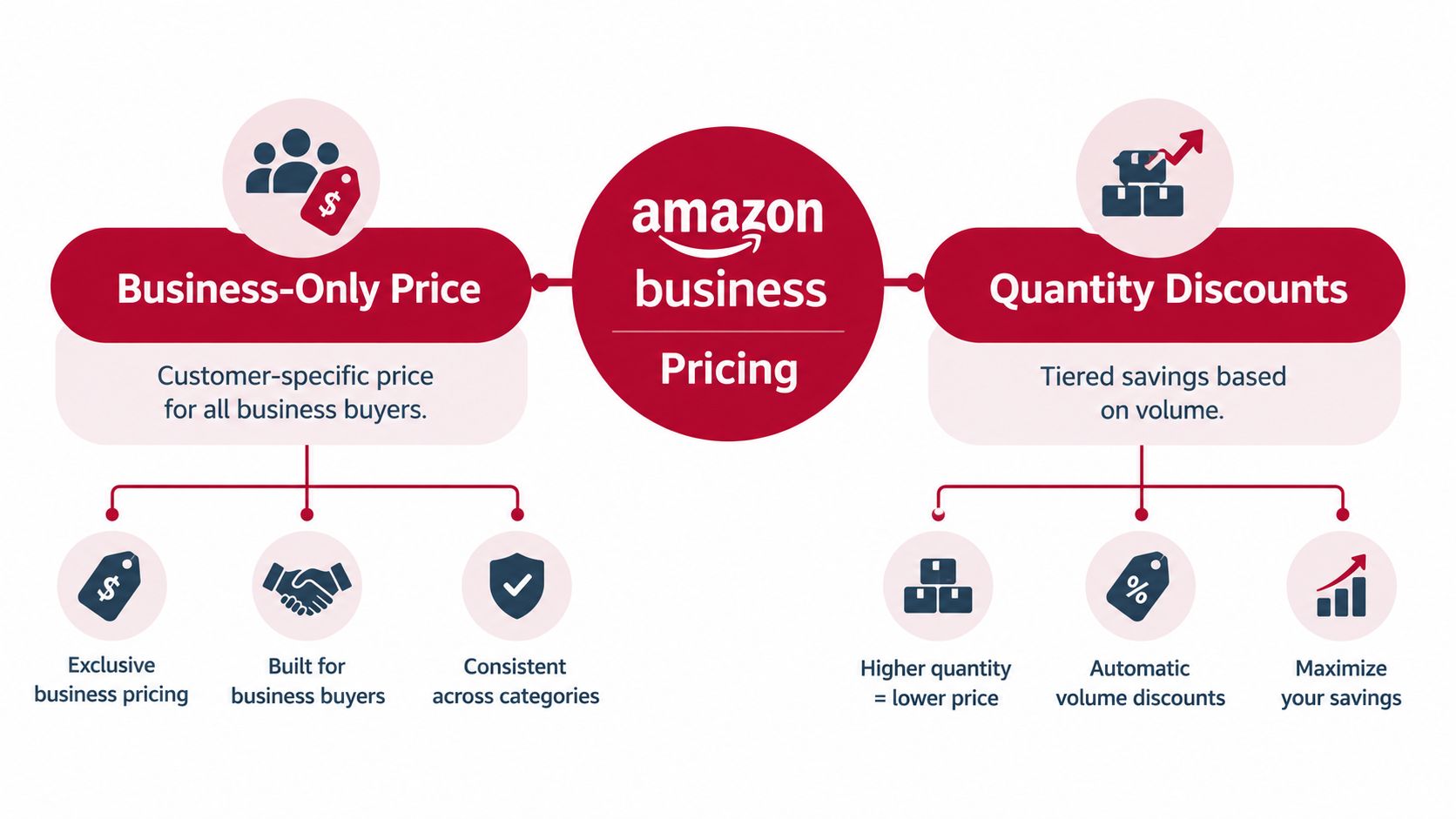
Begin with the standard retail price, then set the business-only price below it. Amazon does not permit the business price to exceed the standard retail price, and the feature is limited to sellers participating in Amazon Business (Amazon's seller guidance).
Only then decide whether additional quantity tiers earn their place. A single-unit business order may need a modest procurement incentive. A larger institutional order can support a lower unit price only when it improves contribution dollars, inventory velocity, or order efficiency enough to offset the concession.
Amazon recommends at least a 2% business-price or quantity discount to improve the likelihood that savings display with a strikethrough price. That improves visibility, not profitability. It also does not establish eligibility for every bulk-order benefit.
Set the first business price close to the lowest contribution margin the SKU can support. Make each deeper tier pay for itself through measurable operational value. A larger order is not automatically a better order if the lower price removes the margin that made the sale worthwhile.
A $40 product does not create $40 of contribution for the brand. Amazon's fee stack can include the selling-plan allocation, category referral fee, fulfillment or shipping cost, storage, and aged-inventory charges. Product cost, packaging, inbound freight, advertising, and expected returns sit outside Amazon's headline deductions, yet they determine whether the order makes money.
Referral fees generally range from 8% to 15%, depending on category, and apply to the total sales price. FBA fulfillment fees are charged per unit based on size and weight. Monthly storage reflects the space used in fulfillment centers. Inventory stored for 181 days or longer may also incur an aged-inventory surcharge, according to Amazon's published seller fee details.
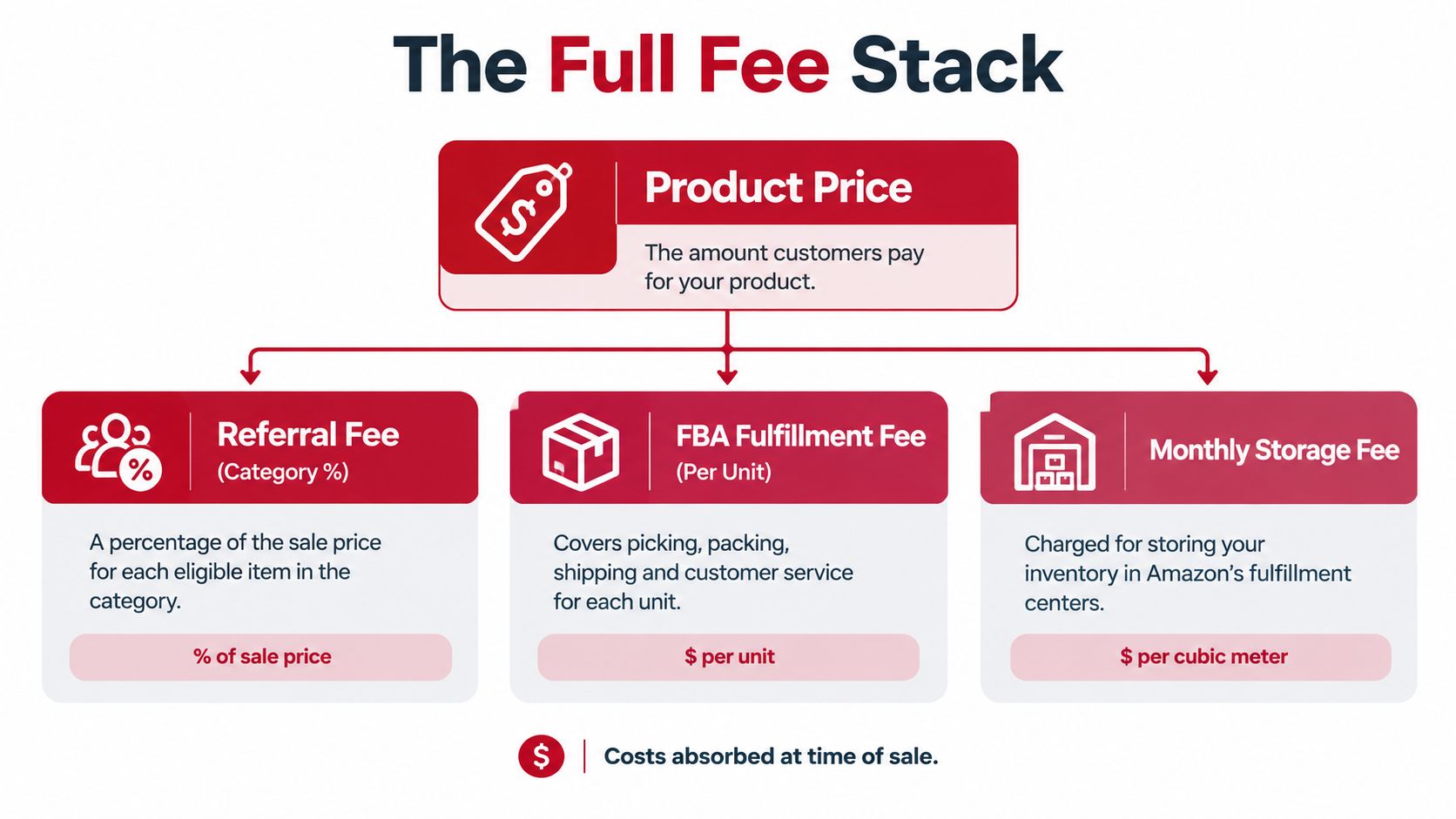
Amazon's published 2026 U.S. fee summary states that FBA fees will rise by an average of $0.08 per unit sold, or less than 0.5% of an average item's selling price, with most changes effective January 15, 2026 (Amazon's 2026 U.S. fee summary).
Portfolio averages can hide pressure on low-priced CPG products. For standard-size products priced between $10 and $50, Amazon reports an average $0.25 per-unit increase for small-standard fulfillment fees and a $0.05 per-unit increase for large-standard products. On a $12 item, a $0.25 increase equals 2.1% of selling price before referral fees or advertising. On a $40 item, the same increase equals 0.6%.
The pricing consequence differs by SKU. A $12 snack, supplement, or cleaning refill may need a different business price from a $40 multipack, even when both receive the same percentage discount.
Build contribution models at SKU level with four layers:
The Amazon selling fee breakdown can help teams map the marketplace deductions, while HireAccountants for ecommerce founders offers a resource for organizing ecommerce bookkeeping and reporting.
A business price works only when the order remains contribution-positive after the full fee stack. A discount that looks attractive on the buying page can still destroy the economics of the sale.
A business buyer orders enough units to clear Amazon's bulk threshold. The seller chooses a 2% discount because it preserves more revenue, then discovers that the order does not qualify for the relevant fee treatment. That small pricing gap becomes a contribution-margin decision, not merely a discount-setting choice.
Amazon's bulk-order guidance associates a 2% discount with the possibility of showing savings through a strikethrough price. The same guidance states that a qualifying Amazon Business purchase must exceed $1,000 in item value for one product, calculated as unit price multiplied by quantity, and that the business price or quantity discount must provide at least 3% savings against the standard price to qualify for the relevant bulk-order fee discount (Amazon's bulk-order fee guidance).
Consider a product with a $40 standard price.
| Order Size | Unit Price at 2% | Unit Price at 3% | Order Gross at 2% | Order Gross at 3% | Bulk-Fee Eligible |
|---|---|---|---|---|---|
| 26 units | $39.20 | $38.80 | $1,019.20 | $1,008.80 | 2%: No, 3%: Yes |
| 100 units | $39.20 | $38.80 | $3,920.00 | $3,880.00 | 2%: No, 3%: Yes |
At 26 units, both prices exceed the $1,000 item-value threshold. Only the 3% price meets the stated discount condition. The 2% price retains more gross revenue per unit and may support savings presentation, but it does not meet the 3% requirement for the fee treatment.
At 100 units, the 3% price gives up $40 in gross revenue compared with the 2% price before fees. The potential fee benefit must therefore exceed that concession after referral and fulfillment costs. Referral fees vary by category and apply to the total sales price, including delivery and gift-wrap charges. Validate the result against the SKU's actual category and fulfillment model, rather than treating the threshold as automatic savings.
Compare contribution under both prices:
Contribution per order = gross sales minus product cost, freight, referral fees, fulfillment, storage allocation, advertising, returns, and other order-specific costs.
Add the potential bulk-fee effect only when the quantity, item value, and discount satisfy the qualification rules. A larger order does not automatically justify a lower price. Heavy products can consume the concession through fulfillment costs, while compact consumables may gain contribution from higher velocity without adding much handling complexity.
Set the smallest discount that accomplishes the commercial objective. If 2% supports business-buyer visibility and fee eligibility is not needed, moving to 3% may reduce contribution. If orders consistently exceed $1,000 and the fee benefit is material, test the 3% price at SKU level and measure the resulting contribution dollars.
A quantity ladder should follow the SKU's contribution economics, pack structure, and operational constraints. Amazon permits up to five quantity thresholds, giving CPG sellers room to keep the single-unit offer viable while reserving larger concessions for orders that reduce handling or improve replenishment value. The threshold count is only useful if each tier earns its place in the margin model.
Take a consumable with a $24.99 standard price and a $23.99 business price. One test structure could use thresholds at 6, 12, 25, and 50 units, producing five price points when the business price serves as the first layer.
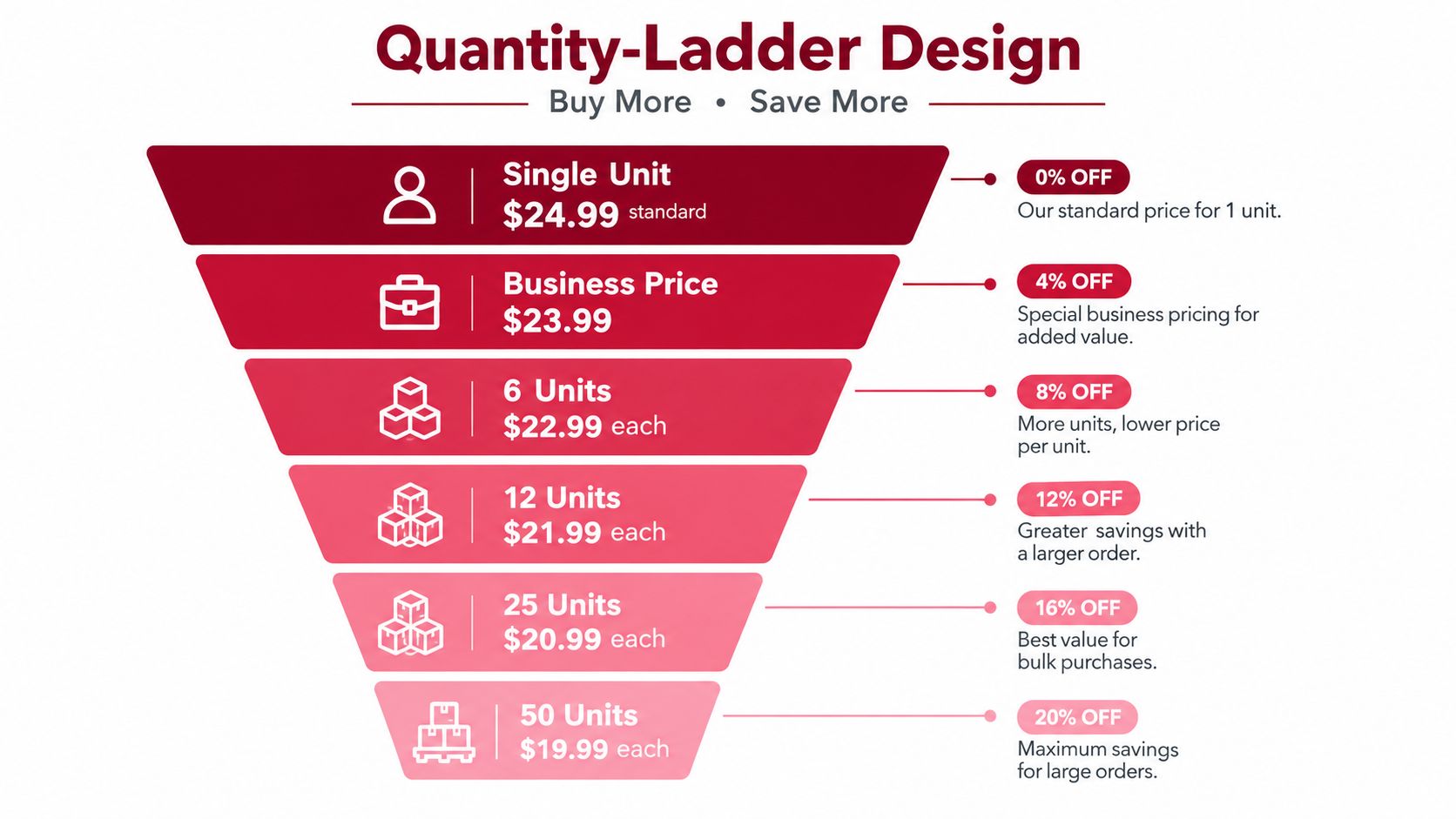
These prices are an example architecture, not a universal recommendation. Calculate contribution margin from the SKU's actual costs, then test whether each tier creates more contribution dollars than the discount gives away.
| Tier | Quantity | Example Unit Price | Contribution Margin Per Order Test |
|---|---|---|---|
| Standard retail | 1 | $24.99 | Establish the consumer baseline |
| Business price | 1 or more | $23.99 | Remain positive after all unit costs |
| Tier one | 6 units | Test a modest reduction | Confirm that added units improve contribution dollars |
| Tier two | 12 units | Test a deeper reduction | Compare with case-pack and replenishment economics |
| Tier three | 25 units | Reserve for stronger volume | Include stockout and inventory allocation risk |
| Tier four | 50 units | Use only with operational justification | Validate fulfillment, freight, and channel impact |
Set the first quantity discount close to the minimum viable business price. Offering the deepest concession immediately conditions buyers to wait for the lowest tier and leaves little room to absorb changes in FBA fees, freight, or advertising costs.
For every threshold, calculate:
A 50-unit order can generate less contribution than a 25-unit order if the price concession exceeds the savings from fewer order events. A 6-unit tier may perform better when it matches the case pack and supports repeatable replenishment. That is the break-even decision to solve before adding another discount level.
For a broader view of unit economics, wholesale terms, and channel positioning, use this wholesale pricing strategy guide alongside the SKU model.
Amazon Business quantity discounts can begin with purchases of as few as two units. Amazon also states that business discounts of 3% or more, combined with orders of two or more units of the same product, can qualify for reduced FBA and referral fees (Amazon's quantity discount buyer guidance).
That changes the operational question. The issue isn't only how much margin to surrender. It's whether the brand should discount two individual units, sell a case-compatible quantity, or reserve deeper pricing for institutional orders.
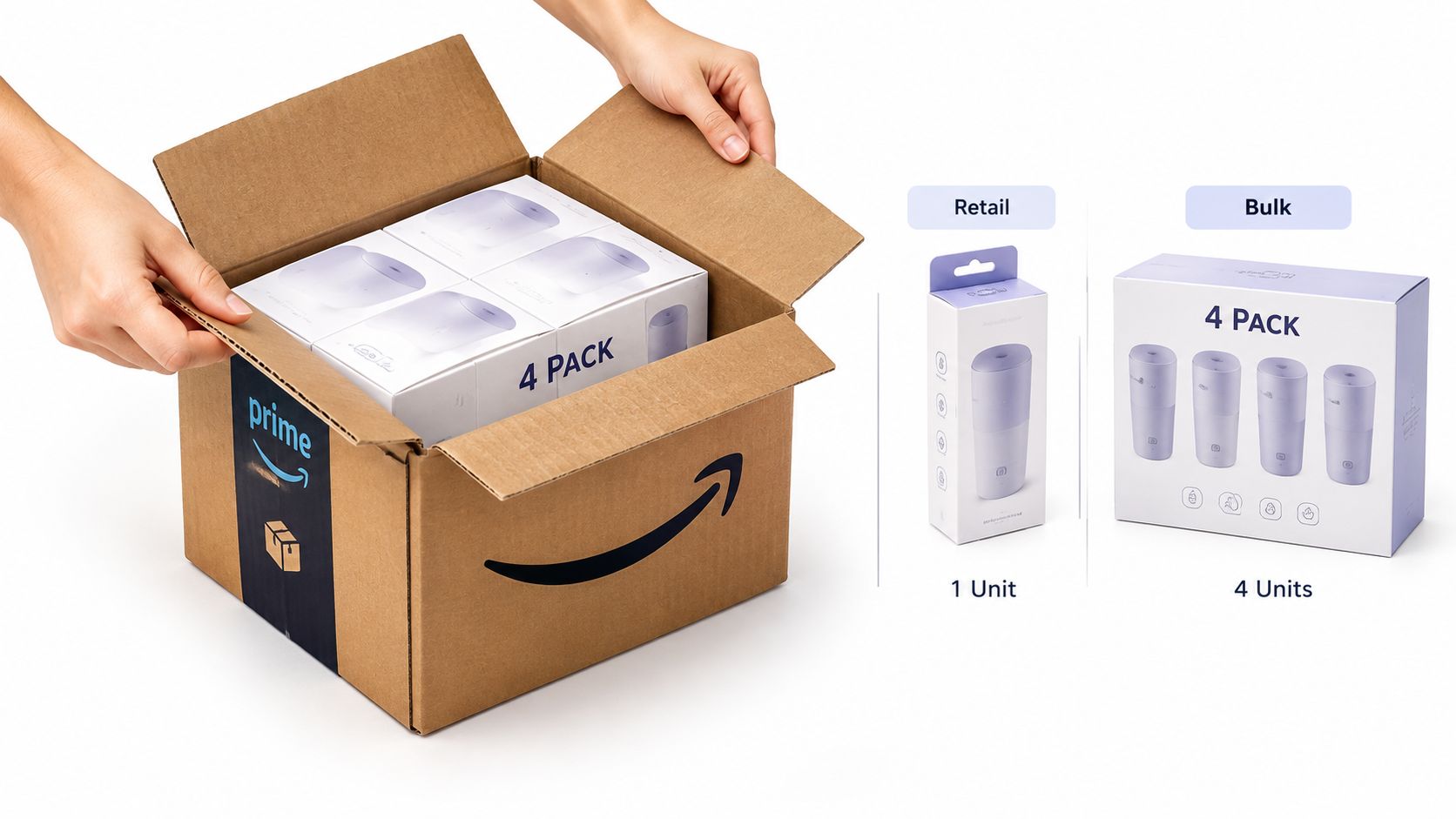
For shelf-stable snacks or supplements, a two-unit starting point may increase basket size without creating much additional operational complexity. The brand can capture more units per order while keeping the threshold accessible to smaller offices, clinics, or hospitality buyers.
Bulky products require a different judgment. A two-unit discount may increase carton usage, handling effort, and shipping exposure without producing enough contribution improvement. A case-pack threshold may be more appropriate if it aligns with the existing warehouse and inbound configuration.
Fragile products add another variable. More units in one order can reduce the number of separate pick-and-pack events, but damage risk can rise if the product isn't packaged for the quantity being sold. A discount ladder that ignores breakage can produce attractive gross sales and unacceptable returns.
Date-sensitive products need even tighter control. A low threshold can improve velocity, but a deep tier may encourage a buyer to take more inventory than the brand can safely rotate. The model should include expiration exposure, lot management, and the risk that a large order creates a later stockout for regular buyers.
Quantity discounts are assortment decisions in disguise. The threshold determines how buyers consume inventory, how the warehouse handles it, and how quickly the brand must replenish.
Before publishing a tier, compare the quantity with the product's case pack, carton dimensions, shelf life, forecasted demand, and stockout risk. If the quantity doesn't fit the physical product, the pricing strategy is incomplete.
Amazon Business pricing can win procurement volume and still damage the broader business. The risk appears when an Amazon Business buyer receives a lower net price than a distributor, wholesale account, or DTC customer with comparable order economics.
The comparison shouldn't stop at unit price. Model contribution by channel using the terms that apply:
A lower Amazon Business price may still be rational if Amazon creates incremental demand that no other channel would capture. It becomes dangerous when an existing wholesale buyer merely switches the purchasing route.
Before setting a new business price, ask:
Channel conflict often begins with a well-intentioned attempt to grow one marketplace. The broader mechanics are covered in this practical guide to what channel conflict means for growing brands.
The decision standard is simple: publish the Amazon Business offer only when its incremental contribution exceeds the contribution and strategic value of the demand it may displace.
Amazon Business pricing works best as an operating system rather than a one-time configuration.
Foundation means building the SKU-level contribution model before setting any discount. Include the Amazon fee stack, product cost, freight, advertising, returns, inventory exposure, and channel opportunity cost. This week, select the highest-volume business-eligible SKUs and calculate the true contribution per order.
Optimization means testing the 2% visibility threshold against the 3% fee-eligibility threshold, then tuning quantity tiers against actual order behavior. Review which quantities buyers purchase, whether the ladder fits case packs, and whether deeper discounts create contribution dollars or merely larger gross orders.
Amplification means using repeatable B2B velocity to make better assortment and channel decisions. Expand only the SKUs that maintain positive contribution, replenish predictably, and avoid damaging wholesale or DTC economics.
Reddog Consulting Group applies this margin-first approach across marketplace performance, pricing, inventory velocity, and growth planning for CPG brands. A working session can focus on your Amazon Business fee stack, discount thresholds, or cross-channel economics.
Reddog Consulting Group offers practical CPG support for Amazon margin analysis, marketplace performance, and channel growth planning. Book a free 30-minute working session with Reddog Consulting Group to review your Amazon Business pricing model and identify the next profitable operating decision.
Leave a comment: