
Published: March 2020 | Last Updated:September 2026
© Copyright 2026, Reddog Consulting Group.

A wholesale order can look like a win on Monday and become a margin problem by Friday. The buyer accepts your retail price, the purchase order is larger than expected, and the placement looks strategically important. Then freight, payment terms, fulfillment, chargebacks, retailer discounts, and marketplace fees arrive. The order produced revenue, but the contribution left behind is too thin to fund the next production run.
That's why a wholesale pricing strategy can't stop at “take MSRP and cut it in half.” The traditional keystone model, wholesale at about 50% of MSRP, still gives retailers room to roughly double the price at shelf, but it doesn't tell you whether your own channel economics work. A product can have a sensible shelf price and still fail once landed cost and account friction are included.
The practical work starts with a margin floor, then moves into order size, velocity, inventory exposure, and channel rules. Packaging decisions matter here too. Reviewing credible packaging suppliers can help you assess carton formats and shipping implications before freight costs become a hidden concession.
The common failure starts with a retailer asking for a clean wholesale list. The brand owner opens a spreadsheet, divides the suggested retail price by two, and feels protected by the keystone rule. The retailer gets a familiar margin, the buyer sees a competitive shelf price, and the brand moves quickly toward a first order.
The trouble appears when the brand calculates what remains after the shipment leaves the warehouse. A wholesale price has to absorb product cost, inbound freight, outbound fulfillment, payment timing, promotional support, damaged units, and deductions. If the retailer also expects free freight or extended terms, the original price may no longer cover the work required to serve the account.
Operator's rule: A wholesale order isn't profitable because the invoice is large. It's profitable when the reorder still works after every cost attached to serving that account.
Top-line growth makes this problem harder to spot. A large opening order can temporarily improve production efficiency while increasing inventory pressure and cash tied up in receivables. If the account reorders slowly, the brand has exchanged usable cash for units sitting in a retailer's network, while marketplace inventory may continue accumulating and generating storage or aged-inventory exposure.
A durable approach follows RedDog's Foundation, Optimization, Amplification sequence without treating it as a slogan. Foundation means establishing the landed-cost model, contribution-margin floor, and documented channel rules. Optimization means improving order breaks, velocity, freight terms, and reorder behavior. Amplification comes later, when the economics are stable enough to expand across Amazon, Walmart, DTC, wholesale, and distribution without multiplying the same pricing mistake.
Success looks like profitable reorders, not just initial placement. The price list should tell a buyer what they pay, but the operating model must tell you whether the account deserves more inventory, better terms, or a firm no.
Start with the cost that follows the product into the channel. Manufacturing cost alone isn't a sufficient floor. Use landed cost, which includes COGS, fulfillment, freight, and the operational costs that attach directly to the order. Then decide how much contribution must remain after those costs and before broader overhead.
A practical rule from current sourcing guidance is to preserve a target contribution margin in the low-to-mid twenties percentage range after COGS and fulfillment but before overhead. The precise floor depends on the account, service burden, and velocity, but the discipline is consistent. Set the floor first, then test every discount against it. Commerce Catalyst's wholesale pricing guidance also frames keystone as a shorthand, where wholesale is doubled to establish MSRP, while the decision is whether discounts remain above the margin floor.
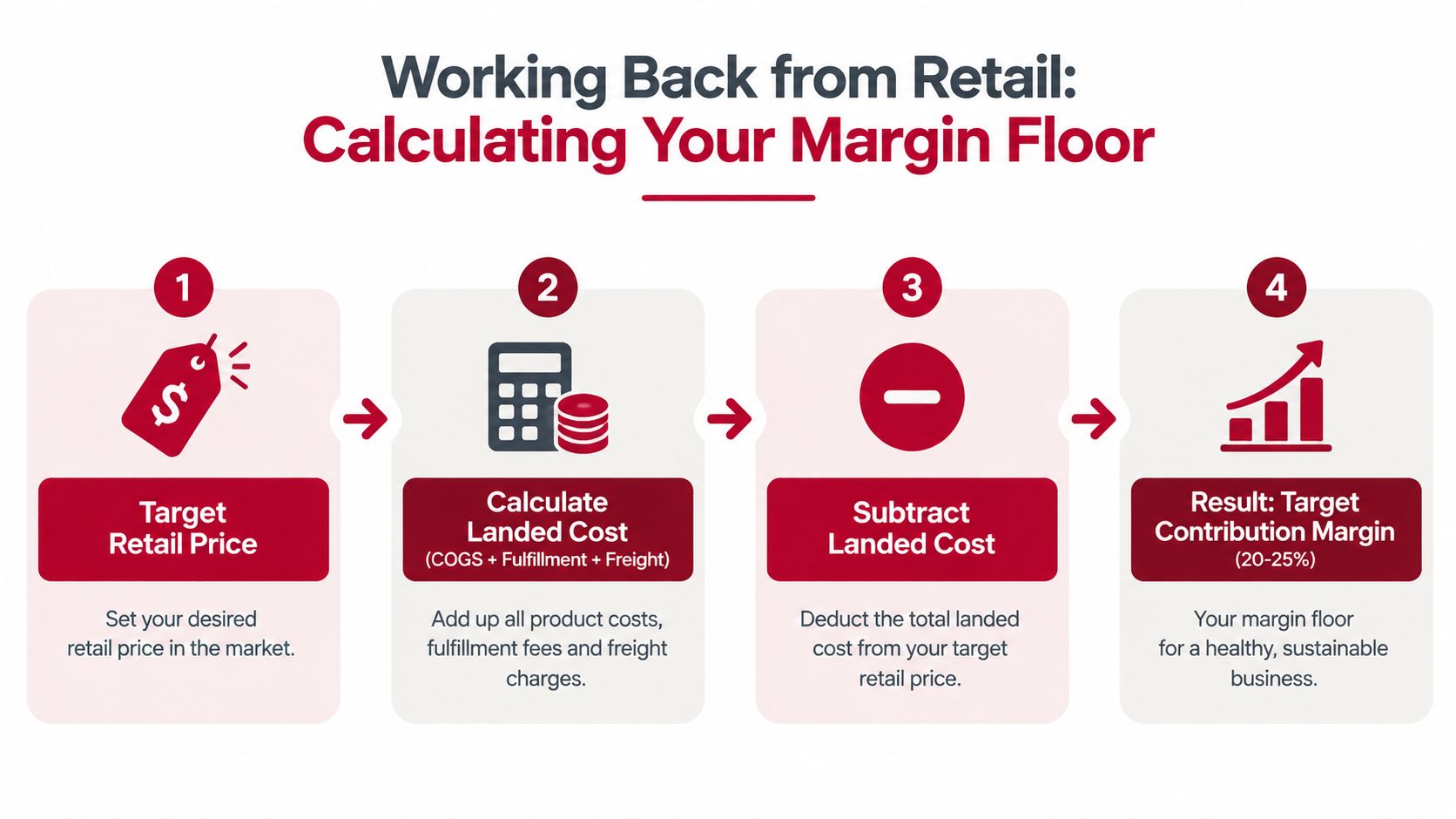
Suppose the MSRP is $24.99. A keystone starting point places wholesale at roughly $12.50, which gives the retailer room to approximately double the price at shelf. That number is only a starting point. If landed cost is $6, the arithmetic may look healthy. If landed cost is $9 after freight and fulfillment, the same wholesale price leaves far less contribution for overhead, payment delays, support, and deductions.
A recent wholesale pricing guide recommends checking that wholesale is at least 2.2x to 2.5x COGS to preserve a healthy margin after freight, fees, and terms. That check doesn't replace a full landed-cost model, but it catches products that look acceptable under keystone while failing under real channel conditions. See RedDog's contribution margin calculation guide for a practical way to separate revenue, variable cost, and contribution.
Use this order rather than starting with a retailer's requested discount:
The last step is where many price lists fail. A discount that looks small on the invoice can be expensive when it applies to every unit, delays payment, or forces the brand to provide support that wasn't priced into the account.
There isn't one universal formula because different products create different risks. A stable, low-service item may tolerate a cost-plus structure. A differentiated CPG product with strong shopper demand may justify value-based pricing. A retailer buying in meaningful volume may need a tiered ladder, but only if the order break improves contribution rather than reducing price.
Wholesale pricing is a margin between selling price and purchase price, not merely a markup. Statistics Canada defines the wholesale service price as that margin, and its Wholesale Services Price Index rose from 100.0 in Q1 2008 to 120.9 in Q4 2017, a 20.9% increase over that period. The same data show different sector outcomes, including margin growth of 56% for petroleum products, 43% for food, beverage and tobacco, and 27% for miscellaneous wholesalers. Those differences reinforce the need to match the model to category economics rather than copy a competitor's formula. Statistics Canada's wholesale margin data provides the historical context.
| Pricing Model | Best Fit | Margin Control | Channel Risk |
|---|---|---|---|
| Cost-plus | Products with predictable costs and limited differentiation | Clear cost recovery, but only if all variable costs are included | Can overprice weak-demand items or ignore what the channel can support |
| Keystone | Retailers expecting a familiar shelf-margin structure | Simple anchor tied to MSRP | Can underprice the brand when freight, fees, and terms rise |
| Value-based | Differentiated products with strong shopper value | Captures willingness to pay when demand supports it | Can create resistance if retailer sell-through doesn't justify the shelf price |
| Tiered volume | Accounts where larger orders improve handling and replenishment economics | Protects margin through order breaks and a lowest-tier floor | Poorly designed tiers train buyers to wait for discounts |
Cost-plus is useful for establishing a floor, but it can become detached from market reality. Keystone is easy to communicate, yet it should be validated against landed cost and channel requirements. Value-based pricing is powerful when the product earns its position, but it requires evidence from sell-through and reorder behavior.
Tiered pricing is often the most practical operating model because it connects the concession to a behavior that creates value, such as a larger order or more efficient shipment. The wholesale distribution strategy guide is useful when the pricing decision also depends on distributor roles, account coverage, and channel boundaries.
The right question isn't “Which formula is correct?” It's “Which pricing structure pays for the work this channel creates?”
A price list should make profitable behavior easy for the buyer and visible to your team. Flat discounts create ambiguity. Ad hoc concessions create inconsistency. A structured ladder gives the retailer a reason to consolidate orders while giving the supplier a defensible limit.
Current wholesale benchmarks report that brands using structured price ladders tied to order breaks achieved 18% to 25% higher average order values and kept accounts 2.3x longer than brands using flat pricing. The same benchmark reports that 67% of emerging DTC brands entering wholesale still relied on informal email or verbal pricing. These findings are cited in Endless Commerce's wholesale price list guidance, and the operational lesson is straightforward. If terms live in scattered messages, your team can't enforce the economics consistently.
Start with 3 to 4 volume tiers, then connect each tier to an order break that changes your cost-to-serve. The illustrative breaks $500, $1,000, and $2,500 can work as planning markers, but they shouldn't be copied without checking freight, pick-and-pack effort, payment exposure, and production constraints.
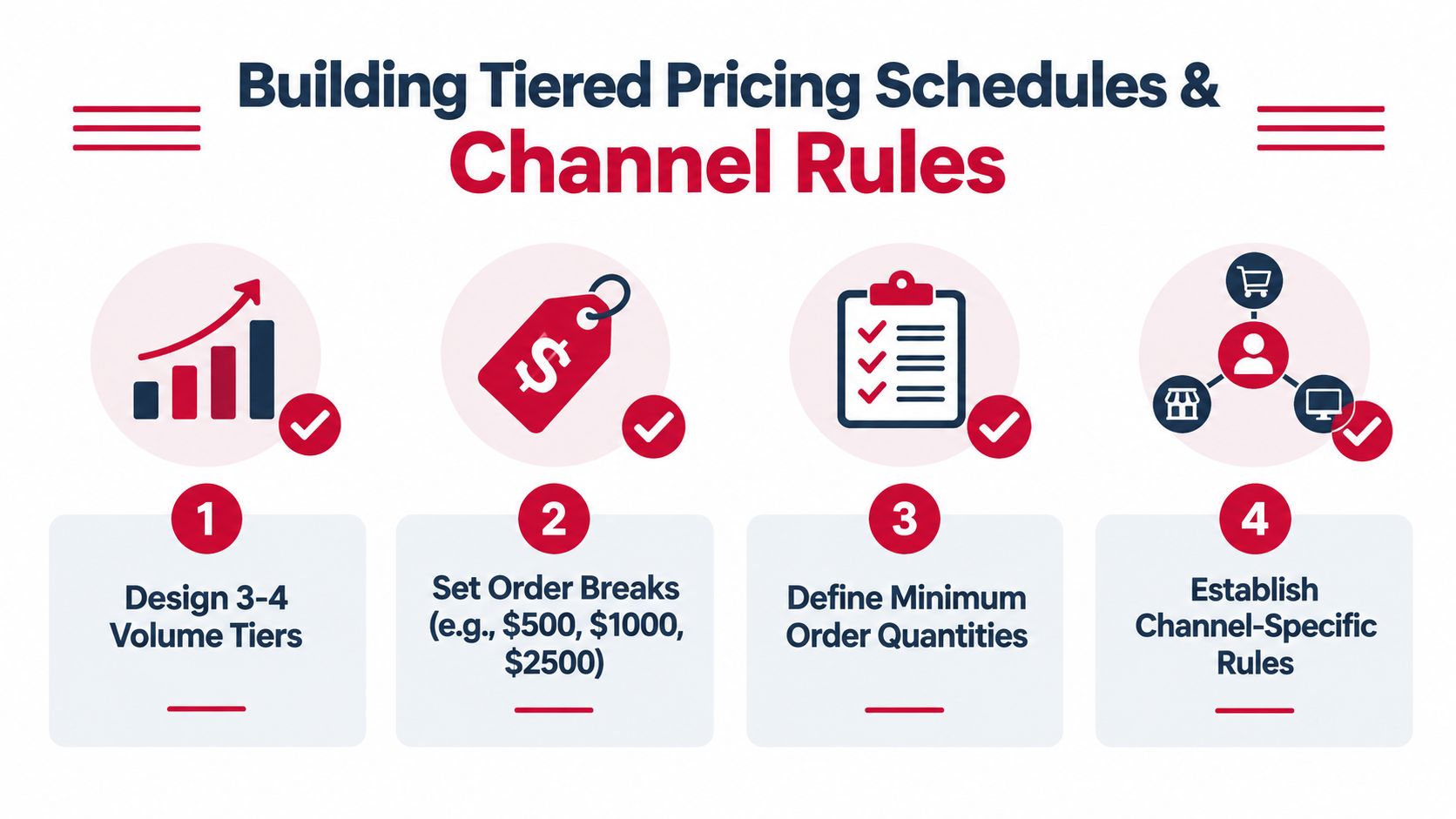
For each tier, document:
The lowest tier should be viable without relying on future volume. Higher tiers can reward consolidated purchasing, but they shouldn't turn every negotiation into a race toward the deepest discount.
MAP policies, authorized-account rules, and channel-specific assortments help prevent a wholesale partner from undermining your Amazon, Walmart, or DTC pricing. They also clarify what happens when a retailer wants to sell through a marketplace that carries different fulfillment and advertising costs.
A good document makes exceptions visible. If a buyer receives a temporary launch allowance, record the dates, eligible SKUs, order conditions, and who approved it. Don't let a one-time concession become the new base price through verbal precedent.
Documentation standard: Every buyer should see the same base terms, with exceptions approved and measured against contribution margin.
This structure also helps sales teams negotiate without improvising. Instead of offering a discount because the buyer asks, they can trade value for a defined behavior, such as a larger opening order, consolidated shipment, faster payment, or a committed reorder window.
Retailer negotiations become easier when the team can show what each concession costs. A buyer may ask for a lower unit price, free freight, longer payment terms, or launch support. Those requests aren't interchangeable. A larger order may reduce handling cost, while extended terms increase cash exposure. Free freight may be manageable on a consolidated shipment and destructive on small, fragmented orders.

Use a concession matrix before the call. For every requested change, show the impact on contribution per unit, total contribution per order, cash timing, and operational workload. If a buyer wants a lower price, ask what behavior the reduction purchases. If there's no larger commitment, improved payment timing, or lower service burden, the concession is margin transfer.
Wholesale volume also changes inventory decisions. A large opening order can improve production planning, but it may create a slow-moving account if the retailer hasn't validated demand. A smaller order with a clear reorder signal can be more valuable when it improves inventory velocity and reduces the chance of aging stock.
Marketplace economics belong in the same model. Walmart Fulfillment Services charges a base fee starting at $3.45 per unit for items with a shipping weight of 1 lb or less, and Walmart adds a $1 surcharge for items priced under $10. Apparel and hazardous materials add another $0.50 per unit. These fees come from Walmart's WFS fee guidance, and they can change the relative attractiveness of a wholesale shipment versus marketplace fulfillment.
Amazon's 2026 U.S. fee update states that FBA fees will rise by an average of $0.08 per unit sold, or less than 0.5% of an average item's selling price. It also states that minimum aged-inventory fees for items 12 to 15 months old rise by $0.15 to $0.30 per unit per month, calculated against the greater of $0.30 per unit or $6.90 per cubic foot. The Amazon fee update shows why inventory age belongs in channel pricing decisions.
Use a proper inventory forecasting process that connects wholesale commitments with marketplace demand, production lead times, and reorder probability. If you need outside support for buyer outreach, companies can also evaluate services that help brands hire closers, but the commercial team still needs a margin-approved offer before anyone negotiates.
The useful forecast isn't “how many units can we sell?” It's “how many units can we sell at a contribution level that justifies the inventory, service, and cash commitment?”
Static pricing assumes buyer behavior stays stable. It doesn't. Retailers change shelf sets, encounter inventory shocks, revise assortment policies, and shift channel priorities. A price that worked for an account last season can be too low after demand strengthens or too high after the retailer changes its merchandising plan.
Purdue's 2026 wholesale pricing playbook recommends varying prices within an acceptable band, tracking retailer order response over time, and treating sudden shifts in order quantity as signals that buyer behavior or retailer policies have changed. The Purdue pricing playbook frames pricing as a learning system rather than a one-time formula.
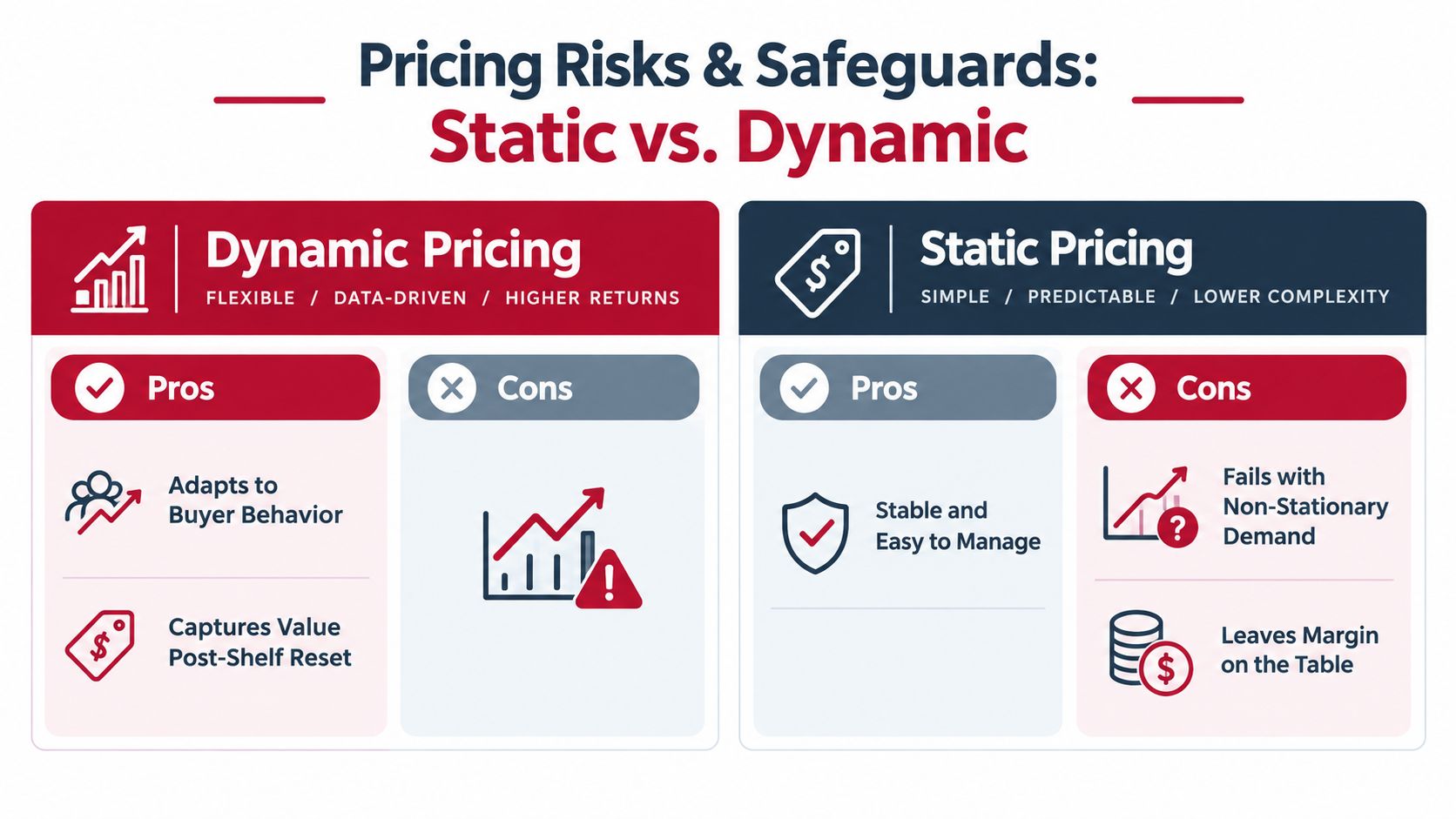
A safe test changes one commercial variable at a time. You might compare two approved price points across comparable reorder windows, test a higher MOQ with unchanged unit pricing, or exchange a freight concession for a larger consolidated order. Record the quoted price, order quantity, reorder interval, payment behavior, promotional support, and resulting contribution.
Don't announce a permanent price change based on one unusual order. A sudden increase may reflect a buyer's temporary stock build. A sudden decline may reflect a shelf reset rather than price sensitivity. The signal becomes useful when it appears across comparable orders and account conditions.
The floor also has to include costs brands routinely exclude. Manufacturing cost isn't enough if freight, insurance, transaction fees, damaged units, chargebacks, and reorder servicing consume the remaining contribution. CartWhisper's wholesale pricing discussion emphasizes landed cost, overhead, account friction, price ladders, MOQs, and periodic reviews rather than one universal wholesale number.
Include review windows, approved promotional periods, and rules for temporary tests. State that test pricing applies to defined SKUs, quantities, dates, or account conditions. That protects the retailer from surprise changes while protecting the supplier from an informal discount becoming permanent.
The risk isn't that prices move. The risk is that prices move without a measurement plan.
A working wholesale pricing system has three layers. Foundation tracks landed cost, contribution margin, MSRP, channel rules, and the lowest acceptable price. Optimization monitors order value, reorder timing, MOQ performance, freight leakage, payment behavior, and account-level service costs. Amplification expands the proven structure across Amazon, Walmart, DTC, wholesale, and distribution without assuming that one channel's economics transfer automatically to another.
Review the model at least on a recurring quarterly cadence, and sooner when freight, fulfillment, marketplace fees, assortment, or retailer terms change. Keep one controlled price list, one exception log, and one margin calculator so sales, operations, and finance work from the same assumptions.
The core KPIs are contribution per order, contribution per unit, reorder velocity, inventory age, discount leakage, freight recovery, and cash conversion. Revenue belongs on the dashboard, but it shouldn't outrank the metrics that explain whether revenue is creating usable profit.
RedDog Consulting Group can help CPG operators connect pricing, marketplace performance, inventory velocity, and channel planning in one operating model. Book a free 30-minute working session through Reddog Consulting Group to review where wholesale terms are compressing margin and which growth decisions deserve deeper analysis.
Leave a comment: