
Published: March 2020 | Last Updated:September 2026
© Copyright 2026, Reddog Consulting Group.

Most advice about Amazon Automate Pricing starts with the wrong objective. Winning the Buy Box can increase visibility, but a sale that loses money after COGS, freight, fulfillment, referral fees, promotions, and channel costs isn't growth. For CPG brands, automated repricing should first defend contribution margin, then support inventory velocity and Featured Offer competitiveness within rules the operator can afford.
Amazon's native tool can help, but it won't replace a pricing strategy. Manual updates leave offers exposed when competitors move, while unrestricted price matching can push a product into an uneconomic position. The useful question isn't how to turn repricing on. It's whether the rule protects the floor, respects fulfillment economics, and gives the team enough control to intervene when marketplace conditions change.
The Buy Box, now referred to by Amazon as the Featured Offer, matters because it gives shoppers a prominent purchasing path. That doesn't make every Featured Offer win profitable. A CPG operator has to evaluate the complete unit economics behind the offer, including landed product cost, fulfillment, marketplace fees, discounts, and the margin required to fund future inventory.
Amazon's academic pricing analysis illustrates why this deserves disciplined attention. Researchers identified algorithmic sellers by looking for highly correlated price movements, then found that those sellers represented 2.4% of sellers while covering 51% of crawled products in the dataset (academic analysis of algorithmic Amazon sellers). The practical implication is significant: a relatively small number of automated operators can influence pricing across a broad share of visible products.
That environment changes the role of Amazon Automate Pricing. It isn't a magic revenue button, and it shouldn't be allowed to chase every competitor movement. It works better as a controlled margin-defense layer, especially for replenishable products where small price changes repeat across substantial unit volume.
Manual pricing can work for a narrow catalog with stable competition. It becomes fragile when a brand manages multiple pack sizes, seasonal demand, promotional calendars, and inventory positions. A competitor can move before the team reviews the account, and the operator may respond using a stale view of fees or stock pressure.
Blind matching creates the opposite problem. If the lowest visible offer reflects a reseller clearing inventory, an unauthorized discount, or a temporary promotion, matching it can reset the economics for the brand without improving the long-term channel position.
Practical rule: The Featured Offer is an input to pricing decisions, not the definition of a profitable price.
RedDog's Foundation → Optimization → Amplification framework starts with the same discipline. Foundation means knowing which SKUs can tolerate competitive movement, where the contribution-margin floor sits, and which products should remain outside automated rules. Optimization then tests the mechanics. Amplification scales only after the pricing system behaves predictably.
A healthy pricing rule should answer three operational questions:
Automate Pricing is valuable when it reduces reaction time without transferring economic control to the marketplace. It fails when the team measures only unit sales and ignores contribution per order.
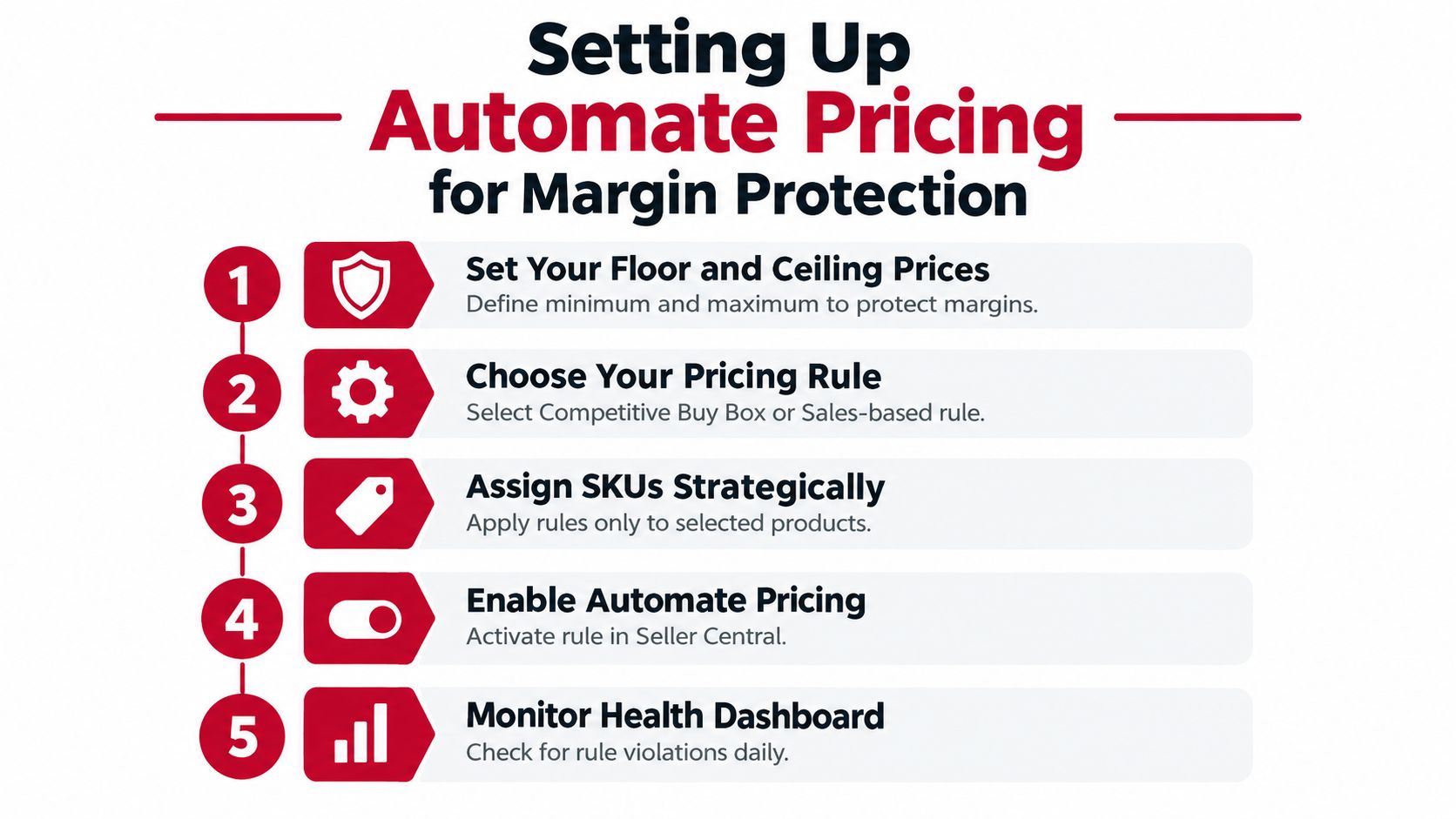
Automate Pricing should defend contribution margin before it chases the Featured Offer. Amazon includes the tool in Seller Central at no separate repricing charge for Professional selling plan accounts. The U.S. plan is listed at $39.99 per month plus selling fees in the Amazon Automate Pricing overview. The rule still has an economic cost: each price move can change margin, fee treatment, price perception, and inventory timing.
Begin with a SKU-level contribution model. Include COGS, inbound freight, prep or packaging, FBA fees, referral fees, expected promotional funding, and the contribution margin required from each order. The minimum price should reflect that SKU's current economics, not a convenient number copied across the catalog.
CPG formats often carry different cost profiles. A single-unit trial pack may create a heavier fulfillment burden than a multi-pack. A premium variety pack may carry more inventory risk than a core replenishment item. Put products with different economics into separate rule groups, or keep selected items outside automation until their price behavior is understood.
Set up the rule in this sequence:
Amazon describes the system as rule-based rather than fully autonomous. Sellers can start, stop, or edit rules, and the system pauses when listings become inactive, as documented in the Amazon automated pricing controls. The operator therefore retains control of the economic boundaries while Amazon adjusts prices within them.
For a plain-language explanation of selling-price inputs, the Ruit guide to reseller pricing provides useful calculation context. For Amazon-specific decision points, this guide to Amazon price adjustment adds practical context for reviewing price changes.
Choose the rule based on the business objective. If the objective is protecting target contribution while staying competitive, an aggressive matching setting can be the wrong configuration even when it produces more unit sales.
Use the embedded walkthrough after the SKU economics, boundaries, and assignments are documented:
A repricer can make a small price adjustment that creates a larger fulfillment consequence. In 2026, Amazon's U.S. FBA structure includes a price-based break: products priced under $10 automatically receive Low Price FBA fulfillment rates that are $0.86 lower than rates for products priced above $10 (Amazon's 2026 Low Price FBA rates). That lower rate can look attractive, but the repricing decision still has to account for the revenue surrendered by crossing the threshold.
The operational risk is easy to miss. A rule designed to match the market may move an item from just above the threshold to just below it, or push it in the opposite direction during a competitor response. The price change, fulfillment-rate change, and resulting contribution margin need to be evaluated together.
Build a buffer around any price point that changes fulfillment treatment. Don't set the minimum price directly against the threshold unless the model proves that both sides produce acceptable contribution. A buffer gives the operator room to avoid oscillation when competitors move by small increments.
Amazon's broader 2026 fee changes also affect standard-size products priced between $10 and $50. Small standard-size items in that band increase by $0.25 per unit on average, while large standard-size items increase by $0.05 per unit on average (Amazon's 2026 standard-size FBA fee update).
| Price Band | Small Standard-Size Change | Large Standard-Size Change |
|---|---|---|
| Under $10 | $0.12 increase per unit on average | No change |
| $10 to $50 | $0.25 increase per unit on average | $0.05 increase per unit on average |
Amazon states that standard-size products under $10 increase by $0.05 per unit on average overall, with small standard-size items in that band increasing by $0.12 per unit on average and large standard-size items remaining unchanged (Amazon's 2026 FBA fee update for lower-priced products). The table shows why size classification belongs in the repricing model. A rule that makes sense for one physical format can be wrong for another.
Suppose a small standard-size CPG item sits near the price break. The correct decision isn't “stay below $10 because fulfillment is cheaper” or “stay above $10 because the list price is higher.” Compare the complete contribution result on each side, then add the effect of velocity, inventory age, promotional funding, and replenishment timing.
A useful pricing review asks:
The FBA fulfillment fee guide is useful when translating fee updates into SKU-level pricing decisions. The key is to update floors before activating a new rule, not after the repricer has already changed the offer.
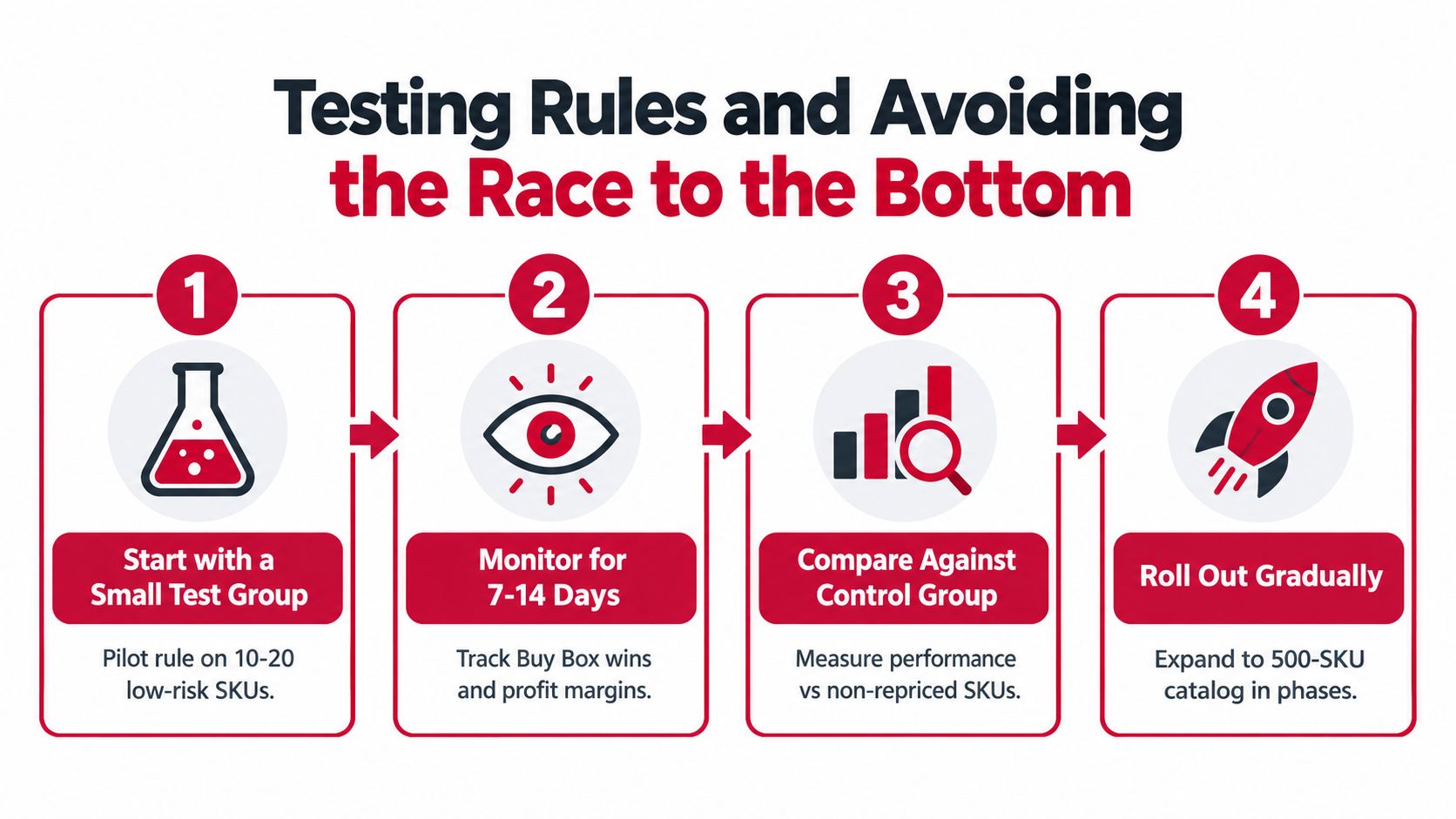
Turning on a rule across a large catalog is a portfolio-wide pricing change, not a test. Begin with products where the downside is contained, the economics are clear, and the team can inspect results without confusing pricing effects with demand, advertising, or inventory changes.
Automated pricing can update quickly. That responsiveness helps when marketplace conditions shift, but it can also create a feedback loop among competing sellers. One seller lowers the offer, another rule follows, and the category can move toward a price that no longer protects contribution margin. Test design must separate useful responsiveness from uncontrolled undercutting.
Select a small group of low-risk SKUs. An internal rollout may begin with 10 to 20 products, but that range is a testing choice, not a performance benchmark. Choose products with stable listings, known costs, adequate stock, and enough ordinary marketplace activity to reveal how the rule behaves.
Keep comparable SKUs outside the rule where possible. The control group will not create a perfect experiment because marketplace conditions change, but it provides a reference for price, units, contribution, and Featured Offer behavior. That comparison helps identify whether a result came from repricing or from a broader demand or inventory shift.
Record the test in a simple operating log:
A price spiral can look rational at the individual SKU level. Each seller matches the current offer, and each rule remains within its own boundaries. The combined result can still push the category below the brand's contribution requirement, particularly when a lower price crosses an FBA fee threshold.
Set a maximum ceiling as carefully as the minimum floor. The ceiling limits movement when a competitor disappears or a pricing signal becomes unreliable. A pause is a valid control, especially during a promotion, stock transition, or listing correction.
Test before scale: Expand coverage only after the team can explain each significant movement and reconcile it to margin.
Amazon allows sellers to start, stop, and edit rules, while inactive listings can cause a rule to pause. Use those controls deliberately during launches, inventory changes, listing fixes, and major promotional events. The Amazon rule governance documentation describes these operating controls.
The right rollout is gradual. Move from low-risk products to higher-velocity items only when the rule respects the approved floor, reacts as expected, and produces reporting the operator can use. Winning the Featured Offer has limited value if the resulting order loses contribution after fees. Automation should defend the margin boundary first, then pursue volume inside it.
Automated pricing still needs an operating system. Amazon validation rules, listing status, promotions, inventory, and marketplace conditions can change what a rule does. An active status in Seller Central only confirms that the rule is running, not that its price remains acceptable for contribution margin.
Set the cadence around decisions. Daily reviews catch exceptions that need intervention. Weekly reviews decide whether each rule still belongs on its assigned SKUs.
Daily checks should cover products most exposed to price movement:
Weekly checks should test the setup rather than isolated price events:
Document an owner for each exception. The record should show the SKU, trigger, approved action, and time of review. That history makes it easier to distinguish a deliberate margin decision from a rule that drifted through changing costs or listing conditions.
Amazon also sets limits on how far a rule can move. Its maximum item price validation guidance allows a seller's maximum to reach six times the recent sales price or $200, whichever is higher (Amazon maximum item price validation guidance). Automation therefore operates inside Amazon's permissions and validation logic. A ceiling that looks commercially sensible can still require adjustment if the platform rejects it.
Cross-border sellers need a separate exception process. Amazon's guidance indicates that cross-border pricing updates pause during active promotions in a marketplace. An operator who expects every regional price to keep updating can create a temporary mismatch between markets.
Record the marketplace, promotion dates, assigned rule, and manual override owner. After the promotion ends, review the resulting prices before restoring normal automation. This review matters when Amazon activity overlaps with wholesale commitments, DTC promotions, or distributor pricing.
Platform guardrails define the operating envelope. A resilient SOP states what the rule may change, what requires approval, and which events trigger an immediate pause. That control protects contribution margin before automation pursues additional volume.
Amazon pricing doesn't stay on Amazon. Wholesale buyers notice marketplace behavior, DTC customers compare offers, and distributors may question a price that undercuts the economics of their channel. A brand that optimizes one marketplace without protecting channel relationships can create revenue in one account while weakening the broader retail system.
Use Amazon's competitive signals as market intelligence, not as an automatic instruction for every channel. A sustained competitive shift may inform a MAP review or a pack architecture decision. A short-lived seller discount shouldn't automatically reset the DTC price or wholesale floor.
Set channel floors from the same contribution model, then adjust for each channel's costs and strategic role. Amazon may carry FBA and marketplace fees. DTC may carry payment processing, fulfillment, customer acquisition, and service costs. Wholesale may trade margin for predictable volume, retailer access, and replenishment.
That structure helps operators make cleaner decisions:
A structured competitive pricing intelligence approach can help teams separate a meaningful market signal from a temporary offer. That distinction is more valuable than reacting faster to every visible price change.
RedDog's Foundation phase establishes the cost and channel rules. Optimization tests Amazon pricing behavior against contribution and inventory objectives. Amplification then scales the system across products and channels, with governance strong enough to prevent automation from becoming an unmanaged discount engine.
For qualified CPG founders and operators, Reddog Consulting Group offers a free 30-minute working session focused on Amazon pricing rules, contribution margin, FBA fee exposure, and marketplace performance. Bring a representative SKU set and current channel economics, and use the session to identify where automation can protect margin without undermining broader growth planning.
Leave a comment: