
Published: March 2020 | Last Updated:February 2026
© Copyright 2026, Reddog Consulting Group.

An Amazon FBA forwarder is an operational partner managing your inventory's journey from the factory floor to Amazon's fulfillment centers. This isn't just about moving boxes; it's a critical function that directly impacts your contribution margin, inventory velocity, and cash flow.
Your forwarder handles customs clearance, FBA prep, and final delivery. Getting this piece wrong will slowly—or quickly—erode profit. Getting it right builds a resilient supply chain foundation, a core part of the 'Foundation' phase in any scalable growth plan. It's the operational bedrock that lets your brand scale without breaking.

Treating your freight forwarder like a simple shipping provider is a common—and costly—mistake. Moving boxes from Point A to Point B is the absolute baseline, not the value-add. A truly effective FBA forwarder is a strategic partner whose performance shows up directly on your brand’s P&L.
Their expertise, or lack thereof, reveals itself in tangible ways that go far beyond a freight quote. It’s in the nimble handling of customs that prevents costly port demurrage charges. It’s in avoiding Amazon’s non-compliance fees because they know how to palletize exactly to spec.
This is especially true with Amazon’s new inbound placement fees. An optimized shipment plan from a savvy forwarder can be the difference between a negligible cost and a fee that decimates your margin on a product.
Let's ground this in a practical scenario. Imagine you're importing a container with 10,000 units of your product from overseas.
That 15% reduction doesn't just lower your freight bill; it drops your per-unit cost to $4.25. This adds $7,500 in pure contribution margin back to your bottom line from a single shipment. That's the difference between a product with razor-thin unit economics and one that can profitably support ad spend and drive real growth.
A great forwarder doesn’t just ship your product; they protect your profit. They are the first line of defense against supply chain friction and margin erosion.
For CPG brands scaling on Amazon, a reliable forwarder is non-negotiable. With roughly 70% of U.S. sellers sourcing from China, navigating ocean freight from key ports into Amazon's network is a standard operational hurdle. A competent partner can cut your landed costs by 15-30% while ensuring zero prep rejections—a huge deal with Amazon's increasingly strict rules.
Understanding and optimizing your shipping timelines is another critical piece of the P&L puzzle. Knowing how long does shipping take directly impacts your inventory carrying costs, stockout risk, and ultimately, your cash flow.
This kind of operational insight is what separates a basic shipper from a strategic partner. Shifting your perspective to see them this way is the first step toward building a resilient and profitable supply chain.
Choosing an FBA forwarder based on the lowest per-unit shipping quote is a classic rookie mistake. It’s an approach that prioritizes a single line item over the total cost of ownership, and it almost always ends up costing brands more in the long run through delays, fees, and lost sales.
A cheap quote can easily mask operational incompetence. You need a partner, not just a mover of boxes. This means your vetting process has to dig into their operational capability, Amazon-specific knowledge, and communication style—not just the initial price.
The goal here is to de-risk your supply chain. Your forwarder is the critical link between your supplier and your primary sales channel. If that link is weak, the entire system is vulnerable.
Start by asking questions that reveal their actual, hands-on experience with Amazon’s ecosystem:
These questions immediately shift the conversation from price to capability, which is where the real value lies.
A quote is way more than just one number. A low base rate can be incredibly misleading once all the other charges get tacked on. The cheapest option on paper often becomes the most expensive one by the time your goods are finally checked in.
To see how this plays out, let's look at how three different types of forwarders might present a quote for the same exact shipment.
This table breaks down three quotes, showing how a low initial rate can hide extra fees that drive up your total landed cost.
| Cost Component | Forwarder A (Low-Cost Leader) | Forwarder B (Mid-Tier Specialist) | Forwarder C (Premium Service) |
|---|---|---|---|
| Ocean Freight (Base) | $2,200 | $2,500 | $2,800 |
| Origin Charges | Included | Included | Included |
| Destination Port Fees | $450 | $500 | $550 |
| Customs Clearance | $150 | $175 | Included |
| Fuel Surcharge | Billed Separately (~$300) | Included | Included |
| Chassis Fee | Billed Separately (~$250) | Included | Included |
| Amazon FBA Prep | $0.45/unit | $0.40/unit | $0.35/unit |
| Final Delivery | $500 | $550 | Included |
| All-In Estimated Cost | ~$3,850 + Prep | $3,725 + Prep | $3,350 + Prep |
At first glance, Forwarder A's base rate looks like a steal. But they nickel-and-dime you with separate surcharges that a more experienced amazon fba forwarder bundles into their pricing. Forwarder C, while appearing most expensive initially, actually provides an all-in DDP service that simplifies your accounting and removes the risk of surprise fees.
This is a perfect example of why you have to analyze the total landed cost, not just the freight rate. A transparent, all-inclusive quote from a partner like Forwarder C gives you predictability, which is absolutely essential for managing your contribution margin.
Your forwarder’s communication style is a direct indicator of their professionalism and a huge part of your vetting process. Inconsistent updates and vague tracking information are massive red flags.
An experienced forwarder knows that silence is the most expensive part of shipping. They provide proactive updates at key milestones: cargo received, vessel departed, customs cleared, and final delivery scheduled.
Ask potential partners about their technology stack. Do they offer a portal for live tracking? Who is your dedicated point of contact? When a container gets pulled for a random customs inspection, you need a partner who tells you immediately—not one you have to chase for three days just to get an answer. For a deeper dive, you can learn more about the critical questions to ask when you vet a freight forwarder for Amazon FBA in our related guide.
Ultimately, vetting a forwarder is about building confidence in their ability to protect your inventory and your margin. The right partner becomes an extension of your own operations team, enabling you to focus on growth.
To protect your margins, you have to understand the full journey your inventory takes. The path from your factory floor to an Amazon FBA check-in is loaded with potential landmines—places where delays happen, costs pile up, and your profits quietly get chipped away. This isn't just theory; it's a field guide to getting ahead of your supply chain.
Think of this as the 'Optimization' phase of your business growth. Once you've got the basics down, you have to tighten up operational levers like logistics. This is how you prevent stockouts, avoid overstocking, and keep your working capital free. It's also where your freight forwarder’s real competence is put to the test.
This visual shows you the high-level flow for questioning, analyzing, and ultimately picking the right partner to manage this critical path for you.
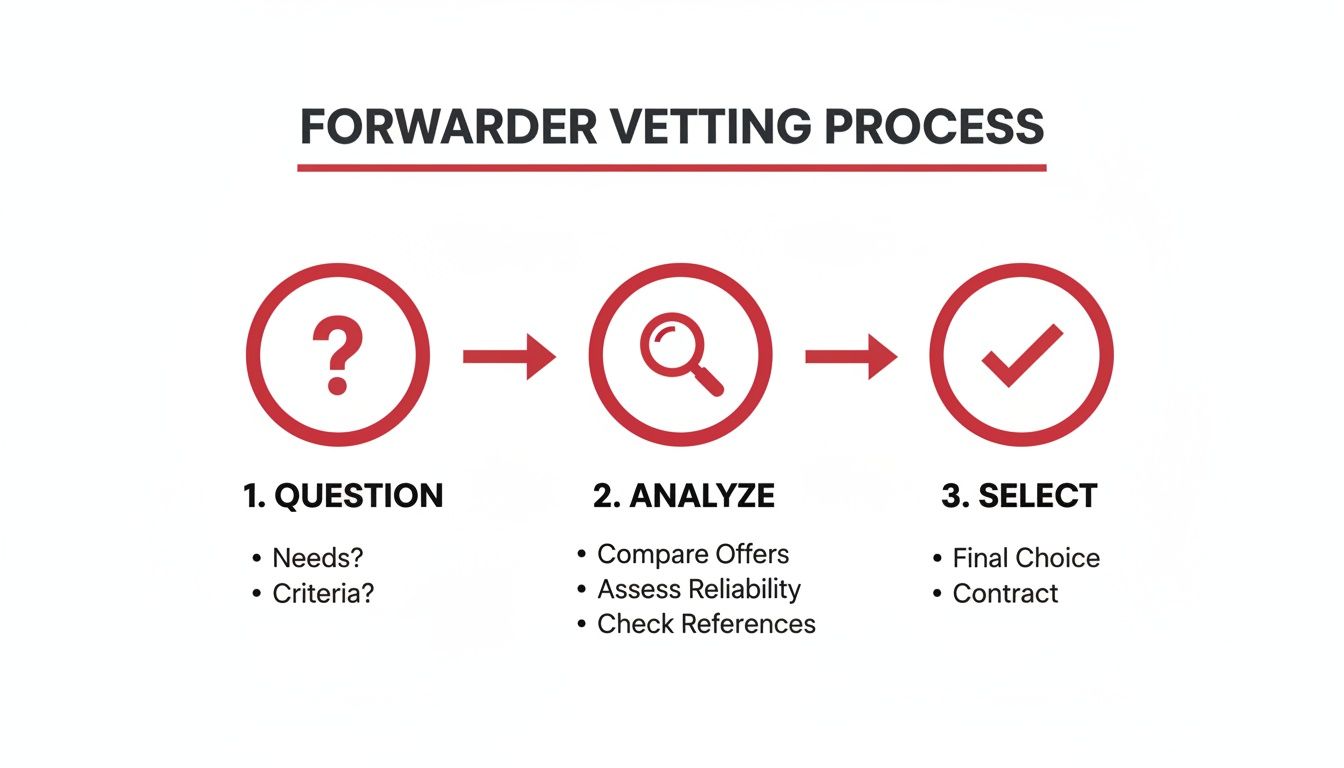
The key takeaway here is that vetting isn’t a quick price comparison. It's a structured process of asking the right questions and analyzing the answers so you can make a choice with confidence.
Your first big decision is choosing between air and sea freight. This isn't just about speed; it's a strategic move that directly hits your inventory velocity and cash flow.
The breakeven math is simple: will the margin you lose paying for air freight be less than the margin you’d lose from stocking out for 30+ days while a sea shipment crawls across the ocean? For a hero SKU in Q4, the answer is almost always yes. A critical part of this is also understanding the responsibilities of the Importer of Record (IOR), who is essential for navigating customs smoothly.
Incoterms are the rules that define who is responsible for your goods at each stage of the shipping journey. If you get this wrong, you'll find yourself stuck with risks and costs you never budgeted for. As an Amazon brand owner, you really only need to worry about three.
Choosing anything other than DDP is a false economy. The tiny bit you think you're saving gets wiped out by the first unexpected customs delay or surprise port fee. Just pay for the predictability.
Let's put some real numbers to what happens when this critical path breaks down. Imagine your shipment gets flagged for a random customs inspection and sits in port for 10 days. This isn't just an annoying delay; it's a direct hit to your wallet.
This is exactly why a freight forwarder who specializes in Amazon FBA is so valuable. We've seen real-world DDP quotes from Shanghai to Amazon's ONT fulfillment center for a 40ft container ranging from $3,650 to $6,800. A good partner in that range can save you 15-30% on landed costs and lock in transit times of 15-19 days.
For a complete breakdown of the entire process, check out our guide on how to ship from China to Amazon FBA, which dives even deeper into these operational steps.

The initial freight quote is just the tip of the iceberg. The real damage from a subpar Amazon FBA forwarder comes from operational screw-ups that trigger a domino effect of hidden fees, lost sales, and tanking profit margins. Too many brands treat these as one-off headaches instead of what they really are: systemic leaks draining their P&L.
Just one rejected shipment can wipe out the entire profit from a container of inventory. These aren't minor hiccups. They are direct, measurable hits to your bottom line that can stall your growth and lock up your working capital. Getting a handle on these potential failures is key to building a resilient supply chain.
Let's break down the true cost of a common—and completely avoidable—mistake: a single pallet getting rejected by Amazon for bad palletizing or labeling. We’ll assume the pallet holds 500 units of a product you sell for $25, with a healthy 40% contribution margin ($10/unit).
The hard costs alone can climb to $890 for one messed-up pallet. That's nearly $1.80 in unplanned cost tacked onto every single unit, slashing your margin on that inventory by 18%. And this doesn't even touch the long-term damage from stocking out.
Beyond rejected pallets, other costs love to ambush unprepared brands. Demurrage and per diem fees—basically penalties for letting your container sit at the port too long—can run $75-$150 per day. A customs holdup of just a few days can add hundreds of dollars you never planned for.
Another huge risk is putting all your eggs in one forwarding basket. A strong relationship is great, but having no backup plan puts your entire supply chain one business failure away from total collapse. What happens if your forwarder loses their customs bond, gets dropped by their main carrier, or just goes under? Diversifying with a primary and a secondary forwarder is a smart hedge.
This brings up the classic debate: go with an independent forwarder or use Amazon's own Global Logistics (AGL) service?
Amazon Global Logistics vs. Independent Forwarder: On the surface, AGL looks like a seamless, one-stop shop. The reality is that it often lacks the flexibility, personalized service, and actual problem-solving you get from a dedicated, independent forwarder. When things go sideways—and they will—trying to navigate Amazon's support channels for a logistics fire is a nightmare. An independent partner works for you, not for Amazon.
A top-tier forwarder acts as your insurance policy against these expensive blunders. Their job is to know Amazon’s receiving requirements, which are spelled out in guides covering what is FBA, even better than you do. They spot supplier mistakes before they leave the factory, ensure everything is compliant before it ships, and proactively manage the entire process. That operational discipline is what truly protects your bottom line.
Once you’ve found a forwarder you can trust, the real work begins. Your goal should be to move beyond a simple transactional relationship where you just book shipments. The real win is turning them into a proactive, strategic partner. We call this the 'Amplification' stage of our growth framework, where you lean on operational partners to build a durable, margin-first system.
A great Amazon FBA forwarder is much more than a logistics provider; they're sitting on a goldmine of data. Their lead times—from the moment they pick up at your factory to the day your inventory gets checked in at FBA—are critical inputs for your inventory forecasting.
Instead of guessing, you can build your demand planning around real-world transit times. This lets you place purchase orders with far more precision, which directly improves your inventory velocity and shortens your cash conversion cycle. The result? Less cash tied up in inventory that isn't moving and a much lower risk of getting hit with Amazon's aged inventory surcharges.
To make this leap, you need to set up a communication rhythm that goes beyond just asking for tracking numbers. A Quarterly Business Review (QBR) is the perfect tool for this. Don't think of it as some stuffy corporate meeting; it's a hands-on working session focused on what worked, what didn’t, and how to improve.
A solid forwarder QBR agenda should hit these key points:
This kind of collaborative planning turns logistics from a cost center into a genuine competitive advantage. Your forwarder stops being just a vendor you send instructions to and becomes a partner who offers insights that actually shape your purchasing decisions.
This level of integration is non-negotiable, given the mind-boggling scale of Amazon's FBA network. Their logistical machine is massive, handling an estimated 17.2 million U.S. orders every single day in 2024. That volume is a huge opportunity, but it's also a risk for the 82% of global sellers who rely on FBA. For a deeper dive into these numbers, you can read the full research on Amazon logistics statistics.
Recent changes, like FBA fee hikes and the new inbound placement surcharges for sending inventory to non-optimal warehouses, make precise forwarding more important than ever. A forwarder who truly gets these nuances can help structure your shipments to minimize these new fees, directly protecting your profit margins.
Your forwarder sees supply chain trends before you do. They have visibility into port congestion, container shortages, and shifting carrier rates. A true partner proactively brings this intelligence to you, helping you get ahead of disruptions instead of just reacting to them.
Ultimately, integrating your forwarder into your growth operations means you have to treat them like an extension of your team. They hold the final piece of the puzzle connecting your factory to your customer. By building a partnership grounded in data and proactive planning, you create a supply chain that doesn't just support your growth—it actively drives it by freeing up cash, protecting margins, and allowing you to scale profitably.
Even sellers who’ve been in the game for years still have questions about the finer points of FBA forwarding. Logistics is one of those areas where a tiny mistake can have huge financial ripple effects. Here are some straight-up, practical answers to the questions CPG brands ask us most.
Delivered Duty Paid (DDP) means your forwarder handles everything—the ocean freight, customs clearance, duties, taxes, and the final truck ride to Amazon's warehouse. You get a single, all-in price, which gives you absolute certainty on your landed cost.
Delivered Duty Unpaid (DDU), which is now more accurately called Delivered at Place (DAP), means the forwarder gets your goods to the port in the destination country. After that, it's all on you. You're responsible for handling customs, paying duties, and arranging the final delivery.
For 99% of Amazon sellers, DDP is the only sane choice. It takes all the variables off the table and prevents your shipment from getting stuck at a port over an unpaid customs bill you didn't even know was coming. That slightly higher price for DDP isn't a fee—it's an insurance policy against catastrophic delays that can cause a stockout and tank your Best Seller Rank. Trying to save a few hundred bucks with DDU is a classic case of being penny-wise and pound-foolish.
If you want your holiday inventory to arrive via ocean freight, you need to be booking that shipment with your Amazon FBA forwarder by August at the absolute latest. That means your products better be finished and ready for pickup from the factory by early September.
This timeline isn't just pulled out of thin air. It’s built to withstand the chaos of Q4 logistics:
Your goal should be to have your inventory fully checked-in and ready for sale by the end of October. If you wait until September to book your freight, you're rolling the dice on finding vessel space. You'll either pay a fortune for a last-minute spot or be forced to air freight your inventory, which will completely destroy your profit margins during what should be your most lucrative quarter.
A lot of suppliers will offer to handle the shipping for you, usually under FOB or CIF Incoterms. It might sound convenient, but it's a huge operational risk and almost always ends up costing you more than hiring your own forwarder.
Your supplier is an expert at making your product, not at navigating the complexities of global logistics and Amazon's constantly changing rules. When they manage shipping, they're just outsourcing it to their local buddy. This leaves you with zero visibility into where your shipment is, no control over the process, and absolutely no one to call when something goes wrong.
When you hire your own independent forwarder, you cleanly separate manufacturing from logistics. You get a dedicated partner whose only job is to protect your inventory, make sure it meets all of Amazon's strict prep rules, and give you transparent tracking from the factory floor to the fulfillment center door.
A truly professional Amazon FBA forwarder should have a prep failure rate that’s basically zero. Their entire value is built on knowing Amazon’s receiving requirements inside and out. A huge part of their job is acting as your quality control—catching labeling mistakes or packaging problems from your factory and fixing them before the shipment leaves their warehouse.
If your freight forwarder is consistently getting shipments rejected by Amazon because of prep errors, they are failing at their most critical task. This isn't just an annoyance; it's a direct hit to your bottom line from rework fees and lost sales while you're stocked out.
When you're vetting a new forwarder, ask to see their documented standard operating procedure (SOP) for FBA prep. Even more important, ask for their written policy on how they handle costs if a rejection is their fault. A real pro will take full financial responsibility for their own mistakes, no questions asked.
Picking the right FBA forwarder isn't just a logistics task—it's one of the most critical P&L decisions you'll make. Get it right, and you protect your profitability and build the operational foundation to scale. Get it wrong, and you'll watch your margins get eaten alive by surprise fees and stockouts.
Think of your forwarder as the guardian of your contribution margin. They’re the ones responsible for getting your inventory from the factory to Amazon’s fulfillment centers safely, on time, and on budget. A solid supply chain built with a great partner is the foundation for predictable, profitable growth. This is about more than just moving boxes; it's about moving your business forward.
If logistics headaches and unpredictable landed costs are compressing your margins, it's time for an operational review. We help CPG founders build resilient, cost-effective supply chains that support profitable growth.
Book a complimentary 30-minute strategy call to analyze your current freight operations and identify opportunities to improve your unit economics. This is a working session, not a sales pitch.
Leave a comment: