
Published: March 2020 | Last Updated:August 2026
© Copyright 2026, Reddog Consulting Group.

The most popular advice about Amazon Best Sellers Rank is also the least useful: get the number down at any cost. That approach turns a relative marketplace signal into a vanity KPI, then encourages discounts, aggressive PPC, and inventory bets that can weaken contribution margin. A better operator asks a harder question: what sales velocity produced this rank, and did that velocity create durable profit?
BSR can help answer that question, but only when it sits beside ordered units, conversion, advertising spend, inventory cover, and contribution dollars. A rank improvement that depends on a coupon or an uneconomic ad campaign may look good on a dashboard while leaving the brand with less cash and more operational risk.
Amazon Best Sellers Rank is useful when treated as a diagnostic for marketplace velocity and margin quality. It shows how an ASIN performs relative to other products in its category. Amazon describes BSR as a category-based ranking calculated from sales volume, with recent sales weighted more heavily than older sales and updates occurring frequently. Its official Best Sellers Rank guidance explains the ranking framework.
The number still cannot serve as a sales report. A rank of 500 does not reveal unit volume, contribution after fees, or whether the velocity came from repeat demand, a temporary deal, or high advertising spend. Amazon also states that BSR is not a direct sales count and that a lower number indicates stronger relative performance in the applicable category, as explained in its customer help documentation.
Operator rule: Use BSR as a signal for marketplace velocity rather than a standalone health metric.
BSR is also nonportable. A rank of 500 in one category node may reflect very different commercial activity from the same rank elsewhere. A narrow leaf can have a smaller, more concentrated competitive set than a broad category. Price point, pack size, seasonality, and competitor density determine the economics behind the number.
Operators often read BSR backward. They set a rank target, then choose discounts, PPC bids, and inventory commitments designed to create a short sales spike. A margin-led sequence works better:
A temporary rank gain can still provide a useful test. It may show that a listing converts more effectively at a certain price or that a product responds to a particular audience. The test earns its place only when you measure the margin outcome after the promotion ends, including the cost of replenishment and the advertising required to maintain the new velocity.
Amazon Best Sellers Rank is a relative, category-specific sales-velocity score. Products are ordered against other products in the same category, so the number describes competitive position rather than absolute demand. Amazon says both recent and all-time sales factor into the calculation, with recent sales carrying more weight, and its official Amazon KDP documentation for books explains the same relative principle for Best Seller and Category Ranks.
For books, Amazon also says a title can appear in up to three Best Seller Category lists. That illustrates an important point for CPG operators: one ASIN can have more than one relevant rank when Amazon places it in multiple category nodes. You need to record the node alongside the number, otherwise the comparison may be meaningless.
Independent technical explanations describe BSR as a time-decayed weighted sales model that recomputes roughly hourly. In practical terms, a recent order can influence the rank more than an older order, while the effect of a promotion can fade as the weighting window decays. Amazon BSR for POD sellers provides additional context on how sellers interpret the metric in day-to-day tracking.
That behavior creates both value and risk:
The hourly refresh matters operationally because it makes BSR a potential leading indicator of velocity loss. If orders slow after a price change or an ASIN goes out of stock, rank may reflect the change before a longer reporting period makes the issue obvious. That doesn't mean you should react to every update. It means you should annotate rank movement with promotions, pricing, availability, and ad changes.
For a deeper explanation of how the metric fits into the broader Amazon seller ecosystem, see this guide to Amazon seller ranking. The practical takeaway is simple: record rank, category node, timestamp, ordered units, and the commercial action that might have caused the movement.
There is no universal good BSR. The number only becomes useful after you identify the category node, competitive set, price architecture, and product role in the portfolio.
A rank of 100 in Grocery isn't automatically comparable with a rank of 100 in Sports Nutrition. A rank of 1,000 in a narrow leaf such as Beef Jerky may reflect a different sales pace from 1,000 in a broad Grocery node because the competing products, catalog depth, and purchase patterns differ. The ranking tells you position against similar items, not the size of the market underneath that position.
Use a hierarchy of benchmarks rather than one target for every ASIN:
| Operating situation | More useful BSR question |
|---|---|
| Launch | Has the ASIN entered a relevant target leaf and established repeatable velocity? |
| Scaling | Is the product improving against direct alternatives without sacrificing contribution dollars? |
| Mature product | Does the ASIN remain competitive through normal seasonality, pricing changes, and inventory cycles? |
A launch target such as sub-1,000 in a chosen leaf can be a useful internal ambition, but it isn't a verified market standard and shouldn't be treated as one. The same applies to a scale goal such as sub-200 in a trunk or a maturity goal such as top-10 in a leaf. Those targets only make sense if they come from your own historical performance and category observations.
The leaf node helps you understand direct competition. It can show whether your snack, supplement, or pantry item is gaining ground among close substitutes. The parent category gives a broader view, but it can be noisier because the competitive pool is wider.
Then add average selling price and contribution dollars. A lower-priced multipack may generate more units and a stronger rank while producing less profit per order. A higher-priced bundle may rank lower but create more contribution per shipment and reduce the need for discounting.
The practical definition of a good BSR is therefore: a rank that reflects healthy velocity at an acceptable contribution margin, supported by reliable inventory and not dependent on a single campaign.
A stronger BSR can hide a weaker business. Operators get into trouble when they treat rank improvement as the objective instead of asking whether the added velocity produces durable contribution dollars.
The first decision trap is chasing a target rank without defining the economics behind it. A product may gain orders through a deep discount, a large coupon, or aggressive PPC while contribution per order falls. The rank improves, but the ASIN becomes harder to support at its regular price.
Lower rank is also not automatically better. A stronger position can increase visibility and velocity within its category, yet the result may depend on spending or pricing that the business cannot sustain. Review the margin effect after promotional and advertising support ends, not only during the lift.
The most visible ASIN is not necessarily the strongest business. A category leader may operate with a lower price, a larger promotional budget, or a different cost structure. Compare contribution dollars per order with sustainable order volume, then account for inventory exposure and return risk.
Fee changes can turn a volume win into a margin loss. Inventory swings can make a temporary rank improvement expensive to maintain. The operator's job is to identify whether the ASIN is gaining efficient velocity or buying a better position.
Margin check: Before approving a BSR initiative, state what happens to contribution dollars when the promotion or ad support stops.
BSR tracking should reduce decision noise, not create another full-time job. Tools such as Helium 10's Keyword and Product Tracking can help capture daily rank and category movement, while Jungle Scout's category views are useful for competitive benchmarking. DataDive and similar platforms can help compare parent and subcategory nodes, provided the team records the exact node rather than treating every rank as interchangeable.
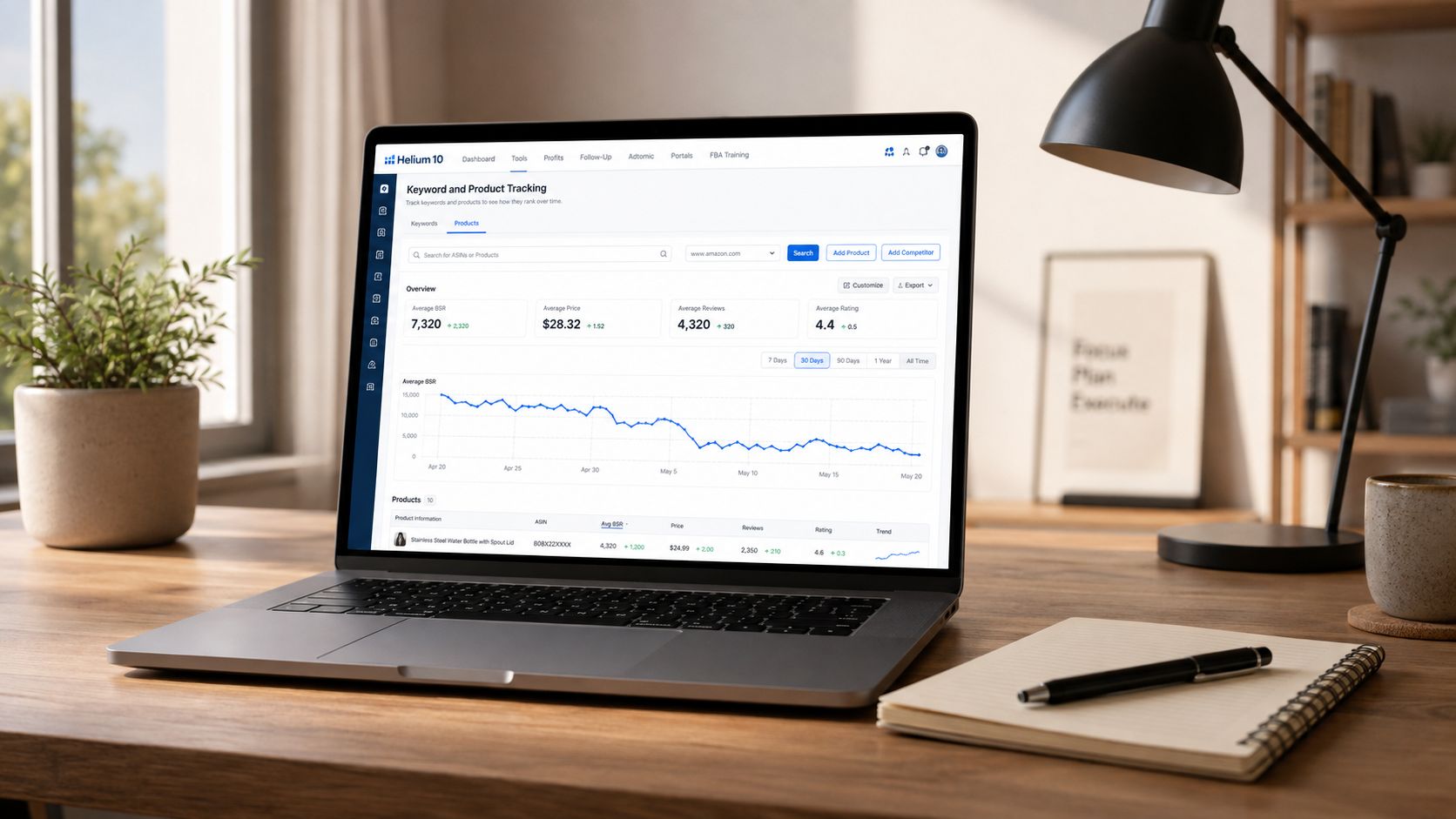
For a smaller catalog, a 15-minute weekly Google Sheet pull from Amazon product-page information may be enough. The right system depends on the number of ASINs, the volatility of the products, and how quickly the team needs to identify a pricing, promotion, or availability problem. A tool is only useful if someone connects the movement to an action.
Checking a volatile product once a week can flatten the story. A promotion may lift rank and then fade between observations, while a stockout can create a misleading before-and-after gap. Active products deserve more frequent sampling, while steady performers can usually be reviewed weekly.
The point isn't to watch every update. It's to collect enough context to compare like with like. RankEngine's ranking insights are a useful reference for thinking about rank tracking as a historical trend rather than a single screen value. For an omnichannel view, see this practical guide to tracking Amazon rankings for omnichannel growth.
A Monday review can use one compact row per ASIN:
Use the video below as a visual reference for dashboard-based tracking, then keep the review tied to margin and replenishment decisions.
BSR is an output of sales velocity, not a budget allocation rule. A rank improvement matters only when the orders behind it produce acceptable contribution dollars and can be supplied without creating a later inventory problem. Start with the lowest-cost path to profitable orders, then check whether the gain survives after the intervention ends.
Improve the title, bullets, A+ content, image stack, and product information before buying more traffic. A stronger detail page can convert existing sessions more efficiently, creating orders without paying to acquire every one through PPC.
Measure the change through unit session percentage, ordered units, advertising efficiency, and contribution dollars per session. A conversion lift can still hide a pricing issue if the ASIN requires deeper discounts to close the sale. Compare the margin created by the improved conversion with the cost of any offer supporting it.
A limited promotional test is easier to defend than a permanent price reset. Build a before-and-after contribution model that includes selling price, product cost, fulfillment, referral fees, coupon funding, advertising, and expected returns. The model should show total contribution dollars, not just units sold or BSR movement.
If a lower price produces more orders while contribution per order falls sharply, calculate the incremental volume required to keep total contribution dollars flat. That extra volume may also increase replenishment pressure, returns, or cash tied up in stock. In that case, a better rank can represent weaker economics.
Practical rule: Price for the role you need the ASIN to play, not for the rank you want to screenshot.
A stockout interrupts sales velocity, disrupts conversion continuity, and may force the team to rebuild momentum after replenishment. Replenishment decisions should combine forecasted demand, lead time, inbound reliability, and safety stock. A temporary rank spike is not a reliable new baseline.
Set an internal days-of-cover threshold that fits the product's supply chain and seasonality. This threshold is an operating control, not a universal Amazon rule. It limits the chance that a short-lived surge produces an availability failure that later erases profitable velocity.
Sponsored Products and Sponsored Brands can accelerate traffic, but spend should be mapped against incremental contribution, not ACoS alone. A campaign above the preferred ACoS may still be useful if it creates profitable organic orders. A campaign with an acceptable reported ACoS can destroy margin if it takes credit for orders that would have occurred without the ad.
After each meaningful budget change, review rank, non-ad orders, total contribution dollars, TACoS, and inventory cover. Separate paid order growth from genuine incremental demand. If the rank holds only while spend rises, the campaign is buying a position rather than building an efficient sales base.
Coupons and deals can concentrate sales into a short period and improve recent velocity. They can support demand testing or a controlled inventory clearance, provided the test has a defined margin floor and stopping condition.
Test one promotion at a time when possible. Record the starting rank, units, price, ad spend, contribution dollars, and post-promotion baseline. If rank falls back immediately, the offer created a temporary spike rather than a durable demand change. The post-promotion contribution result should determine whether the offer returns.
Customer experience affects conversion, but review activity is not a direct BSR input. Amazon states that BSR is calculated from sales volume data and is not directly influenced by page views or customer reviews, as noted earlier. Reviews can still matter indirectly when they help shoppers decide to purchase.
Track conversion rate, return reasons, customer complaints, and contribution after returns. Do not pursue review volume through practices that violate Amazon policy or create operational exposure. Product quality, packaging, fulfillment, and expectation setting should carry the work.
Use this guide to calculate contribution margin, then connect each BSR intervention to a dollar outcome. A higher rank is useful when it reflects efficient, repeatable velocity. It is a warning sign when it depends on discounts, rising ad spend, or inventory risk that the margin model cannot support.
The fastest route to a better Amazon Best Sellers Rank can damage the business. Lower prices may increase orders while fees, coupons, fulfillment costs, and PPC consume the additional revenue. Aggressive advertising can create dependency, and stockouts can interrupt the velocity that the rank reflects.
The operating sequence matters because each layer carries a different risk profile.
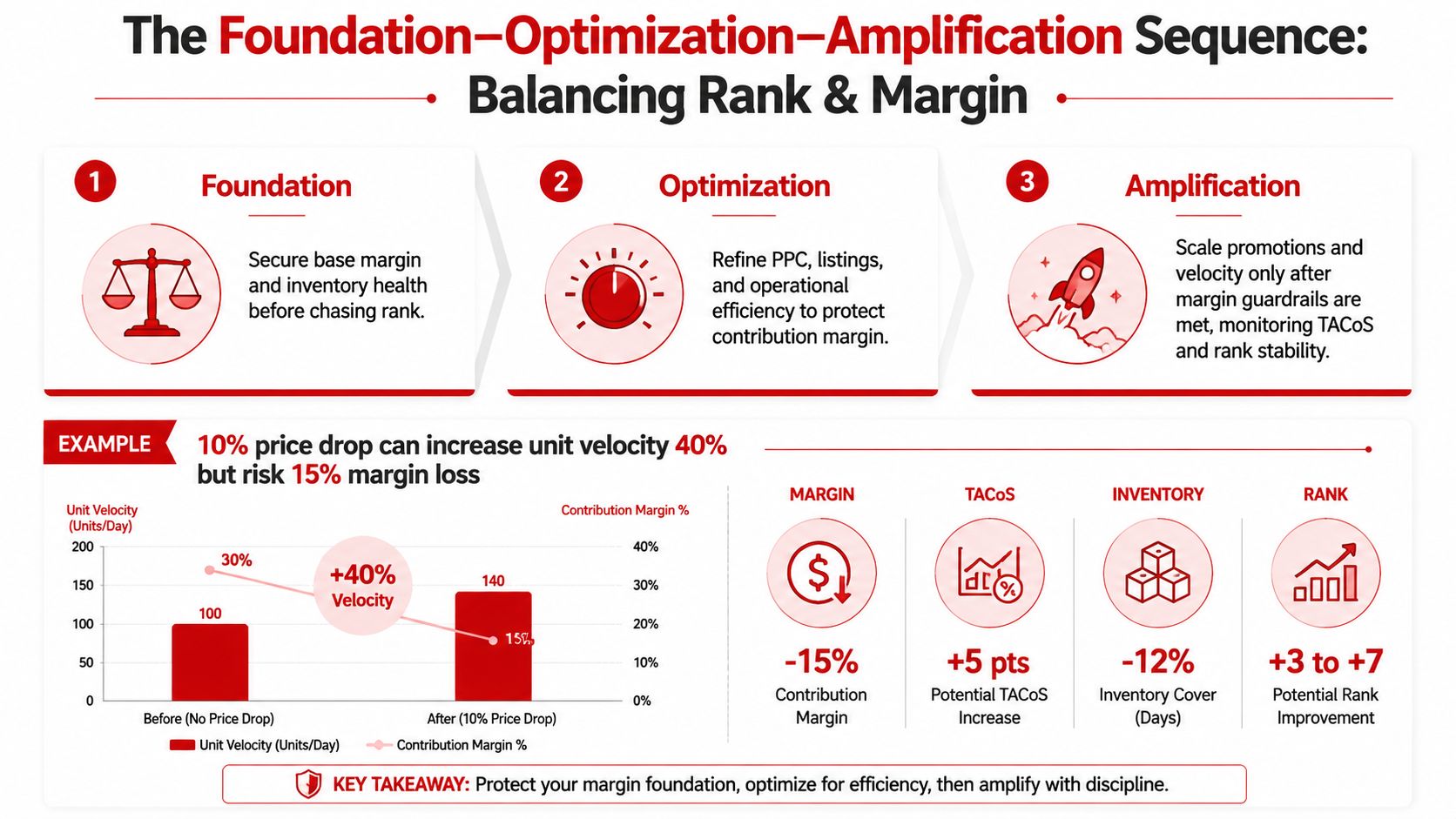
Foundation work includes accurate demand forecasting, compliant variation setup, reliable replenishment, contribution-margin economics, and review monitoring. It answers whether the product can absorb more demand without creating a service, cash-flow, or inventory problem.
Set guardrails before scaling. Useful controls include a minimum contribution-dollar requirement per order, a TACoS ceiling, a days-of-cover range, a return-rate limit, and a stockout alert. These controls turn BSR from a target into one input in a controlled operating system.
Optimization covers listing changes, pricing tests, conversion improvements, and search-term targeting. The objective is to make each qualified session and order more productive before adding more traffic.
A brand might reject a deep price cut that increases units but lowers contribution dollars, then test a lower-cost bundle or a smaller coupon instead. That choice may produce a less dramatic rank movement, but it can create healthier economics and a more dependable replenishment plan.
Amplification adds PPC scale, coupons, deals, bundles, and external traffic only after the foundation and optimization work meet their guardrails. Each lever should have a defined budget, an exit condition, and a post-test review.
Measure BSR, ordered units, ad spend, contribution dollars, and replenishment risk together. If one metric improves while the others deteriorate, the team hasn't found profitable growth. It has found a trade-off that needs a deliberate decision.
Review Amazon Best Sellers Rank alongside ordered units, sessions, unit session percentage, advertising cost of sales, contribution margin, return rate, in-stock rate, and category share. A lower rank usually indicates stronger recent sales velocity, but the operating question is what changed and whether the change produced durable contribution dollars.
Use a baseline and annotate promotions, price changes, listing edits, ad launches, and stock events. Separate main-category movement from subcategory movement, then review a 7-day or 28-day trend rather than reacting to one hourly update. Amazon's ranking is designed to reflect current demand, so the useful interpretation comes from trend context, not a single point.
Investigate when a product leaves its normal rank range, TACoS rises above plan, or contribution dollars decline for two consecutive weeks. The objective isn't to win a ranking screenshot. It's to build a repeatable system that identifies profitable velocity gains without subsidizing uneconomic growth.
Reddog Consulting Group works with CPG founders and operators on margin review, marketplace performance, inventory velocity, and growth planning across Amazon and other retail channels. Book a free 30-minute working session through Reddog Consulting Group to examine what your BSR is signaling and whether your current growth levers are producing durable contribution dollars.
Leave a comment: