
Published: March 2020 | Last Updated:August 2026
© Copyright 2026, Reddog Consulting Group.

If you want to know how to grow my small business online with limited time and cash, start here: fix your website’s conversion path, launch one content and SEO engine, capture emails at every touchpoint, and run a small paid search or social test for immediate leads. That order isn’t arbitrary. Email marketing returns roughly $36 for every $1 spent, and SEO returns about $22 per $1, but SEO takes 3 to 6 months to compound while paid ads deliver traffic this week.
Do these three things in the next 72 hours:
Sustainable online growth comes from sequencing a conversion-ready website, a compounding SEO and email engine, and small paid tests, while CPG founders protect contribution margin at every step.
| Point | Details |
|---|---|
| Fix conversion first | A clear CTA, fast mobile load, and trust signals make every other channel more efficient. |
| Sequence for ROI | Email returns about $36 per $1 and SEO about $22 per $1, but SEO needs 3 to 6 months. |
| Use paid for speed | Small, tracked ad tests tied to a converting landing page deliver leads within days. |
| Protect margin | CPG brands should calculate SKU-level contribution margin before scaling any channel. |
| Get a margin review | Reddog offers a free 30-minute strategy call on contribution margin and channel economics. |
You don’t need a full marketing department to see movement in 14 days. You need a short list, executed in order.
Expect early wins from the ad test and email capture within days. The website fix and content piece are investments that pay off over the following months, not the following week.
Every channel you invest in afterward runs through your website, so weak conversion architecture wastes ad spend and organic traffic alike — learn how to improve your digital presence for SMB growth for better results. Before you spend another dollar on acquisition, confirm your site does these things:
Install Google Analytics 4 and conversion pixels for any ad platform you plan to use, then set up goals for purchases, form fills, and calls. Shopify’s guidance on sales funnels recommends starting with a one-page funnel for your flagship product before adding complexity elsewhere.
Pro Tip: Pick one metric, conversion rate on your primary landing page, and fix that before touching anything else. Test one headline variant and one CTA color against your current version for two weeks; resist the urge to change five things at once.
SEO is an appreciating asset, not a light switch. It typically takes 3 to 6 months to generate consistent, reproducible leads, but once it works, it keeps working without a recurring ad spend.
Choose your first three topics from real customer questions, high-intent keywords tied to a purchase decision, and pages specific to your service area or product line. A single strong piece published monthly compounds into predictable organic traffic over time far more reliably than sporadic bursts.
Your tactical checklist:
Given that SEO returns about $22 for every $1 spent against email’s roughly $36, building a content and SEO strategy early sets up the highest long-term return per dollar, once you’re past month three.
Pick where your customers already spend time, not every platform that exists. A B2B service business likely needs LinkedIn and maybe one other channel. A retail or CPG brand often gets more traction from Instagram and TikTok, where product demos and unboxing content perform well.
A large majority of the U.S. population maintains a social profile, so reach isn’t the constraint, relevance is. Prioritize short-form video, real product usage clips, and customer testimonials over polished brand content. Repurpose one piece of content across three formats weekly rather than creating something new every day.

Add paid spend only to amplify posts that already perform organically, or to target a narrow, high-intent audience with a small test budget.
Pro Tip: Ignore likes and follower counts. Track leads, bookings, or add-to-cart actions tied to specific posts, that’s the only signal that tells you whether social is actually working.
Email typically delivers the highest return of any channel available to a small business, which makes list building and automated flows your first retention priority, not an afterthought.
Build these four sequences first:
Capture emails everywhere: an on-site offer, a checkout field, and a QR code at the point of sale if you operate a physical location. Acquisition costs have risen notably since 2023, and personalized onboarding can improve retention in that critical first 90 days, which is exactly why keeping an existing customer costs far less than acquiring a new one.
Paid channels are the right tool when you need demand now, not in three months. Use small, measurable tests tied to a landing page that already converts, never a page you haven’t checked yet.
Budget $500 to $1,000 per month if you’re a lean, local operation just starting out; growing businesses often spend more. Before you spend a dollar, confirm you have a focused single offer, conversion tracking installed, a narrow target audience, and one primary KPI you’re measuring against, usually cost per lead or cost per sale.
Pro Tip: If your landing page converts below 2%, fix the page before you scale ad spend. More traffic to a weak page just multiplies your losses.
Ask for reviews at the point of sale and follow up by email within a week of purchase; response rates drop fast after that window. Reply to every review, good or bad, using a short template that acknowledges the specific feedback.

Referral programs work best when kept simple: a fixed discount or credit for both the referrer and the new customer, tracked with a unique code. For CPG brands considering marketplaces, evaluate margin impact, inventory and fulfillment rules, and storage fees before listing, not after.
Pro Tip: Micro-influencers with 5,000 to 50,000 engaged followers often convert better per dollar than larger names, especially for CPG products where trust and authentic usage matter more than reach.
Track conversion rate, customer acquisition cost, customer lifetime value, return on ad spend, email open and click rates, organic traffic growth, and retention rate. Those seven numbers tell you almost everything about channel health.
| Channel | Primary KPI | Expected Timeline |
|---|---|---|
| Paid search/social | Cost per lead, ROAS | Immediate to a few weeks |
| SEO/content | Organic traffic, rankings | 3 to 6 months |
| Open rate, click rate, ROI | Immediate to short term | |
| Social organic | Engagement to lead ratio | 1 to 3 months |
Review paid performance weekly, content and SEO monthly, and overall strategy quarterly. Email’s roughly $36 return and SEO’s $22 return per dollar spent should guide where you invest once your foundation is solid.
Growth that erodes contribution margin isn’t growth, it’s a slower way to run out of cash. Before scaling any channel, run this checklist:
Pro Tip: Align promotional cadence with inventory velocity. Running a discount right before a restock delay strands your margin gains in a stockout, and you’ll pay for the promotion twice.
Working with CPG brands, we’ve watched founders chase topline growth that quietly bled contribution margin dry. The brands that scale sustainably calculate unit economics before they discount, not after.
There are plenty of general marketing playbooks out there for growing traffic and followers. Reddog focuses on a narrower, harder question: which channels actually contribute to profit once you account for Amazon FBA fees, Walmart WFS margin compression, 3PL storage costs, and pricing strategy across DTC and wholesale.
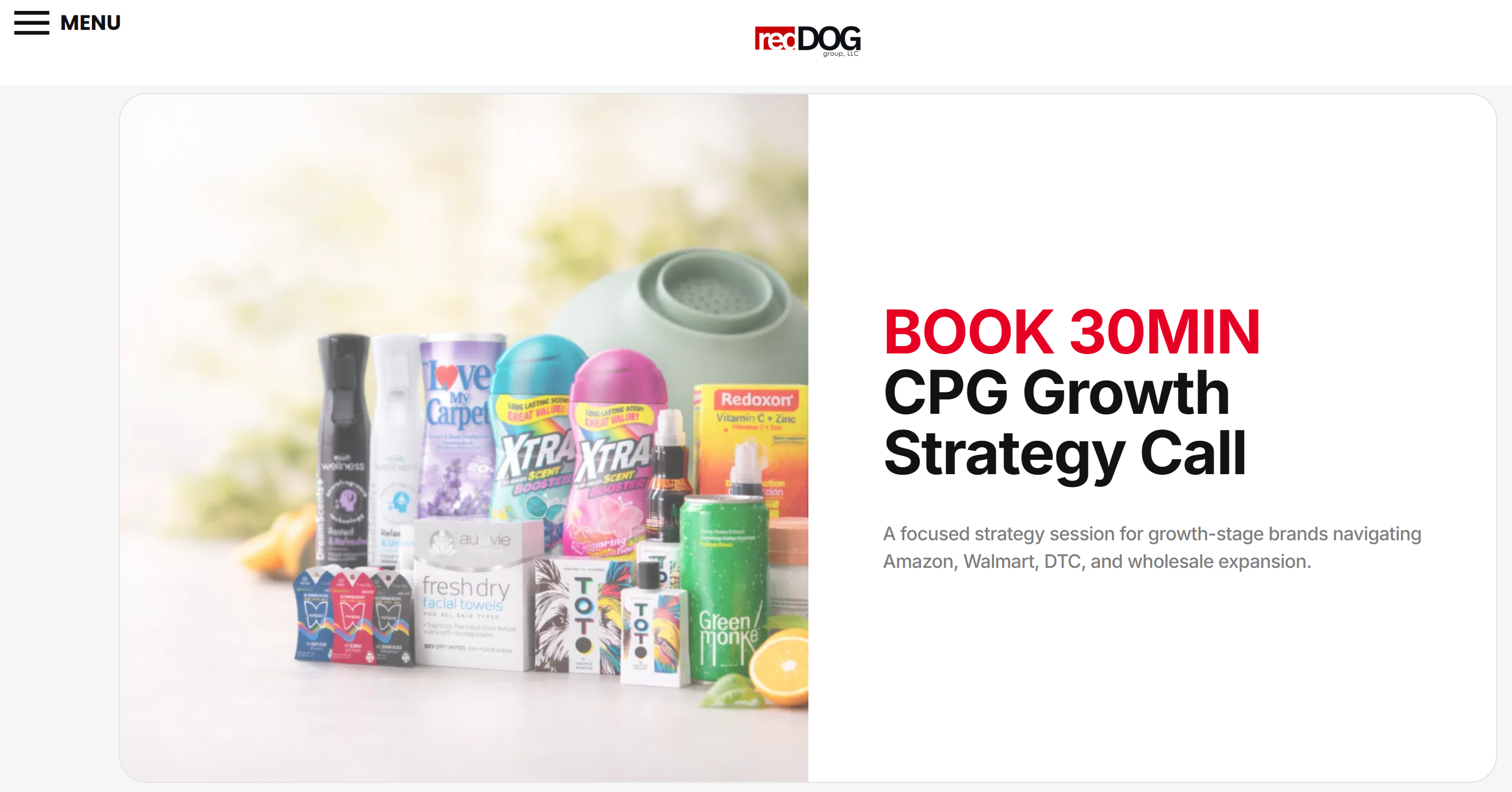
If you’re a CPG founder or operator in the $500K to $20M revenue range weighing where to expand next, book a free 30-minute strategy call with Reddog. We’ll walk through your contribution margin by channel, inventory velocity, and where a pilot expansion makes sense before you commit real budget. It’s a practical review, not a sales pitch, built for founders who want clarity before they scale.
Leave a comment: