
Published: March 2020 | Last Updated:August 2026
© Copyright 2026, Reddog Consulting Group.

An omnichannel retail strategy unifies inventory, data, and customer experience across every channel a shopper might use, from Amazon and Walmart.com to a mobile app to the store shelf, so the transaction feels like one continuous relationship instead of separate silos. Three things follow immediately from that definition. Operationally, it demands real-time inventory and order orchestration across channels, not separate spreadsheets per marketplace. On measurement, it requires channel-level economics and shared KPIs rather than vanity metrics reported in isolation. Organizationally, it needs one cross-functional owner, because no single department controls the full customer journey.
If you’re starting from zero, don’t try to unify everything at once. Audit your current channel mix, pick the one pairing with the clearest margin upside (often DTC plus a single retail partner), and pilot there first.
Omnichannel retail strategy succeeds when inventory visibility, unified data, and channel-level contribution margin get solved together, not addressed one at a time.
| Point | Details |
|---|---|
| Definition matters | Omnichannel unifies inventory, data, and customer experience; multichannel keeps those separate. |
| Start with one pairing | Pilot a single channel pairing, like DTC plus one retail partner, before scaling further. |
| Measure margin, not just revenue | Track channel-level contribution margin, basket size, and repeat purchase rate from day one. |
| Fix inventory visibility first | Most program failures trace back to data silos and poor cross-channel inventory sync. |
| Get a margin-first review | Reddog’s free 30-minute strategy call maps channel P&Ls and pilot priorities for CPG brands. |
Multichannel retail means selling on several channels that operate independently. Your Amazon listing, your Shopify store, and your Walmart page each run their own inventory, pricing, and customer data with little crosstalk. Omnichannel retail flips that: every channel draws from the same inventory pool, the same customer profile, and the same brand promise, so a shopper who browses on Instagram and buys in-store gets treated as one person, not three data points. That distinction is the entire industry has been slow to close. Industry reporting on CPG brands found only about 12% of brands feel comfortable with their level of omnichannel integration, even though 44% say they’ve invested in internal education to get there.
Think about the core touchpoints you’re actually trying to connect:
A useful way to picture the architecture is in three layers: the customer-facing layer (what shoppers see and touch), the orchestration layer (order routing, inventory allocation, identity resolution), and the systems layer (the databases and platforms doing the work underneath). Most CPG brands over-invest in the top layer and skip the middle one entirely, which is where the breakdowns happen.
Pro Tip: Don’t try to connect all six touchpoints simultaneously. Start with one high-value pairing, like your DTC site and your strongest wholesale partner, and prove the inventory sync works before adding a third channel.
The case for customers is straightforward: a seamless experience across channels, more convenience in how and where they buy, and personalization that actually reflects their history with your brand rather than treating every visit as a first date.
The business case is where CPG operators should pay closer attention:
Realistic ROI examples look modest but compound. A brand that connects loyalty across its app and in-store POS often sees a measurable lift in repeat purchase rate within two to three quarters. A brand that shares inventory visibility between DTC and wholesale can reduce safety stock at the SKU level without increasing stockout risk, freeing cash that was previously parked in redundant inventory.
The number worth tracking: roughly 75% of shoppers use both digital and physical touchpoints during the same purchase journey, according to Oliver Wyman’s research on omnichannel CPG data. If three out of four of your customers are already behaving this way, your channel strategy should assume it, not treat it as an edge case.
The concept becomes concrete fastest through the use cases brands actually run:
For an emerging CPG brand with thin margins, unified loyalty is usually the lowest-cost, highest-signal pilot: it requires a CDP and a loyalty platform, not a full logistics overhaul. Growth-stage brands with retail partnerships already in place should look harder at BOPIS or ship-from-store, since the infrastructure to support them often already exists on the retailer’s side. Whichever you pick, scope the pilot with a named owner, a 90-day window, and two or three KPIs decided before launch, not after.
Most CPG teams don’t fail at omnichannel because the idea is wrong. They fail because they try to build everything at once instead of following a phased sequence. A practical five-step model for building a seamless approach starts with due diligence and gap analysis, moves through assortment and fulfillment alignment, and ends with continuous measurement, and that sequencing matters more than any single tactic inside it.
Timelines and costs vary a lot by company size. An emerging CPG brand under $2 million in revenue can often run a lean pilot, connecting one marketplace with DTC inventory, using existing tools and a part-time technical resource, inside three to four months. A growth-stage brand in the $5 million to $20 million range typically needs a dedicated project owner, some middleware investment, and six to nine months to get a multi-channel pilot fully validated before scaling. Neither number is a guarantee. Supply-chain capability is consistently the gating factor: McKinsey’s research on CPG omnichannel programs found that when executives in Europe were asked about their progress, 80% had omnichannel efforts under way, but fewer than 25% believed they were actually on the right track.
Before calling a pilot successful, check for:
You don’t need every enterprise platform on the market. You need the right systems talking to each other. A product information management (PIM) system centralizes product data so listings stay consistent across every channel. An order management system (OMS) routes orders to the right fulfillment source, whether that’s a warehouse, a 3PL, or a retail shelf. A customer data platform (CDP) resolves identity so the same shopper is recognized whether they’re on your app or in a store. Point-of-sale (POS) systems capture the in-store transaction and feed it back into the same inventory pool everything else draws from.
Prioritize integrations in this order: inventory visibility first (you can’t orchestrate what you can’t see), order orchestration second, identity resolution third. When evaluating vendors, weight API maturity and integration openness far more heavily than feature lists. A platform with fewer features but a genuinely open API will outperform a feature-rich system that locks your data in.
Resist the urge to rip out your entire tech stack for a single pilot. Most early wins come from a lightweight middleware or orchestration layer sitting on top of what you already have, not a wholesale platform replacement. Reddog’s breakdown of omnichannel commerce covers how this layered approach plays out across ecommerce, marketplaces, and physical retail in more depth.
Track these at both the pilot and program level:
Attribution is the hard part. Multi-touch attribution models work reasonably well for digital-heavy journeys, but for CPG brands with meaningful in-store volume, lift experiments (comparing a pilot region or SKU set against a control) tend to give cleaner answers. Channel-level P&Ls remain the most reliable long-term measurement approach, since they force every channel to prove its contribution margin rather than hide behind top-line growth. For most pilots, a simple lift comparison is enough to make a go or no-go call.
Build one unified executive dashboard showing overall program health, backed by channel-level drilldowns for the operators actually running each piece. Reddog’s guide to omnichannel marketing integration covers measurement frameworks for coordinating campaigns and attribution across channels in more detail.
Data silos are the most common failure point. When your POS, e-commerce platform, and marketplace accounts each hold separate customer records, you can’t build the unified profile omnichannel depends on. The fix is identity resolution through a CDP or equivalent middleware, not a bigger spreadsheet.
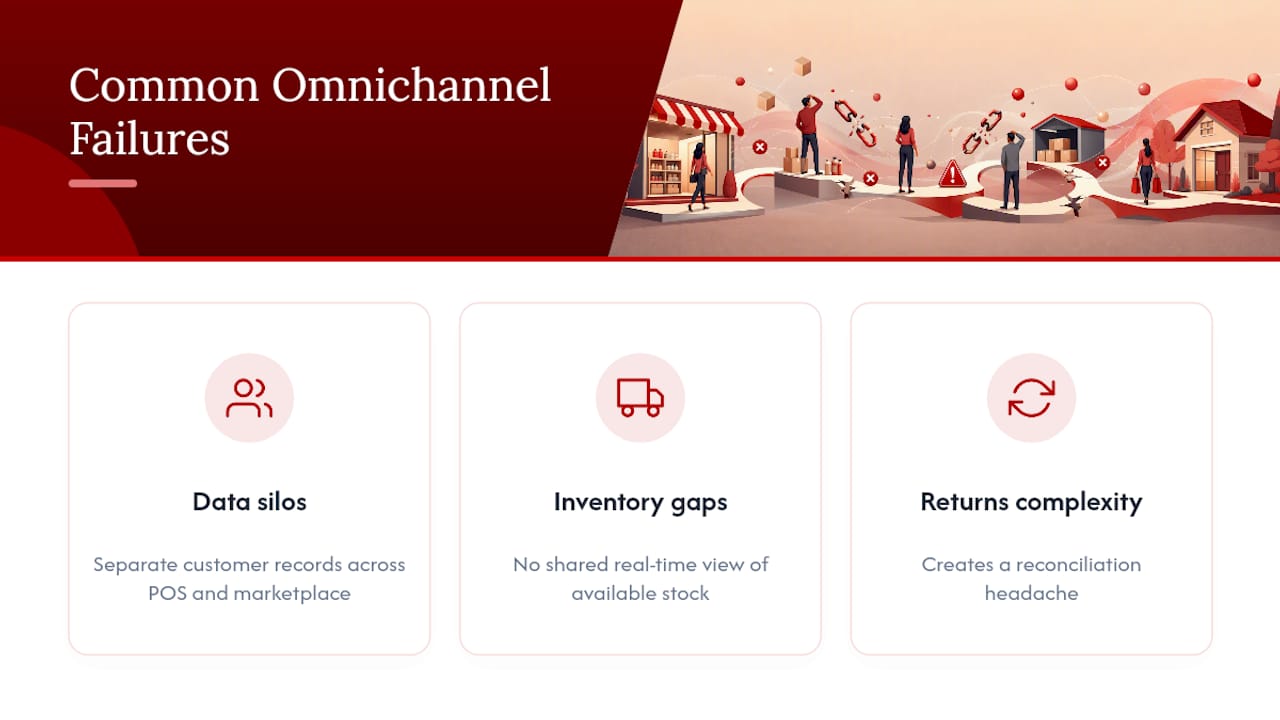
Inventory visibility gaps come next. If your warehouse doesn’t know what your retail partner has on shelf, you’ll overpromise online and underdeliver in-store. Distributed order management systems solve this by giving every channel a shared, real-time view of available stock.
Returns complexity trips up more programs than founders expect. A customer who buys online and wants to return in-store creates a reconciliation headache if your systems aren’t built for it. Standardize the return policy across channels first, then build the routing logic to match.
Watch for these red flags in your own program: no channel-level P&L, no single owner for cross-channel governance, and a supply chain that hasn’t been upgraded to match the ambition of the customer experience you’re building.
Pro Tip: Change management beats technology every time in the early stages. Build a small cross-functional steering team, run one fast, visible pilot, and let that early win create the internal credibility you need before asking for a bigger budget.
CPG economics make omnichannel harder than it looks in a generic retail playbook, because margin, cash timing, and shelf presence work differently in every channel. Before investing in any new touchpoint, build channel-level P&Ls that account for Amazon FBA fees, Walmart WFS margin compression, and wholesale terms separately. Set SKU-level assortment rules so you’re not spreading the same catalog thin across channels with wildly different margin profiles. Monitor inventory velocity closely, since a SKU that moves fast on Amazon may sit for months in a distribution warehouse.
Slotting fees, promotional allowances, and cash-cycle timing all vary by retailer, and treating them as afterthoughts is how healthy top-line growth turns into thin or negative contribution margin. A CFO-focused playbook for omnichannel CPG brands recommends unified demand planning and dynamic re-allocation rules precisely because channel economics shift fast enough that static plans go stale within a quarter.
Most clients we talk to have already started omnichannel work informally, usually by adding a channel without connecting it to anything else. The trajectory that tends to work: audit your channel economics honestly before adding new touchpoints, lock down inventory visibility across whatever channels you already run, then pilot one connected experience with a hard 90-day review. Resist the pull toward a full platform replacement before a pilot has proven measurable margin or retention gains. That spending decision should follow evidence, not precede it.

Reddog is the alternative to guessing your way through channel expansion. Rather than chasing every marketplace or platform trend, we help you find out which channel pairing actually improves your contribution margin before you commit budget or headcount to it.
Our free 30-minute strategy call is built around three things: a quick channel-level P&L check to see where margin is leaking, a snapshot of your inventory velocity across current channels, and two or three prioritized pilot ideas based on your specific revenue and margin profile. This works best for CPG brands in the $500,000 to $20 million revenue range, whether you’re a founder, head of sales, or operator trying to make sense of Amazon FBA fees, Walmart WFS margin compression, or DTC and wholesale expansion at the same time.
If that sounds like where you’re at, book your free 30-minute strategy call and bring your current channel numbers. We’ll help you figure out where the real opportunity is before you spend another dollar on a new platform.
What is omnichannel retail strategy in simple terms? It’s an approach where every sales channel, from your website to a retail shelf, shares the same inventory, customer data, and brand experience, so a shopper feels like they’re dealing with one connected business instead of separate stores.
What does omnichannel mean in retail versus multichannel? Multichannel means selling across several channels that operate independently. Omnichannel connects those channels so inventory, pricing, and customer profiles stay consistent no matter where someone shops.
What are the main benefits of omnichannel strategy for a small CPG brand? The biggest early wins are usually better inventory efficiency and higher repeat purchase rates, since a connected loyalty or inventory system reduces waste and keeps customers engaged across more than one touchpoint.
How long does it take to implement an omnichannel retail strategy? A lean pilot connecting two channels can run in three to four months for a smaller brand. Growth-stage brands scaling a validated pilot across more channels often need six to nine months or longer.
What is the first step in how to implement omnichannel retail? Audit your current channels, systems, and data flows honestly before touching any technology. You need to know where the gaps actually are before you can prioritize which one to fix first.
Leave a comment: