
Published: March 2020 | Last Updated:October 2026
© Copyright 2026, Reddog Consulting Group.

You know the moment. Sales are still coming in, inventory is still moving, and then a performance notification lands in Seller Central and cuts straight through the day. For a CPG operator, that usually means a messy mix of cash tied up in FBA, ad spend still running on products that may be frozen, and a team trying to figure out whether the issue is a listing glitch, a product complaint, or a broader account problem.
The wrong instinct is to treat the amazon appeal process like a customer service reply. It isn't. Amazon's own framework is built around a formal performance notification, a corrective Plan of Action, and evidence that shows what failed, what changed, and how recurrence will be prevented, with submission handled through Seller Central's Account Health flow. That means the core work is operational, not rhetorical. Amazon account health and compliance overview makes that structure clear, and so does this deeper breakdown of Amazon seller account health.
A suspended seller usually opens the notice and sees three questions at once. What triggered this. Is the problem at the ASIN level or the account level. And do I need to admit fault or prove Amazon got it wrong.
That triage matters because not every enforcement is the same. A soft policy warning may only require a targeted correction, while a listing-level deactivation can hinge on one SKU, one image set, or one supplier issue. A full account suspension is broader, and the response has to match that scope instead of sounding like a generic apology.

The first move is not writing. It's reading. Amazon's appeal workflow is tied to the specific Performance Notification in Seller Central, not an unrelated support thread, and sellers should use the relevant Reactivate or Appeal action in Account Health. That matters because the notice tells you what Amazon thinks broke, and the response should answer that exact problem.
A practical way to stay calm is to ask whether the issue is customer experience, policy compliance, or fulfillment performance. If the answer points to a product-condition complaint, a bundle mismatch, or a documentation gap, the appeal needs to be built like a control plan. If the answer is “Amazon made a mistake,” then the submission needs proof, not frustration.
For an operator who's already juggling margin pressure, the temptation is to react fast and hope speed wins. It usually doesn't. The Stewart Accounting Services appeal support example is useful as a reminder that formal appeals work better when they're tied to a defined process and a defined record, not a plea for mercy.
A single bad listing photo does not call for the same response as a broader account health failure. The notice determines the evidence set, the corrective actions, and the level of cross-functional review you need before anyone hits submit.
Practical rule: if the notice affects multiple ASINs, treat it like a systems issue until the evidence proves otherwise.
Don't write a broad narrative and hope it fits. Build the appeal around the exact notice, then separate out shared process failures, like catalog controls or supplier verification, from product-specific fixes. That keeps the response focused and stops the team from wasting time on the wrong layer of the problem.
Open Seller Central's Account Health dashboard first, then open the exact Performance Notification tied to the enforcement. Amazon may ask for a questionnaire, a policy acknowledgment, a quiz, or supporting documentation, so diagnosis starts by reading what the platform is asking for, not what you think it wants.
Pull the affected ASINs, order IDs, date ranges, supplier records, and fulfillment records into one working folder. If the violation touches multiple products, map each one separately, because a shared explanation is weaker than a clean linkage between issue, SKU, and corrective action.
That's also where the decision splits. If the violation was valid, the appeal should acknowledge the policy and explain the correction. If the enforcement was wrong, the submission should state that Amazon's action was in error and attach evidence showing compliance. Amazon's guidance makes that distinction explicit, and the response path inside Seller Central follows it.
A simple discipline helps: don't write until you can answer five questions from the folder alone, what happened, when it happened, which products were affected, who supplied them, and what evidence supports your version of events. That's how the appeal shifts from memory to record.
| Question | Acknowledge Violation | Dispute as Error |
|---|---|---|
| Did the product, listing, or process break policy? | Yes, and the appeal should say so clearly. | No, the appeal should show compliance. |
| What should the narrative focus on? | Root cause, correction, prevention. | Proof, record alignment, and documentation. |
| What documents matter most? | Updated packaging, training records, quality-control evidence. | Invoices, images, supplier records, and other compliance proof. |
| What tone works? | Direct and corrective. | Calm and evidence-led. |
If you've ever tried to reconcile a messy chargeback before the inventory count closed, the logic is the same. The story doesn't matter until the documents line up. This supplier-relationship guide is relevant here because supplier traceability often determines whether the appeal is reviewable at all.
A strong amazon appeal process follows a chain, not a script. Amazon's guidance rewards a root cause, an immediate corrective action, and a preventive control, which is really just the operating logic behind any durable fix. If one of those layers is missing, the appeal reads like a complaint instead of a control plan.
Take a mislabeled bundle that triggered a customer complaint. The root cause might be a catalog mapping error, not a bad product. The corrective action could be a listing update and inventory quarantine. The preventive control might be a pre-shipment SKU audit so the same mix-up doesn't happen again.
That structure works because every sentence answers one of four questions, what failed, why it failed, what changed, and how recurrence will be detected. Amazon's appeal guidance specifically asks sellers to identify the event causing the issue, explain the corrections already taken, and provide evidence when the enforcement was made in error. A response that drifts into storytelling without those answers usually feels thin.
The appeal gets stronger when it reads like a memo from the person who already fixed the problem.
Use actual operational terms. Say you quarantined inventory, corrected a listing claim, replaced a non-compliant image, or terminated an unverifiable supplier if that's what happened. Avoid “we've taken steps to improve” unless you can name the step, the owner, and the evidence trail.
The preventive control is where many appeals get vague. “This won't happen again” is not a control. A real control names the owner, the frequency, the evidence, and the escalation threshold. That can be a weekly review, a pre-publication claim check, a lot-level receiving log, or an approval gate before inventory is released.
For brands that need an external operator, Reddog Consulting Group's Amazon reinstatement services are one example of a structured approach that includes assessment, Plan of Action creation, documentation assembly, appeal submission, and iterative resubmissions through Seller Central. The value isn't the wording, it's the discipline of linking cause, correction, and control.
The appeal should not ask the reviewer to infer the fix. Attach the proof that supports each layer. A packaging photo supports a corrected label. A training record supports a new process. A QC log supports the control that prevents recurrence.
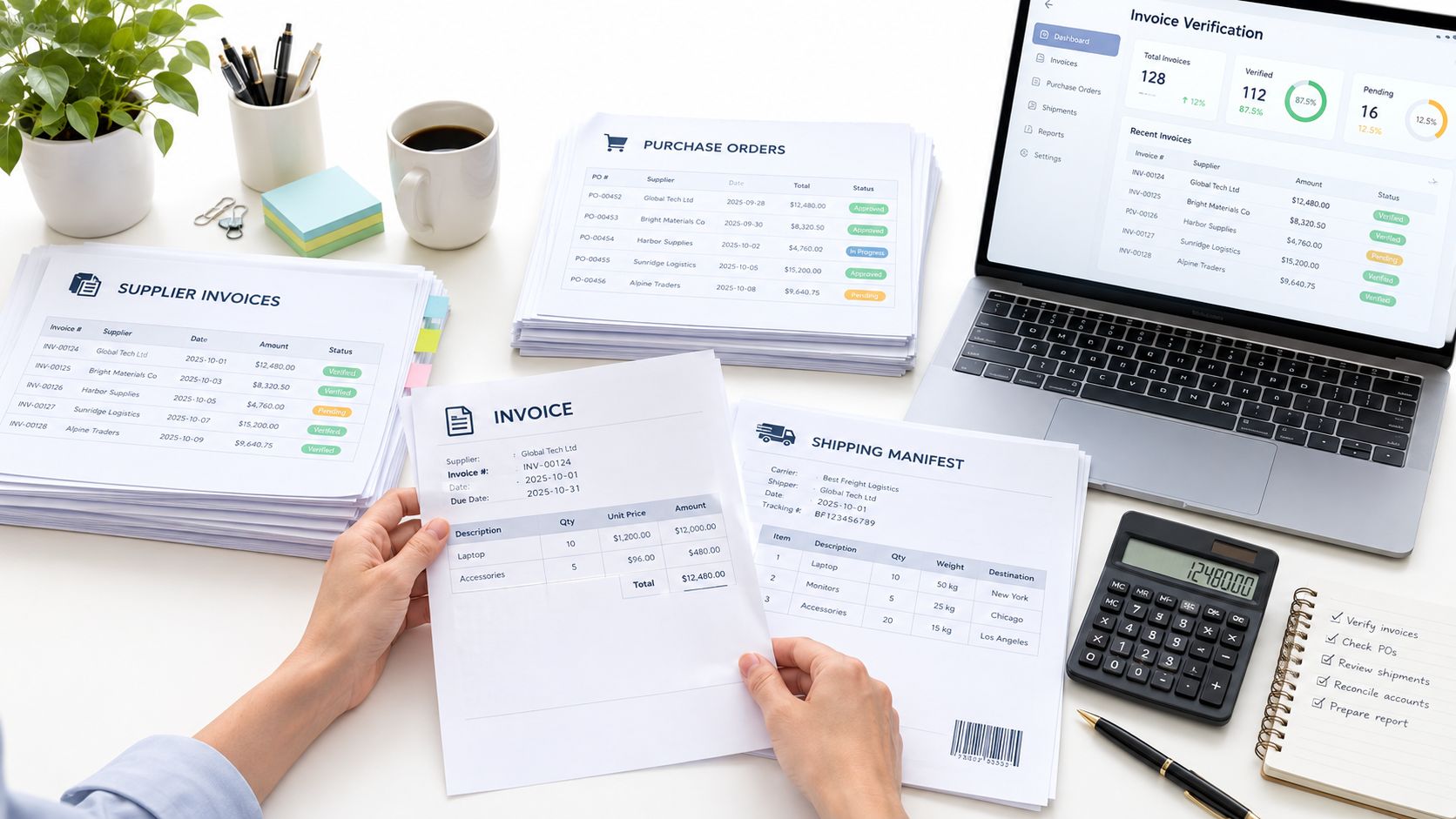
The documentation review belongs in finance and operations, not in a generic admin folder. Amazon's invoice standards are specific, the invoice should be dated within the 365 days before the performance notification, show quantities sufficient to cover the cited ASIN's sales volume and in-stock inventory during the relevant period, and include clear product identifiers plus supplier contact details. Amazon also rejects quotes, pro forma invoices, self-issued invoices, and editable files such as spreadsheets or word-processing documents.
Start with purchase orders, then match them to receiving records, supplier identity, ASINs, and sales records. If the volumes don't line up, don't hope the gap won't be noticed. Fix the evidence set or adjust the appeal to reflect what can be proven.
Brands often discover they have legitimate product but an unreliable chain of custody. The stock may be real, but if the paper trail doesn't cover the volume Amazon is reviewing, the appeal can still stall. That's why this work belongs in the Foundation stage of a marketplace growth system, before scaling ads or pushing more inventory.
A useful external reference for invoice structure is the RegisterCompany.ie invoice guide. The reason it matters here is simple, clean invoicing habits make it easier to prove what was bought, when it was bought, and from whom.
Use one matrix per enforcement. Track the requirement, document filename, issuing party, date coverage, ASIN or order linkage, and the exact sentence in the Plan of Action it supports. That sounds tedious, but it's faster than resubmitting weak evidence and waiting for another denial.
| Reconciliation field | What to verify |
|---|---|
| Supplier identity | Name, phone number, address, website, and legal consistency with Seller Central. |
| Product identifier | Product name, model number, or UPC on the invoice. |
| Date coverage | The invoice falls inside the review window. |
| Quantity coverage | Enough product to support the review volume. |
| Transaction quality | Authentic, unaltered, and completed, not a quote or editable file. |
Practical rule: if you can't trace a unit from supplier to receiving to ASIN, the appeal file isn't finished.
The section is also where a business owner feels the margin trade-off. A brand can carry inventory and still be unable to defend it, which turns working capital into stranded cash if Amazon won't reinstate the account.
The Plan of Action should sound like an operations memo, not an apology letter. Amazon wants to see that the seller understands the issue, fixed it, and installed a control that can be audited later. If the draft reads like it was copied from a forum, it usually fails the scan test.
Use three sections, root cause, corrective action, and preventive control. Keep the root cause narrow and factual. Keep the corrective action observable. Keep the preventive control specific enough that another operator could run it.
A weak version says, “We've reviewed our process and will do better.” A stronger version says, “We identified a catalog mapping error that misrepresented the bundle, removed affected inventory, updated the listing, and added pre-shipment SKU verification before release.” The second version is better because it identifies a failure, a fix, and a control.
Amazon reviewers don't need drama. They need clarity, proof, and a path to confidence. That means short paragraphs, direct sentences, and evidence called out by reference so the reviewer can match the narrative to the documents.
Good appeals don't try to persuade with volume. They persuade by making the record easy to verify.
Use this as a starting point, then rewrite it against the actual evidence, not your memory:
The internal discipline matters as much as the words. Reddog's Amazon reinstatement services fit naturally here because the work is assembling the file, matching the evidence, and keeping the submission coherent across iterations.
Don't bury the reviewer in files. If a sentence claims a packaging fix, attach packaging photos. If a sentence claims supplier correction, attach the relevant invoice or termination record. Every attachment should earn its place by proving one line in the appeal.
The biggest mistake is assuming more appeals means better odds. It doesn't. Amazon's process rewards the quality of the first complete submission, not a flood of lightly edited retries.
A defensive appeal can also backfire when the record shows a real process gap. If the complaint is legitimate and the seller spends the whole draft arguing, the reviewer still sees an unresolved control failure. On the other hand, a clean admission without evidence doesn't prove the business changed in any durable way, so it can still get rejected.
Every week the account stays down, inventory velocity slows, ad spend loses efficiency, and Prime placement can disappear. For a CPG brand, that can hit the launch curve on new SKUs too, because one frozen account often blocks the rest of the portfolio from compounding.
There's also a trap in treating a listing symptom as the whole problem. If one ASIN triggered the notice but the root issue is catalog hygiene or supplier verification, fixing only the visible SKU creates a false sense of progress. The next enforcement tends to find the same gap in a different place.
A fast response that misses the real cause usually becomes an expensive delay.
The other underpriced risk is the language of certainty. “This will never happen again” sounds confident, but it's not a control. Amazon wants measurable safeguards, not reassurance. Owner, frequency, evidence, escalation threshold. Without those, the appeal remains a story.
Seller Fulfilled Prime performance appeals have a 14 calendar day window from the performance notification, a four day window to answer an information request, and a cap of three appeals per quarter. An appeal overturned as valid does not count toward that cap, which makes the first submission strategically important. Amazon's appeal timing guidance is the cleanest reference for those procedural constraints.
That changes the operating rule. Submit a complete first appeal before the deadline, because repeated versions that only change a few words can burn through the quarterly allowance without closing the evidence gap. In practice, that means you should not push “good enough” just to feel productive.
If Amazon asks for clarification, answer the request directly and keep the reply tied to the existing appeal. Don't open a new support case unless the issue belongs outside the performance notification. Amazon's workflow expects the response to stay attached to the original enforcement, and it warns against repeatedly submitting documents before the current appeal has been reviewed.
When the issue spans multiple products, map each enforcement to its own evidence and corrective action. Shared process failures still belong at the system level, but the documentation should show which ASIN, order, or policy issue connects to which control gap. That's how the record stays usable.
This is also where teams underestimate the value of disciplined support work. If the internal owner is overloaded, a best place to hire legal assistants search can make sense for document assembly, version control, and follow-up tracking, as long as the appeal strategy still sits with the operator who understands the business.
The best appeals improve the business even before reinstatement. They force catalog audits, supplier verification, packaging photo standards, and weekly Account Health monitoring into the normal workflow. That's the actual connection to Foundation, then Optimization, then Amplification. You protect the base first, then tune the system, then scale what survives pressure.
A brand that treats reinstatement as the end of the work usually ends up back in trouble. The stronger move is to make the appeal findings part of the control system, so the account doesn't just come back, it comes back harder to break.
If you need help turning an Amazon suspension into a clean operating plan, Reddog Consulting Group works through account recovery, evidence mapping, and marketplace margin trade-offs with CPG operators. Book a free 30-minute strategy call with Reddog Consulting Group to review your appeal file, your controls, and the next move for your Amazon business.
Leave a comment: