
Published: March 2020 | Last Updated:January 2026
© Copyright 2026, Reddog Consulting Group.

Nearly one out of every three American consumers makes a purchase through an online marketplace each month. For American e-commerce managers steering small or medium-sized brands, marketplace selling strategies are no longer optional for staying competitive. Understanding what makes marketplaces tick and debunking common myths will help you sharpen your multichannel approach, allowing smarter decisions and greater revenue impact for your brand.
| Point | Details |
|---|---|
| Marketplace Selling Advantages | Small and medium-sized businesses can expand reach and scale operations with minimal initial investment through online marketplaces. |
| Types of Marketplaces | Different marketplace models (B2B, B2C, C2C) cater to various business needs and customer segments, providing strategic growth opportunities. |
| Key Success Factors | Successful marketplace selling requires optimization of product listings, efficient inventory management, and excellent customer service. |
| Risks and Mitigation | Businesses should be aware of legal, financial, and operational risks, and implement strategies to address these challenges effectively. |
A marketplace represents a digital platform where multiple third-party sellers converge to showcase and sell their products, creating a comprehensive shopping environment for consumers. Online marketplaces function as sophisticated digital ecosystems that streamline transactions by connecting sellers with potential buyers across diverse product categories and industries.
For small and medium-sized businesses (SMBs), marketplace selling offers remarkable opportunities to expand market reach without massive upfront infrastructure investments. These digital platforms enable entrepreneurs to leverage established infrastructure, accessing customer bases that would traditionally require substantial marketing budgets. Sellers can list products with minimal setup costs, test new market segments, and scale operations rapidly through platforms that handle complex transactional processes.

The strategic advantages of marketplace selling extend beyond simple product distribution. By utilizing market research techniques, SMBs can validate product demand, assess competitive landscapes, and optimize their positioning. Marketplaces provide real-time insights into consumer preferences, allowing businesses to adapt product offerings, pricing strategies, and marketing approaches with unprecedented agility.
Pro tip: Start by selecting one marketplace that aligns closely with your product category and has a demonstrated track record of supporting small business growth.
Online marketplaces represent diverse digital ecosystems with unique transaction models designed to support different business needs. Marketplace types range from global generalist platforms to specialized niche environments that cater to specific product categories and customer segments, providing small and medium-sized businesses with strategic opportunities for growth and market penetration.
Three primary marketplace categories emerge for SMBs: Business-to-Business (B2B), Business-to-Consumer (B2C), and Consumer-to-Consumer (C2C). Online marketplaces vary significantly in their operational structures, with B2B platforms facilitating complex transactions between companies, B2C marketplaces connecting businesses directly to consumers, and C2C platforms enabling peer-to-peer selling. Each model offers distinct advantages: B2B marketplaces support wholesale transactions and specialized industry connections, B2C platforms provide broad retail exposure, and C2C environments enable direct individual sales.
Here’s a quick comparison of major online marketplace types for SMBs:
| Marketplace Type | Typical Users | Example Platforms | Primary Benefit |
|---|---|---|---|
| B2B | Businesses | Alibaba, ThomasNet | Bulk sales, industry focus |
| B2C | Consumers | Amazon, Walmart | Large consumer audience |
| C2C | Individuals | eBay, Facebook Marketplace | Peer-to-peer sales |
The selection of an appropriate marketplace depends on multiple factors including product type, target audience, and business scale. Retail giants like Amazon represent generalist platforms offering massive reach, while niche marketplaces like Etsy for handmade goods or Wayfair for home furnishings provide targeted audience access. SMBs must carefully evaluate marketplace characteristics such as commission rates, audience demographics, listing requirements, and integration capabilities to maximize their selling potential.
Pro tip: Conduct thorough research and potentially test multiple marketplaces simultaneously to identify the most compatible platform for your specific product and business model.
For small and medium-sized businesses, marketplace expansion represents a transformative strategy for accelerating growth and market penetration. Digital marketplaces enable SMBs to leverage the digital economy for economic expansion by providing unprecedented access to broader consumer bases and reducing traditional market entry barriers.
The strategic advantages of marketplace expansion extend far beyond simple sales channels. SMBs gain significant competitive advantages through enhanced customer acquisition, diversified sales streams, and reduced operational costs, enabling businesses to scale operations more efficiently. These platforms offer critical infrastructure that supports rapid market testing, provides sophisticated analytics, and allows companies to reach specialized global markets that would typically be inaccessible through conventional selling methods.
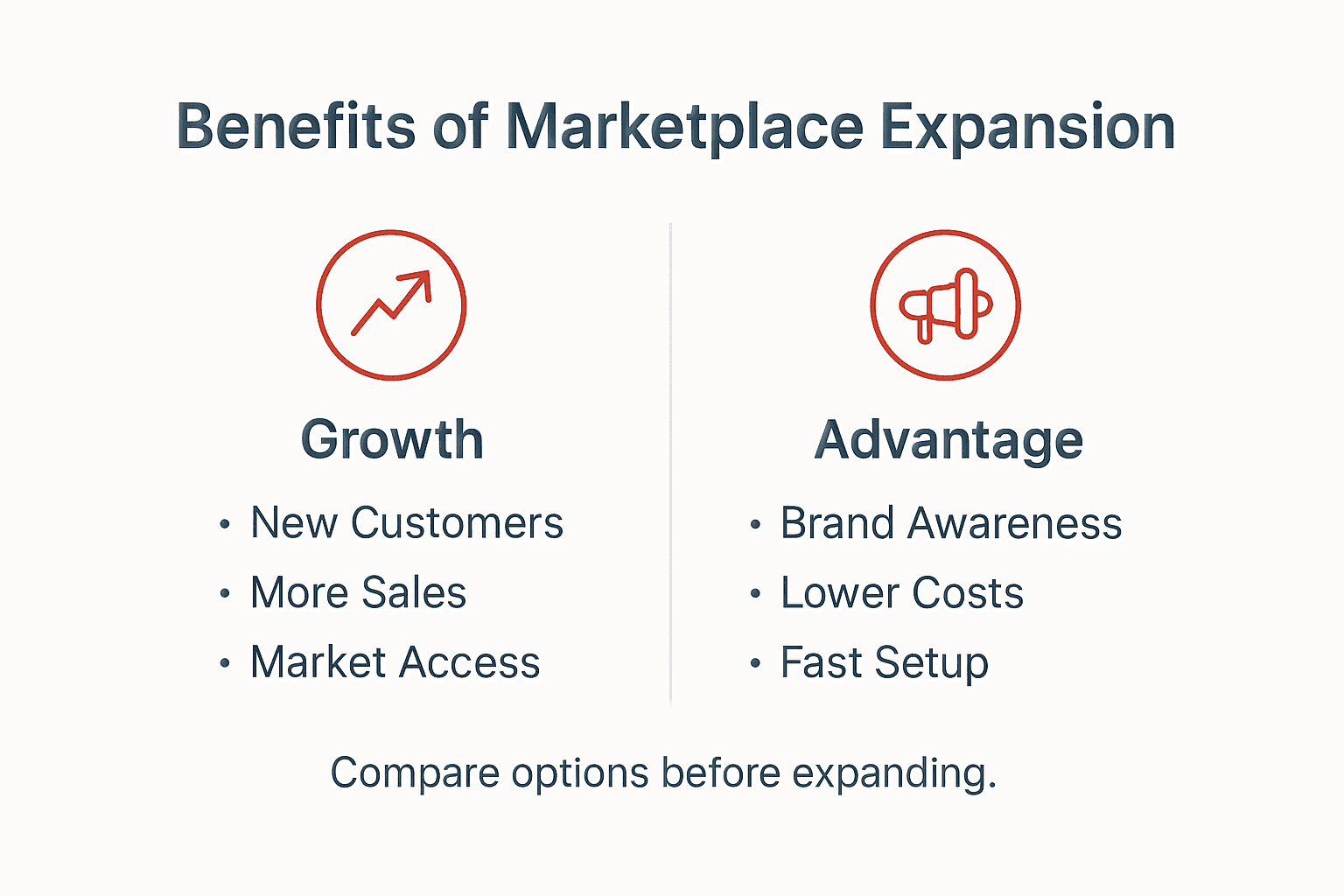
Marketplace expansion fundamentally transforms how small businesses approach growth, offering multiple strategic benefits. Key advantages include instant market credibility, reduced marketing expenses, built-in payment and shipping systems, and access to sophisticated digital tools that would be prohibitively expensive for individual businesses to develop independently. By leveraging established marketplace ecosystems, SMBs can focus on product development and customer experience while benefiting from advanced technological support and massive existing customer networks.
Pro tip: Analyze multiple marketplaces systematically, starting with platforms most aligned with your specific product category and target demographic.
Successful marketplace selling demands a strategic approach that goes beyond simply listing products. Brands must implement robust supply chain risk management strategies to ensure product availability and marketplace competitiveness, addressing critical elements that distinguish thriving sellers from those struggling to gain traction.
Marketplace success hinges on precise optimization of product listings, consistent inventory management, and exceptional customer service. Small businesses need to invest in marketplace-specific marketing techniques, develop deep understanding of platform algorithms, and create strategies that maximize product visibility. This requires continuous monitoring of consumer feedback, rapid adaptation to market trends, and meticulous attention to platform-specific compliance requirements.
Key success factors for brands include developing comprehensive digital strategies that align with marketplace dynamics. Critical requirements encompass maintaining high-quality product data, implementing reliable fulfillment processes, responding promptly to customer inquiries, and building a reputation for consistency and reliability. Brands must also develop sophisticated analytics capabilities, enabling them to track performance metrics, understand consumer behavior, and make data-driven decisions that optimize their marketplace presence.
Pro tip: Create a dedicated marketplace performance dashboard that tracks key metrics like conversion rates, customer reviews, and inventory turnover to systematically improve your selling strategy.
Online marketplace participation introduces complex legal and financial risks that small businesses must carefully navigate. Product liability represents a significant potential exposure, with sellers needing comprehensive understanding of regulatory frameworks and consumer protection laws to prevent costly legal challenges.
Marketplace sellers face multiple operational risks including non-compliance with consumer protection regulations and unexpected fee structures. Common financial pitfalls include miscalculating transaction fees, overlooking platform-specific compliance requirements, and failing to maintain competitive yet profitable pricing strategies. Sellers must meticulously analyze marketplace fee structures, which typically include listing fees, commission percentages, and potential additional charges that can significantly impact profit margins.
Beyond financial considerations, marketplace selling demands rigorous attention to operational details. Critical mistakes include inadequate product descriptions, poor quality images, inconsistent inventory management, and substandard customer service. These errors can rapidly erode seller ratings, reduce product visibility, and ultimately undermine marketplace success. Successful sellers develop systematic approaches to platform management, investing time in understanding algorithmic ranking factors and continuously optimizing their digital storefront.
Below is a summary of common marketplace risks and how to proactively address them:
| Risk Type | Example Issue | Mitigation Strategy |
|---|---|---|
| Legal Compliance | Product liability | Regular legal reviews and training |
| Financial | Unexpected platform fees | Analyze fee structures quarterly |
| Operational | Poor inventory management | Automated stock tracking tools |
| Reputation | Negative customer reviews | Proactive customer support and follow-up |
Pro tip: Develop a comprehensive marketplace compliance checklist that reviews platform policies, fee structures, and legal requirements quarterly to proactively manage potential risks.
The journey to expanding your small or medium-sized business through marketplace selling can be challenging. From navigating complex fee structures to optimizing product listings and managing inventory effectively, many SMBs struggle to unlock the true revenue growth potential described in the article. You need a proven partner who understands how to leverage marketplace ecosystems, manage omnichannel retailing, and implement focused digital marketing techniques that fuel rapid, sustainable growth.
At Reddog Group, we specialize in helping brands like yours overcome these exact challenges. With comprehensive Digital & Business Consulting Services by Reddog Consulting, we provide tailored solutions for marketplace management, Amazon FBA, and integrated online-offline strategies designed to maximize revenue and streamline operations. Our expertise managing over 50 brands and 30,000 SKUs means you benefit from real-world insights and strategies that drive year-over-year growth.

Ready to transform your marketplace presence and accelerate your growth? Explore how our results-driven approach can position your brand for success by visiting the Home page and learn more at https://reddog.group. Don’t wait to take advantage of the marketplace expansion opportunities that await your business today.
Selling on marketplaces allows small and medium-sized businesses to access broader customer bases, reduce marketing costs, and benefit from built-in infrastructure for payment and shipping, ultimately facilitating growth without significant upfront investment.
Choosing the right marketplace involves evaluating factors such as your product type, target audience, commission rates, and the marketplace’s specific features. It’s beneficial to conduct thorough research and consider testing multiple platforms to find the best fit.
Key success factors include optimizing product listings, maintaining consistent inventory management, delivering exceptional customer service, and utilizing analytics to track performance. A strategic digital approach that aligns with marketplace dynamics is essential for success.
Common mistakes include inadequate product descriptions, poor quality images, miscalculating fees, and neglecting customer service. To avoid these pitfalls, focus on thorough preparation and management, and continuously optimize your listings based on performance data.
Leave a comment: