
Published: March 2020 | Last Updated:December 2025
© Copyright 2026, Reddog Consulting Group.

Over half of American retail brands now rely on performance marketing to drive business results. Digital competition raises the stakes, making it more important than ever to track every ad dollar and outcome. If you want your American e-commerce brand to thrive amidst shifting trends and slim margins, understanding how to turn measurable marketing into predictable growth sets your team apart from the crowd.
| Point | Details |
|---|---|
| Performance Marketing Focus | E-commerce brands should invest in measurable marketing outcomes to enhance growth and visibility in digital campaigns. |
| Channel Optimization | Brands must analyze channel performance metrics to refine strategies and maximize return on investment across digital platforms. |
| Comprehensive Tracking | Implementing robust tracking mechanisms across multiple marketing channels is essential for understanding customer journeys and improving campaign effectiveness. |
| Holistic Approach | Successful performance marketing integrates immediate metrics with long-term brand health, balancing short-term gains with sustainable growth. |
Performance marketing represents a strategic approach where e-commerce brands pay exclusively for measurable marketing outcomes like sales, clicks, or specific conversions. Unlike traditional advertising models, this method focuses on trackable results that directly contribute to business growth. Performance marketing strategies have revolutionized how digital brands connect with consumers by providing unprecedented visibility into campaign effectiveness.
At its core, performance marketing operates through targeted digital channels such as search engines, social media platforms, and affiliate networks. E-commerce brands can precisely track each marketing investment, understanding exactly how much revenue is generated per marketing dollar spent. By leveraging data-driven techniques, businesses can optimize campaigns in real time, adjusting strategies to maximize return on investment. The ability to measure and attribute specific actions makes performance marketing a powerful tool for brands seeking predictable, scalable growth.
Key performance indicators for e-commerce brands typically include conversion rates, customer acquisition cost, click-through rates, and total revenue generated. Successful performance marketing requires a sophisticated approach to data analysis, continuously refining targeting strategies and understanding customer behavior patterns. By implementing robust tracking mechanisms and analytics tools, brands can create increasingly precise marketing campaigns that deliver measurable results.
Pro tip: Implement multi-channel tracking systems that integrate data across different platforms to gain comprehensive insights into your performance marketing efforts.
Performance marketing encompasses several sophisticated digital channels designed to drive measurable outcomes for e-commerce brands. Performance-based advertising models include diverse pricing strategies like cost-per-click (CPC), cost-per-lead (CPL), and cost-per-acquisition (CPA), which enable businesses to pay only for specific, trackable marketing results. These channels provide granular control over marketing spend and precise measurement of campaign effectiveness across multiple digital platforms.
The primary channels of performance marketing include search engine marketing, affiliate marketing, display advertising, email marketing, and social media marketing. Each channel offers unique advantages for targeted customer acquisition. Search engine marketing allows brands to appear in relevant search results, while affiliate marketing leverages external partners to promote products. Display advertising creates visual brand touchpoints, email marketing enables direct communication, and social media marketing facilitates engagement through targeted advertising and content strategies.
Here’s a comparison of major performance marketing channels and their unique strengths for e-commerce brands:
| Channel | Key Advantage | Best Use Case |
|---|---|---|
| Search Engine Marketing | High intent audience reach | Capturing ready-to-buy shoppers |
| Affiliate Marketing | Extended audience networks | Leveraging partner promotions |
| Display Advertising | Visual brand awareness boost | Retargeting and product exposure |
| Email Marketing | Personalized customer contact | Post-purchase relationship building |
| Social Media Marketing | Advanced audience targeting | New customer acquisition |
Successful performance marketing requires a strategic approach to channel selection and optimization. E-commerce brands must analyze each channel’s performance metrics, understanding conversion rates, customer acquisition costs, and overall return on investment. By implementing robust tracking mechanisms and continuously refining targeting strategies, businesses can create integrated marketing campaigns that maximize reach and minimize unnecessary spending across digital platforms.
Pro tip: Develop a comprehensive cross-channel tracking system that integrates data from multiple performance marketing channels to gain holistic insights into your marketing effectiveness.
Performance marketing campaigns function through a strategic, data-driven approach that transforms traditional marketing methods into precision-targeted initiatives. Marketing performance measurement systems involve defining clear strategic objectives and establishing key performance indicators (KPIs) that directly align with business goals. This methodical process enables brands to track, analyze, and optimize marketing efforts with unprecedented accuracy, ensuring every marketing dollar generates measurable value.

The campaign workflow typically progresses through several critical stages: initial goal setting, audience targeting, channel selection, content creation, deployment, real-time tracking, and continuous optimization. Marketers leverage advanced analytics tools to monitor campaign performance across multiple dimensions, including conversion rates, customer acquisition costs, engagement metrics, and overall return on investment. By implementing sophisticated tracking mechanisms, brands can make immediate, data-informed adjustments to improve campaign effectiveness and maximize marketing impact.
Successful performance marketing campaigns require a holistic approach that integrates data from multiple touchpoints and channels. This means creating seamless tracking mechanisms that capture customer interactions across search engines, social media platforms, email marketing, and display advertising. Advanced marketers use sophisticated attribution models to understand the complex customer journey, identifying which channels and specific marketing activities contribute most significantly to conversions and revenue generation.
Pro tip: Develop a comprehensive dashboard that consolidates performance metrics from all marketing channels, enabling real-time insights and rapid strategic adjustments.
Performance marketing demands a sophisticated approach to measuring campaign effectiveness through comprehensive marketing key performance indicators. Essential metrics span multiple dimensions, including impressions, clicks, conversion rates, customer acquisition cost, and customer lifetime value. These indicators help e-commerce brands track performance across different stages of the customer journey, from initial awareness to final conversion, providing a nuanced understanding of marketing impact and return on investment.
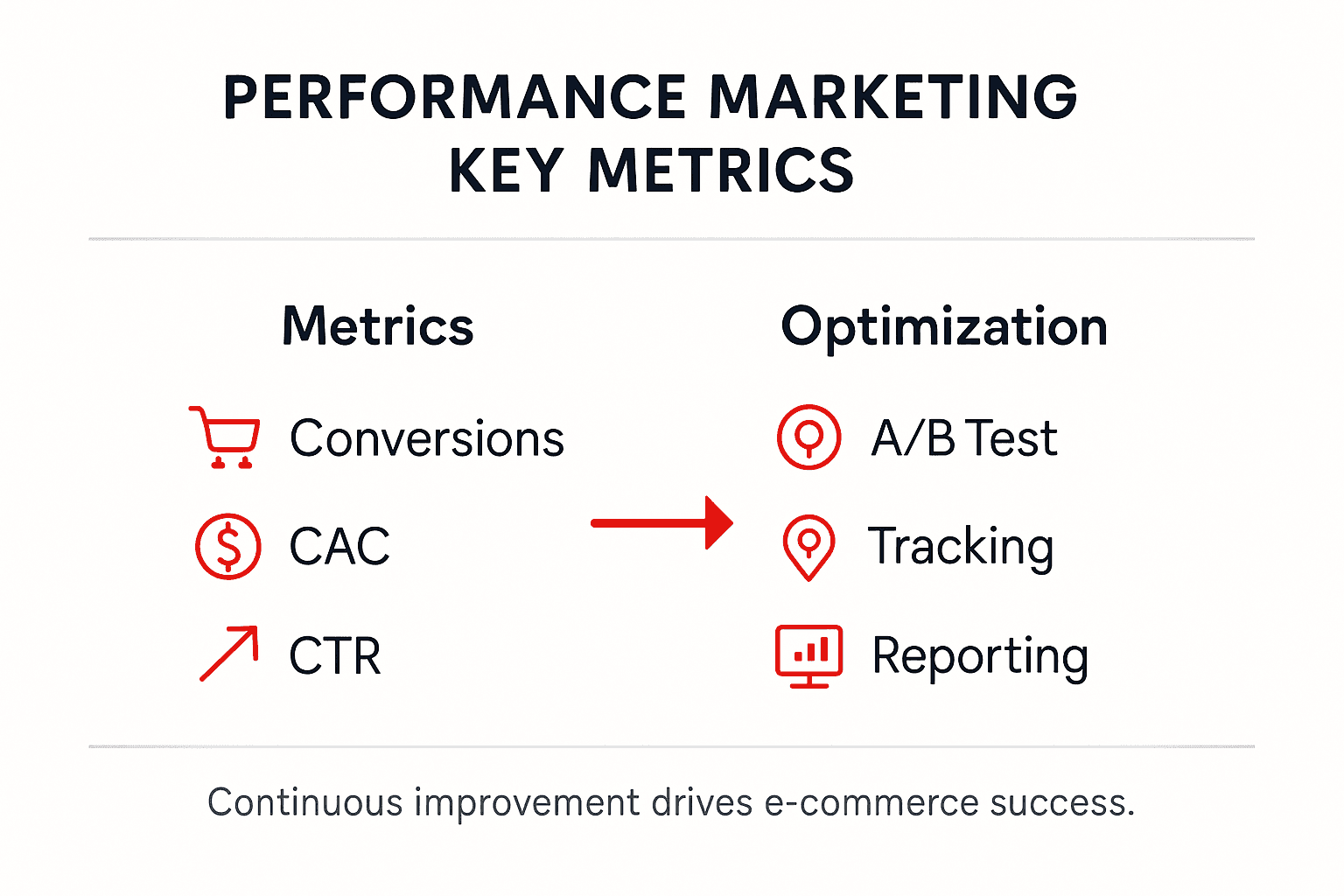
Summary of essential performance marketing metrics and their business impact:
| Metric | What It Measures | Business Impact |
|---|---|---|
| Conversion Rate | Percent of actions completed | Shows campaign effectiveness |
| Customer Acquisition Cost | Spend per new customer | Indicates efficiency of spend |
| Click-Through Rate | Interest in ad/offer | Reveals targeting effectiveness |
| Customer Lifetime Value | Total future revenue per user | Influences budget decisions |
| Impressions | Total ad views | Gauges reach and market presence |
Optimization techniques in performance marketing require a dynamic, data-driven strategy that continuously refines campaign elements. Marketers leverage advanced methods such as A/B testing, attribution modeling, and real-time data analysis to make precise adjustments. These techniques involve systematically experimenting with targeting parameters, creative content, bidding strategies, and audience segmentation to incrementally improve campaign performance and maximize marketing efficiency.
Successful performance marketing optimization requires a holistic view that balances short-term results with long-term brand growth. This means developing sophisticated tracking mechanisms that capture not just immediate conversions, but also understand the broader customer journey and lifetime value. By integrating advanced analytics and machine learning technologies, brands can create increasingly intelligent marketing strategies that adapt in real-time to changing market conditions and consumer behaviors.
Pro tip: Implement a comprehensive marketing dashboard that consolidates metrics from multiple channels, enabling quick identification of high-performing strategies and immediate optimization opportunities.
E-commerce brands frequently encounter significant challenges in performance marketing that can dramatically undermine their growth potential. Performance measurement systems often fail when marketers misalign metrics with strategic goals, creating a narrow perspective that prioritizes short-term gains over sustainable growth. This myopic approach can lead to inefficient spending, reduced marketing effectiveness, and diminished overall return on investment, ultimately preventing brands from achieving their true growth potential.
One of the most critical mistakes e-commerce brands make is treating performance marketing as a purely transactional strategy, disconnected from broader brand-building efforts. Successful marketers understand that maximizing ROI requires a holistic approach that balances immediate conversion metrics with long-term brand equity development. This means creating campaigns that not only drive immediate sales but also build meaningful customer relationships, foster brand loyalty, and create lasting value beyond single-transaction interactions.
To truly optimize performance marketing ROI, brands must develop sophisticated, integrated measurement strategies that go beyond surface-level metrics. This involves creating comprehensive tracking mechanisms that capture the entire customer journey, from initial awareness to conversion and subsequent retention. Advanced techniques such as multi-touch attribution modeling, predictive analytics, and continuous performance benchmarking enable brands to understand the complex interactions between different marketing channels and their cumulative impact on business growth.
Pro tip: Develop a dynamic marketing dashboard that tracks both immediate performance indicators and long-term brand health metrics, allowing for nuanced and strategic decision-making.
Understanding the power of performance marketing means recognizing the challenge of tracking every marketing dollar to maximize ROI and sustainable business growth. If you struggle with aligning your marketing metrics to strategic goals or balancing short-term conversions with long-term brand building, you are not alone. The article highlights key pain points such as the need for comprehensive tracking, multi-channel insights, and data-driven optimization to overcome pitfalls common in performance marketing initiatives.
At Reddog Group, we specialize in addressing these exact challenges through tailored solutions in omnichannel retailing and digital marketing. With extensive experience managing over 50 brands and 30,000 SKUs, we deliver tested strategies including marketplace management, Amazon FBA, and DTC channel optimization. Our integrated approach ensures your campaigns are not just trackable but continuously optimized for measurable growth and lasting brand equity. Learn how our strategic guidance and marketing campaigns can elevate your brand’s performance in complex marketplaces by visiting our professional consulting platform.
Take control of your performance marketing today and transform analytics into action
Ready to overcome common pitfalls and maximize your ROI with expert guidance that aligns with your growth goals Discover the difference a strategic partner can make by exploring our tailored services at Reddog Group. Act now to start scaling your brand with data-driven, omnichannel mastery designed for measurable success.
Performance marketing is a strategic approach where businesses pay solely for measurable marketing outcomes like sales, clicks, or specific conversions, focusing on trackable results that directly drive growth.
Key performance indicators often include conversion rates, customer acquisition cost, click-through rates, and total revenue generated, helping brands assess the effectiveness of their marketing efforts.
E-commerce brands can optimize their campaigns by using data-driven techniques such as A/B testing, continuous performance analysis, refining targeting strategies, and implementing robust tracking mechanisms to adjust campaigns in real-time.
Common pitfalls include misaligning metrics with strategic goals, focusing solely on short-term gains rather than sustainable growth, and treating performance marketing as a transactional effort that neglects broader brand-building initiatives.
Leave a comment: