
Published: March 2020 | Last Updated:March 2026
© Copyright 2026, Reddog Consulting Group.

Most emerging CPG founders think fulfillment is just about getting products from point A to point B. In reality, fulfillment optimization is a strategic lever that can reduce costs by 15-40%, improve order accuracy to 98-99%, and transform razor-thin margins into sustainable profit. For brands scaling across Amazon, Walmart, DTC, and wholesale channels, mastering fulfillment means understanding inventory routing, hybrid 3PL models, AI-powered order management, and the real economics behind every shipment. This guide breaks down what fulfillment optimization actually means for CPG brands generating $500K to $20M in revenue and how to implement it without bleeding cash.
| Point | Details |
|---|---|
| Multi-channel complexity | Fulfillment optimization manages order processing across DTC, Amazon, Walmart, and wholesale to reduce costs and increase accuracy. |
| AI-powered routing | Intelligent systems evaluate 49+ source-location combinations to optimize cost and service levels automatically. |
| Hybrid fulfillment model | Combining in-house operations with 3PL services balances control and scalability for $500K-$20M CPG brands. |
| Performance benchmarks | Target fulfillment costs at 25-30% of gross margin, order accuracy at 98-99%, and on-time in-full delivery at 96%+. |
| Strategic pricing impact | Margin-first pricing strategies create resilience in fulfillment operations during seasonal surges and channel expansion. |
Fulfillment optimization is the strategic management of storage, order processing, picking, packing, and delivery across multiple channels to minimize costs and maximize accuracy. For emerging CPG brands, this means coordinating inventory across DTC websites, Amazon FBA, Walmart WFS, wholesale distributors, and sometimes regional 3PLs. Each channel has different fee structures, speed expectations, and margin implications that directly impact your bottom line.
The core challenge is maintaining real-time inventory visibility while routing orders to the most cost-effective fulfillment source. When you’re selling the same SKU on your Shopify store, Amazon, and through a regional distributor, you need systems that prevent overselling, minimize shipping distances, and optimize for contribution margin rather than just speed. This requires more than spreadsheets and manual updates.
Real-time inventory visibility prevents the costly mistakes that plague multi-channel operations. Stockouts on Amazon trigger suppressed listings and lost Buy Box eligibility. Overselling on DTC creates customer service nightmares and refund costs. Wholesale partners expect consistent availability or they’ll drop your line. An omnichannel fulfillment strategy connects these dots through centralized inventory management.
Here’s what fulfillment optimization actually includes for emerging CPG brands:
The complexity multiplies when you factor in product-specific requirements. Temperature-controlled items need specialized 3PLs. Fragile products require custom packaging that eats into margins. Heavy or bulky goods face dimensional weight penalties that make certain fulfillment locations uneconomical. These operational realities force strategic decisions about which channels to prioritize and how to structure your fulfillment strategy for CPG profitability.
“Emerging CPG brands often underestimate how quickly multi-channel fulfillment complexity outpaces manual processes. The breaking point typically hits between $1M and $3M in revenue when order volume exceeds 50-100 per day across channels.”
Hybrid fulfillment models combining in-house operations with 3PL partnerships offer the most flexibility for brands in the $500K to $20M range. You maintain direct control over your highest-margin DTC orders while leveraging 3PL networks for wholesale distribution and marketplace fulfillment. This approach requires clear decision rules about which orders go where, but it prevents the all-or-nothing trap of committing entirely to one model before you understand your true economics.
Implementing fulfillment optimization follows a phased approach that builds capability over time. Foundation work establishes your order management system and basic inventory tracking. Optimization adds intelligent routing and carrier selection. Advanced implementation introduces AI-powered forecasting and dynamic fulfillment source allocation. Rushing to advanced tactics without solid foundations creates expensive mistakes.
A centralized order management system (OMS) serves as the control tower for multi-channel fulfillment. Your OMS ingests orders from every sales channel, maintains a single source of truth for inventory levels, and executes routing rules that determine where each order ships from. Without this unified view, you’re flying blind. Manual order entry and spreadsheet inventory tracking break down completely once you exceed 20-30 orders per day across multiple channels.
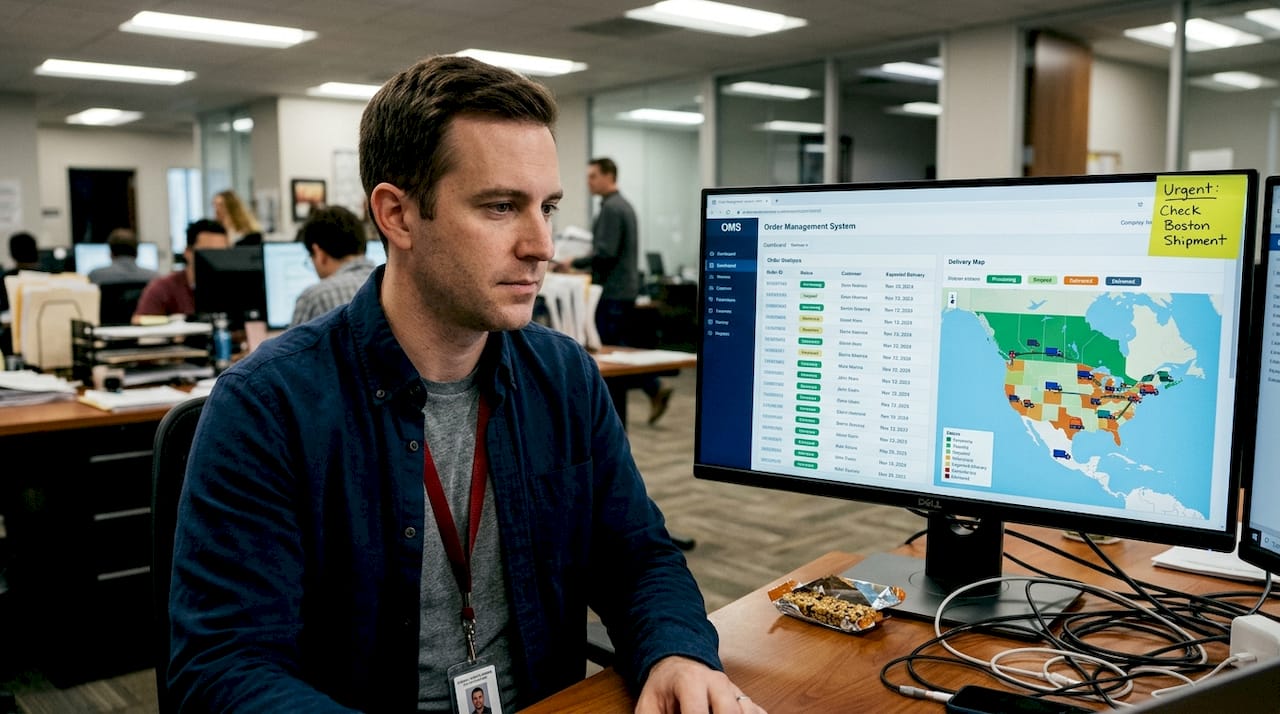
AI-powered order routing evaluates 49+ source-location combinations to optimize both cost and service levels simultaneously. The algorithm considers shipping costs from each potential fulfillment location, current inventory levels, delivery speed requirements, and even carrier performance history. This level of optimization is impossible manually but becomes essential when you’re managing inventory across your own warehouse, two regional 3PLs, Amazon FBA, and Walmart WFS.
Here’s the phased implementation roadmap for emerging CPG brands:
Demand forecasting integration transforms fulfillment from reactive to proactive. When your system predicts increased orders for specific SKUs based on seasonality, promotions, or trend analysis, it can trigger inventory transfers before stockouts occur. This prevents the nightmare scenario of having 5,000 units sitting in your California warehouse while all your orders come from East Coast customers paying premium shipping rates.
Pro Tip: Start tracking your fulfillment cost per order by channel and product category. You’ll quickly discover that some SKUs are unprofitable on certain channels once you account for actual shipping costs, packaging materials, and labor. This data drives smarter decisions about channel mix and product assortment.
Intelligent order routing delivers measurable benefits that directly impact your P&L. Brands typically see 12-25% reduction in shipping costs within 90 days of implementation. Order accuracy improves to 98-99% when automated systems replace manual picking and packing. On-time delivery rates increase because the system selects fulfillment sources that can meet customer expectations rather than defaulting to a single warehouse location. These improvements compound over time as you refine routing rules based on actual performance data.
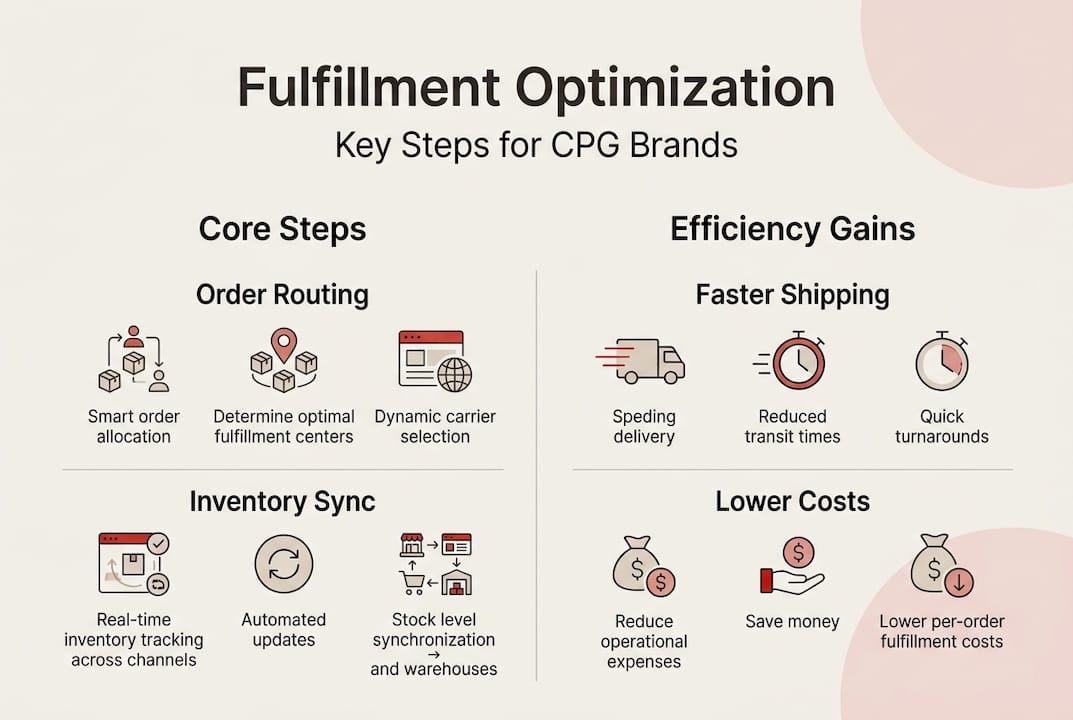
The connection between inventory management best practices and fulfillment optimization is direct. You can’t optimize what you can’t track accurately. Implementing cycle counting, SKU-level location tracking, and real-time inventory updates creates the data foundation that makes intelligent routing possible. Similarly, inventory forecasting prevents the fulfillment bottlenecks that occur when you’re constantly scrambling to restock fast-moving SKUs.
The 3PL versus in-house decision isn’t binary for most emerging CPG brands. Pure in-house fulfillment gives you maximum control but requires significant fixed costs in labor, warehouse space, and systems. Pure 3PL outsourcing offers scalability but sacrifices control and can introduce margin compression on lower-volume SKUs. The hybrid approach leverages both models strategically.
3PL delivery lowers shipping costs by 15-40% versus retail shipping rates and typically breaks even at 500-1000 orders per month. Below that threshold, the fixed monthly minimums and per-order fees make 3PLs uneconomical. Above it, their negotiated carrier rates and zone optimization create real savings. In-house fulfillment offers maximum control with higher fixed labor costs but lower variable costs per unit once you achieve efficiency.
Here’s how the economics compare:
| Model | Best for | Cost structure | Control level | Scaling flexibility |
|---|---|---|---|---|
| In-house | <500 orders/month, high-margin DTC | High fixed, low variable | Maximum | Limited by space/labor |
| 3PL | >1000 orders/month, wholesale distribution | Low fixed, higher variable | Moderate | High |
| Hybrid | $500K-$20M brands, multi-channel | Optimized blend | Strategic | Maximum |
| Amazon FBA | Amazon-only or Amazon-heavy brands | Performance-based fees | Minimal | Amazon ecosystem only |
The hybrid model works by keeping high-margin, low-volume DTC orders in-house where you control the customer experience and capture full margin. Route wholesale orders and marketplace fulfillment through 3PLs that specialize in B2B distribution or have favorable agreements with Amazon and Walmart. This approach requires clear routing rules but delivers the best economics for brands in growth mode.
Consider a CPG brand doing $3M annually across channels: 40% DTC, 35% Amazon, 25% wholesale. They fulfill DTC orders in-house (averaging 15 orders per day), use a regional 3PL for wholesale distribution (averaging 8 pallet shipments per week), and leverage Amazon FBA for marketplace orders. Total fulfillment costs run 28% of gross margin versus 35-40% if they tried to handle everything in-house or 32-35% if they outsourced everything to a single 3PL.
Pro Tip: Calculate your true breakeven point by tracking all costs including labor burden, rent allocation, packaging materials, and shipping. Many brands discover their in-house operation is more expensive than assumed once they account for management time and error rates.
The decision points for when to add 3PL capacity:
Understanding logistics in ecommerce for CPG brands helps you evaluate 3PL partners effectively. Look for providers with experience in CPG, strong technology integration capabilities, and transparent pricing without hidden fees. The cheapest option often creates the most expensive problems through poor accuracy, slow processing, or inadequate customer service.
Industry benchmarks provide the targets you should aim for as you optimize fulfillment operations. These metrics separate high-performing CPG brands from those struggling with fulfillment as a profit drain.
| Metric | Target range | Impact if missed |
|---|---|---|
| Fulfillment cost % of gross margin | 25-30% | Margin compression, unprofitable channels |
| Order accuracy rate | 98-99% | Returns costs, customer churn, negative reviews |
| On-time in-full delivery | 96%+ | Chargebacks, lost Buy Box, wholesale account loss |
| Inventory accuracy | 98%+ | Stockouts, overselling, poor forecasting |
| Shipping cost per order | Varies by channel | Direct margin impact, channel profitability |
Fulfillment costs should remain 25-30% of gross margin to maintain healthy unit economics. Order accuracy targets of 98-99% prevent the death spiral of returns processing and customer service costs. OTIF performance at 96%+ keeps you in good standing with wholesale partners and marketplaces. 3PL partnerships save 15-40% on shipping costs when implemented at appropriate scale.
Multi-channel complexity introduces edge cases that standard fulfillment processes can’t handle. Temperature-controlled products require specialized 3PLs with cold chain capabilities, adding 20-40% to fulfillment costs. Fragile items need custom packaging that reduces cubic efficiency and increases dimensional weight charges. Low-margin, high-weight products become unprofitable on certain channels once you account for actual shipping costs.
The routing complexity multiplies fast. A brand with 3 fulfillment locations serving 7 sales channels across 7 shipping zones creates 147 potential routing combinations. Without intelligent automation, you’ll default to simple rules that leave money on the table. Peak season surges compound the problem when order volume doubles or triples, overwhelming manual processes and increasing error rates.
Common challenges emerging CPG brands face:
“The brands that scale profitably treat fulfillment as a strategic capability, not a tactical afterthought. They invest in systems and processes before they’re drowning in order volume, and they track contribution margin by channel religiously.”
Expert insights emphasize that pricing strategies directly influence fulfillment resilience. Brands with healthy gross margins (50%+ for DTC, 35%+ for wholesale) can absorb fulfillment cost variability and invest in optimization. Those operating on thin margins (25-30% gross) have no buffer for fulfillment mistakes or seasonal cost spikes. Strategic pricing creates the margin room needed to scale fulfillment operations sustainably.
The connection between fulfillment strategy benchmarks and overall business performance is direct. Brands hitting these targets consistently grow faster because they’re not constantly firefighting fulfillment problems. They can focus on product development, marketing, and channel expansion instead of explaining to customers why orders are late or dealing with wholesale chargebacks.
Implementing systems to increase ecommerce sales for CPG brands requires fulfillment operations that can scale with demand. Marketing campaigns that drive 50-100% order increases will fail if your fulfillment operation can’t process and ship accurately. The best growth strategies are built on fulfillment foundations that can handle surges without breaking.
Navigating multi-channel fulfillment complexity while maintaining healthy margins requires specialized expertise. RedDog Group helps emerging CPG brands in the $500K to $20M range optimize fulfillment operations across Amazon, Walmart, DTC, and wholesale channels. We focus on contribution-margin-first strategies that reduce fulfillment costs, improve order accuracy, and create scalable operations that support profitable growth.
Our Amazon marketplace management services include FBA optimization, inventory positioning, and fee management that directly impact your bottom line. We help you understand the real economics of each channel and make data-driven decisions about where to invest and where to pull back. Whether you’re evaluating 3PL partners, implementing a hybrid fulfillment model, or scaling into new retail channels, we provide the analytical framework and operational guidance to execute successfully. Contact RedDog Group to discuss how we can help optimize your fulfillment strategy and improve profit margins across your retail channels.
Fulfillment optimization is the strategic management of order processing, inventory routing, and delivery operations across multiple retail channels to minimize costs while maintaining high accuracy and speed. For CPG brands, this means coordinating fulfillment between DTC operations, marketplace programs like Amazon FBA, 3PL partners, and wholesale distribution to maximize contribution margin.
Selling across DTC, Amazon, Walmart, and wholesale creates routing complexity where the same SKU must be available from multiple fulfillment sources. This requires centralized inventory management, intelligent order routing based on cost and speed requirements, and systems that prevent overselling. Brands typically need hybrid fulfillment models combining in-house and 3PL operations to manage this complexity economically.
Choose 3PL when order volume consistently exceeds 500-1000 per month, you’re expanding into new geographic regions, or you need specialized capabilities like temperature control. Keep fulfillment in-house when volume is below 500 orders monthly, you need maximum control over customer experience, or your margins can’t absorb 3PL fees. Most emerging CPG brands benefit from a hybrid approach that uses both strategically.
Target fulfillment costs at 25-30% of gross margin, order accuracy at 98-99%, and on-time in-full delivery at 96% or higher. Inventory accuracy should reach 98%+ to prevent stockouts and overselling. 3PL partnerships typically reduce shipping costs by 15-40% compared to retail rates once you exceed the breakeven volume threshold of 500-1000 orders monthly.
AI-powered order routing evaluates dozens of source-location combinations to select the most cost-effective fulfillment option for each order automatically. Integrated demand forecasting predicts inventory needs and triggers transfers before stockouts occur. Real-time inventory management prevents overselling across channels and enables intelligent routing decisions that balance cost, speed, and accuracy without manual intervention.
Leave a comment: