
Published: March 2020 | Last Updated:February 2026
© Copyright 2026, Reddog Consulting Group.

Facing sudden surges in orders can quickly turn excitement into anxiety for Texas-based CPG brands. As you juggle Amazon, Walmart, DTC, and wholesale, a fragmented approach risks draining margins and slowing growth. A well-crafted fulfillment strategy does more than move boxes—it is the backbone that protects inventory accuracy, manages logistics costs, and supports your cash flow. Understanding how a structured fulfillment strategy impacts each retail channel empowers you to grow profitably without operational chaos.
| Point | Details |
|---|---|
| Fulfillment Strategy Impact | A strong fulfillment strategy is essential for profitability, customer satisfaction, and scalability in CPG brands. |
| Channel-Specific Approaches | Different sales channels require tailored fulfillment methods; flexibility is key to successfully managing them. |
| Cost and Margin Awareness | Each fulfillment decision directly affects contribution margins; brands should monitor channel-specific fulfillment costs closely. |
| Importance of Inventory Accuracy | Real-time inventory visibility is crucial to prevent stockouts and overstock, impacting overall fulfillment efficiency. |
Fulfillment strategy for CPG brands isn’t just about getting products shipped. It’s the backbone of your entire operation, directly affecting margins, customer satisfaction, and your ability to scale.
At its core, fulfillment involves managing storage, order processing, and delivery across multiple sales channels—Amazon, Walmart, DTC, wholesale, and brick-and-mortar distribution. Your fulfillment strategy dictates whether you can handle a 300% spike in orders during a promotional week without destroying your margins or leaving customers waiting.
CPG fulfillment differs fundamentally from standard eCommerce. You’re managing volume at scale, not just speed. You’re dealing with SKU complexity, retailer compliance requirements, and inventory velocity that changes weekly. Your strategy must account for all of this simultaneously.
Every fulfillment decision affects your contribution margin. Where you store inventory, how you process orders, whether you use a 3PL or handle it in-house—these choices ripple through your P&L.
Consider these real-world impacts:
Your fulfillment strategy determines whether each sales channel actually contributes profit or just moves products.
Different channels require different fulfillment approaches. DTC allows you maximum control but demands speed. Amazon FBA compresses margins but removes logistics burden. Walmart wholesale requires compliance with strict vendor guidelines. Distributor relationships demand consistent, predictable delivery.
One strategy doesn’t work for all channels. You need flexibility.
This is where many brands stumble. They pick one fulfillment model and force it everywhere. That’s backwards.
Companies increasingly recognize this reality. CPG brands are outsourcing fulfillment not primarily for cost savings but for the flexibility to handle volume fluctuations and intense promotional cycles. A 3PL partner handles the operational complexity while you focus on growth and profitability.
The strategic decision becomes: What are your core competencies? What should you outsource? The answer shapes your entire fulfillment strategy.
Your fulfillment strategy addresses these questions:
Without clear answers, you’re reactive. With them, you’re profitable.
Many CPG brands benefit from exploring how multichannel distribution impacts both customer reach and operational complexity. The right fulfillment strategy ties these together.
Pro tip: Map your current fulfillment costs by channel—storage, labor, 3PL fees, shipping—and calculate actual contribution margin per channel. You’ll likely discover that one channel is profitable while another is cannibalizing your cash flow.
There’s no single “best” fulfillment model for CPG brands. What works for fresh products on Amazon doesn’t work for dry goods in wholesale distribution. What scales for DTC cannibalizes margins on retail.
The brands winning at profitability aren’t picking one model. They’re building hybrid approaches that blend multiple fulfillment strategies based on product type, channel, and margin reality.
Understanding your options is the first step. Each model trades control for efficiency differently.
In-House Fulfillment
You own the warehouse, manage inventory, and process orders yourself. Maximum control. Maximum headache.
Pros: You keep all margin; you control quality and speed; you own customer data.
Cons: High fixed costs; requires operational expertise; limits scalability; ties up capital in real estate and equipment.
For most CPG brands under $10M, this only works for one channel—typically DTC. Even then, it’s usually a bottleneck.
Third-Party Logistics (3PL) Fulfillment
A 3PL partner stores, picks, packs, and ships your products. You pay per unit handled or per month.
Pros: Scalable; variable costs; handles volume spikes; geographic flexibility; expertise in operations.
Cons: Less control; margin compression; dependency on partner performance; integration complexity.
This is where most CPG brands operate efficiently. You focus on product and sales; the 3PL handles logistics.
Marketplace Fulfillment Services
Amazon FBA, Walmart Fulfillment Services (WFS), and similar platforms handle everything from receiving to delivery. Fulfillment by Amazon explained includes fee structures that vary by product weight, category, and seasonality.
Pros: No operational burden; Prime eligibility; brand trust; returns handled by platform.
Cons: Highest per-unit cost; margin compression; less control; inventory restrictions.
Here is a summary comparing the core fulfillment models for CPG brands:
| Model Type | Control Over Operations | Cost Structure | Best Use Case |
|---|---|---|---|
| In-House Fulfillment | Maximum control, hands-on | High fixed, low variable | DTC for small-scale brands |
| Third-Party Logistics | Moderate control, shared | Variable, scalable | Multichannel, fast growth |
| Marketplace Fulfillment | Minimal control, automated | Highest per-unit cost | High-volume, retail platform |
Leading CPG companies blend these models strategically. Hybrid fulfillment strategies combine distribution centers, fulfillment centers, and local options to optimize for different product categories and channels.
Here’s how it works in practice:
Your fulfillment model determines how much margin stays in your pocket when volume grows.
Start with this framework:
Then assign fulfillment models to channels based on margin reality, not convenience.
Most Texas-based CPG brands find this combination works: DTC through a regional 3PL or dedicated fulfillment, Amazon FBA for fast-moving SKUs, Walmart WFS or 3PL depending on margin, and wholesale through distributor-friendly 3PLs.
Pro tip: Run a fulfillment cost model for each channel including all fees, labor, storage, and shipping. Compare it to your gross margin by channel. If fulfillment costs exceed 25% of gross margin, that channel is destroying profitability—change your model.
Your fulfillment strategy doesn’t just move boxes. It controls how much profit you actually keep and when cash hits your bank account. Get this wrong, and growth destroys profitability.

Every fulfillment decision ripples through your P&L and cash flow statement. Wrong storage location, slow order processing, poor inventory accuracy—these aren’t operational details. They’re margin killers.
Fulfillment costs compress margins in three ways: direct costs, hidden inefficiencies, and customer chargeback risk.
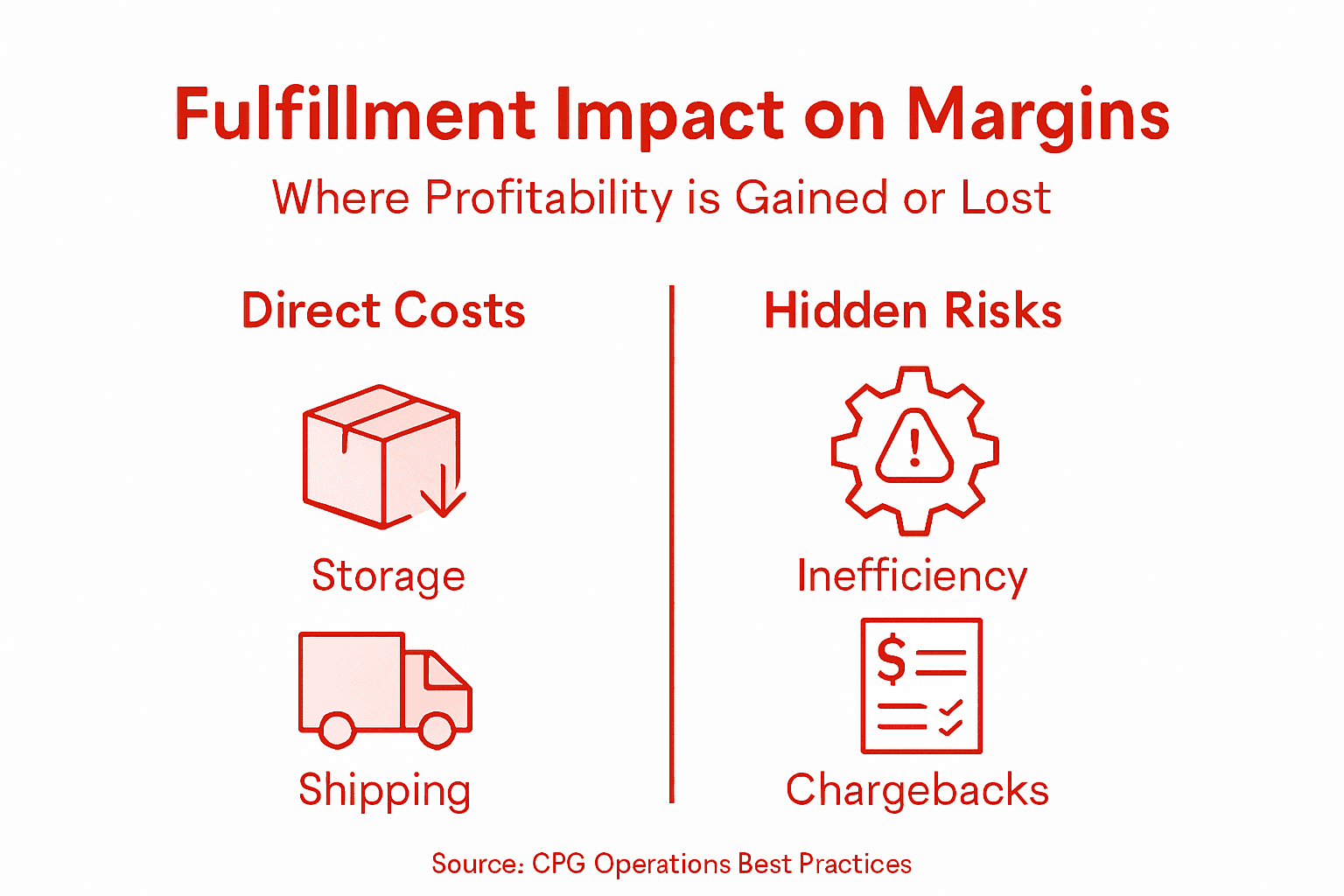
Direct costs are obvious. Storage, labor, 3PL fees, shipping. These are line items you see daily.
Inefficiencies hide in the details. Slow order processing creates customer complaints and returns. Poor inventory accuracy leads to overstock in slow SKUs and stockouts in fast ones. Both destroy margin.
Chargeback risk is invisible until it hits. Amazon charges you for slow inventory turns. Walmart penalizes you for receiving errors. Retail partners dock you for compliance failures. Each of these erodes contribution margin.
Effective fulfillment reduces costs and improves inventory turns, supporting pricing power and customer satisfaction simultaneously. This is how brands maintain margins while scaling.
Margin and cash flow aren’t the same thing. You can be profitable on paper and broke in reality.
Fulfillment strategy controls your cash conversion cycle. Here’s how:
Inventory carrying costs. Product sitting in storage for 120 days ties up cash that could fund growth. Every week inventory sits, you lose 0.5-1% margin to carrying costs and obsolescence risk.
Payment terms. Amazon holds payment 14 days. Walmart 30. Your 3PL wants payment weekly. Your supplier wants payment net-30. The gap between what you pay and when you get paid is cash flow hell.
Returns and chargebacks. Slow or inaccurate fulfillment triggers returns and platform chargebacks. You lose product, shipping, and margin. Cash outflows spike while revenue stays flat.
Fulfillment inefficiency doesn’t just lower margins—it locks up working capital and delays cash recovery.
These are the real fulfillment cash flow problems we see constantly:
Maintaining inventory accuracy and controlling shipping speed directly protects cash flow by reducing errors and chargebacks.
Your fulfillment strategy must optimize for both margin and cash, not just one.
This means:
When fulfillment works right, margin and cash flow improve together. When it doesn’t, they both collapse.
Pro tip: Calculate your cash conversion cycle by channel: days inventory outstanding plus days sales outstanding minus days payable outstanding. If it’s over 60 days, your fulfillment strategy is locking up cash. Shorten it by fixing inventory accuracy, increasing turns, or negotiating better payment terms with fulfillment partners.
Most CPG brands make the same fulfillment mistakes. They don’t learn from others. They hit the wall, then scramble to fix it.
Knowing what breaks before it breaks you saves months and margin. Here are the pitfalls that destroy profitability.
You think you have 500 units in stock. You actually have 300 across three locations, with 150 sitting in the wrong warehouse.
This happens when you don’t sync inventory in real time across fulfillment locations. Amazon says you have 200 units. Your 3PL says 180. Your spreadsheet says 500. Someone loses.
Result: Overselling, stockouts, chargebacks, and furious customers.
The fix: Real-time inventory visibility. If you can’t see exact unit counts across all locations within 15 minutes, your fulfillment system is broken.
You use Amazon FBA for low-velocity SKUs. You use in-house fulfillment for high-volume wholesale. You use 3PL for DTC but don’t give them volume commitments.
Each channel has different margin requirements and speed expectations. Forcing one model everywhere destroys profitability on at least one channel.
The fix: Model fulfillment costs by channel, not globally. If a channel’s fulfillment cost exceeds 25% of gross margin, change your approach.
You ship the wrong product. You ship incomplete orders. You ship to the wrong address. Customers lose trust.
Omnichannel environments make this worse. Ship-from-store models compound errors. One wrong fulfillment location creates cascading problems.
Result: Returns spike. Customer lifetime value drops. You lose $50 in future revenue trying to fix one $20 order error.
The fix: Audit fulfillment accuracy weekly. Target 99%+ order accuracy. Build error-catching processes before packing, not after returns arrive.
You think fulfillment is just shipping boxes. Then you hit seasonal spikes. Volume doubles. Your 3PL can’t scale. Your inventory explodes. Your cash flow collapses.
Scaling fulfillment requires clear strategic alignment and flexible operations that adapt to volume fluctuations. Most brands underestimate how complex this gets.
The fix: Plan fulfillment for 2X your current volume, not your current volume. Build partnerships with 3PLs that can scale. Test your processes during slower periods.
You check your P&L monthly. By then, a fulfillment problem has compounded for weeks.
Fulfillment breaks fast. One week of slow inventory turns cascades into two weeks of excess stock. One compliance failure triggers platform holds on future shipments.
The fix: Track these metrics weekly:
The table below highlights key metrics to monitor for long-term fulfillment success:
| Metric | Why It Matters | Action Triggered by Changes |
|---|---|---|
| Inventory Turns | Indicates sales and cash flow speed | Adjust reorder strategy or velocity |
| Order Accuracy Rate | Reflects customer satisfaction | Audit and correct fulfillment errors |
| Cost Per Unit | Shows fulfillment efficiency | Evaluate model or renegotiate terms |
| Chargeback Rate | Signals compliance performance | Improve processes or training |
Weekly fulfillment visibility prevents problems from becoming crises.
You build an in-house fulfillment operation to save money. You hire staff. You rent warehouse space. You manage inventory manually. Growth stalls because fulfillment becomes your bottleneck.
Most CPG brands don’t have the operational expertise to run fulfillment efficiently at scale. They also shouldn’t. It’s not your core business.
The fix: Partner early with a 3PL that understands CPG. Yes, it costs more upfront. But it frees you to focus on product and sales. And it scales without you building infrastructure.
Pro tip: Audit your top three fulfillment errors from the last 90 days. Identify the root cause of each. Build a simple process to prevent that error from happening again. Do this quarterly. Most fulfillment problems are operator error, not system limitation.
Retail expansion is tempting. You see a gap in the market. You think more channels equals more revenue. Then reality hits: your fulfillment can’t support the growth, margins compress, and cash flow stalls.
Expansion without optimization is growth that destroys profitability. You need a framework for evaluating whether your fulfillment strategy can actually support retail growth.
Before you expand to a new retail channel, ask one question: Can my current fulfillment handle this?
Most brands skip this step. They land a Walmart listing, then realize their 3PL can’t handle the volume. They try to expand DTC while Amazon FBA is already consuming all their inventory. They commit to regional distribution before they have visibility into inventory velocity.
Fulfillment readiness means three things: capacity, accuracy, and speed.
Capacity: Can your 3PL or fulfillment operation handle 150% of your current volume without service failures?
Accuracy: Can you maintain 99%+ order accuracy across all locations as volume increases?
Speed: Can you meet each channel’s required ship time without premium logistics costs crushing margin?
If you answer no to any of these, don’t expand yet. Fix fulfillment first.
Effective retail inventory management requires demand forecasting and supply chain visibility to ensure product availability while minimizing costs.
Different channels have wildly different inventory velocity. Amazon FBA requires fast turns. Wholesale may allow 60+ day inventory sits. DTC velocity depends on your marketing spend and customer base.
Before expanding, map inventory velocity for each channel you serve:
If your overall DIO is above 90 days, you’re locking up too much cash. Expansion will only make this worse. Optimize velocity first.
Retail operations optimization requires integrating sales, inventory, and fulfillment strategies to respond to channel shifts and consumer behaviors effectively.
These three functions must talk to each other constantly. Sales forecasts demand. Inventory plans what to buy. Fulfillment delivers it.
When they don’t align, expansion fails:
Integration means your fulfillment strategy evolves with your sales strategy, not independently.
Before you commit to a new retail channel, complete this assessment:
If you answer no to more than one item, delay expansion. You’ll destroy margin trying to scale faster than your operations can support.
This is the real decision: Do you have margin and cash capacity to expand, or do you need to optimize first?
Expand if:
Optimize if:
Most Texas CPG brands in your stage should optimize before expanding. One well-optimized channel that contributes 15% margin beats two channels that contribute 8% margin each.
Pro tip: Run a contribution margin analysis by channel including all fulfillment costs: storage, labor, 3PL fees, shipping, chargebacks, and returns. You’ll likely find one channel is far more profitable than you thought and another is destroying margin. Optimize the profitable channel first, then decide whether to expand or fix the unprofitable one.
Struggling to balance fulfillment costs with channel-specific margin pressures can stall your CPG brand’s growth and cash flow. This article highlights the crucial need for tailored hybrid fulfillment strategies, real-time inventory visibility, and precise cost modeling to avoid common pitfalls like excess safety stock, chargebacks, and slow inventory turns. If you want to stop guessing which channels are draining your profitability and start making data-driven decisions that optimize every fulfillment dollar, expert guidance is essential.
Discover how RedDog Group, a Houston-based CPG retail growth consultancy, helps emerging brands unlock operational clarity across Amazon, Walmart, DTC, wholesale, and distribution. Our margin-first approach targets your specific challenges such as 3PL storage costs, Amazon FBA fees, Walmart WFS margin compression, and inventory velocity to build fulfillment strategies that protect margin and accelerate cash flow. Take control of your fulfillment today by visiting our CPG Retail Growth Offer and partner with experts dedicated to putting measurable profitability back in your hands.
A fulfillment strategy for Consumer Packaged Goods (CPG) brands involves managing storage, order processing, and delivery across multiple sales channels. It directly impacts margins, customer satisfaction, and scalability.
Fulfillment decisions affect contribution margins through storage costs, order processing speed, and inventory management. An effective strategy ensures that fulfillment costs do not exceed 25% of gross margin, protecting overall profitability.
The core fulfillment models include in-house fulfillment, third-party logistics (3PL), and marketplace fulfillment services. Each model offers different levels of control, cost structures, and best-use cases based on product type and sales channel.
CPG brands can optimize their fulfillment strategy by mapping their channel mix, calculating contribution margin by channel, and understanding inventory velocity. Establishing partnerships with 3PLs and monitoring fulfillment metrics weekly are also essential for effective growth.
Leave a comment: