
Published: March 2020 | Last Updated:March 2026
© Copyright 2026, Reddog Consulting Group.

Most CPG brands pour resources into B2B ecommerce platforms only to watch them fail. The culprit isn’t technology or budget. It’s strategic misalignment. Sales teams undermine digital channels with better offline deals. Analytics sit unused. Nobody owns the platform. This guide cuts through the confusion to show you what B2B ecommerce actually requires for CPG brands. You’ll learn how to align teams, track the right metrics, and build a platform that trade partners actually use. Whether you’re launching your first B2B channel or fixing a stalled one, these insights will help you grow profitably.
| Point | Details |
|---|---|
| Strategic alignment drives success | Sales team buy-in and clear ownership are non-negotiable for platform adoption and growth. |
| Analytics reveal hidden opportunities | Tracking cart abandonment, login rates, and order frequency unlocks optimization insights most brands miss. |
| Platform features determine outcomes | Integration capabilities, pricing flexibility, and supply chain transparency separate winning platforms from failures. |
| Real success requires dedicated management | B2B ecommerce isn’t set-and-forget; ongoing optimization and fresh content maintain momentum. |
B2B ecommerce refers to digital transactions between businesses, specifically how CPG manufacturers sell to retailers, distributors, and other trade partners through online platforms. Unlike consumer-facing channels, B2B ecommerce handles bulk ordering, custom pricing tiers, and complex buyer relationships. For CPG brands, this means creating digital storefronts where wholesale customers place orders, track shipments, and manage their accounts without phone calls or email chains.
The strategic importance is straightforward. Manufacturers investing in B2B marketplace platforms gain loyalty from trade partners by reducing friction in ordering and improving forecast accuracy. When a regional distributor can log in at 2 AM to place an order with accurate inventory visibility, they’re more likely to reorder consistently. This predictability transforms your demand planning and cash flow management.
Key benefits include:
The difference between B2B and B2C ecommerce goes beyond transaction size. B2B requires approval workflows, credit terms, minimum order quantities, and integration with buyer procurement systems. Your platform needs to handle these complexities while still feeling intuitive. A distributor placing a $15,000 order shouldn’t face more friction than a consumer buying a $30 product.
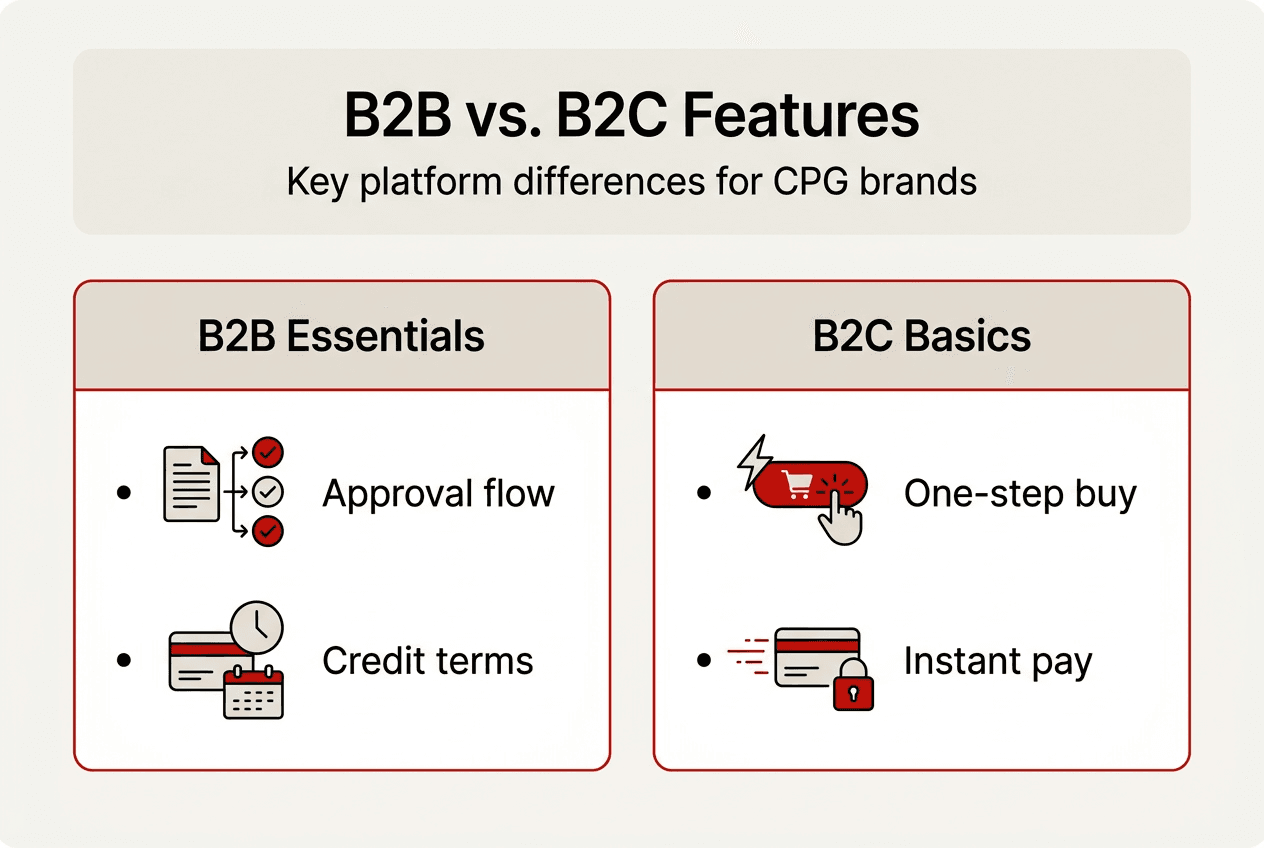
For CPG brands in the $500K to $20M revenue range, B2B ecommerce represents a critical growth lever. It’s not about replacing your sales team. It’s about giving them a tool that scales their effectiveness and gives trade partners the convenience they increasingly expect.
The gap between B2B ecommerce potential and reality is often brutal. You build the platform, announce the launch, and then watch usage flatline. The reasons are predictable but often invisible until it’s too late.
Sales team misalignment kills platforms faster than any technical issue. Many B2B ecommerce initiatives fail because the sales team actively undermines the platform. When your reps can offer better pricing or terms offline, buyers have zero incentive to use the digital channel. Your sales team isn’t being difficult. They’re responding to incentives. If commissions favor offline deals or if the platform doesn’t reflect negotiated pricing, they’ll route business around it every time.
Analytics blindness compounds the problem. Lack of key metric tracking hinders the ability to manage and optimize the digital channel. Without visibility into cart abandonment rates, login frequency, or order completion times, you’re flying blind. You can’t fix what you can’t measure. Most brands launch platforms without basic ecommerce analytics infrastructure, then wonder why performance stagnates.
“The number one reason B2B ecommerce fails is lack of ongoing management and ownership. Platforms become stale, product information gets outdated, and the user experience degrades until buyers give up and go back to phone orders.”
Common pitfalls that drain resources and momentum:
Failure to assign clear ownership results in stagnation. Someone needs to own the platform’s success, monitor metrics weekly, and coordinate with sales, operations, and IT. Without this accountability, urgent tasks always trump platform improvements. Product descriptions stay generic. New items don’t get added promptly. The platform becomes a digital ghost town.
The consequence isn’t just wasted technology investment. It’s damaged credibility with trade partners who tried the platform, had a poor experience, and now resist future digital initiatives. Recovery from that trust deficit takes years.
The right platform capabilities separate functional B2B ecommerce from transformative growth channels. Generic ecommerce platforms force workarounds that create friction. Purpose-built B2B solutions handle the complexity CPG brands actually face.
Critical features your platform must support:
Pro Tip: Prioritize platforms offering granular customer segmentation over those with the flashiest interface. A distributor and a small retailer need completely different experiences, pricing, and minimum order quantities. One-size-fits-all platforms create friction that kills adoption.
Integration capabilities, order minimums, data analytics tools, and supply chain transparency should drive your platform selection when choosing a B2B CPG marketplace solution. These aren’t nice-to-have features. They’re the foundation of a platform that trade partners will actually use consistently.
| Platform Capability | Basic Solution | Advanced B2B Platform |
|---|---|---|
| Pricing flexibility | Fixed catalog pricing | Unlimited customer-specific tiers with contract integration |
| Order management | Manual order entry | Automated processing with ERP sync and approval workflows |
| Analytics depth | Basic sales reports | Cart abandonment, reorder patterns, buyer behavior tracking |
| Inventory visibility | Static availability | Real-time stock levels with restock date projections |
| Mobile experience | Responsive design | Native mobile optimization for warehouse ordering |
| Customer segmentation | Single buyer type | Multiple buyer types with distinct catalogs and pricing |
The difference in outcomes is measurable. Brands using advanced platforms see higher adoption rates, larger average order values, and better forecast accuracy. Your ecommerce tech stack should treat B2B as a strategic channel requiring purpose-built tools, not an afterthought bolted onto consumer infrastructure.
Implementation matters as much as features. The best platform poorly implemented still fails. Plan for 90 days of intensive setup including data migration, pricing configuration, user training, and soft launch testing with select trade partners before full rollout.
Nature’s Path faced a problem familiar to growing CPG brands. They had diverse buyer types ranging from small independent retailers to large distributors, each requiring different pricing, minimums, and catalog access. Managing this complexity through phone orders and email created bottlenecks that limited growth.

Their existing ecommerce setup couldn’t handle customer-specific pricing at scale. Sales reps spent hours processing orders manually and fielding questions about product availability. Trade partners got frustrated with the friction and delayed responses. The company needed a B2B platform that could automate complexity while maintaining the personalized experience buyers expected.
After implementing SparkLayer’s B2B ecommerce platform, Nature’s Path achieved 10x growth and a 400% AOV increase. Here’s how they did it:
The results went beyond revenue growth. Order processing time dropped by 75%. Sales reps redirected time from manual order entry to relationship building and new customer acquisition. Forecast accuracy improved as the platform revealed ordering patterns invisible in the old system.
Key takeaways for other CPG brands:
Nature’s Path also leveraged their B2B platform for cross-border ecommerce growth, using the same infrastructure to serve international distributors with region-specific pricing and shipping terms. This scalability turned the platform into a growth engine rather than just an operational efficiency tool.
The lesson isn’t that every brand needs SparkLayer specifically. It’s that purpose-built B2B platforms with the right features, properly implemented and actively managed, can transform trade partner relationships and unlock growth that manual processes can’t support.
Building a B2B ecommerce platform that actually drives growth requires more than technology. It demands strategic clarity on channel economics, sales alignment, and operational integration. Most CPG brands get one shot at launching their B2B channel before trade partners write it off as another failed digital initiative.
RedDog Group helps emerging and growth-stage CPG brands navigate this complexity with margin-focused B2B ecommerce strategies. We work with brands in the $500K to $20M range to design platforms that trade partners actually use, integrate with your existing operations, and contribute measurably to profit rather than just top-line revenue. Our approach addresses sales team alignment, pricing strategy, analytics infrastructure, and ongoing optimization. Whether you’re launching your first B2B channel or fixing a stalled platform, we provide the strategic clarity and execution support to make it work. Explore our Amazon growth consulting and omnichannel growth services to see how we help CPG brands scale profitably across digital and physical retail channels.
B2B ecommerce for CPG brands means digital platforms where manufacturers sell to retailers, distributors, and other trade partners. It handles bulk ordering, custom pricing tiers, and complex buyer relationships through online storefronts that replace phone and email orders.
Sales team alignment increases adoption by ensuring reps don’t offer better terms offline that undermine the platform. When commissions include digital orders and the platform reflects negotiated pricing, sales teams become advocates who drive trade partners to use the channel.
Track cart abandonment rates, login frequency, order completion times, reorder patterns, and average order value trends. These metrics reveal friction points and optimization opportunities that directly impact platform performance and trade partner satisfaction.
Assign a dedicated platform manager responsible for content updates, user experience optimization, and coordinating with sales, operations, and IT. This person monitors metrics weekly and ensures the platform stays fresh and functional rather than becoming stale.
Look for ERP integration, unlimited customer-specific pricing tiers, order minimum enforcement, buyer type segmentation, detailed analytics, real-time inventory visibility, quick reorder functionality, and approval workflows. These features handle the complexity CPG brands face with diverse trade partners.
Leave a comment: